Category Archives: Mount Kisco

Missouri couple makes an affordable, recycled home out of shipping containers | Mt Kisco Real Estate

Zach and Brie Smithey of St. Charles, Missouri, have remodeled several homes, but none of them were the perfect fit. “We were looking for something that wasn’t quite the norm,” Zach explains.

“We renovated homes built in 1880, 1904, and the 1970s. With each house, we got closer to our flavor, but never quite hit it,” he says. “We realized that to do something different, we had to start from scratch—to get what we really wanted, we couldn’t follow someone else’s template.”

When they purchased an empty lot in 2011, they pictured building a more traditional house made out of conventional materials. But as the years passed, their vision shifted, and at some point, they stopped thinking about what a house should be and began wondering what other forms it might take. Ideas such as a concrete house, a geodesic dome, and a tiny house were weighed and rejected. “Realistically, how many people could live in a tiny house for the rest of their lives?” wonders Brie.

The couple who built the shipping container house left some metal walls exposed. Here, you see light-green metal walls and a white metal ceiling. Artwork by owner Zach Smithey, showing portraits of Abraham Lincoln and Mark Twain, decorates the walls.
When Zach and Brie Smithey designed and built their container house, they left some of the metal uncovered, creating an effect that could be compared to exposed brick in a more conventional house. The art is by Zack, from a Mark Twain and Abraham Lincoln series.

The couple doesn’t remember how the concept was raised, but when the idea of a container house came on their radar, it immediately felt right. “I had never seen one before, and I wasn’t even sure they existed,” Zach says. Online searches convinced them and informed them that if they built a container house, they’d be the first in the area to do so.

“We chose a container house because it gave us the most bang for our buck,” says Brie. “It allowed us to use recycled materials, which was important to us. The cost of it, and the fact we did so much of it ourselves, allowed us to live mortgage free, which was also important to us.”

Little did they know that at the time they were doing the research, their future home was sitting in a nearby container yard. “Once we decided to do this, I found a broker that sources containers from container yards across America,” Zach says. “There are many options: You can buy them new, used, or ready to be retired.”

Zach Smithey stands by his black pit bull named Boomer. The dog sits on bed next to a large, arched window that’s installed upside down. An old, elaborate fireplace mantel is installed behind Smithey.
Above: Zach poses with his dog, Boomer, who sits on a bed placed beside one of the upside-down arched windows. The window and the mantel are both architectural salvage. Below: Zach made a simple mannequin a piece of art and installed it over a stairway.

The couple chose the last option, feeling that a few dents only add to the character of the units. They ended up with containers that had been built in Shanghai and traveled around the world 12 times on boat, train, and truck before coming to rest in North St. Louis. “We found eight 40-foot containers, each one with nine-foot-high ceilings,” Zach says. “We paid $1,600 for each, and $375 to have each of them delivered, so they ended up being about $2,000 apiece. The whole project cost us about $135,000.”

The couple had the containers delivered to their lot, used a crane to stack them in a giant cube shape (there are four containers on the bottom and four on the top), and began shaping them into their home. “Building a regular house is an additive process—you put more on it day by day,” says Zach. “But in a house like this, it’s more of a subtractive process. You stack up the containers, and then you carve away the walls you don’t need.”

A pair of large paintings by Zach decorate the living room.
In the basement, the couple used all the scrap wood generated from the project to panel the walls. They painted it all white to unify the space.
In the living room, two large black-and-white artworks show a female and male figures; random pieces of wood panel the basement, and it’s all painted white; a long staircase has mismatched, salvaged balusters in the railing, and an abstract portrait of Ma
Another painting from the Mark Twain series hangs at the top of a run of stairs with railing composed of many different salvaged balusters.

Before we go on with this story, there are a few things you need to understand about the Smitheys. The first is that Zach is an artist and that informs his remodeling projects. “For me and my art, it’s all about the process, not the end result,” he says. “This house is just like a big sculpture project. I figured it out as I went along, and the journey was more important than the destination. In the end, we have something we couldn’t have imagined at the beginning if we had had a hard and fast goal we were aiming at.”

The second thing you need to know is that he and his wife appear to be the types who see things differently. For example, what mere mortals consider a packing pallet or purchasing low cost pallets for businesses, this couple sees as a building opportunity/free wood. “The great thing is that once people know you think this way, they seek you out and unload stuff,” says Zach. Indeed, when they talk about the home, very little is new and explanations are peppered with phrases like: “My friend was remodeling a house and had to get rid of a lot of brick” or “My friend’s wife works at a JCPenney that cancelled a remodel and had a lot of extra materials.”

Large, mullioned windows act as dividers in the living room to make a small sitting room. In the kitchen, a row of painted mannequin busts sit on a shelf. Half rounds of wood are painted white and hung on the wall to create shelves.
Above: Salvaged windows and pillars separate a small sitting room from the larger living area. Below: In the kitchen, more painted mannequins decorate the walls. Half rounds created by cutting the tops of industrial cable spindles in half act as wall-mounted shelves.

Finally, this is a couple that’s seemingly unfazed by things they don’t initially know how to do. He’s an artist and she had worked as a massage therapist—but they didn’t hesitate to purchase and operate a restaurant (Miss Aimee B’s Tea Room & Gallery), something they’d never done before. She later founded Brie’s Protein Bars, a health food company. They apply this can-do attitude to remodeling; so having no direct experience with container buildings was no problem.

“Really, the only way to learn how to remodel is to remodel,” says Zach. “We did most of it ourselves, save for the electric, plumbing, and HVAC. Because we were doing it ourselves, we were constantly changing tasks and using/developing new skills. It was exhausting and went on 12 hours a day, seven days a week, for a year and 14 days.”

Brie agrees that the process was difficult. “I expected it to be hard—if it were easy, everyone would be doing it,” she allows. “What I didn’t expect is how difficult it would be to work with the metal. It’s heavy, it’s thick… YouTubers make it look easy, but trust me, it’s not for everyone.”

In the most basic terms, here’s what they did: Stacked up the containers, cut out openings between them, built a frame within the metal shell, put in the utilities, and then hung the drywall (except in strategic places where they left the metal exposed).

Salvaged wood is used to make an unusual bed whose foot floats above the floor and whose head has a sharp slope. The whole thing is painted aqua and two black dogs (a pit bull named Boomer and a labrador named George) lie on the bed.
Frustrated with uncomfortable headboards, Zach designed his own. The angle is crafted for comfortable reading or watching television (they plan to mount one near the ceiling in the future). Boomer (left) and George (right) enjoy it as well.

Of course, that simplistic explanation doesn’t even begin to cover the improvisation that went into it. “I figured it out as I went along,” says Zach. The figure-it-out-as-you-go style is responsible for features like antique arched windows hung upside down in the living room (they were left behind at their restaurant, rescued from an old church next door); baseboard and crown molding made from randomly cut boards from packing pallets; and cement board painted in a rainbow of drip patterns and installed as shower walls.

Throughout, recycled materials are everywhere you look. In addition to the aforementioned items, rope pulled from the mud on the banks of the Mississippi was cleaned and used to frame a television; birdbaths and a fountain plucked from a landscaping company’s boneyard find new life as sinks and a plumbed bar table; a combine chain and tractor hooks are used to support a wall-hung vanity in the upstairs bath; and a conch shell is repurposed as a faucet in a bathroom on the main floor.

The master bath has a mirror that’s broken and spread apart to span the vanity. A curving piece of painted wood fills the gap. A wooden vanity is supported by industrial combine chains. Cement bird bath basins are outfitted as sinks. In the shower, cement
Above: In the master bath, a piece of salvaged mirror was stretched to fit the vanity by breaking the glass and filling the resulting gap with a piece of painted wood. The vanity is supported by chains from an old combine and sports sinks made from bird bath basins. Below: To make the shower walls, Zach drip painted sections of cement board before installing them.

Of course, none of this was easy or without headaches. “If, during construction, we encountered a problem we looked at it as an opportunity to innovate,” Zach says.

Anything this different is bound to inspire curiosity—especially in a small community like St. Charles (population: 69,293). “When we were building it, not a day went by without someone coming into the house and asking questions,” says Zach. The curiosity reached such a pitch, that the couple decided to host a community open house on May 20, the day the last light fixture was hung. The couple anticipated a few hundred people, and they were surprised when 2,000 showed up. “I was in shock,” says Brie. “Negative comments always seem louder than positive ones, but that day, it seemed like the house was full of positive comments and so many compliments.”

The shipping container’s metal is visible on the back of the house. You can see two large sliding doors the Smithey’s installed, opening the lower level to the patio.
The front of the container house is clad in salvaged brick, but rear facade shows off the metal is was born with.

The couple decided to make it a benefit for the local animal shelter, and ended up raising $8,000 at the door for the organization.

read more…

https://www.curbed.com/2017/9/11/16234506/shipping-container-home-tour-missouri?utm_medium=email&utm_campaign=Homes%20of%20the%20Week%2091717&utm_content=Homes%20of%20the%20Week%2091717+CID_298c5940234781f324d216c4c6aa57fe&utm_source=cm_email&utm_term=This%20135K%20shipping%20container%20house%20lets%20its%20owners%20live%20mortgage%20free

Cladding used in many U.K. high-rises ‘combustible’ | Mt Kisco Real Estate

LONDON — Tests on the exterior cladding of tower blocks across Britain that use similar material found outside the building in west London where at least 79 people died in a fire have shown that some of them are “combustible,” British Prime Minister Theresa May said Thursday.

May said the tests were being carried out so that “all possible steps to ensure buildings are safe” were taken. Investigators believe that the type of exterior cladding used on the Grenfell Tower after a refurbishment last year may have caused the fire to spread more rapidly than if a different material was used. It had a plastic core.

The fire’s cause has not been established, although investigators suspect it may have started when a refrigerator exploded on one of the block’s lower floors.

There are thought to be approximately 4,000 tower blocks in Britain similar to the 24-storey residential complex in Kensington that went up in flames last week.

May said in an address to Parliament that authorities have been checking about 100 buildings a day and that the results come back within hours. Her office estimated that there are about 600 buildings in Britain that have the same type or similar cladding to that used in Grenfell Tower. However, May said it was still too early to draw conclusions about what caused the fire or why it appeared to spread so quickly.

“I urge any landlord who owns a building of this kind to send samples for testing as soon as possible. Any results will be communicated immediately to local authorities and local fire services. Landlords have a legal obligation to provide safe buildings and where they cannot do that we expect alternative accommodation to be provided. We cannot and will not ask people to live in unsafe homes,” she said.

May’s address came as the chief administrator of the neighborhood where the fire took place resigned Thursday, effectively marking the disaster’s first formal departure of a high-level official in the wake of Britain’s worst blaze in decades.

Nicholas Holgate, chief executive of the Kensington and Chelsea council, said he was asked to leave by May’s government. The initial days after the June 14 inferno were marked by chaos as authorities struggled to deal with the scope of the aftermath.

Residents who survived the tower blaze lost everything, only to get little help or information on how to secure shelter or vital supplies. Of the 600 people who lived in the tower block, many were low-income workers, recent immigrants and refugees.

Researchers at the Universite Catholique de Louvain in Belgium believe the Grenfell Tower disaster is now the deadliest fire in mainland Britain since they started keeping close records at the start of the 20th century. A fire at Bradford City Stadium in northern England on May 11, 1985, killed 56 people.

read more…


https://www.usatoday.com/story/news/world/2017/06/22/london-fire-grenfell-tower/103097418/

Used home sales rise 1.1% | Mt Kisco Real Estate

Sales of previously owned houses in the United States went up 1.1 percent month-over-month to a seasonally adjusted annual rate of 5.62 million in May of 2017, following a downwardly revised 5.56 million in the previous month and beating market expectations of a 0.5 percent drop. Sales of single family houses went up 1 percent to 4.98 million after falling by 2.8 percent in the previous month and those of condos increased 1.6 percent to 0.64 million, following a flat reading in April. The median house price increased to an all-time high of $252,800 and the months’ worth of supply went up to 4.2 percent from 4.1 percent. In addition, the number of houses available in the market increased to 1.96 million from 1.92 million in April. Existing Home Sales in the United States averaged 3902.01 Thousand from 1968 until 2017, reaching an all time high of 7250 Thousand in September of 2005 and a record low of 1370 Thousand in March of 1970.

United States Existing Home Sales
CalendarGMTActualPreviousConsensusForecast (i)
2017-05-2402:00 PMApr5.57M5.70M5.65M5.7M
2017-06-2102:00 PMMay1.1%-2.5%-0.5%0.6%
2017-06-2102:00 PMMay5.62M5.56M5.55M5.6M
2017-07-2402:00 PMJun5.62M5641.63%
2017-07-2402:00 PMJun1.1%5641.63%
2017-08-2402:00 PMJul5620.38%

read more…

www.tradingeconomics.com

Manhattan Renters Seeking Deals Send Leasing to a Record | Mt Kisco Real Estate

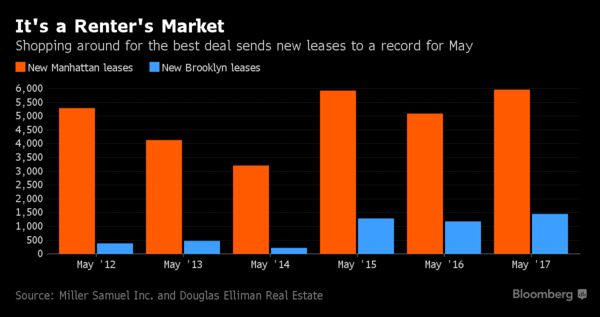
In Manhattan, the number of newly signed leases climbed 17 percent in May from a year earlier to 5,969, the biggest total for the month in nine years of record-keeping, according to a report Thursday by appraiser Miller Samuel Inc. and brokerage Douglas Elliman Real Estate. In Brooklyn, new apartment contracts surged 23 percent to 1,460, also the biggest total for the month in data going back to 2008.

Renters are taking advantage of a market that’s crowded with listings, weighing offers of free rent and other perks from landlords who are working to keep their units filled. Twenty-five percent of all new leases signed last month in Manhattan came with some kind of concession from the owner, about double the share in May 2016, Miller Samuel and Douglas Elliman said. In Brooklyn, sweeteners were offered on 15 percent of new agreements, up from 8.8 percent a year earlier.

“They realize, ‘I do have quite a bit of options so let me take a look,’” Hal Gavzie, Douglas Elliman’s executive director of leasing, said of renters’ thinking. “‘Let’s just test the water and see what’s out there.’”

Vacancies Drop

In Manhattan, the surge of renter interest was enough to push down the vacancy rate to the lowest in two years, 1.72 percent, the firms said. It was the first time since 2015 that the figure dipped below 2 percent.

While all that dealmaking helped attract tenants, it kept a lid on rent growth. In Manhattan, net effective rents — calculated after incentives are factored in — were up 0.6 percent in May from a year earlier, to a median of $3,377, the firms said. In Brooklyn, the median rent after concessions dropped 2.1 percent to $2,782.

Some landlords are luring tenants by actually lowering their asking prices — a way to stand out from the crowd where free months of rent and payment of broker’s fees have become commonplace, Gavzie said.


read more…


https://www.bloomberg.com/news/articles/2017-06-08/manhattan-renters-seeking-deals-send-leasing-to-a-record-for-may

Mortgage rates average 3.94% | Mt Kisco Real Estate

Freddie Mac (OTCQB: FMCC) today released the results of its Primary Mortgage Market Survey® (PMMS®), showing the 30-year fixed mortgage rate inching lower for the third consecutive week and setting a new low for the year.

News Facts

  • 30-year fixed-rate mortgage (FRM) averaged 3.94 percent with an average 0.5 point for the week ending June 1, 2017, down from last week when it averaged 3.95 percent. A year ago at this time, the 30-year FRM averaged 3.66 percent.
  • 15-year FRM this week averaged 3.19 percent with an average 0.5 point, the same as last week. A year ago at this time, the 15-year FRM averaged 2.92 percent.
  • 5-year Treasury-indexed hybrid adjustable-rate mortgage (ARM) averaged 3.11 percent this week with an average 0.5 point, up from last week when it averaged 3.07 percent. A year ago at this time, the 5-year ARM averaged 2.88 percent.

Average commitment rates should be reported along with average fees and points to reflect the total upfront cost of obtaining the mortgage. Visit the following link for the Definitions. Borrowers may still pay closing costs which are not included in the survey.

Quote
Attributed to Sean Becketti, chief economist, Freddie Mac.

“In a short week following Memorial Day, the 10-year Treasury yield fell 4 basis points. The 30-year mortgage rate remained relatively flat, falling 1 basis point to 3.94 percent and once again hitting a new 2017 low.”

Developers are chasing the lower end of the condo market | Mt Kisco Real Estate

New condominiums coming to market are getting cheaper, as developers work to capture buyers in the popular sub-$5 million market.

In Manhattan, the average unit price on condos approved for market by the New York Attorney General’s office has been steadily trending down over the past two years. Back in 2015, developers were shooting for an average unit price of just under $5 million, according to The Real Deal’s analysis of accepted offering plans for the borough. In 2016, that average had dropped 24 percent to just below $3.8 million. And it looks like the trend is here to stay. In the first four months of 2017, the analysis showed, the average accepted unit price in the borough was $3.1 million, down 18 percent from 2016’s average accepted price.

It’s more evidence developers are shifting gears to provide product for the lower end of the market.

“We’re trying to make sure apartments aren’t too big or too expensive, given where the market is,” said Steven Rutter, the director of new development at Stribling Associates. “It’s a larger strategy to design stuff that is more affordable. We know the under $5 million market is stronger.” Stribling is handling sales at Gluck + and Cogswell Lee Development’s 150 Rivington Street, a project that was approved for sale last year with apartments starting at $995,000. Rutter said many developers are now planning buildings with a different mix of unit sizes than two or three years ago. “Buyers are looking for value right now. There’s a lot for them to choose from.”

At Corcoran Sunshine Marketing Group, president Kelly Kennedy Mack said in some cases they are telling their developer clients to adjust their unit mixes to remain below certain prices — although it’s not a blanket approach.

“There’s been an intelligent and necessary response to supply and demand dynamics,” she said. Corcoran tracks when buildings open for sale, which the firm define’s as when a sales office opens, rather than when the AG approves the offering plan. Mack said five of the seven Manhattan developments that have become publicly available this year are targeting a mid-market price of between $1,800 and $2,400 per square foot. It’s now been a year since a development with an average asking price of $4,000 per square foot and above has opened, with Related Companies’ 70 Vestry the most recent last big-ticket item, according to Mack.

The shift towards cheaper new development product has also broadened the buyer pool, developers said. “We’ve introduced the new development market to people who haven’t been able to afford it it before,” said Dan Hollander, managing principal of DHA Capital. Its project at 75 Kenmare Street in Nolita, approved earlier this year, has an average unit price of $3.7 million, according to the AG’s office. The company opted for lower prices following the success of its previous project at 50 Clinton Street, according Hollander, which launched in 2015 offering one-bedrooms for under $1 million and two-bedrooms for under $2 million. All but four of the 37 units are in contract at 50 Clinton, according to StreetEasy data. Hollander said targeting the lower price points and building more efficient-sized apartments was “experimental” at the time, but paid off because there’s so much demand in the sub $5-million market. “A lot of people want to get into a new condo… It’s a very appealing prospect, but there’s been little out there in their price range,” he said.

For other developers, the lower part of the Manhattan market has always been a safe bet. “We’ve been working like this for years,” said Gaia Real Estate’s Danny Fishman. “We always said we don’t care about the top 5 or 10 percent.” The company is joining with Acro Group to develop the Vantage, at 97-unit condo conversion at 308 East 38th Street where 30 percent of the units are priced under $1 million. Fishman said their business plan is to keep the unit cost down, and to design buildings with fewer amenities so there are lower common charges. The Vantage, approved earlier this year, has a gym but no swimming pool. The firm took a similar approach at its Hell’s Kitchen condo conversion at 416 West 52nd Street, where Gaia launched sales last year with the sub-$3 million buyers as the target.  “I’m giving up the market of the billionaire, but how many are there?” said Fishman.

CORE’s Emily Beare agreed that more new development product is becoming available for buyers who would normally only be able to buy resales. “For a few years the new development was geared towards the ultra-luxury, $10 million and above, and much larger units…. I think developers have switched direction a little for people who were priced out,” she said. The strategy shift may benefit buyers seeking new apartments with multiple bedrooms at a lower price point, she added.


read more…


https://therealdeal.com/2017/05/25/de-luxed-developers-are-chasing-the-lower-end-of-the-condo-market/?utm_source=The+Real+Deal+E-Lerts&utm_campaign=eb04985cb1-New_York_Weekend_Update_10.18.2015&utm_medium=email&utm_term=0_6e806bb87a-eb04985cb1-385733629

Mortgage rates average 4.02% | Mt. Kisco Real Estate

Freddie Mac (OTCQB: FMCC) today released the results of its Primary Mortgage Market Survey® (PMMS®), showing the 30-year fixed mortgage rate remaining around four percent for the fifth consecutive week.

News Facts

  • 30-year fixed-rate mortgage (FRM) averaged 4.02 percent with an average 0.5 point for the week ending May 18, 2017, down from last week when it averaged 4.05 percent. A year ago at this time, the 30-year FRM averaged 3.58 percent.
  • 15-year FRM this week averaged 3.27 percent with an average 0.5 point, down from last week when it averaged 3.29 percent. A year ago at this time, the 15-year FRM averaged 2.81 percent.
  • 5-year Treasury-indexed hybrid adjustable-rate mortgage (ARM) averaged 3.13 percent this week with an average 0.5 point, down from last week when it averaged 3.14 percent. A year ago at this time, the 5-year ARM averaged 2.80 percent.

Average commitment rates should be reported along with average fees and points to reflect the total upfront cost of obtaining the mortgage. Visit the following link for the Definitions. Borrowers may still pay closing costs which are not included in the survey.

Quote
Attributed to Sean Becketti, chief economist, Freddie Mac.

“The 30-year mortgage rate fell 3 basis points this week to 4.02 percent. However, this week’s survey closed prior to Wednesday’s flight to quality. The delayed impact of the associated decline in Treasury yields may push mortgage rates lower in next week’s survey.”

Price it right and they will come | Mt Kisco Real Estate

No, that’s not a typo: Douglas Elliman’s profits dipped to just $100,000 during the first quarter of 2017, down from $7.1 million during the same period last year, parent company Vector Group reported Friday. The paltry sum was attributed to fewer closings at new development projects, Vector executives said.

Elliman closed sales worth $5.6 billion during the first quarter, compared to last year’s $5.7 billion, the company said. That resulted in $155.5 million in first-quarter revenue, down slightly from $157.6 million last year.

“There were less new development closings. That’s a higher-margin business so that hurt us,” said Douglas Elliman CEO Howard Lorber, during an earnings call Friday.

While the firm’s net income for the quarter was $100,000, its adjusted EBITDA (earnings before interest, tax, depreciation and amortization) was $1.8 million, compared to $9.1 million in 2016’s first quarter.

Overall, Vector’s first-quarter revenue was $415.2 million, up from $380.8 million in 2016’s first quarter. Vector reported a net loss of $4.2 million compared with net income of $19.3 million during the first quarter of last year.

Lorber told investors that New Valley, the real estate investment vehicle of Vector, would continue to take an “opportunistic” approach. “If there’s something that makes sense, that’s an opportunistic type of investment or a troubled project where we think we can add value, we’re interested,” he said.

In general, he said, the New York market has picked up — a sentiment shared by others in recent weeks.

Real estate conglomerate Realogy Holdings Corp., which reported its first-quarter results on Thursday, generated $1.2 billion in revenue for the quarter, a 6 percent improvement from the prior year, the company said. New Jersey-based Realogy had an adjusted net loss of $23 million compared to an adjusted loss of $17 million in 2016’s first quarter — both attributed to low seasonal transaction volume.

During an earnings call Thursday, Realogy CEO Richard Smith said there are “early signs of stabilization” in the luxury market, with sales in the $2.5 million-and-up segment up 10 percent from this time last year. “New product in New York City continues to be particularly strong,” he said.

NRT — the division that owns the Corcoran Group, Sotheby’s International Realty and Citi Habitats — saw revenue jump seven percent year-over-year to $897 million for the first quarter.

But Smith cautioned that there isn’t enough inventory on the low end of the market, and he described a recent bidding war for a $1 million New York City apartment as an example. Some 200 people showed up at the open house, 25 of them made bids and the apartment sold for 20 percent above the asking price, he said. “Listen, we don’t see that play out in every market,” he said. “The good news is, when something is priced right… it’s selling.”


read more…


https://therealdeal.com/2017/05/05/elliman-only-made-100k-in-profits-in-q1/?utm_source=The+Real+Deal+E-Lerts&utm_campaign=5e50cfa7fe-New_York_Weekend_Update_10.18.2015&utm_medium=email&utm_term=0_6e806bb87a-5e50cfa7fe-385733629

Rental Apartment Absorption Flat While Condominium Absorption Jumps | Mt Kisco Real Estate

The US Census Bureau, in collaboration with the US Department of Housing and Urban Development, releases data on completions and absorption rates for multifamily buildings with at least 5 apartments. The most recent release shows that completions of nonsubsidized, unfurnished, rental apartments amounted to 73,800 in the third quarter of 2016. This is 11,700 more than the second quarter of 2016, but 9,800 fewer than the third quarter of 2015 (Figure 1).

The absorption rate (apartments rented within 3 months of completion) for rental apartments completed in the third quarter of 2016 stood at 61 percent. This is 4 percentage points higher than the second quarter of 2016 (57 percent), but essentially unchanged compared to the rate from the third quarter of 2015 (60 percent) (Figure 1).

The release also revealed that the median asking rent of apartments completed in the third quarter of 2016 was $1,507. This is a significant increase compared to the median asking rent from the third quarter of 2015: $1,346.

In the third quarter of 2016, condominium completions rose considerably to 6,100, which is 2,800 units more than in the second quarter of 2016 and 1,800 higher than completions in the third quarter of 2015. The condominium absorption rate also posted an increase to 74 percent, which is 10 percentage points higher than the second quarter of 2016 and 23 percentage points higher compared to the third quarter of 2015 (Figure 2).

Figure 3 displays subsidized and tax credit unit completions as a share of total apartment completions. In the third quarter of 2016, subsidized or tax credit units represented approximately 6 percent (5,200 units) of total apartment completions. This is about the same share seen in the second quarter of 2016 (7 percent). It important to note that starting in 2010, the share of these units completed surged, but started to decrease significantly starting in 2014.


read more…


http://eyeonhousing.org/2017/03/rental-apartment-absorption-flat-while-condominium-absorption-jumps/

Home Price Gains Continue | Mt Kisco Real Estate

The Case-Shiller (CS) National Home Price Index, released by S&P Dow Jones Indices, continued to rise in October. The CS Home Price Index rose at a seasonally adjusted annual growth rate of 10.7%, up from 10.1% last month. Due to tight inventory and high demand, house prices have accelerated since May and reached the pre-recession peak of 2006.

Along with the increases in national home prices, local home prices also increased in varying degrees in October. Figure 2 shows the annual growth rate of home prices for 20 major U.S. metropolitan areas.

All of the 20 metro areas had positive home price appreciation, ranging from 3.5% to 18.3%. Atlanta had the highest home price appreciation at 18.3%, while Chicago had the lowest but still positive growth at 3.5%. Home price appreciation in seven of the 20 metro areas was higher than the national level of 10.7%. Those markets are Atlanta (18.3%), Cleveland (16.7%), Tampa (15.1%), Dallas (12.6%), San Francisco (12.4%), Washington DC (11.4%) and Boston (11.1%).


read more…