Mortgage rates now 4.94% | South Salem Real Estate

Freddie Mac today released the results of its Primary Mortgage Market Survey® (PMMS®), showing that mortgage rates rose significantly across the board.

Highest mortgage rates in seven years

Sam Khater, Freddie Mac’s chief economist, says, “The economy continued to show resilience as strong business activity and growth in employment drove the 30-year fixed mortgage rate to a seven year high of 4.94 percent – up 11 basis points from last week.”

Added Khater, “Higher mortgage rates have led to a slowdown in national home price growth, but the price deceleration has been primarily concentrated in affluent coastal markets such as California and the state of Washington. The more affordable interior markets – which have not yet experienced a slowdown home price growth – may see price growth start to moderate and affordability squeezed if mortgage rates continue to march higher.”

News Facts

  • 30-year fixed-rate mortgage (FRM) averaged 4.94 percent with an average 0.5 point for the week ending November 8, 2018, up from last week when it averaged 4.83 percent. A year ago at this time, the 30-year FRM averaged 3.90 percent. 
  • 15-year FRM this week averaged 4.33 percent with an average 0.5 point, up from last week when it averaged 4.23 percent. A year ago at this time, the 15-year FRM averaged 3.24 percent. 
  • 5-year Treasury-indexed hybrid adjustable-rate mortgage (ARM) averaged 4.14 percent with an average 0.3 point, up from last week when it averaged 4.04 percent. A year ago at this time, the 5-year ARM averaged 3.22 percent.

Checking your zillow zestimate | Cross River Real Estate

Prospective home buyers often want to get pricing information for various properties without having to always rely on a real estate agent. This is where real estate sites like Zillow.com come in very handy. However, can you really rely on the site’s value estimates? Many have wondered whether Zillow provides accurate data with its Zestimate home price estimates.

Zillow is a business website, established to get eyeballs on a bunch of homes for sale and, in turn, to sell advertising to real estate professionals. It isn’t a real estate company with a group of agents.

Zillow bases many of its value conclusions on opinions formed by using algorithms that process data collected from various sources. No matter how great the algorithm is, opinions are not facts. If Zillow and similar sites truly had their finger on the pulse of the real estate market, any of these sites could’ve predicted the collapse of the housing market, which they did not.

Understanding Zillow’s Zestimate

Zillow acquires data by amalgamating all the information on housing it can gain access to. It mixes and merges data from various sources into one source. Many computerized programs exist that can forecast the value of a home. Even real estate agents use computerized programs, but the difference is real estate agents don’t rely on those programs alone like Zillow relies on the artificial intelligence used to assemble its Zillow Zestimates.

At least for now, Zillow can’t predict how a buyer will feel when she enters a home. Zillow can’t tell you whether the interior has been updated, if the workmanship is superior, whether the materials used are inferior, or whether a school around the corner has decreased the value of homes backing up to the football field or any other number of factors real estate agents and appraisers use when they know the neighborhood and have inspected the home in person.

How Agents Arrive at an Estimate of Value

When agents begin to assess a property, the first thing they typically do is study the home from an overhead, satellite view on Google. They note whether it backs up to a busy street, the proximity to commercial property or freeways, the size of other homes nearby, the vegetation and landscaping, its orientation to the sun and, if available, will view any photos of the exterior plus a street scene.

An agent might then run an automated valuation using specialized real estate software. One is Realist, a company owned by CoreLogic, that is data-centric for all sales, including non-MLS, and will take into consideration surrounding home sales varying 25 percent or less in configuration and type, including other parameters an agent can manually establish.

Another type of automated valuation is based on sales pulled directly from the MLS, and computed based on​ square footage, including high, low, median and average values of all sold, pending, and active listings. Those two types of automated valuations and the resulting values alone are often very different from each other but, used together, can provide a range of value, generally not more than a 5-percent difference. That process provides a lot of information but still is not nearly enough to establish a strong value conclusion.

Armed with that information, an agent would then inspect the home and look at it through the eyes of a buyer, how an appraiser will view it, and where it would be positioned against the competition to ​drive traffic to the home. It’s not unusual to enter a home with a prepared listing agreement in hand and end up manually changing the listing price after viewing the home. Automation, such as that used by Zillow, can never take the place of personal assessment.

The Zillow Zestimate of Value Accuracy

Zillow never claims to be 100 percent accurate all the time or even 80 percent accurate most of the time in all areas. If all the homes within a six-block radius are very similar to each other, in a suburban subdivision, filled with homes built around the same year, and about the same size and with identical amenities, a Zillow estimate will be much more accurate, perhaps within 10 percent, because there are not enough specific variances to throw it off. In other cases, such as for older neighborhoods with many homes that have been improved in different ways, it won’t be that close at all.

Real World: Zillow vs. Actual Sale Prices

The following four typical homes were actual home sales, and the price outcome is compared with their Zillow Zestimates at the point of sale, to highlight some of the variations in the two values.

One property is two houses on a lot in Midtown Sacramento, located on a busy street near the railroad tracks and close to freeway noise, across from a commercial property. Zillow estimated the value of that home at $380,733, but it sold at $349,000, after almost 6 months on the market, with plenty of exposure. In this case, the Zillow estimate was about 9 percent too high.

The second home was a custom waterfront property in the Pocket area of Sacramento. Zillow valued that home at $983,097, yet it sold at $1,085,000, which was 10 percent more than the Zillow estimate. If the sellers had relied on the Zillow estimate, they would have lost more than $100,000, which is no small change.

The third home was a reconstructed home in an exclusive area of Davis, California, near the University of California, Davis. Zillow valued that home at $1,230,563, but it sold for $1,495,000, and for cash, with no financing involved. That Zestimate was more than 20 percent too low.

Finally, the fourth home was a lakefront home in Elk Grove, California. Again, the Zillow estimate was too low, at $488,711, and it sold for 16 percent more, which included the buyer’s lender’s appraisal, at $565,500.

The Zestimate is formulated to give website visitors a range of value. It’s not meant to replace an appraisal nor a real estate professional’s opinion of value. Many agents might take a gander at Zillow values before visiting a seller because they know the seller is looking at those values, but not because there is value to the agent as a professional in the estimate. Real estate agents do not use Zillow to price a home.

Zillow as a Backup Value

In some cases, agents will tell their clients to look at a home’s price on Zillow to justify how good of a good deal they are getting when buying a home, providing the Zestimate is much higher than the actual sales price, of course. It’s a selective usage with agents. When the price is to their advantage, they might use it as evidence for their client. Even banks don’t know any better, so in a short sale situation for example, when the offer is more than a Zestimate, a short sale agent might point to the Zestimate when in negotiations with the short-sale bank.

read more…

https://www.thebalance.com/how-accurate-are-zillow-home-estimates-1798268?utm_campaign=moneysl&utm_medium=email&utm_source=cn_nl&utm_content=14839109&utm_term=

Share of large new homes remains flat at 3.08% | Mt Kisco Real Estate

26,000 new large homes built

According to the Census Bureau’s Survey of Construction, the share of new homes started with 5,000 square feet or more of living space stood at 3.08 percent in 2017, essentially unchanged from 3.05 percent in 2016. The total number of 5,000+ square-foot homes started in absolute terms was 26,000, up from 24,000 in 2016.

In 2015, the number of 5,000+ square feet homes started was the highest since 2007, and their share of the new market was the highest since the inception of the series in 1999. In the boom year of 2006, 3.04% or 45,000 new homes started were 5,000 square feet or larger. In 2007, the share of new homes this size was 3.56%, yet the total number that year fell to 37,000. In 2008, only 20,000 such homes were started, or 3.24% of the total. From 2009 to 2012, the number of these large homes started remained well under 20,000 a year and accounted for less than 3% of all new single-family construction during this period.

A previous post discussed a recent, slight downward trend in the median and average size of new single-family homes evident in quarterly data and attributed this to an expansion in the entry-level segment. The post concludes that home size is expected to trend lower. Some growth is possible at the upper tail of the size distribution, however, even if the overall average is trending in the opposite direction.

When analyzed by the different characteristics, 80 percent of 5,000+ square feet home started in 2017 have a porch, 74 percent have a finished basement, 68 percent have a 3-or-more car garage, 63 percent have a patioand more than half (56 percent) have a community association. Fifty-eight percent of the homes have 5 bedrooms or more and 73 percent have 4 bathrooms or more.

read more…

http://eyeonhousing.org/2018/10/5000-square-foot-homes-essentially-unchanged-in-2017/

Mortgage applications fall | Pound Ridge Real Estate

Mortgage Rates steady

U.S. consumers filed fewer loan applications to buy and refinance homes, while home borrowing costs were mixed with 30-year mortgage rates unchanged on the week, the Mortgage Bankers Association said on Wednesday.

The Washington-based industry group said its seasonally adjusted index on mortgage requests fell 2.5 percent to 329.5 in the week ended Oct. 26. It hit 322.1 two weeks earlier, which was the weakest reading since Dec. 26, 2014.

Interest rates on 30-year conforming mortgages, whose balances are $453,100 or less, on average were unchanged at 5.11 percent, the highest since February 2011.

Other borrowing costs that MBA tracks were both higher and lower from the previous week.

MBA’s seasonally adjusted measure on loan applications for home purchases, a proxy on future home sales, fell 1.5 percent to 224.9 last week. It was close to 224.0, which was the lowest since February 2017, set two weeks earlier.

The purchase application index was lower year-over-year, according to Joel Kan, MBA’s assistant vice president of economic and industry forecasts.

“Purchase applications may have been adversely impacted by the recent uptick in rates and the significant stock market volatility we have seen the past couple of weeks,” Kan said in a statement.

Mortgage rates jumped this month in step with U.S. bond yields US10YT=RR on worries about rising inflation and growing federal borrowing to finance a widening budget deficit.

Rising borrowing costs, disappointing company results and trade tensions between China and the United States stoked a stock market rout as the S&P 500 .SPX fell last Friday to its lowest since early May.

China, Japan factory output weakens in face of trade threat

Wall Street share prices have recovered some of last week’s losses.

The group’s seasonally adjusted gauge on refinancing applications decreased 3.8 percent to 884.2 last week, holding above 838.1 two weeks ago, which was the lowest reading since December 2000.

read more..

https://www.reuters.com/article/us-usa-mortgages/u-s-mortgage-applications-slip-rates-mixed-mba-idUSKCN1N51SP

NY ranked 48th for voter participation in last midterms | Mt Kisco Real Estate

With just about two weeks remaining before the midterm election, early voting has begun in many states. And as is true every year, several states will see significantly better turnout than others — sometimes twice as high. And while there are numerous reasons why people don’t vote, a recent study found that one major factor is that some states make it much harder than others to cast a ballot.

New York, which does not allow people to vote early, saw 56.2 percent of voters turn out for the 2016 election, following 29 percent in the 2014 midterm election and 53.5 percent in the 2012 election, according to an analysis of election data by the nonprofit organization FairVote. FairVote is a nonprofit dedicated to reforming America’s electoral system to achieve full participation and obtain a “truly representative democracy.”

If history is any indicator, several states will see between just 25 percent and 35 percent of voters turn out. This includes Texas, which ranked dead last in the country for voter turnout in the 2014 election with a paltry 28.3 percent. Here were the worst states for voter turnout (Washington, D.C., included) in the 2014 midterm election:

51. Texas 28.3 percent
50. Indiana, 28.8 percent
49. Mississippi 28.9 percent
48. New York, 29.0 percent
47. Nevada, 29.3 percent
46. Tennessee, 29.7 percent
45. Oklahoma, 29.8 percent
44. Utah, 30.2 percent 
43. California, 30.8 percent
42. West Virginia, 32 percent

Meanwhile, some states see more than double that turnout. Maine had the highest voter turnout in the 2014 election at 58.5 percent of eligible voters. Wisconsin, Colorado, Alaska and Oregon rounded out the top five with 56.8 percent, 54.5 percent, 54.4 percent and 53.5 percent of voters casting a ballot, respectively. All except Oregon allow residents to vote up to 15 days before Election Day.Subscribe

As noted earlier, there are a variety of reasons that some states see better turnout than others. FairVote noted some of the biggest involve how competitive the races are supposed to be, the demographics of the voting population — voters tend to be older, wealthier, more educated and white — and how restrictive voting laws are.

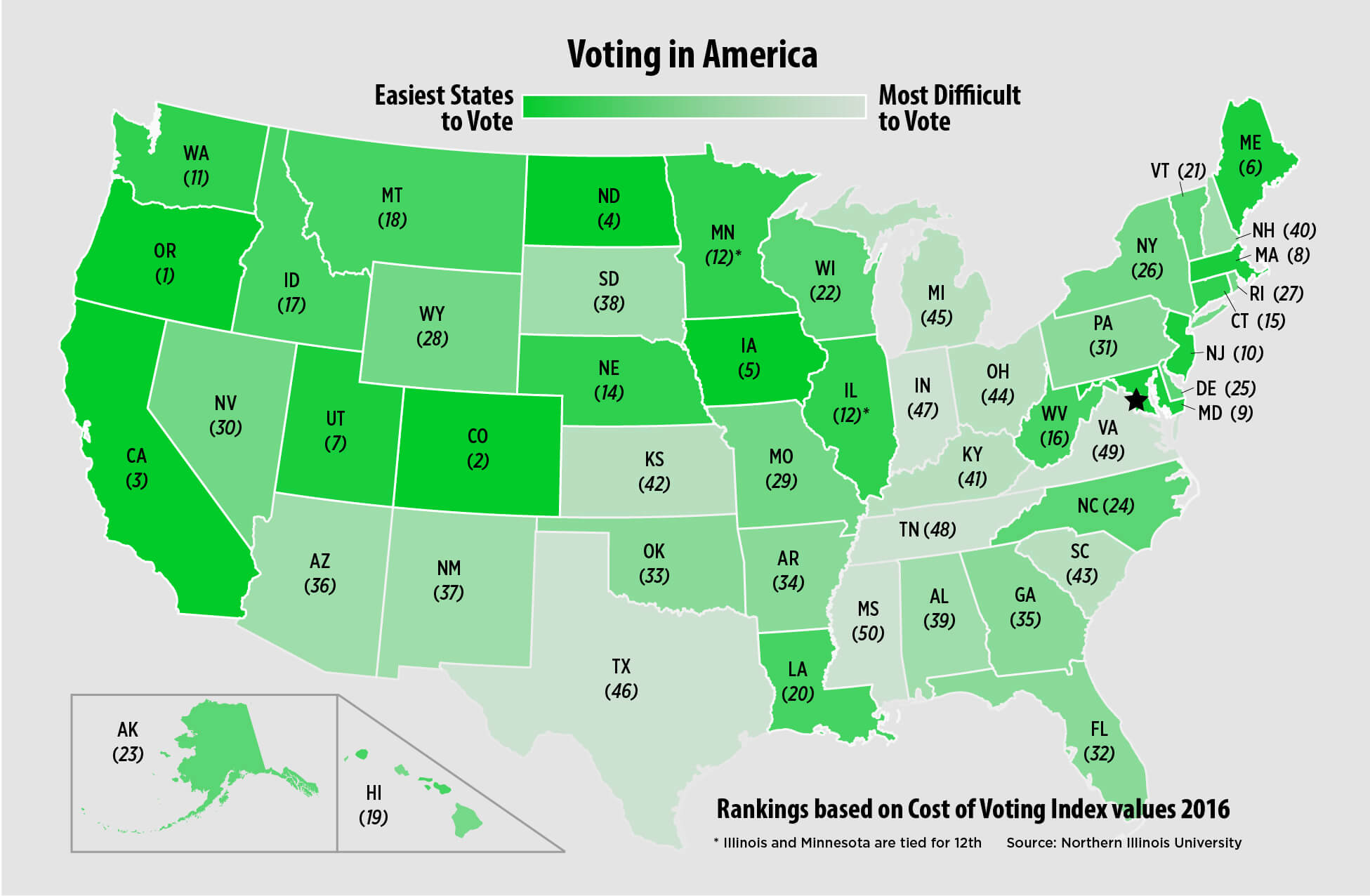
A new study lent a lot of credence to that last factor. Researchers at Northern Illinois University, Jacksonville University and Wuhan University in China found that states are influencing who votes by either making it easier or harder to cast a ballot. They created an index and ranked each state according to the time and effort it took to vote in each presidential election from 1996 through 2016. They scrutinized the effect of more than 30 factors involving registration and voting laws.

“The study does give us some very substantive findings that we can report about the effect on voter turnout,” wrote lead author Scot Schraufnagel. “But we created this index with the idea in mind that it’s going to have a lot of interest for reasons beyond voter turnout because it helps to define an electoral climate, which might influence whether people are willing to run for public office or who is willing to run for office. There also are implications for civil rights. We know, anecdotally, states with larger African-American populations have higher ‘cost of voting’ values.”Mississippi, Virginia, Tennessee, Indiana, Texas and Michigan were ranked as the states where it’s most difficult to vote. Maine, Oregon, California and Colorado all cracked the top 10 in places where it’s easiest.

In 37 states, including three that mail ballots to all voters, along with Washington, D.C., any eligible voter can cast a ballot in person before Election Day without an excuse, according to the National Conference of State Legislatures. Colorado, Washington and Oregon use all-mail voting.

Meanwhile, 13 states, including New York, Michigan and Pennsylvania, offer no early voting and require you to provide a reason to vote by absentee ballot.

Making it easier to vote nationwide could boost election turnout by about 10 percentage points, Schraufnagel noted. This includes same-day voter registration policy, mail-in voting and, yes, early voting.

read more…

https://patch.com/new-york/bedford/s/gjevh/here-s-how-many-people-vote-in-new-york?utm_source=alert-breakingnews&utm_medium=email&utm_term=weather&utm_campaign=alert

Realtor confidence up while sales are down | Cross River Real Estate

Interest rates and low inventory caused home sales to fall in September, but Realtors expect housing conditions to improve over the next six months.

The Buyer Traffic Index decreased to 51 in September, down from 61 in September 2017, according to the National Association of Realtors Confidence Index.

The index gathers monthly information from Realtors about local real estate market conditions, characteristics of buyers and sellers and issues affecting homeownership and real estate transactions. An index of more than 50 indicates an expectation of improvement.

The Seller Traffic Index also decreased, falling to 41 in September, down from 45 in September 2017, according to NAR.

However, despite these decreases, Realtors expect that, over the next six months, conditions will improve for the single-family housing market. The Confidence Index – Six-Month Outlook Current Conditions came in at 53 in September.

The same can’t be said for other housing markets. For example, the index for townhomes came in at 44, and 43 for condominium properties.

When asked about major issues affecting housing transactions in September, Realtors answered that low inventory and interest rates were the most common issues.

But while Realtors may be optimistic about the future, some economists disagree.

“Our expectations for housing have become more pessimistic: Rising interest rates and declining housing sentiment from both consumers and lenders led us to lower our home sales forecast over the duration of 2018 and through 2019,” Fannie Mae Chief Economist Doug Duncan said.

Most experts expect one final rate hike in December 2018 and another two or three rate hikes in 2019. These rising rates will only continue to push potential homebuyers out of the market.

In fact, recent data from NAR showed that existing home sales hit their lowest level in three years, and Freddie Mac data shows interest rates are currently at a 10-year high. Now, these factors could be pushing more families to rent instead of buying a home.

Despite the difficult conditions, some home buyers managed to increase their share. First-time buyers accounted for 32% of sales in September, up from 29% in September last year.

read more…

Southern California suffers its worst housing slump in over a decade | Waccabuc Real Estate

  • The number of new and existing houses and condominiums sold during the month plummeted nearly 18 percent compared with September 2017, according to CoreLogic.
  • That was the slowest September pace since 2007, when the national housing and mortgage crisis was hitting.
  • The median price of Southern California homes sold in September, $505,000, was still 3.6 percent higher than it was a year ago. That was the lowest annual gain for any month in more than three years.
GP: California real estate for sale Pasadena. 

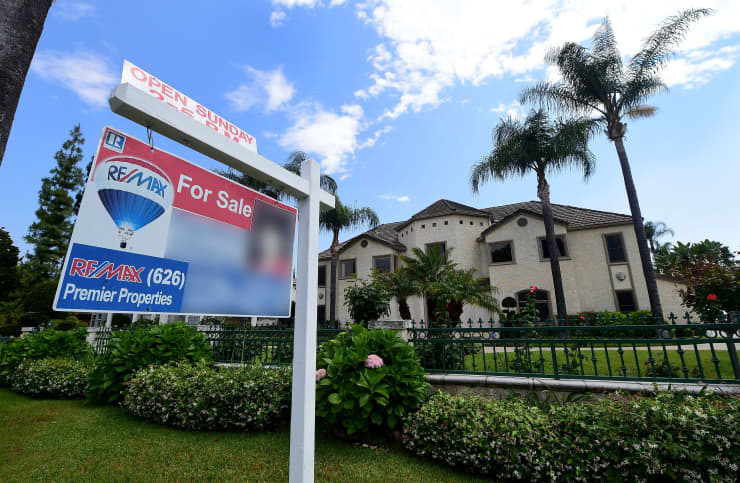
A property for sale in Arcadia, California.Frederic J. Brown | AFP | Getty Images

Higher mortgage rates and overheated home prices hit Southern California home sales hard in September.

The number of new and existing houses and condominiums sold during the month plummeted nearly 18 percent compared with September 2017, according to CoreLogic. That was the slowest September pace since 2007, when the national housing and mortgage crisis was hitting.

Sales have been falling on an annual basis for much of this year, but this was the biggest annual drop for any month in almost eight years. It was also more than twice the annual drop seen in August.

“The double whammy of higher prices and rising mortgage rates has priced out some would-be buyers and prompted others to take a wait-and-see stance,” said Andrew LePage, a CoreLogic analyst, in the release. “There was one caveat to last month’s sharp annual sales decline — this September had one less business day for recording transactions. Adjusting for that, the year-over-year decline would be about 13 percent, still the largest in four years.”

On a monthly basis, sales fell 22 percent in September compared with August. Sales usually fall about 10 percent from August to September.

We cannot afford the monthly payment

Sales of newly built homes are suffering more than sales of existing homes, likely because fewer are being built compared with historical production levels. Newly built homes also come at a price premium. Sales of newly built homes were 47 percent below the September average dating back to 1988, while sales of existing homes were 22 percent below their long-term average.

The median price of Southern California homes sold in September, $505,000, was still 3.6 percent higher than it was a year ago. That was the lowest annual gain for any month in more than three years.

“Price growth is moderating amid slower sales and more listings in many markets,” LePage said. “This is welcome news for potential homebuyers, but many still face a daunting hurdle – the monthly mortgage payment, which has been pushed up sharply by rising mortgage rates.”

LePage noted that while the median sale price was up 3.6 percent year over year in September, the principal and interest mortgage payment on the median-priced home was up 14.2 percent because mortgage rates increased about 0.8 percentage point over that period.

read more…

https://www.cnbc.com/2018/10/30/southern-california-suffers-its-worst-housing-slump-in-over-a-decade.html?__source=newsletter%7Ceveningbrief


Freddie Mac researches renting | Pound Ridge Real Estate

New research by Freddie Mac Multifamily finds a large and growing segment of renters continue to believe renting is a more affordable option than owning, even as many of those same renters are feeling the squeeze of rising housing costs. The latest “Profile of Today’s Renter” reveals that all generations of renters continue to perceive renting as the more affordable housing choice and remain satisfied with their current situation.

According to the survey pdf, 78 percent of renters believe renting is more affordable than owning – up a stunning 11 points from just six months ago in February 2018. This is the case even as the majority of renters (66 percent) reported difficulty affording their rent at some point over the past two years. The survey found nearly 9 in 10 renters employed in the essential workforce, such as healthcare and education, had significant difficulty affording the rent over the past two years.

Affordability of Renting

While perceptions of affordability over owning increased by 11 points to 78 percent among all renters, the survey found this was evident across generations. In fact, millennials (up 14 points to 75 percent), Generation Xers (up 11 points to 70 percent) and baby boomers (up eight points to 81 percent) all saw marked increases in the perception that renting is more affordable than owning.

Rising Cost of Renting

The survey also indicates that a significant number or renters – 66 percent – reported having trouble affording their monthly rent in the last two years – significantly more than the 43 percent of homeowners who experienced similar difficulties. More than half of renters say these changes affected spending on food, utilities and other essentials (51 percent) – as well as savings (50 percent) and nonessential items (64 percent). For renters living in rural areas, the impacts were particularly stark, with 77 percent spending less on essential items versus 59 percent in urban and suburban areas. While a majority of renters across generations reported these difficulties, older millennials (aged 28-37) reported the greatest hardship, with 79 percent reporting trouble affording rent over the past two years.

As noted earlier, renters employed in the essential workforce – such as the healthcare and education sectors – had significant additional difficulty affording rent, with a staggering 88 percent reporting hardship affording rent over the past two years. This is compared with 65 percent of all other workforce renters and 61 percent of homeowners in the essential workforce. Approximately half (48 percent) of renters working in essential jobs believe it is difficult to find housing that is affordable close to where they work – compared to 39 percent of homeowners in the essential workforce.

Rental Satisfaction

A consistent number of renters – 63 percent – continue to express their satisfaction with their rental experience. In fact, 58 percent of renters believe that renting is a good choice for them now and do not have plans to buy a home at this time – up from 54 percent in February. Over the last three years there has been a gradual increase in the number of renters who are not interested in buying. This quarter shows a small increase in this trend, with 23 percent of renters reporting they have no interest in buying a home – up from 20 percent in February. In addition, 42 percent of baby boomers have expressed no interest in owning a home.

A total of 66 percent of renters plan to continue renting for their next residence – up 11 points from February. Consistent with this view, fewer renters (41 percent) believe buying a home will be equally or more affordable in the next 12 months – down from 46 percent in February.

Survey Methodology

Freddie Mac’s custom renter research is based on a survey conducted online between August 13-15 among 4,040 adults aged 18 and over, including 1,059 renters, by Harris Poll, on behalf of Freddie Mac, via its QuickQuery omnibus product. The previous survey was conducted between January 30-February 1, 2018 among 4,115 adults and 1,209 renters using the same methodology.

read more…

http://www.freddiemac.com/research/consumer-research/20181017_affordability_renting.html

Case Shiller prices up 5.8% | Chappaqua Real Estate

  • Nationally, prices rose 5.8 percent in August compared with August 2017, according to the S&P CoreLogic Case-Shiller home prices index. That is less than the 6 percent annual gain in July.
  • The index’s 10-City Composite rose 5.1 percent annually, down from 5.5 percent in the previous month. The 20-City Composite posted a 5.5 percent year-over-year gain, down from 5.9 percent in the previous month.
  • “Following reports that home sales are flat to down, price gains are beginning to moderate,” David M. Blitzer, managing director and chairman of the index committee at S&P Dow Jones Indices, said in a release.
GS: Real estate agent and prospective buyer in house 091001

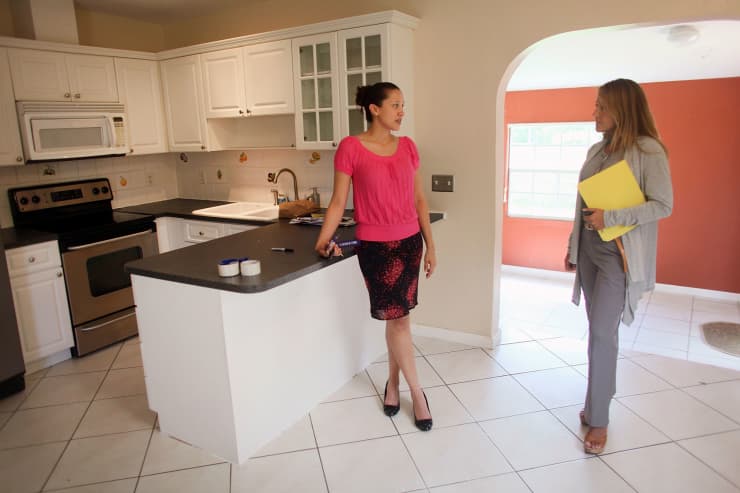
A real estate agent shows a home for sale to a prospective buyer in Miami.Getty Images

Mortgage interest rates didn’t begin their recent surge until the start of September, but home prices were already feeling pressure, as fewer people could afford what was for sale.

Nationally, prices rose 5.8 percent in August compared with August 2017, according to the S&P CoreLogic Case-Shiller home prices index. That is less than the 6 percent annual gain in July.

The index’s 10-City Composite rose 5.1 percent annually, down from 5.5 percent in the previous month. The 20-City Composite posted a 5.5 percent year-over-year gain, down from 5.9 percent in the previous month.

“Following reports that home sales are flat to down, price gains are beginning to moderate,” David M. Blitzer, managing director and chairman of the index committee at S&P Dow Jones Indices, said in a release. “Rising prices may be pricing some potential home buyers out of the market, especially when combined with mortgage rates approaching 5 percent for 30-year fixed rate loans.”

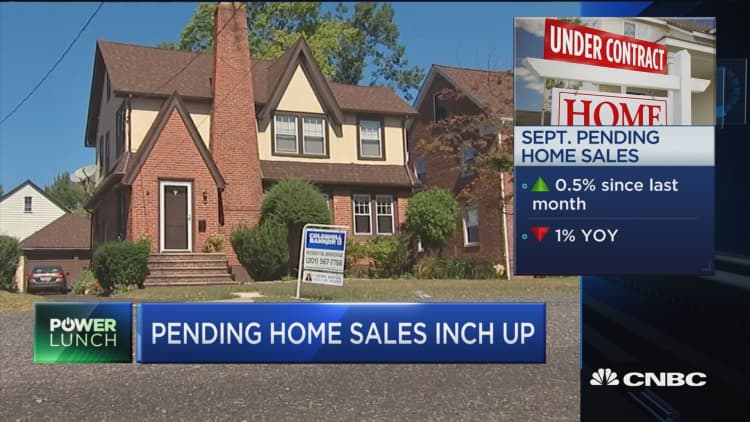
WATCH NOWVIDEO00:46Pending home sales inch up

The jump in mortgage interest rates began at the start of September, but home sales were already slowing, as prices were just too high for some buyers, especially entry-level buyers. Home prices have been pushed higher over the past few years due to a critical shortage of homes for sale. Inventory, however, finally began to rise in August, and continues to gain this fall. Not only are there more listings, but fewer sales, so homes are sitting on the market longer.

The market is beginning to balance more between supply and demand, following one of the strongest seller’s markets in decades. There is little concern, however, that prices will actually fall, only that the gains will fall back to more normal, historical levels of 3 percent to 4 percent annually.

“There are no signs that the current weakness will become a repeat of the crisis, however. In 2006, when home prices peaked and then tumbled, mortgage default rates bottomed out and started a three year surge,” said Blitzer. “Today, the mortgage default rates reported by the S&P/Experian Consumer Credit Default Indices are stable. Without a collapse in housing finance like the one seen 12 years ago, a crash in home prices is unlikely.”

Even as the gains shrink, some local markets continue to show price strength. Las Vegas, San Francisco and Seattle saw the biggest annual gains among the 20-city index.

In August, Las Vegas home prices jumped 13.9 percent year-over-year, followed by San Francisco with a 10.6 percent increase and Seattle with a 9.6 percent gain. Four of the 20 cities reported greater price increases in the year ending August 2018 versus the year ending July 2018.

read more…

https://www.cnbc.com/2018/10/30/home-price-gains-fall-below-6percent-for-the-first-time-in-a-year-august-sp-case-shiller-indices.html

Home builder confidence rises | Bedford Corners Real Estate

Builder confidence in the market for newly-built single-family homes rose one point to 68 in October on the National Association of Home Builders/Wells Fargo Housing Market Index (HMI). Builder confidence levels have held in the high 60s since June.

Builders continue to view solid housing demand, fueled by a growing economy and a nearly 50-year low for unemployment. Lumber price declines for three straight months from elevated levels earlier this summer have also helped to reduce some cost pressures, but builders will need to manage supply-side costs to keep home prices affordable.

Favorable economic conditions and demographic tailwinds should continue to support demand, but housing affordability has become a challenge due to ongoing price and interest rate increases. Unless housing affordability stabilizes, the market risks losing additional momentum as we head into 2019.

Derived from a monthly survey that NAHB has been conducting for 30 years, the NAHB/Wells Fargo Housing Market Index gauges builder perceptions of current single-family home sales and sales expectations for the next six months as “good,” “fair” or “poor.” The survey also asks builders to rate traffic of prospective buyers as “high to very high,” “average” or “low to very low.” Scores for each component are then used to calculate a seasonally adjusted index where any number over 50 indicates that more builders view conditions as good than poor.

The HMI index measuring current sales conditions rose one point to 74 and the component gauging expectations in the next six months increased a single point to 75. Meanwhile, the metric charting buyer traffic registered a four-point uptick to 53.

Looking at the three-month moving averages for regional HMI scores, the Northeast rose three points to 57 and the South edged up one point to 71. The West held steady at 74 and the Midwest fell two points to 57.

read more…

http://eyeonhousing.org/2018/10/builder-confidence-rises-one-point-in-october-remains-at-summer-levels/