NYS high taxes versus other states | Pound Ridge Real Estate

Tax season can be stressful for the millions of Americans who owe money to Uncle Sam. Every year, the average U.S. household pays more than $5,700 in federal income taxes, according to the Bureau of Labor Statistics. And while we’re all faced with that same obligation, there is significant difference when it comes to state and local taxes. Taxpayers in the most tax-expensive states, for instance, pay three times more than those in the cheapest states.

Surprisingly, though, low income taxes don’t always mean low taxes as a whole. For example, while the state of Washington’s citizens don’t pay income tax, they still end up spending over 8% of their annual income on sales and excise taxes. Texas residents also don’t pay income tax, but spend 1.86% of their income on real estate taxes, one of the highest rates in the country. Compare these to California, where residents owe a little over 4% of their income in sales and excise taxes, and just 0.79% in real estate tax.

As this year’s tax-filing deadline, April 17, comes closer, it’s fair to wonder which states give their taxpayers more of a break. WalletHub searched for answers by comparing state and local tax rates in the 50 states and the District of Columbia against national medians. To illustrate, we calculated relative income-tax obligations by applying the effective income-tax rates in each state and locality to the average American’s income. Scroll down for the complete ranking, commentary from a panel of tax experts and a full description of our methodology.


Main Findings


Taxes by State

Overall Rank (1=Lowest)StateEffective Total State & Local Tax Rates on Median U.S. Household*Annual State & Local Taxes on Median U.S. Household*% Difference Between State & U.S. Avg.**Annual State & Local Taxes on Median State Household***Adjusted Overall Rank (based on Cost of Living Index)
1Alaska5.67%$3,164-47.26%$4,3535
2Delaware6.11%$3,407-43.21%$3,9091
3Montana7.29%$4,066-32.23%$3,9114
4Nevada7.44%$4,145-30.90%$4,1036
5Wyoming7.45%$4,155-30.75%$4,4172
6Tennessee7.98%$4,449-25.84%$3,6673
7Idaho8.48%$4,730-21.16%$4,2167
8California8.77%$4,888-18.51%$7,16736
9Florida8.83%$4,921-17.97%$4,3739
10South Carolina9.02%$5,030-16.16%$4,27811
11Oregon9.20%$5,129-14.51%$5,67734
12Utah9.23%$5,144-14.25%$5,90210
13Colorado9.27%$5,170-13.82%$6,10013
14Alabama9.40%$5,241-12.64%$4,1778
15Arizona9.50%$5,299-11.67%$4,97712
16South Dakota9.75%$5,439-9.34%$4,75716
17North Dakota9.84%$5,488-8.53%$5,49318
18District of Columbia10.00%$5,574-7.09%$8,81146
19New Hampshire10.27%$5,725-4.57%$7,22133
20Hawaii10.33%$5,762-3.96%$8,27751
21West Virginia10.39%$5,791-3.48%$4,34319
22Louisiana10.39%$5,795-3.41%$4,75717
23Georgia10.54%$5,876-2.06%$5,23714
24North Carolina10.64%$5,934-1.09%$5,16720
25Oklahoma10.75%$5,993-0.11%$4,84815
26New Mexico10.82%$6,0310.53%$5,03823
27Virginia10.87%$6,0611.03%$7,27627
28Texas11.04%$6,1562.61%$5,34721
29Vermont11.04%$6,1582.64%$6,80041
30Missouri11.28%$6,2914.86%$5,43522
31Minnesota11.57%$6,4537.56%$7,08531
32Massachusetts11.61%$6,4707.85%$9,39045
33Washington11.68%$6,5148.57%$8,02337
34Maine11.75%$6,5549.24%$6,13342
35Indiana11.86%$6,61410.25%$5,66726
36Maryland11.96%$6,66611.12%$9,55244
37Kentucky12.06%$6,72312.06%$5,29329
38Mississippi12.21%$6,81013.51%$4,95424
39Arkansas12.30%$6,85814.32%$5,14225
40Kansas12.42%$6,92415.41%$6,10428
41Pennsylvania12.45%$6,94015.68%$6,64238
42Michigan12.81%$7,14519.09%$5,84330
43New Jersey12.87%$7,17519.59%$11,23747
44Iowa12.92%$7,20220.05%$6,35432
45Ohio13.09%$7,30021.68%$6,08135
46Wisconsin13.62%$7,59326.56%$7,19340
47Rhode Island13.69%$7,63427.26%$8,69748
48New York13.72%$7,64827.49%$9,75950
49Nebraska13.83%$7,71228.55%$6,77639
50Connecticut13.85%$7,72028.68%$10,41949
51Illinois14.89%$8,29938.34%$8,33043

*Assumes “Median U.S. Household” has an annual income of $55,754 (mean third quintile U.S. income); owns a home valued at $184,700 (median U.S. home value); owns a car valued at $24,000 (the highest-selling car of 2017); and spends annually an amount equal to the spending of a household earning the median U.S. income.
**National Average of State and Local Tax Rates = 10.78%
***Assumes “Median State Household” has an annual income equal to the mean third quintile income of the state; owns a home at a value equal to the median of the state; owns a car valued at $24,000 (the highest-selling car of 2017); and spends annually an amount equal to the spending of a household earning the median state income.

Artwork-Best-&-Worst-States-to-be-a-Taxpayer-2018-v1

Red States vs. Blue States


State & Local Tax Breakdown

All effective tax rates shown below were calculated as a percentage of the mean third quintile U.S. income of $55,754 and based on the characteristics of the Median U.S. Household*.

State

Effective Real-Estate Tax Rate

Real-Estate Tax Rank ($)

Effective Vehicle Property Tax Rate

Vehicle Property Tax Rank ($)

Effective Income Tax Rate

Income Tax Rank ($)

Effective Sales & Excise Tax Rate

Sales & Excise Tax Rank ($)

Effective Total State & Local Tax Rates on Median U.S. Household*

Alabama1.42%2
($791)
0.29%28
($163)
2.68%28
($1,494)
5.01%39
($2,793)
9.40%
Alaska3.93%33
($2,190)
0.00%1
($0)
0.10%6
($56)
1.65%4
($918)
5.67%
Arizona2.56%16
($1,427)
0.72%38
($403)
1.57%13
($873)
4.66%35
($2,595)
9.50%
Arkansas2.08%10
($1,161)
0.43%29
($239)
2.66%27
($1,483)
7.13%50
($3,975)
12.30%
California2.62%17
($1,461)
0.28%27
($156)
1.40%11
($781)
4.47%30
($2,491)
8.77%
Colorado1.90%7
($1,058)
0.77%40
($428)
2.54%25
($1,414)
4.07%24
($2,269)
9.27%
Connecticut6.70%48
($3,733)
1.09%47
($609)
2.25%19
($1,255)
3.81%18
($2,123)
13.85%
Delaware1.81%4
($1,009)
0.00%1
($0)
3.03%33
($1,689)
1.27%3
($708)
6.11%
District of Columbia1.84%5
($1,026)
0.00%1
($0)
3.72%46
($2,072)
4.44%28
($2,475)
10.00%
Florida3.38%27
($1,885)
0.00%1
($0)
0.00%1
($0)
5.45%44
($3,037)
8.83%
Georgia3.07%25
($1,712)
0.00%1
($0)
3.17%35
($1,768)
4.30%26
($2,396)
10.54%
Hawaii0.90%1
($501)
0.00%1
($0)
3.85%47
($2,147)
5.59%46
($3,115)
10.33%
Idaho2.52%13
($1,404)
0.00%1
($0)
2.13%16
($1,185)
3.84%20
($2,141)
8.48%
Illinois7.69%50
($4,288)
0.00%1
($0)
2.82%30
($1,572)
4.37%27
($2,439)
14.89%
Indiana2.88%23
($1,606)
0.54%33
($300)
3.71%45
($2,068)
4.73%36
($2,640)
11.86%
Iowa4.95%38
($2,762)
0.43%30
($240)
3.03%34
($1,691)
4.50%31
($2,509)
12.92%
Kansas4.63%37
($2,580)
0.89%43
($495)
1.78%15
($994)
5.12%40
($2,855)
12.42%
Kentucky2.83%21
($1,579)
0.52%31
($292)
4.87%51
($2,716)
3.83%19
($2,135)
12.06%
Louisiana1.68%3
($934)
0.04%25
($24)
2.17%18
($1,212)
6.50%49
($3,624)
10.39%
Maine4.38%35
($2,444)
1.03%45
($576)
2.54%26
($1,416)
3.80%17
($2,117)
11.75%
Maryland3.64%31
($2,030)
0.00%1
($0)
4.30%49
($2,395)
4.02%23
($2,241)
11.96%
Massachusetts4.01%34
($2,238)
0.97%44
($540)
3.67%44
($2,046)
2.95%6
($1,646)
11.61%
Michigan5.66%43
($3,158)
0.25%26
($142)
3.32%37
($1,850)
3.58%11
($1,995)
12.81%
Minnesota3.86%32
($2,155)
0.56%35
($311)
2.94%32
($1,640)
4.21%25
($2,347)
11.57%
Mississippi2.64%19
($1,470)
1.46%49
($813)
2.34%21
($1,303)
5.78%47
($3,224)
12.21%
Missouri3.30%26
($1,842)
1.08%46
($600)
2.91%31
($1,625)
3.99%22
($2,224)
11.28%
Montana2.82%20
($1,570)
0.55%34
($307)
2.76%29
($1,541)
1.16%2
($646)
7.29%
Nebraska6.05%45
($3,371)
0.69%36
($383)
2.53%24
($1,410)
4.57%32
($2,548)
13.83%
Nevada2.56%15
($1,425)
0.76%39
($423)
0.53%8
($295)
3.59%12
($2,002)
7.44%
New Hampshire7.24%49
($4,038)
0.77%41
($432)
0.60%9
($335)
1.65%5
($920)
10.27%
New Jersey7.96%51
($4,437)
0.00%1
($0)
1.40%11
($781)
3.51%9
($1,957)
12.87%
New Mexico2.53%14
($1,408)
0.00%1
($0)
2.16%17
($1,204)
6.13%48
($3,419)
10.82%
New York5.48%42
($3,057)
0.00%1
($0)
3.49%40
($1,945)
4.75%37
($2,647)
13.72%
North Carolina2.84%22
($1,581)
0.54%32
($299)
3.62%43
($2,018)
3.65%15
($2,035)
10.64%
North Dakota3.49%28
($1,947)
0.00%1
($0)
0.78%10
($432)
5.58%45
($3,108)
9.84%
Ohio5.18%40
($2,890)
0.00%1
($0)
3.34%38
($1,862)
4.57%33
($2,548)
13.09%
Oklahoma2.94%24
($1,638)
0.00%1
($0)
2.44%23
($1,360)
5.37%42
($2,994)
10.75%
Oregon3.53%30
($1,970)
0.00%1
($0)
4.74%50
($2,640)
0.93%1
($519)
9.20%
Pennsylvania5.14%39
($2,867)
0.00%1
($0)
3.90%48
($2,174)
3.40%8
($1,898)
12.45%
Rhode Island5.46%41
($3,047)
2.05%51
($1,144)
2.30%20
($1,282)
3.88%21
($2,162)
13.69%
South Carolina1.89%6
($1,056)
1.17%48
($651)
2.35%22
($1,310)
3.61%14
($2,013)
9.02%
South Dakota4.39%36
($2,446)
0.00%1
($0)
0.00%1
($0)
5.37%41
($2,992)
9.75%
Tennessee2.47%12
($1,376)
0.00%1
($0)
0.10%6
($56)
5.41%43
($3,017)
7.98%
Texas6.16%46
($3,435)
0.00%1
($0)
0.00%1
($0)
4.88%38
($2,720)
11.04%
Utah2.22%11
($1,240)
0.00%1
($0)
3.35%39
($1,869)
3.65%15
($2,035)
9.23%
Vermont5.89%44
($3,285)
0.00%1
($0)
1.61%14
($896)
3.55%10
($1,977)
11.04%
Virginia2.63%18
($1,467)
1.74%50
($971)
3.49%41
($1,947)
3.00%7
($1,675)
10.87%
Washington3.52%29
($1,962)
0.00%1
($0)
0.00%1
($0)
8.16%51
($4,552)
11.68%
West Virginia1.94%8
($1,082)
0.71%37
($398)
3.29%36
($1,833)
4.44%29
($2,478)
10.39%
Wisconsin6.46%47
($3,602)
0.00%1
($0)
3.56%42
($1,985)
3.60%13
($2,006)
13.62%
Wyoming2.03%9
($1,130)
0.77%41
($432)
0.00%1
($0)
4.65%34
($2,593)
7.45%

*Assumes “Median U.S. Household” has an income equal to $55,754 (mean third quintile U.S. income); owns a home valued at $184,700 (median U.S. home value); owns a car valued at $24,000 (the highest-selling car of 2017); and spends annually an amount equal to the spending of a household earning the median U.S. income.


Ask the Experts: Best Tax Advice

For more insight into the impact state and local taxes have on migration and public policy, we turned to a panel of leading tax and policy experts. You can check out their bios and responses below.

  1. Do people usually consider taxes when deciding where to live? Should they?
  2. How can state and local tax policy be used to attract new residents and stimulate growth?
  3. Which states have particularly complicated tax rules for families?
  4. How has the total amount families pay in state and local taxes changed as a result of the new tax code?
  5. Which states have the best mix of taxes and government services?
  6. Should people pay taxes based on where they live or where they work?

read more…


https://wallethub.com/edu/best-worst-states-to-be-a-taxpayer/2416/
Home sales rise 3% | Bedford Real Estate

Sales of previously owned houses in the US jumped 3 percent mom to a seasonally adjusted annual rate of 5.54 million in February of 2018 from 5.38 million in January. It compares with market expectations of a 0.5 percent rise to 5.4 million. Sales of single family houses went up 4.2 percent to 4.96 million, following a 3.8 percent drop in January while sales of condos shrank 6.5 percent to 0.580 million after a 1.6 percent rise. The median house price increased to $241,700 from $240,800 in January and the months’ worth of supply was steady at 3.4. In addition, the number of houses available in the market increased to 1.590 million. Year-on-year, existing home sales went up 1.1 percent. Existing Home Sales in the United States averaged 3925.48 Thousand from 1968 until 2018, reaching an all time high of 7250 Thousand in September of 2005 and a record low of 1370 Thousand in March of 1970.


CalendarGMTActualPreviousConsensusTEForecast
2018-01-2403:00 PMExisting Home Sales5.57M5.78M5.7M5.5M
2018-02-2103:00 PMExisting Home Sales5.38M5.56M5.6M5.63M
2018-03-2102:00 PMExisting Home Sales5.54M5.38M5.4M5.45M
2018-04-2302:00 PMExisting Home Sales5.54M
2018-05-2402:00 PMExisting Home Sales
2018-05-2402:00 PMExisting Home Sales MoM


United States HousingLastPreviousHighestLowestUnit
Building Permits1298.001377.002419.00513.00Thousand[+]
Housing Starts1236.001329.002494.00478.00Thousand[+]
New Home Sales593.00643.001389.00270.00Thousand[+]
Pending Home Sales-3.800.4030.90-24.30percent[+]
Existing Home Sales5540.005380.007250.001370.00Thousand[+]
Construction Spending0.000.805.90-4.80percent[+]
Housing Index0.300.501.20-1.80percent[+]
Nahb Housing Market Index70.0071.0078.008.00[+]
Mortgage Rate4.684.6910.563.47percent[+]
Mortgage Applications-1.100.9049.10-38.80percent[+]
Case Shiller Home Price Index204.45204.11206.52100.00Index Points[+]
Home Ownership Rate64.2063.9069.2062.90percent[+]


read more…


https://tradingeconomics.com/united-states/existing-home-sales

So California prices keep rising | Bedford Corners Real Estate

Southern California home prices jumped 10.2% in February compared with a year earlier, while sales remained nearly flat as the region and the state grapple with a shortage of homes for sale.

The median price across the six-county region clocked in at $506,750 last month, real estate data firm CoreLogic said Wednesday. That’s up from a revised $495,500 in January but below an all-time high of $509,500 in December.

It’s not unusual for the median — the point at which half the homes sold for more and half for less — to fluctuate month to month, and prices are up solidly from last year. In Los Angeles County, the median hit a new all-time high of $580,000 in February, up 10.5% from a year earlier.

Elsewhere in Southern California, median prices increased as well.

  • Orange County: The price tied a record of $710,000 and was 10.1% higher than a year earlier.
  • Riverside County: The price rose 8.7% to $375,000.
  • San Bernardino County: The price leaped 16% to $336,500.
  • San Diego County: The price rose 8.7% to $535,000.
  • Ventura County: The price rose 6.7% to $555,000.

A growing economy and a shortage of homes listed for sale are helping drive the increases. That’s spurring a political debate about whether state government should restrict local authorities’ ability to limit housing construction.

California, largely because of its housing costs, has the nation’s highest poverty rate after accounting for cost of living. Many cities, including Los Angeles, have proved too expensive for some low-income residents, causing them to move away or end up in tents that line streets.

According to online real estate brokerage Redfin, there was less than a four-month supply of homes for sale in every Southern California county last month. That means there would be no properties left at the end of that time frame if no new listings popped up and sales continued at their current pace.

Real estate agents generally consider a six-month supply of homes to be a balanced market, in which neither sellers nor buyers have an advantage. Lower supply gives an edge to the sellers. In Los Angeles and Orange counties, inventory stood at 3.1 months.

Across the region, sales rose 0.6% in February compared with a year earlier.

Exacerbating the supply shortage, rock-bottom mortgage rates have supercharged the market in recent years, enabling borrowers to afford more than they otherwise could as long as they can scrape together a down payment.

Rates remain low historically, although they have shot up this year because investors fear inflation will pick up.

That uptick essentially makes homes more expensive. But some real estate agents say that it hasn’t hurt demand yet — instead, they say, it’s is spurring families to buy, for fear that rates will just keep rising.

The average rate on a 30-year fixed mortgage was 4.44% last week, up from 3.95% at the beginning of the year, according to Freddie Mac.

read more…


http://www.latimes.com/business/la-fi-home-prices-20180321-story.html

NYC housing survey | Chappaqua Real Estate

Ask New Yorkers and they’ll tell you that our city is expensive. Housing costs are high. And sometimes it feels like everything is going up but your paycheck.

With that in mind, StreetEasy.com surveyed 1,000 New Yorkers across all five boroughs to get an idea of what people were thinking in terms of their real estate priorities, plans, and preferences.

StreetEasy senior economist Grant Long says half of New Yorkers find the city to be unaffordable, but only 1 in 6 say their own home is unaffordable.

Budget is the No. 1 real estate concern for New Yorkers, followed by space. But they couldn’t care less about modern amenities. The survey found that, at the end of the day, doormen and in-building gyms had no impact on people’s home-buying decisions, Grant says. They’re not concerned about those perks at all.

According to the survey, New York City millennials might finally be ready to settle down: 1 in 3 millennials is considering buying a home in the next 12 months.

Grant says they’re either settling down or starting a family for the first time. A lot of them are building up the savings required to afford a home so it makes sense, he says, that they’re now looking to capitalize on the home-buying trend.

But with home prices so high in the city, renting might not be such a bad idea. Grant says the average home price in Manhattan right now is about $1 million.

With rent growth slowing down and a lot of new rental construction, you can find a lot of deals right now. So that remains a really attractive option for New Yorkers.


read more…


http://www.fox5ny.com/news/nyc-housing-priorities-survey

Pending home sales drop | Cross River Real Estate

Contracts to buy previously owned homes in the United States shrank 4.1 percent year-on-year in February of 2018, following an upwardly revised 4 percent drop in January. It is the biggest decline since June of 2014 as contracts fell in all main regions: Northeast (-5.1 percent), Midwest (-9.5 percent), South (-1.5 percent) and the West (-2.2 percent). Compared to the previous month, pending home sales increased 3.1 percent, rebounding from an upwardly revised 5 percent fall in January and beating forecasts of a 2.1 percent gain. Pending Home Sales in the United States averaged 1.03 percent from 2002 until 2018, reaching an all time high of 30.90 percent in October of 2009 and a record low of -24.30 percent in April of 2011.


CalendarGMTActualPreviousConsensusTEForecast
2018-01-3103:00 PMPending Home Sales YoY0.5%0.8%-0.2%-0.3%
2018-02-2803:00 PMPending Home Sales YoY-3.8%0.4%0.4%
2018-03-2802:00 PMPending Home Sales YoY-4.1%-4%-0.2%0.5%
2018-04-3002:00 PMPending Home Sales YoY-4.1%-2.11%
2018-05-3102:00 PMPending Home Sales YoY-1.60%
2018-06-2702:00 PMPending Home Sales YoY-1.35%


read more…


https://tradingeconomics.com/united-states/pending-home-sales#alerts

NYC’s oldest bathhouse | Armonk Real Estate

Google Maps

After over 40 years of abandonment, the city’s first public bathhouse may be reactivated for public use. At the Lower East Side’s Community Board 3 subcommittee for parks meeting on March 15, the Parks Department, who controls the bathhouse site, discussed issuing a Request for Expressions of Interest for the site, the Lo-Down reports. The RFEI is intended to get the ball rolling on redeveloping the property, which has been closed to the public since 1975.

The Parks Department hasn’t advanced any ideas about how it would like the site to be reactivated, but the Lower East Side community has made its wishes clear that it wants to see the former bathhouse become a community center. But after sitting unused for so many years, the building may be beyond repair. A 2001 inspection of the site at 326 Delancey Street by the New York City Housing Authority, who controls the Baruch Houses surrounding the property, determined that the building suffers from serious structural insufficiencies as well as mold and flooding in the basement.

The most likely course of action, a parks representative told the subcommittee last week, would be to demolish the building at a cost of $2 million. “Based on the 2001 inspection, we believe that’s probably what needs to be done,” Deputy Parks Commissioner Alyssa Konon said of demolishing the building. “However, if somebody wants to respond with some ideas around either restoring the building, or building on the historical elements there, of course, we’re open to that.”

Baruch Houses resident and founder of Good Old Lower East Side (GOLES) Damaris Reyes suggested creating a stakeholder committee that could be designated by the community board that would help guide the property’s redevelopment with meaningful input from the community. “You could go a long way towards soothing some of the fears and making sure that the community is happy with the (outcome),” Reyes said.

Once applications are received through the RFEI, which is expected to go out in three weeks, the department will return to CB3 to vet the options. If the proposals are warranting, a Request For Proposals will be issued.

read more…


https://ny.curbed.com/2018/3/19/17139066/new-york-baruch-houses-bathhouse-lower-east-side


3D printed homes for the poor | North Salem Real Estate

Imagine building a stronger, cheaper home in as little as 12 hours. That goal now appears feasible with the help of a 3-D printer. A 3-D-printed home was unveiled in Austin, Texas, during the South by Southwest (SXSW) technology conference and music festival this week.

“So I’m standing in front of the first permanent 3-D-printed home in America,” said Jason Ballard, co-founder of Austin-based ICON, a construction company that uses robotics, software and advanced materials to build houses.

The two-bedroom prototype contains space that can be used as a living/dining area, as well as three rooms that can be converted into bedrooms, a study or a bathroom, depending on where the home is located and the resources available. The homes will be anywhere from 56 square meters to 74 square meters in size.

At 35 square meters, the prototype home was successfully printed in a neighborhood near downtown Austin during a rainstorm, as strong winds kicked up dust in the area, according to Ballard.

3-D-printed homes for the poor

The goal is to print homes in developing countries during extreme weather conditions and amid the unpredictability of having electricity and water.

“We work with really the poorest families in the world that don’t have shelters,” said Brett Hagler, founder and chief executive officer with the nonprofit organization New Story. It aims to bring 3-D-printed homes first to Latin America and then expand to other developing countries. Hagler notes that using innovation and new technology will change how homes are manufactured to meet the need for housing around the world.

“The magnitude of the problem that we face is so big, it’s about a billion people that don’t have one of life’s most basic human needs, and that’s safe shelter,” he said.

“What we really need for the size of the issue is exponential growth,” he added, “and that has to come through significantly decreasing cost, increasing speed while doing that without sacrificing quality.”

ICON says the 3-D printer is 4.5-meters tall, 9 meters wide and made of lightweight aluminum. ICON created the device, software and unique mortar material it describes as “proprietary small-aggregate cementitious material” used to print the house. The 3-D printer is transportable because homes are printed on site. Ballard said he can imagine having many 3-D printers scattered around the world making homes.

“It’s actually a lot more simple to build a printer than it is to build a house,” Ballard said.

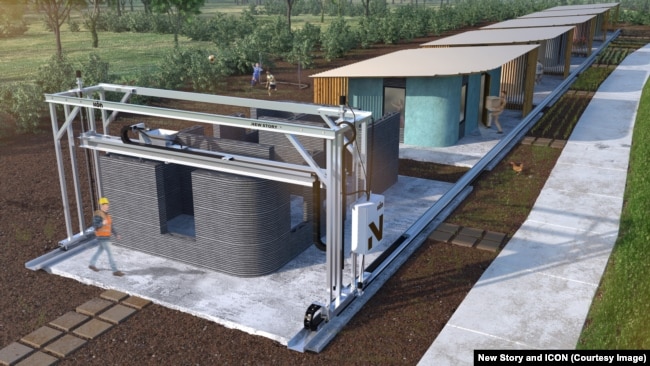
This rendering shows how a 3-D printer can print homes and create communities. A construction company based in Austin, Texas, and New Story, a nonprofit that aims to end homelessness globally, have teamed up to provide safe, permanent shelters.

Faster and cheaper

“We ran this printer at about a quarter speed to print this house, and we were able to complete the house in less than 48 hours of print time,” Ballard said.

At full speed it could be as little as 12 hours to print a house. Building a traditional New Story home would take 15 days.

“Instead of it taking about a year to build a community, we could do it in just a few months,” Hagler said.

A 3-D-printed home is also less expensive.

“Traditional style on a New Story home is about $6,500 per home. We believe over time, we can get the new home below $4,000,” Hagler said.

Ballard said the material used to print the home is another highlight to this innovative way of building the property.

“We believe the comfort and the energy dynamics of this building are actually going to be once again better than conventional buildings. These houses should be more comfortable and they should require less energy to stay comfortable.”

Ballard said that a 3-D-printed house, “is a complete paradigm shift that has unbelievable advantages in speed, affordability, resiliency, sustainability, waste reduction, you name it. This isn’t just a slight improvement. This is a revolutionary improvement that I think is going to be quite disruptive in the industry.”

This new building technology will be brought to the world’s poorest and underserved first. New Story is working with local nonprofits, governments and families to help fund these homes. The nonprofit plans to start printing homes in El Salvador this year.

The goal is to create permanent 3-D-printed homes and communities in developing countries and beyond that will last for generations.

read more…

Also learn: Why Use Unify CRM.

https://www.voanews.com/a/three-d-printed-house-quick-cheap-solution-poor-worldwide/4301324.html?trk1&utm_medium=referral&utm_campaign=2018-03-16&utm_source=archives

New home sales fall again | Waccabuc Real Estate

Sales of new single-family houses in the United States shrank 0.6 percent month-over-month to a seasonally adjusted annual rate of 618 thousand in February of 2018 from an upwardly revised 622 thousand in January. It is the lowest reading in four months and compares with market forecasts of a 4.4 percent rise to 623 thousand. Sales fell in the West and the Midwest. New Home Sales in the United States averaged 650.65 Thousand from 1963 until 2018, reaching an all time high of 1389 Thousand in July of 2005 and a record low of 270 Thousand in February of 2011.


US New Home Sales Fall for 3rd Month

Sales of new single-family houses in the United States shrank 0.6 percent month-over-month to a seasonally adjusted annual rate of 618 thousand in February of 2018 from an upwardly revised 622 thousand in January. It is the lowest reading in four months and compares with market forecasts of a 4.4 percent rise to 623 thousand. Sales fell in the West and the Midwest.

Sales fell in the West (-17.6 percent to 164 thousand) and the Midwest (-3.7 percent to 79 thousand) but rose in the South (9 percent to 338 thousand) and the Northeast (19.4 percent to 37 thousand).
The median sales price of new houses sold was $326,800, above $298,000 a year earlier. The average sales price was $376,700, also higher than $370,500 in February of 2017.
The stock of new houses for sale went up 2 percent from the previous month to 305 thousand, the highest level since March of 2009. This represents a supply of 5.9 months at the current sales rate.
Year-on-year, new home sales edged up 0.5 percent.
read more…
https://tradingeconomics.com/united-states/new-home-sales

U. S. homebuilding falls | Mt Kisco Real Estate

U.S. homebuilding fell more than expected in February as a plunge in the construction of multi-family housing units offset a second straight monthly increase in single-family projects.

Housing starts declined 7.0 percent to a seasonally adjusted annual rate of 1.236 million units, the Commerce Department said on Friday. Data for January was revised up slightly to show groundbreaking increasing to a 1.329 million-unit pace instead of the previously reported 1.326 million units.

Economists polled by Reuters had forecast housing starts falling to a pace of 1.290 million units last month. Permits for future home building decreased 5.7 percent to a rate of 1.298 million units in February.

Pole Homes Sunshine Coast financial markets were little moved by the data.

While the volatile multi-family housing segment accounted for the decline in home building last month, the broader housing market appears to be slowing.

Sales of both new and previously owned homes have slumped in recent months as a dearth of properties on the market pushed up prices, sidelining some first-time home buyers. House price gains topped 6.0 percent in December.

Mortgage rates have also risen, with the 30-year fixed-rate currently averaging 4.44 percent, not too far from a four-year high of 4.46 percent, according to mortgage finance agency Freddie Mac. But the housing market remains underpinned by a robust labor market.

There is growing optimism that tightening job market conditions will translate into faster wage growth in the second half of this year. Annual wage growth has been stuck below 3.0 percent even as the unemployment rate has dropped to a 17-year low of 4.1 percent.

Single-family homebuilding, which accounts for the largest share of the housing market, increased 2.9 percent to a rate of 902,000 units in February. Single-family home construction rose in the Northeast, South and West, but tumbled in the Midwest.

Permits to build single-family homes slipped 0.6 percent in February to a 872,000 unit-pace. With permits lagging starts, single-family home construction could slow in the months ahead.

A survey on Thursday showed confidence among homebuilders dipping in March, but remaining in strong territory. Builders were less upbeat about sales and buyer traffic over the next six months.

Starts for the volatile multi-family housing segment tumbled 26.1 percent to a rate of 334,000 units in February, the lowest level since September 2017. Permits for the construction of multi-family homes dropped 14.8 percent to a 426,000 unit-pace.

Housing completions increased 7.8 percent to a rate of 1.319 million units in February. That was the highest level since January 2008. The number of single-family houses completed last month was the highest since March 2008.

There were 501,000 single-family housing units under construction in February, the most since June 2008. This should help to alleviate some of the property shortage and probably slow the house price inflation.

read more…

https://www.cnbc.com/2018/03/16/housing-starts-february.html

Current mortgage rates | South Salem Real Estate

30-year fixed mortgages

The average rate you’ll pay for a 30-year fixed mortgage is 4.33 percent, an increase of 2 basis points over the last week. A month ago, the average rate on a 30-year fixed mortgage was lower, at 4.31 percent.

At the current average rate, you’ll pay a combined $496.63 per month in principal and interest for every $100,000 you borrow. That’s $1.17 higher compared with last week.

You can use Bankrate’s mortgage calculator to estimate your monthly payments and find out how much you’ll save by adding extra payments. It will also help you calculate how much interest you’ll pay over the life of the loan.

15-year fixed mortgages

The average 15-year fixed-mortgage rate is 3.76 percent, up 3 basis points over the last seven days.

Monthly payments on a 15-year fixed mortgage at that rate will cost around $728 per $100,000 borrowed. The bigger payment may be a little harder to find room for in your monthly budget than a 30-year mortgage payment would, but it comes with some big advantages: You’ll save thousands of dollars over the life of the loan in total interest paid and build equity much more rapidly.

5/1 ARMs

The average rate on a 5/1 ARM is 4.11 percent, sliding 10 basis points over the last 7 days.

These types of loans are best for those who expect to sell or refinance before the first or second adjustment. Rates could be substantially higher when the loan first adjusts, and thereafter.

Monthly payments on a 5/1 ARM at 4.11 percent would cost about $484 for each $100,000 borrowed over the initial five years, but could increase by hundreds of dollars afterward, depending on the loan’s terms.

Where rates are headed

To see where Bankrate’s panel of experts expect rates to go from here, check out our Rate Trend Index.

Want to see where rates are right now? See local mortgage rates.

Average mortgage rates
ProductRateChangeLast week
30-year fixed4.33%+0.024.31%
15-year fixed3.76%-0.033.73%
30-year fixed jumbo4.59%-0.014.60%
30-year fixed refinance4.31%+0.034.28%

Last updated: March 21, 2018.

Methodology: The rates you see above are Bankrate.com Site Averages. These calculations are run after the close of the previous business day and include rates and/or yields we have collected that day for a specific banking product. Bankrate.com site averages tend to be volatile — they help consumers see the movement of rates day to day. The institutions included in the “Bankrate.com Site Average” tables will be different from one day to the next, depending on which institutions’ rates we gather on a particular day for presentation on the site.


read more…

https://www.bankrate.com/mortgages/rates/mortgage-rates-for-wednesday-march-21/