Oregon Governor Kate Brown yesterday signed into law a statewide cap on rent increases—the first statewide policy of this kind. The economic rationale is to lessen financial strain on renters, given that housing costs have risen faster than incomes. In many large cities along East and West Coasts, even middle-income families are stretching to pay for good quality housing in desirable neighborhoods. The political motivation behind Oregon’s new law is also clear: Unhappy rentershave emerged as a more vocal constituency across the country, and policymakers in both parties, from Boston to Minneapolis to San Diego, are taking notice.
But Oregon’s new law will not fix the underlying problem of high housing costs, and it could even make matters worse for vulnerable families.
THE U.S. HAS TWO HOUSING AFFORDABILITY PROBLEMS. RENT CONTROL WON’T FIX EITHER OF THEM.
The first affordability problem is that the nation’s poorest 20 percent have too little income to afford minimum quality housing without receiving subsidies. That’s not a failure of housing markets, but a function of the low wages and unstable incomes generated by labor markets. Poor families could be helped by expanding existing programs such as housing vouchers or the Earned Income Tax Credit (EITC) to cover more poor households. But to fund those programs, middle- and higher-income households would have to pay more in taxes—which state and federal lawmakers have been reluctant to propose.
The second, more challenging affordability problem is that over the past 40 years, the U.S. hasn’t built enough housing in the locations where people most want to live. Metropolitan areas with strong labor markets and high levels of amenities—including Portland, Ore., Seattle, Wash., most of coastal California, and the Northeast corridor from Washington, D.C. to Boston, Mass.—have underbuilt housing relative to demand. The same pattern is true for neighborhoods within cities. Affluent residential areas with good public schools, access to jobs and transportation, have effectively shut down new development of anything other than expensive single family homes on large lots.
The only effective long-term fix to the housing scarcity challenge is to build more housing—especially building less expensive housing in cities and neighborhoods where demand is high. This would require substantial changes to local zoning in nearly every U.S. city. But homeowners are a powerful lobby at every level of government, and only a fewboldelectedofficials have dared to challenge the NIMBYs.
EVEN WELL-DESIGNED RENT CONTROL POLICIES CAN REDUCE HOUSING SUPPLY, HARMING VULNERABLE FAMILIES.
The Oregon law tries to foresee and forestall some ways in which rent control can push landlords and developers into harmful responses. For instance, when landlords cannot raise rents, they often choose to not provide adequate maintenance. The Oregon law allows relatively generous annual rent increases of 7 percent plus inflation to avoid this problem. Although the bill is thoughtfully designed, any such regulations create incentives for developers and landlords to seek out loopholes. Past research shows that property owners in rent controlled cities are more likely to convert apartment buildings into condominiums. A developer considering building an eight-unit apartment building might revise their plans to build only five apartments, just under the cap set by Oregon’s law—thus contributing less new housing overall. Landlords may pre-emptively raise the rent more as they approach the 15 year mark when controls kick in. Even the increased tenant protections could backfire, encouraging landlords to screen out less desirable tenants—including many low-income families with young children.
FIXING HOUSING AFFORDABILITY WILL REQUIRE COURAGE FROM POLITICIANS, AND SOME SACRIFICES FROM AFFLUENT VOTERS.
Rent control is similar to another popular housing policy, inclusionary zoning, in that it tries to push the onus for improving housing affordability onto for-profit developers and landlords. Self-identified progressive homeowners may be willing to support politicians who advocate these policies. But neither rent control nor inclusionary zoning address the underlying causes of housing affordability, and indeed have the potential to discourage new supply and make the problem worse. Politicians need to be honest with their constituents about the cost of better policies as well as the costs of failing to act. Affluent households should pay more taxes to support poor families, and should allow new apartments in their own backyards.
National foreclosure rates continued their recovery in 2018 from their peak during the Great Recession.
Foreclosure filings were reported on one out of every 215 homes last year. That’s down markedly compared with the filings on roughly one in 47 homes in 2010. Last year’s rate is the lowest since at least 2005.
The 2018 U.S. Foreclosure Market Reportshows the national foreclosure rate has been falling steadily for the last eight years, reaching a 13-year-low of 0.47 percent in 2018.
However, the foreclosure picture can look different at the state level.
Almost a third of states saw the number of foreclosure filings — default notices, scheduled auctions and bank repossessions — against homes climb last year, according to the report from ATTOM Data Solutions.
“Plummeting foreclosure completions combined with consistently falling foreclosure timelines in 2018 provide evidence that most of the distress from the last housing crisis has now been cleaned up,” says Todd Teta, chief product officer for ATTOM.
But some evidence of distress was gradually returning to the housing market in 2018, Teta says.
States with the highest foreclosure rates
The states with the highest foreclosure rates were clustered in mostly in the Northeast.
New Jersey has had the highest rate since 2015 and had 1.33 percent of housing units with foreclosure filings last year. Delaware had 0.96 percent; Maryland 0.86 percent; Illinois 0.74 percent and Connecticut 0.72 percent.
States with the lowest foreclosure rates
North Dakota was among the places where foreclosure rates increased from 2017 to 2018. But the Roughrider State’s real estate economy remains strong comparatively.
North Dakota had the lowest rate of housing units with foreclosure filings last year (0.06 percent). South Dakota had 0.07 percent; Montana 0.11 percent and West Virginia 0.12.
Alaska has the fastest-rising foreclosure rate
Alaska’s economy has been struggling in recent years after oil prices dipped in 2014, but the state’s real estate market has proved fairly resilient, according to Terry Fields, assistant professor at the College of Business and Public Policy within the University of Alaska Anchorage.
The data from ATTOM shows homeowners in The Last Frontier may be starting to feel the pressure. A total of 1,145 properties were in the process of foreclosure in 2018 — up from 614 in 2017.
The foreclosure rate in Alaska grew the fastest of all 50 states, rising from 0.20 percent in 2017 to 0.37 percent last year, according to ATTOM.
While local economists are keeping an eye on Alaska’s real estate market, foreclosures are still significantly below the levels they were during the Great Recession and previous bust periods in Alaska, Fields says.
Millennials are finding it increasingly difficult to become first-time buyers. Even for those that have managed to find (albeit shaky) footing on the housing market, it’s not easy. Moving to a bigger and better house is often out of the question, for example. But millennials are a crafty lot; if moving isn’t an option, why not remodel? In fact, over 25% of millennials are choosing to do just that and to get the job done they are taking out rehab loans. In this article, we focus on what they decide to focus their remodeling energies on.
SIZE MATTERS
As we’ve already mentioned, millennials are either choosing or being forced to stay in their homes. With moving an impossibility, even with growing families, millennials have had to get creative with maximizing space:
Function first. Style is important, but if space comes at a premium, then function is the first thing on the millennial’s mind. If looking to build additions or expand you will want to contact a structural engineering services company to help you with your structural questions.
Storage everywhere. Hooks against kitchen walls to hang pots and pans. Drawers under the couch. Pull-out closets. Cabinets against the ceiling. You get the drill.
Natural light. Sometimes it’s impossible to create extra space. So why not the next best thing? Adding a window or skylight can give you the illusion of a bigger home.
ENJOYING OUTDOOR SPACE
Millennials are massively investing in their gardens. In fact, it’s becoming kinda cool, with millennials now spending more on average than their parents. Growing vegetables is definitely becoming a thing, with millennials liking growing their own organic food. It’s tastier, better for the environment, and it’s a fun project to get involved in.
Millennials don’t tend to live in homes with a lot of outdoor space. Gardens are like gold dust, so it’s no surprise that if they manage to get their hands on one, millennials take care of it.They spend a lot of time researching sustainable designs and plants to occupy it.
LOW MAINTENANCE BEATS STYLE
Millennials are big on homes that don’t really take much effort to maintain. They want practical homes built with eco-friendly products. Homes that are built with cheap and sturdy materials, rather than the stylish but overpriced stuff. Here are two examples of what we’re talking about:
Hard flooring, not carpet. Carpets are expensive, get stained easily, will only be in decent condition for a few years tops (less if you have kids!), and it doesn’t look as cool as engineered flooring.
Metal roof. Tiles have the traditional vibe going for them, but they’re more annoying to maintain than metal roofing. And it doesn’t have to look worse either; many of the newer metal roof varieties are modern and slick.
SMART TECHNOLOGY IS THE SMART CHOICE
Millennials are huge on tech, so it’s no surprise that many of them are turning to smart technology to transform their homes. And it’s not just buying an Amazon Echo. These are some remodelling upgrades that help millennials smarten up their homes:
USB outlets. Power outlets aren’t enough these days.
Built-in speaker systems. When it’s challenging to find space in smaller homes, solutions like built-in speaker systems are a cool way to solve the problem.
Motion sensors. Security is important, especially for millennials living in the big cities where break-ins are a little more common.
Smart thermostats. Not only to save bills, but these also help the environment by limiting your energy usage to when you actually need it.
Mortgage rates remained unchanged in the week ending 28th February. The stall in the downward trend came off the back of 3 consecutive weeks of decline. 30-year fixed rates remained unchanged at 4.35%, holding at the lowest level since 7th February’s 4.32%. The figures were released by Freddie Mac.
30-year fixed rates have fallen by 59 basis points since mid-November of last year, the most recent peak.
The pause in rates came as concerns over the global and U.S economic outlook continued to linger. Mixed sentiment towards progress on trade talks between the U.S and China led to a mid-week hiccup. The North Korea Summit also ended abruptly, which was not the outcome that the markets were looking for.
Economic Data from the Week
Economic data released through the week included December housing sector numbers and consumer confidence figures on Tuesday. December factory orders and January pending home sales on Wednesday that came ahead of 4th quarter GDP numbers on Thursday.
On the housing front, house price growth slowed further in December, according to the S&P / CS HPI Composite figures. Coupled with falling mortgage rates, the slower growth in house prices will be welcomed news for prospective home buyers.
Building permits continued its upward trend in December, following a 5% jump in November. In contrast, housing starts slumped by 11.2%, though this could be more to do with the weather than market conditions.
The good news was a combined jump in consumer confidence and pending home sales. Activity in the spring could deliver a much-needed boost to the sector.
Finally, the 4th quarter GDP numbers were in line with expectations. While growth was significantly slower than the 3rd quarter, it could have been far worse. Nonetheless, slower growth and FED Chair Powell’s testimony contributed to the steady mortgage rate figures.
Freddie Mac Rates
The weekly average rates for new mortgages as of 28th February were quoted by Freddie Mac to be:
30-year fixed rates held steady at 4.35% in the week. Rates were down from 4.43% from a year ago. The average fee also remained unchanged at 0.5 points.
15-year fixed rates fell by 1 basis points to 3.77% in the week. Rates were down from 3.90% from a year ago. The average fee increased from 0.4 points to 0.5 points.
5-year fixed rates also remained unchanged at 3.84% in the week. Rates increased by 22 basis points from last year’s 3.62%. The average fee held steady at 0.3 points.
Mortgage Bankers’ Association Rates
For the week ending 22nd February, rates were quoted to be:
Average interest rates for 30-year fixed, backed by the FHA, decreased from 4.68% to 4.64%. Points decreased from 0.58 to 0.48 (incl. origination fee) for 80% LTV loans.
Average interest rates for 30-year fixed with conforming loan balances decreased from 4.66% to 4.65%. Points remained unchanged at 0.42 (incl. origination fee) for 80% LTV loans.
Average 30-year rates for jumbo loan balances decreased from 4.56% to 4.40%, the lowest level since January 2018. Points increased from 0.23 to 0.29 (incl. origination fee) for 80% LTV loans.
Weekly figures released by the Mortgage Bankers Association showed that the Market Composite Index, which is a measure of mortgage loan application volume, surged by 5.3% in the week ending 22nd February. The increase follows on from a 3.6% rise from the previous week.
The Refinance Index rose by 5% in the week ending 22nd February. The rise follows on from a 6% jump in the previous week.
The share of refinance mortgages decreased from 41.7% to 40.4%, following a fall from 41.8% to 41.7% in the week prior.
According to the MBA, home buyers responded favorably to the shift in the mortgage rate environment. Purchase applications for both conventional and government loans were reported to have risen in the reporting week. The upward trend in refinance application volume saw the index hit its highest level in a month.
For the week ahead
It’s a particularly busy week ahead. On the data front, February’s service sector PMI and December new home sales figures will provide direction on Tuesday. Service sector activity will need to impress to ease any immediate concerns over the economic outlook.
Trade figures and February’s ADP nonfarm employment change figures will influence Treasury yields on Wednesday.
Economic data out of the U.S on Thursday includes 4th quarter nonfarm productivity and unit labor costs, which will be released alongside the weekly jobless claims figures. Barring a material deviation from forecast, the numbers will unlikely have a material impact.
Outside of the numbers, there are plenty of factors that will influence Treasury yields and ultimately mortgage rates. Trade talks between China and the U.S, Brexit, and China’s trade data are just a number of drivers ahead of Freddie Mac’s mortgage rates, which will be released on Thursday.
The steady mortgage-rate decline is making purchasing a home more affordable just as the spring buying season heats up.
According to the latest data released Thursday by Freddie Mac, the 30-year fixed-rate average dipped to 4.35 percent with an average 0.5 point. (Points are fees paid to a lender equal to 1 percent of the loan amount.) It was 4.37 percent a week ago and 4.40 percent a year ago. The 30-year fixed rate has fallen 16 basis points since the first of the year. (A basis point is 0.01 percentage point.)
The 15-year fixed-rate average slipped to 3.78 percent with an average 0.4 point. It was 3.81 percent a week ago and 3.85 percent a year ago. The five-year adjustable rate average dropped to 3.84 percent with an average 0.3 point. It was 3.88 percent a week ago and 3.65 percent a year ago.
“Today’s news from Freddie Mac should give buyers some optimism this spring as mortgage rates remain at one-year lows,” said Danielle Hale, chief economist at Realtor.com. “But this spring won’t be without its challenges. Most markets are continuing to see rising home prices, which means many buyers will have to make some trade-offs in order to close this year.”6
The National Association of Realtors said Thursday that sales of existing homes declined 1.2 percent to a seasonally adjusted annual rate of 4.94 million last month, the slowest sales rate since November 2015.
During the past 12 months, sales have plunged 8.5 percent. Would-be home buyers are increasingly priced out of the market as years of climbing prices and strained inventories have made ownership too costly. Declining mortgage rates could aid buyers.
The Federal Reserve released the minutes from its January meeting this week, which showed central bank officials unsure about the need for interest rate increases in 2019. Although the Fed doesn’t set mortgage rates, its decisions influence them.
“Wednesday’s release of the minutes from January’s (Federal Open Market Committee) meeting paints a picture of a more muted outlook for interest rates over the next year,” said Aaron Terrazas, Zillow senior economist. “All eyes are on a string of Fed speakers over the coming week, when we will also see a slew of housing market data, which was a soft spot in the economy at the end of last year. However, the January data are unlikely to provide a definitive judgment on the underlying health of the economy. The market signal in January home sales and permits is likely blurred by the partial federal government shutdown and the polar vortex that hit much of the country mid-month.”
Mixed economic news is putting a damper on rates. More than 84 percent of purchase borrowers and 81 percent of refinance borrowers were offered rates below 5 percent last week, according to LendingTree’s weekly mortgage comparison shopping report.
Bankrate.com, which puts out a weekly mortgage rate trend index, found nearly two-thirds of the experts it surveyed say rates will remain relatively stable in the coming week. Michael Becker, branch manager at Sierra Pacific Mortgage, is one who predicts rates will hold steady.
“Mortgage rates follow the 10-year Treasury and have similarly been consolidating with small differences in rates on a day-to-day and week-to-week basis,” Becker said. “At some point, rates will break out of this tight range and we will see either a spike or drop in rates. If global economic concerns dominate markets, then we will see a drop in rates. If optimism based on progress on trade wars or central bank dovishness prevails in the markets, then there will be a spike in rates. For now, I think rates continue their consolidation pattern and that mortgage rates will be flat in the coming week.”
Meanwhile, mortgage applications have finally started to pick up, according to the latest data from the Mortgage Bankers Association. The market composite index — a measure of total loan application volume — increased 3.6 percent from a week earlier. The refinance index rose 6 percent from the previous week, while the purchase index grew 2 percent.
The refinance share of mortgage activity accounted for 41.7 percent of all applications.
“After slumping over the past month, purchase mortgage applications reversed course, rising nearly 2 percent over the past week and 2.5 percent from a year ago,” said Bob Broeksmit, MBA president and CEO. “With mortgage rates lower than in previous months and holding steady, lenders are indicating that prospective buyers may be eager to start their home search before the spring buying season gets underway.”
U.S. home sales fell in January to their lowest level in more than three years and house prices rose only modestly, suggesting a further loss of momentum in the housing market.
The National Association of Realtors said on Thursday existing home sales dropped 1.2 percent to a seasonally adjusted annual rate of 4.94 million units last month.
That was the lowest level since November 2015 and well below analysts’ expectations of a rate of 5.0 million units. December’s sales pace was revised slightly higher.
The drop in January came after months of weakness in the U.S. housing market. Existing home sales were down 8.5 percent from a year ago.
The U.S. housing market has been stymied by a sharp rise in mortgage rates since 2016 as well as land and labor shortages. That has led to tight inventory and more expensive homes.
At the same time, the 30-year fixed mortgage rate has dipped in recent months and house price inflation is slowing.
The median existing house price increased 2.8 percent from a year ago to $247,500 in January. That was the smallest increase since February 2012.
Last month, existing home sales fell in three of the country’s four major regions, rising only in the Northeast.
There were 1.59 million previously owned homes on the market in January, up from 1.53 million in December.
At January’s sales pace, it would take 3.9 months to exhaust the current inventory, up from 3.7 months in December. A supply of six to seven months is viewed as a healthy balance between supply and demand.
Sam Khater, Freddie Mac’s chief economist, says, “Mortgage rates fell for the third consecutive week, continuing the general downward trend that began late last year. Wages are growing on par with home prices for the first time in years, and with more inventory available, spring home sales should help the market begin to recover from the malaise of the last few months.”
News Facts
30-year fixed-rate mortgage (FRM) averaged 4.35 percent with an average 0.5 point for the week ending February 21, 2019, down from last week when it averaged 4.37 percent. A year ago at this time, the 30-year FRM averaged 4.40 percent.
15-year FRM this week averaged 3.78 percent with an average 0.4 point, down from last week when it averaged 3.81 percent. A year ago at this time, the 15-year FRM averaged 3.85 percent.
5-year Treasury-indexed hybrid adjustable-rate mortgage (ARM) averaged 3.84 percent with an average 0.3 point, down from last week when it averaged 3.88 percent. A year ago at this time, the 5-year ARM averaged 3.65 percent.
Average commitment rates should be reported along with average fees and points to reflect the total upfront cost of obtaining the mortgage. Visit the following link for the Definitions. Borrowers may still pay closing costs which are not included in the survey.
State officials held hearings last week into Con Ed’s ban on new natural-gas customers in much of Westchester, but it’s the state itself that blocked new gas pipelines. What’d anyone expect?
Now, it turns out, the county’s nightmare may begin sooner than thought: When Assemblywoman Amy Paulin, who represents southern Westchester, asked Con Ed if it could delay the ban (set for March 15), the utility was frank: Supply and demand determine whether there’s enough gas, it said. So shortages could occur even beforethen.
Paulin isn’t the only one worried: “A March 15 deadline is just far too soon,” warned County Executive George Latimer. And the ban could choke an economic comeback in Westchester. “A moratorium of no new hookups would create a very chilling effect” on the “revival” in New Rochelle, Yonkers and White Plains.
Yet Con Ed has been warning for a long time now. In 2017, it tried to get the Public Service Commission to let it offer incentives to pipeline developers, who feared being denied permits — but was turned down.
The PSC denies that Con Ed came to it with any “pipeline solution,” Paulin said, but public documents show that’s not so.
Let’s face it: Even if the state forced Con Ed to sign up new customers, the utility still couldn’t deliver gas it doesn’t have.
Yet this disaster is entirely self-inflicted. To suck up to climate-change radicals, who hope to do away with all fossil-fuel-based energy, Gov. Cuomo has been slow to OK new pipelines. In response, pipeline companies have lost interest in New York.
Absent new gas supplies, businesses and residents will shun the county. No one will freeze, but Westchester faces new economic drag.
And New York City’s not far behind.
One hope: a court ruling last month that states can’t use their water-quality certification process to delay federal licensing of hydropower plants. “The scope of the ruling enhances the odds” that the Constitution pipeline will be built, notes Rob Rains of Washington Analysis. Constitution’s sponsors want the court to rule against New York efforts to block the pipeline.
Alas, anti-pipeline foes are gaining steam in New York. Last year, city Comptroller Scott Stringer bucked labor unions to denounce the plan for the Northeast Supply Enhancement pipeline, a source of natural gas that’s vital to the city’s growth. At least seven public-advocate wannabes have now joined him.
Maybe they want to send city folks fleeing, much as a dead economy has Upstaters doing. Then again, if everyone leaves, there’ll be no need for natural gas . .
VIEWS41KSHARE221Designed to amplify nature, these cozy, modern cabins invite you to embrace the simple life.
Winter is the perfect time to rally family and friends for a cabin getaway, featuring days in the unspoiled snow and nights spent nursing hot (spiked) cider around the fireplace. If you’re dreaming about your own rustic retreat in the wilderness, look no further for inspiration than these 20 modern winter cabins below that demonstrate a deep respect for their snowy, wooded surrounds.
Described by Seattle–based Olson Kundig Architects as “a steel box on stilts,” this three-story cabin in upstate Washington is fitted with four 10′ x 18′ steel shutters that are rolled over the glass windows, so it can be sealed off from the elements when not in use. In fact, the client requested that Delta Shelter be virtually indestructible: the steel exterior makes it fire-resistant, while its steel-beam legs protect it from flooding.
NEWSLETTERJoin the Daily Dose Mailing ListBrighten Up Your Inbox
Built in 2005 for a client looking for a compact, easy-to-maintain shelter for his and his friends’ adventures, Delta Shelter’s design was inspired by structures like tree houses and fire lookouts.
Architect Håkon Matre Aasarød, partner at Oslo–based studio Vardehaugen Architects, led the design of Cabin Vindheim—an off-grid cabin deep in the alpine landscape near Lillehammer, Norway, whose spaceship-like appearance gives it an otherworldly presence.
The cabin’s concept was simple: To create a cabin that is small and sparse yet spatially rich. The 55-square-meter (592-square-foot) cabin, commissioned by a private client and completed in 2016, comprises a large living room, bedroom, ski room, and small annex with a utility room. It functions off the water and electricity grids.
Designed by Montreal–based MU Architecture, Nook Residence is an all-white retreat that harmonizes with the snowy landscape outdoors.
Squinting through Quebec’s seasonal fluries, one might not immediately register the Nook Residence, an all-white retreat that purposefully blends into the winter landscape. The house, designed by MU Architecture, presents itself to passersby as a blank monolith; yet around the corner, it opens onto Lake Memphremagog through expansive windows and an interior balcony.
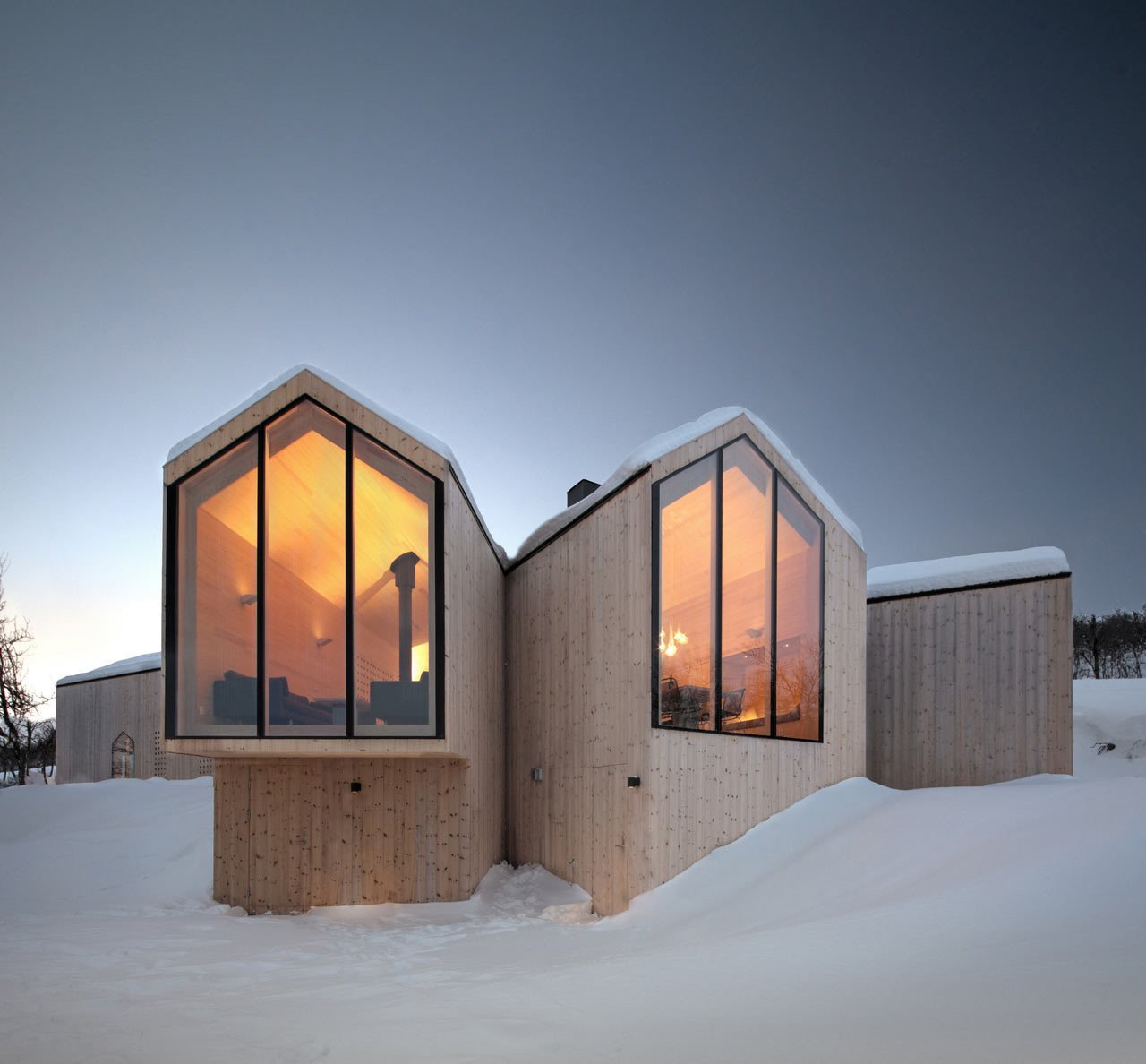
This sleek cabin by Reiulf Ramstad Arkitekter adapts to the slope of the terrain, and divides into two branches of living areas. The same timber cladding of the exterior extends onto the roof, creating a unified expression.
Designed by Reiulf Ramstad Arkitekter for a family of four, the Split View Mountain Lodge is a holiday home near the village of Geilo, Norway. The main volume splits out to form additional annexes that frame individual views of the surrounding mountains.
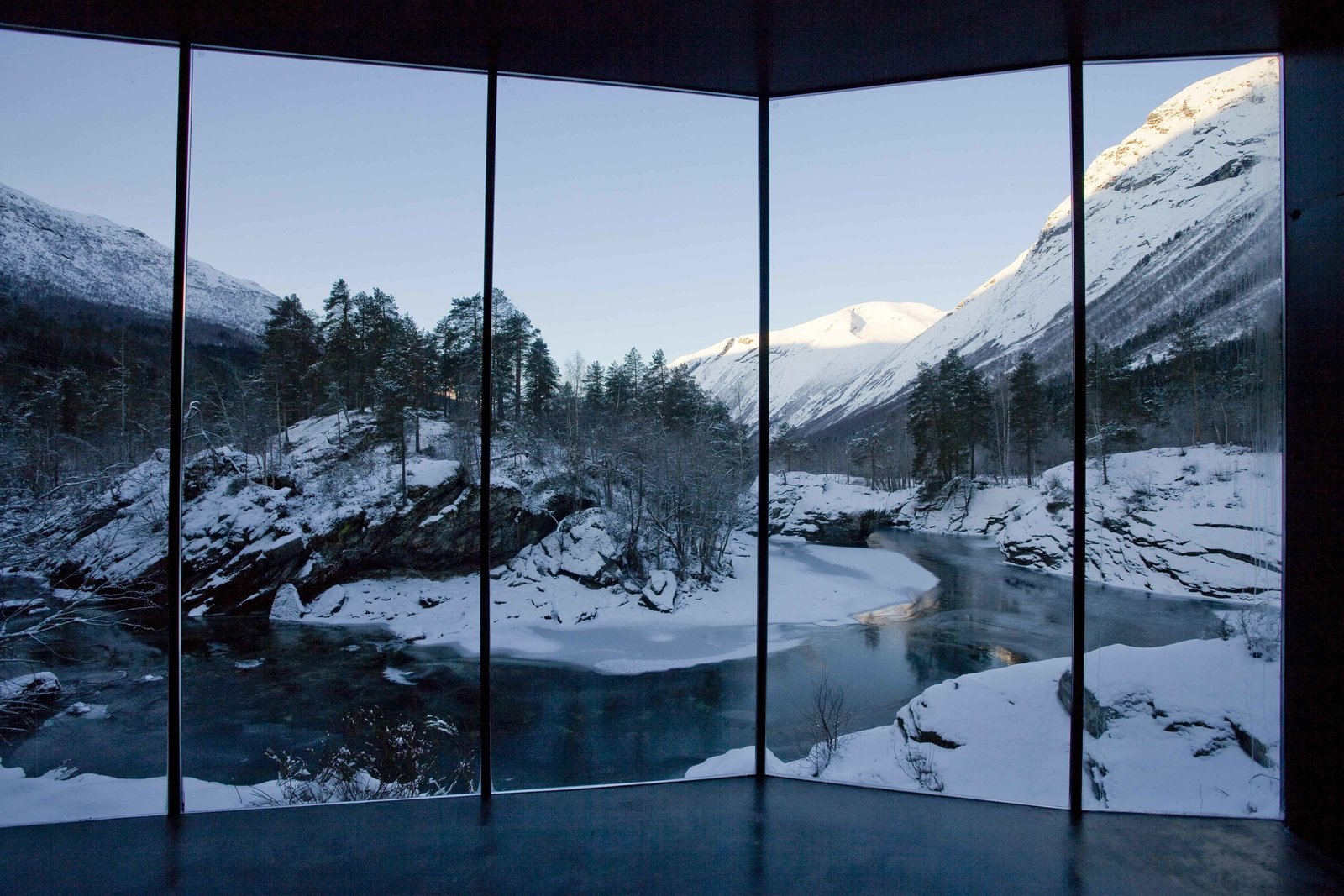
The minimalist cabins of this Norwegian hotel offer elegant shelter, while striking a remarkable communion with the sublime, natural environment. Billed a “landscape hotel,” the lodge features nine separate rooms that offer distinct views of the topography.
Set in a beautiful stretch of fjord country about 250 miles northwest of Oslo, the Juvet Landscape Hotel is the kind of place you could not even dream up. The minimalist design of the Juvet’s rooms bring guests into close contact with the Valldola River and the sublime valley beyond it.
International firm Snøhetta created this new addition to Sweden’s Treehotel that’s perfect for stargazing. Barring a fear of heights, you can choose to lay your sleeping bag on the double-layered net that connects the cabin’s two bedrooms and enjoy a night under the stars.
Hovering over a concrete plinth, Troll Hus is a vacation home that accommodates three generations of skiers in Tahoe, California. The concrete base houses ski storage and a changing area during the snowy season. And when the family isn’t skiing, they can enjoy a partially roofed patio during the summer.
Located in California’s Sugar Bowl neighborhood, this shadowy lair by Mork-Ulnes Architects looks like something out of fairy tale. “We call the house Troll Hus, with a reference to the otherworldly beings in Norse mythology and Scandinavian folklore that are said to dwell in remote mountains,” architect Casper Mork-Ulnes says.
This snug guesthouse in upstate New York, designed by Studio Padron, boasts bright and modern interiors that are a surprising contrast to its dark cedar facade.
Jason and Suzanne Koxvold commissioned Studio Padron to design a 200-square-foot guesthouse on their Ellenville, New York, property. The geometric structure’s dark cedar cladding contrasts with the inviting interior, which is heated by a cast-iron Jøtul stove. A layer of built-in bookshelves made from felled oak lumber also helps insulate the building in winter.
This carbon-neutral house by Helsinki studio Avanto Architects has a facade of dark-stained wood, but light wooden interiors. The retreat allows the owners to live simply, growing their own herbs and vegetables and catching pike at nearby Vaskivesi Lake. There is no running water; the home is solar-powered, well-insulated, and is warmed by the fireplaces.
Shaped like a cross, this four-cornered villa offers four different views of its location on an island in Finland. Avanto Architects created a black exterior, dotted with large windows, to make it invisible from the nearby lake.
Teeming with owls, moose, and black bears, the snowy forests of Eastern Quebec make an ideal site for a winter fortress. It was perfect for Canadian architecture firm _naturehumaine’s latest client, a behind-the-scenes movie guy who wanted a secluded place to recuperate from intensive, exhausting projects. Its geometric silhouette that echoes the classic typology of the region’s gable roof barns.
Architects Stéphane Rasselet and David Dworkind delivered with a strikingly simple concept, anchoring two stacked, rectangular volumes into a steep mountainside surrounded by awe-inspiring vistas.
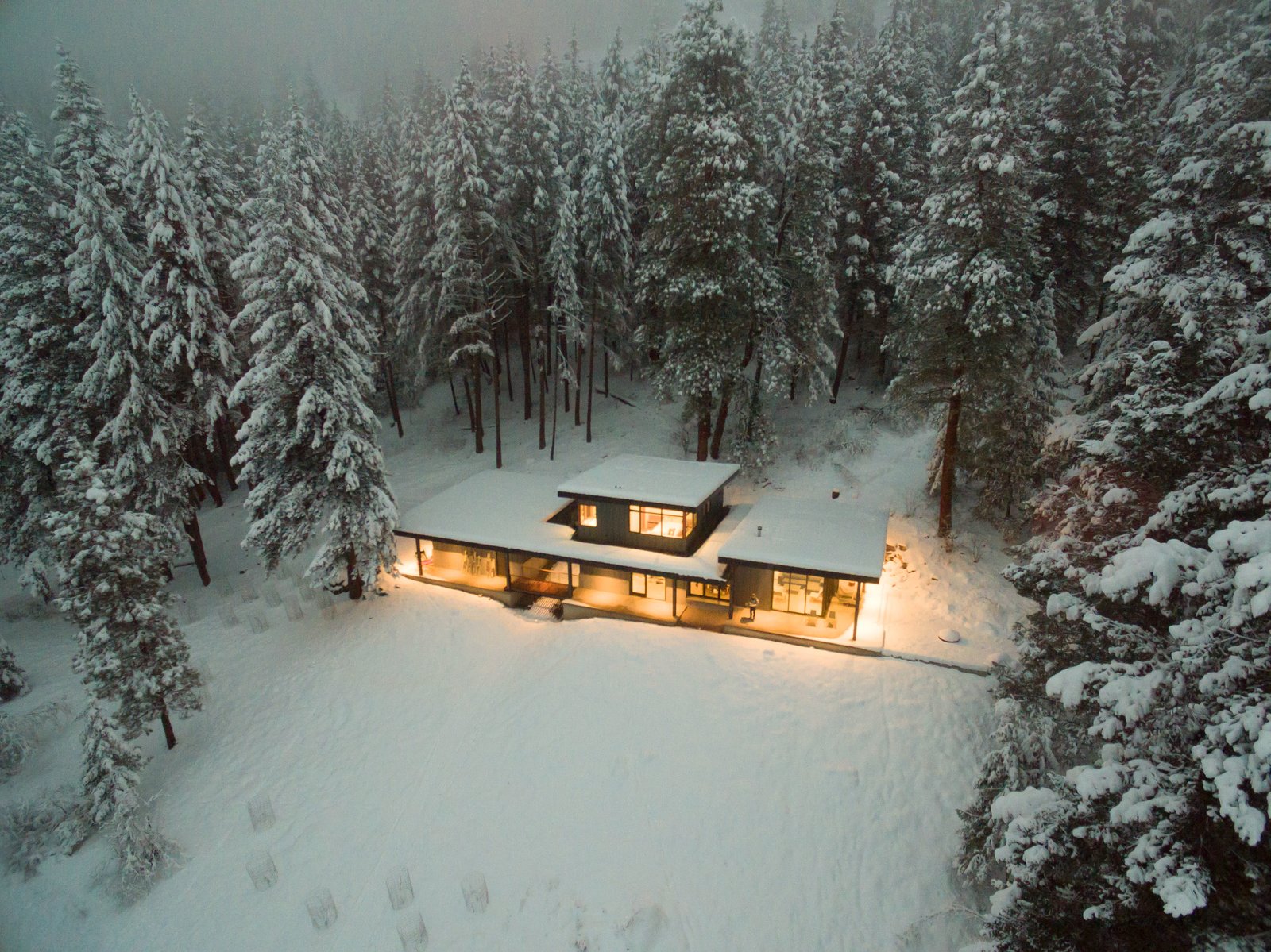
On a sloping, woodland site in Wintrop Washington, CAST Architecture has created a family retreat that allows the landscape to flow through the structure. Super-insulated walls and ceilings, energy-efficient windows, and an efficient radiant heating system minimize energy consumption—even in snowy winters.
This cabin has a commodious kitchen and living area that encourages family and friends to come together for meals and conversation.
Raised to capture views of Mont-Sainte-Anne, High House is a minimalist home in Quebec, Canada designed by Paris-based studio DELORDINAIRE with white, concrete panel cladding that blends into the snowy environment, and stilts that allow sunlight to penetrate the space throughout the day.
White concrete panel cladding and corrugated steel roof panels give this cabin a crisp, geometric form that almost melts into the landscape on bleary, snowy days.
In Hellerud, a borough of Oslo, Norway, local firm Arkitektur + Design used heat-treated pine and bricks to fashion a cozy, family retreat dubbed Stairway to Heaven.
Stairway to Heaven is located on the clients’ parents’ land, just steps away from the homeowner’s childhood home. Two siblings were also building homes on the property, making it a true family compound. The architects were mindful to create a home that utilized the views, but also allowed for privacy between residents.
Nestled within a forest near Ontario’s Kawartha Lakes, this modern cabin name Lake Cottage by Toronto–based architecture firm UUfie has an exterior clad in mirror panels that reflect the natural surroundings.
The cabin is surrounded by a thick forest of birch and spruce.
Set high on a soaring granite outcropping, I-Kanda Architects’ Cabin on a Rock is a modernist, prefab cabin in New Hampshire with a 24-foot-wide sliding glass wall that captures the most scenic views.
“The 900-square-foot cabin perches on one piece of granite, projecting precariously over a steep drop-off to afford dramatic eastern views across the valley below,” says Isamu Kanda, principal at I-Kanda.
To meet with strict Alpine valley building regulations when designing this mountain house in the French alpine commune of Manigod, Studio Razavi Architecture took great care in analyzing local historical buildings to understand what their forms accomplished functionally, and how they shaped the local architectural culture.
The base of this cabin is constructed out of cast-in-place concrete with formwork using the same wood as the floor cladding above.
Set within a hardwood forest along the shores of the Bras D’or Lake, and respectful of its surroundings, this cabin in Nova Scotia, Canada, was designed by local practice Nicholas Fudge Architects with a clear separation between the public and private realms.
This 1,900-square-foot home was assembled on-site in just two days with wall panels consisting of staggered 2′ x 4′ studs on a 2′ x 8′ plate, which eliminates thermal bridging and maximizes energy efficiency.
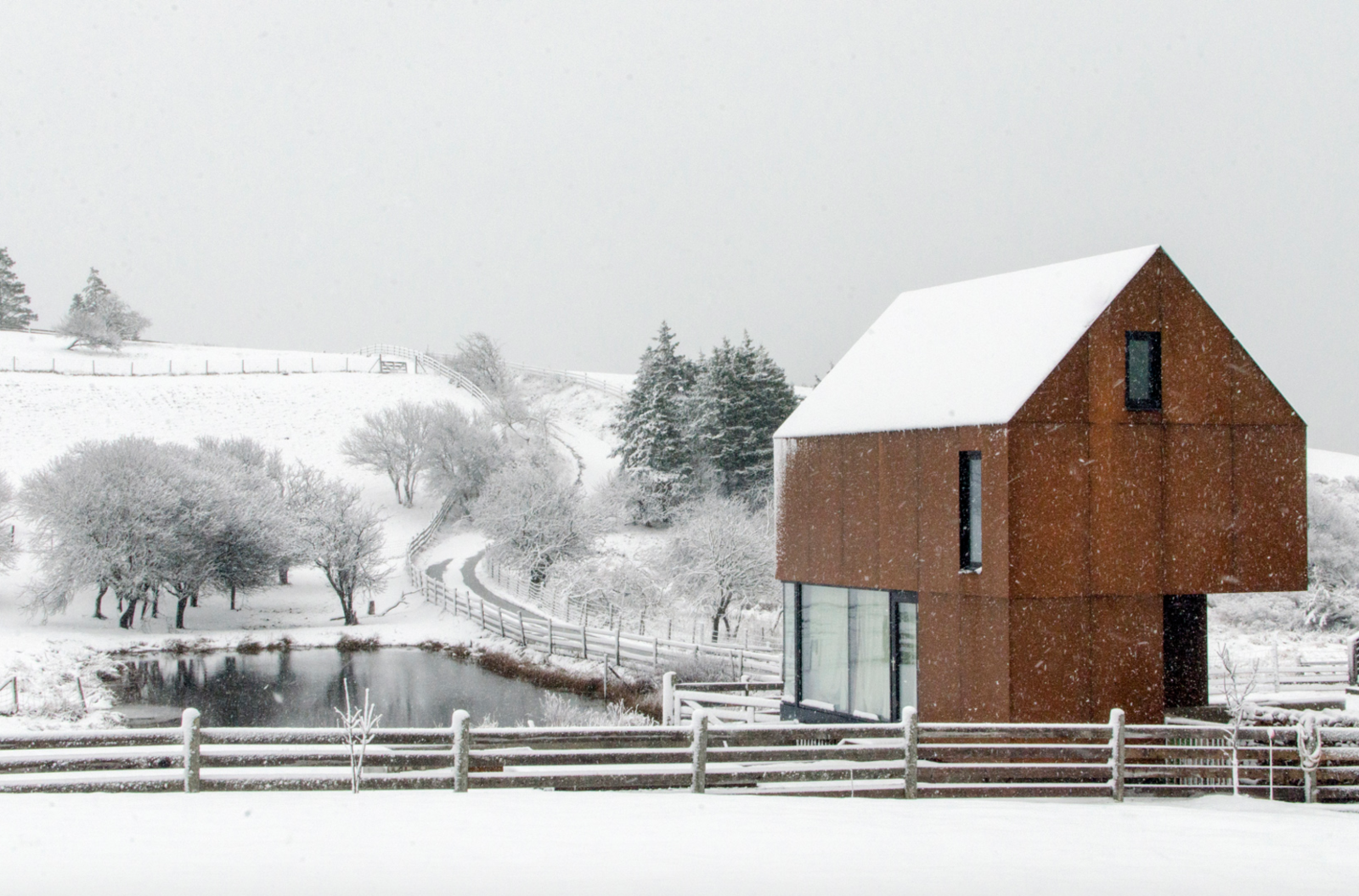
Designed by Canadian architect Brian Mackay-Lyons, Enough House is a Cor-Ten steel holiday rental home with wood beam ceilings and a blend of modern and vintage furniture. A 24-foot-wide corner window looks out to the valleys in the north, and a 12-foot window frames distant views of the beach. The house is available for rent through Boutique Homes.
Enough House by MacKay-Lyons Sweetapple Architects resides on Brian MacKay Lyons’ Shobac farm in Nova Scotia, a campus that allows the firm to experiment with form, materiality, and building. The Cor-Ten steel cabin, which features exposed Douglas fir plywood sheathing and stained pine flooring inside, houses an intern architect.
Chad and Courtney Ludeman, the husband-and-wife team behind Philadelphia’s design-driven Lokal Hotel, transformed this classic 1960s A-frame cabin in New Jersey into a Scandinavian-inspired holiday retreat in the woods.
The material palette consists of concrete, bleached flooring, pine plywood, and lots of matte black and white.
Mork Ulnes Architects designed this compact, pinwheel-shaped, pine-clad cabin on a hilltop side in the north of Oslo with four wings that branch out for distinct views.
Planning regulations required a gable roof, which the architects split into four shed roofs carefully designed to respond to heavy snow shed and meet spatial and aesthetic wishes.
The average interest rate offered in the U.S. is 4.84 percent, according to findings from online lending exchange LendingTree. Rates tended to fall within a fairly narrow range across the country – there were no states with rates below 4.74 percent or in excess of 4.96 percent.
The average down payment across all 50 states is about $28,000, while the average loan offered in the U.S. is $224,297.
Here’s a look at the conditions prospective homebuyers are currently facing in the housing market, as compiled by LendingTree:
Highest interest rates
The states with the highest average interest rates are:
New York: Average interest rates in the Empire State are 4.96 percent, the highest in the country.
Iowa: In Iowa, residents face the second-highest interest rates, at 4.93 percent.
Arkansas: At 4.92 percent, residents in Arkansas only face slightly lower rates than Iowans.
Lowest interest rates
The states where interest rates are the lowest include:
California: The Golden State has the lowest interest rates, on average, at 4.74 percent.
New Jersey: Follows California with the second-lowest rates of 4.75 percent.
Washington & Massachusetts are tied for the third place spot, each state offering average rates of 4.76 percent.
Highest down payment
The states where consumers tend to put down the highest average down payment is New York, at $43,404.
Lowest down payment
On the flip side, residents in West Virginia typically only need to put down a little bit more than $15,000.
Lowest APR
The state with the lowest average APR is California at 4.83 percent.





 7.
7.