via inman.com

Los Angeles, a city where 63.1% of residents rent their homes, is in the midst of a crisis in rental housing.
A recent study by the U.S. Department of Housing and Urban Development laid out the stark facts. Los Angeles rents have increased, after adjusting for inflation, by nearly 30% over the last 20 years. During the same period, renter incomes have decreased by 6%.
One important part of the problem is an inadequate supply of affordable rental units. Only 37 units are available and affordable for every 100 would-be renters living at the average renter income level.
Moreover, the foreclosure crisis, which many predicted would relieve pressure on the rental market by increasing the volume of rental units, has instead exacerbated the problem. Families who lost their homes through foreclosure have turned to the rental market and are competing for units, which has made for an even tighter rental market and more upward pressure on rents.
The effects of the affordability problem extend well beyond those struggling to find places to live. Adequate affordable housing is a key factor for continued growth in a region. Without it, employers can’t hire enough skilled workers, and cities have trouble attracting new businesses.
What’s more, the abolishment of redevelopment agencies in California, which each year provided more than $1 billion statewide and $50 million in Los Angeles alone for affordable housing, has stymied development at a time when we need it most.
It’s against this backdrop that the next mayor will take office. The three leading candidates — Eric Garcetti, Wendy Greuel and Jan Perry — all seem to recognize the challenges, and at a forum last month convened by Housing for a Stronger Los Angeles, they expressed a commitment to solving the city’s housing crisis. Here are some ways the next mayor can address some of the key challenges:
Establish a dedicated, consistent source of funding to support affordable housing. Finding new money in a time of tight budgets is never easy, but for years policymakers have agreed on the need for a dedicated pool of money for city-backed loans to support the construction of affordable housing. This would not be a giveaway because loans would be repaid. Rather, it would be an investment in the city’s future, and the next mayor needs to see that such a fund is created and sustained.
Take advantage of the opportunities presented by transit expansion. Over the next 10 years, Los Angeles will be adding dozens of new transit stations. What happens around these stations could help ease the city’s housing crisis, but only with thoughtful community planning. Yes, we need higher-density, transit-oriented developments, but it will be crucially important to ensure that this housing isn’t exclusively for the affluent. The mayor should lead the way on this.
Attack homelessness with renewed vigor. Los Angeles has more homeless people than any American city other than New York, and the number of homeless veterans continues to be unacceptably high. The next mayor should focus resources from across government and the private sector on addressing the issue. This will require a comprehensive assessment of the needs of those on the streets in order to develop the kinds of assistance and housing that will make the biggest difference.
Address the city’s foreclosure crisis before it debilitates neighborhoods. Concentrated foreclosures can lead to neighborhood distress that extends beyond the foreclosures themselves. The city must provide leadership that limits the extent of this damage, both by working with at-risk neighborhoods to make sure homeowners are aware of the resources available to them and by using the considerable financial leverage it has to encourage lenders to work with homeowners in trouble.
Preserve the affordable units that we have. Construction can ease pressure on rents, but only if it adds units to the total stock of housing. Merely tearing down old units and erecting new ones doesn’t help. The city needs to exercise its zoning and permitting power to encourage development that expands housing opportunities.
Los Angeles is an expensive place to live. Its broad economic base, diverse and interesting population and temperate climate make it a very desirable place to live, which necessarily drives up costs. This won’t change. The next mayor must take an assertive approach and deal with the affordability challenges directly
Many have named a U.S. housing recovery as a bright spot in a so-called broader domestic economic recovery.
And data seems to support this analysis, despite a slowdown in sales momentum at the end of the year. Existing home sales in December were up 12.8% from the same time in 2011, with the total number of sales in 2012 rising to the highest level in five years, according to the National Association of Realtors. Meanwhile, the annual price for existing homes also jumped to the highest level since 2005, with the median price of a home up 11.5% in December from the same period in 2011.
But David Stockman, former director of the Office of Management and Budget in the Reagan Administration sees little to get excited about.
He tells The Daily Ticker, “I would say we have a housing bubble…again.”
Stockman argues a combination of artificially low interest rates and speculation are to blame, not unlike the last boom and bust cycle in real estate.
“We don’t have a real organic sustainable recovery because in a world of medicated money by the central bank, things aren’t what they appear to be,” Stockman argues.
And according to Stockman, it’s this medicated, cheap money being put to work by investors that’s driving the apparent healing in some of the hardest hit real estate markets in the country.
“It’s happening in the most speculative sub-prime markets, where massive amounts of ‘fast money’ is rolling in to buy, to rent, on a speculative basis for a quick trade,” he contends. “And as soon as they conclude prices have moved enough, they’ll be gone as fast as they came.”
By ‘fast money’, Stockman is referring to professional investors like hedge funds and private equity firms. To his point, global investment firm Blackstone (BX) has spent more that $2.5 billion on 16,000 homes to manage as rentals, according to Bloomberg. It’s now the country’s largest investor in single-family homes to manage as rentals, with properties in nine markets. And Blackstone is joined by others like Colony Capital LLC and Two Harbors Investment Corp. (SBY) in trying to turn this market into a new institutional asset class, Bloomberg reports.
Stockman argues the problem in housing is the two forces needed for a recovery, first-time buyers and trade-up buyers, are missing. With the combination of 7.9% unemployment and staggering student loan debt, he doesn’t see a young generation of new home buyers coming into the market. And with baby boomers heading for retirement with less than adequate savings, he thinks they’ll be trading down with their homes, not up.
Stockman sees a rise in interest rates as the trigger for any kind of bust. He says you can’t have zero rates forever, referring to the Fed’s ZIRP and quantitative easing policies of the last several years.
“As soon as the Fed has to normalize interest rates, housing prices will stop appreciating and they’ll probably head down,” he explains. “The fast money will sell as quickly as they can and the bubble will pop almost as rapidly as it’s appeared. I don’t know how many times we’re going to do this, and the only people who benefit are the top one percent – the hedge funds, the LBO funds, the fast money people who come in for a trade, make a quick buck, and move along to the next bubble.”
Mortgage rates, for their part, rose from an average 3.42 percent to 3.53 percent on Thursday, the sharpest increase in 10 months, according to the weekly survey of 30-year mortgages by Freddie Mac, the government-backed mortgage company. Even still, mortgage rates are hovering around their lowest levels in more than 30 years.
As for the “American Dream” of home ownership, Stockman argues the past model where the government was trying to get to 69% home ownership was a huge policy mistake that led to no-downpayment loans, liars loans, and a degradation of lending standards. He says the government should have no dog in the hunt when it comes to ownership versus renting.
“Let the market decide,” Stockman says.
When prehistoric man first discovered fire it would have had a profound effect upon his life, as until then the sun was the only source of heat. Not only did he now have light, but he also had a way of keeping himself and his family warm.
Around 42000 BCE Neanderthals built hearths in their homes to control their fires and by 3000 BCE braziers had been invented. In 1000BCE North Koreans had invented a form of underfloor heating which was eventually copied by the Greeks and Romans. By the 6th century this type of heating had been replaced in favour of hearths again. The first chimneys appeared around the 12th century, definitely a much better idea than just a hole in the roof.
The introduction of coal as a fuel for the home in the 16th century led to multiple flues and fireplaces. More efficient stoves followed, then in the 1850′s radiators first appeared in Russia, probably a very welcome invention given their winters! Edison made the first electric heater in 1883, a vast improvement on the smoke and soot of a coal fire.
With the rising cost of fossil fuels and electrcity, scientists developed devices which worked on solar energy and came up with the idea of panels to heat domestic water. We may think of this as a very recent invention, given how popular solar panels have become in recent years, but this was actually patented in the USA in 1896!
By the 1990′s it was becoming obvious that we needed to various heating technologies that could save money and also reduce CO2 emmissions. This is why we found an underfloor insulation supplier, that way we could insulate under the floor and keep the heat in the house better. Ultra low-energy buildings appeared in Germany, paving the way for more efficient systems for the home market. With costs rising every year scientists must look at ways of economically improving our home heating systems.
Author: Danny Ashton Danny Ashton on the Web Danny Ashton on Twitter Danny Ashton RSS Feed
Danny Ashton is Founder of Neo Mammalian Studios and loves to share infographic tips on Twitter –@neomammalian… View full profile
This article is an original contribution by Danny Ashton.
Mt Kisco Has Low 2012 ‘Days on Market Average’ | RobReportBlog
Average Days on Market for 2012 Sold Homes 207 Armonk 176 Chappaqua 201 Pound Ridge 238 North Salem 198 Bedford NY 235 South Salem 186 Bedford Hills 175 Mount Kisco 196 Katonah
Qualifying Recognised Overseas Pension Schemes (QROPS) are seen by many as the best route to tax effective retirement savings for expats.
However, with so many countries offering QROPS there is another issue for those thinking of transferring their pension to consider.
That is whether the country where the QROPS is based has a double tax agreement (DTA) with the UK.
This is a quick guide to understanding the issue
What is QROPS?
QROPS allows for anyone with a UK pension pot planning to leave the country to retire, or has already done so, to transfer their pension offshore.
With planning, this can be a hugely rewarding but the QROPS must be recognised by HM Revenue and Customs.
However, financial advisers should take careful note of the DTA in place before recommending a QROPS jurisdiction.
What is a DTA?
This is an agreement between the UK and other countries to avoid earners and investors paying tax twice on the same money.
What do I need to do?
You need to ensure that your financial advisor is aware of a few issues – most importantly where does the DTA in place put the primary taxing rights – in the QROPS jurisdiction or the UK? This could be a very simple and expensive mistake to make.
Will the DTA cover my scheme?
You will need to check this, but the scheme may only cover occupational pensions rather than private pensions, for instance.
How much tax will I pay?
A financial advisor will advise on tax bands under a DTA and whether it will be a nil rate when you retire. Essentially tax will have to be paid on your pension and the DTA will define in which of the two countries you will pay it – either in the UK or where you are planning to live. You will only be taxed once.
If your QROPS is in a third country, the benefit will be paid gross of tax.
What is Unilateral Tax Credit Relief (UTCR)?
This is similar to a DTA and is the relief given when a source of income has already been taxed in another country. Most countries have these in place rather than a DTA as they are easier to implement and are, generally, fairer to those being taxed.
For more information about the double taxation treaties for 185 countries and territories, click this link http://unctad.org/en/Pages/DIAE/International%20Investment%20Agreements%20(IIA)/Country-specific-Lists-of-DTTs.aspx
A U.S. flag decorates a for-sale sign at a home in the Capitol Hill neighborhood of Washington, August 21, 2012.
Credit: Reuters/Jonathan Ernst
Home prices rose in November to rack up their best yearly gain since the housing crisis began, a further sign that the sector is on the mend.
But data on consumer confidence on Tuesday was less encouraging, with moods falling to their lowest level in more than a year as Americans became more pessimistic about the economic outlook and their financial prospects.
The S&P/Case Shiller composite index of 20 metropolitan areas gained 0.6 percent in November on a seasonally adjusted basis, in line with economists’ forecasts.
Prices in the 20 cities rose 5.5 percent year over year, making for the strongest yearly price increase since August 2006 when prices were on their way down.
“This is continuing a trend in place for the better part of a year,” said Omair Sharif, U.S. economist at RBS Securities in New York. “This is another indication that the housing rebound is fairly entrenched at this point.”
The housing market became a bright spot for the economy last year as prices rose and inventory tightened. The sector is expected to contribute to economic growth in 2013, though a number of challenges remain, including tight access to mortgages and on-going foreclosures.
It was the 10th month in a row that prices have increased, the longest string of gains since before 2006. Last year’s rise in prices beat a nine-month consecutive run in 2009 and 2010, when the market was boosted by a homebuyer tax credit.
Separate data from The Conference Board showed an index of consumer attitudes fell to 58.6 in January from an upwardly revised 66.7 the month before, falling short of economists’ expectations for 64. It was the lowest level since November 2011.
At the start of the year, U.S. politicians came to an agreement that averted the so-called fiscal cliff of spending cuts and tax increases that had been set to come into effect.
But the deal did raise taxes for many Americans, while a payroll tax holiday came to an end. Also, a number of budget decisions remain.
“Consumers are probably pretty unhappy to notice that their payroll taxes have gone up,” said David Sloan, economist at 4Cast Ltd in New York.
U.S. stocks pared slight gains immediately after the report was released, while the euro rose to a session high against the dollar.
The expectations index tumbled to its lowest level since October 2011 at 59.5 from 68.1. The present situation measure slipped to 57.3 from 64.6.
Consumers’ views on the labor market were also weaker, with the “jobs hard to get” index rising for the first time since September.
Home prices on a non-adjusted basis slipped 0.1 percent. The non-adjusted numbers showed prices fell in about half of the cities covered by the survey, with the winter months typically a weak period for housing, the survey said.
Phoenix, which saw its housing market rebound sharply last year, led with the biggest yearly gain at 22.8 percent. New York was the only city to fall, down 1.2 percent from the previous year.
You’re smart.
You got drive.
You’re blogging, and blogging, and blogging. You’re producing good content. But somehow your efforts are not rewarded.
Your enthusiasm for checking your traffic stats is gone. Because the trickle of traffic makes you feel down, lonely, and maybe a little desperate. Are you wasting your time?
Let’s be honest.
Building a blog is hard work. It’s tough. And you need to be business savvy. That’s right. You need to treat your blog as a business. You need to get serious about marketing your blog. Because if you don’t market your blog, it’s going to remain lonely out there.
Let’s have a look at 11 common blog marketing mistakes. Avoid these mistakes, and you’ll gain more traffic, more shares, and more comments. And eventually, you’ll be able to make serious money.
Mistake 1: You’ve jumped straight in
Of course, it’s great to get started.
Get a domain name, a web host, a theme, a topic you love writing about; and you’re ready to go. Right?
I don’t think so. You need to know what your audience likes; what they want to read about, what they’re passionate about.Before launching Social Triggers, Derek Halpern knew exactly what his audience wanted: fact-based advice on how to grow web traffic. That’s why he combines academic research with blogging tips.
Before you start your blog, research your audience. Read comments on the big blogs your audience is reading. Which topics resonate most? What are readers passionate about? What questions do they ask? What do they struggle with?
Mistake 2: Your audience is too diverse
When you’re writing your blog posts, who do you write for? Are you trying to write for as big a crowd as possible? Are you trying to appeal to as many readers as you can?
Writing to a crowd makes your writing bland; writing to one person makes you engaging and fascinating.
Start by describing your ideal reader. Have you seen how the Word Chef describes her ideal client? You don’t have to publish your ideal reader. But you need to know who you’re writing for.When you write your next blog post, imagine writing to just one reader: your ideal reader.
Mistake 3: You’ve picked the wrong topic
Do you think you need to avoid the big topics, because they’re too competitive? Think again. If you pick a topic nobody has written about, then most probably hardly anyone is interested in your topic.
The truth is: the big topics are the topics people want to read about. Finance. Personal development. Blogging. Parenting. Marketing. Gadgets.
Yep, those topics are competitive. Hugely competitive. But you can be sure there’s an audience waiting for you. You just have to figure out how you’re going to stand out from the other blogs. And that’s why you need a purple cow.
Mistake 4: You don’t have a purple cow
A purple cow is what makes you different. If you’d see a purple cow, it would draw attention, wouldn’t it? You’d be fascinated by it and you’d remember it, wouldn’t you? That’s why you need a purple cow—a term coined by Seth Godin.
Why would people read you blog rather than a competing blog? A few ideas:
- Your personality appeals to your readers.
- Your passion attracts followers.
- Your writing style is special.
- Your opinion is appreciated.
- Your experience is unique.
You’re not Walmart or Target. You don’t need to appeal to everyone. If you create something truly different, some people may think you’re crazy. But that doesn’t matter. As long as other people love your blogging, that’s absolutely fine. Don’t be afraid to put readers off. Because you’ll build a stronger bond with your core audience.
Apple has raving fans who queue up to trade in their iPhone 4S to an iPhone 5 as soon as it’s launched. But Apple also has its haters, who avoid buying Apple products.
Do you know Johnny B Truant? He’s not everyone’s cup of tea, because he tells it as it is and he swears a lot. But he has hugely passionate fans, too. You see? You don’t need to appeal to everyone. You just have to build your own tribe.
Mistake 5: You don’t know how you want to change the world
You can’t create passionate readers if your message is lame. If you want to fascinate people and create a loyal following, you need a mission. Strong brands are on a mission. Think Nike, Apple, or Harley Davidson. Popular bloggers are on a mission, too.
Leo Babauta at Zenhabits teaches people to live simply, to keep themselves centered and at peace as they make a slow journey to creating good habits and achieving their goals. A clear mission, isn’t it?
How are you going to change the world?
Mistake 6: Your design puts people off
If you want to be taken seriously, then you need to look professional. Your blog is your brand. What impression do you want to leave? Professional? Full of fun? Warm? Corporate? Artistic?
Compare these two social media blogs: Simply Zesty looks fresh, but rather corporate. The {grow} blog from Mark Schaefer looks just as professional, but a little more fun.
Also, keep in mind that your design has a large impact on readability. Use white space, large fonts, and sub headlines to guide your readers through your content.
Mistake 7: Your blogging voice is erratic
You’re a blogger. You’re a writer. You communicate through your content.
Your brand is not just your blog design; and not just what you’re blogging about. It’s also how you blog. What’s you’re writing style? And does it match your blog design? Does it match your brand?
You need a unique voice that reflects your brand. Have you read the Aweber and MailChimp blogs? Aweber is quite serious and a bit corporate. MailChimp is cheeky and more personable. One is not better than the other. They’re just different. And their tone of voice reflects their brands.
Jon Morrow and Darren Rowse both blog about blogging. Jon Morrow is like your favourite high-school teacher. He tells you off when he needs to and uses strong language, but inspires you to study harder. Darren Rowse is like a friendly neighbour. Full of useful advice, helpful when you’re stuck, and he never says a bad word about you.
How are you positioning yourself? And does your tone of voice match?
Mistake 8: You’re hiding yourself
As a blogger, you are an important part of your brand. People connect with you because of who you are.
Nobody enjoys phoning a call centre. Nobody wants to get in touch with a boring corporation. Nobody wants to chat with a faceless company.To build a loyal following you need to be human and get a little personal. Show your passion, mention some titbits about your life, share your experience, and let your passion shine through.
Even though I mainly write about copywriting and content marketing, my email subscribers know I love cycling, because I use cycling analogies to explain copywriting tricks and I’ve even included cycling holiday snaps to illustrate points. That’s how I’m building a connection with my readers.
Mistake 9: You think your traffic will snowball
You need to market your blog to gain an audience. Overnight success doesn’t exist.
Generating traffic is hard work, and no shortcuts exist. Social media and SEO can generate traffic, but guest blogging is often the best way because guest blogging allows you to borrow the audience from a big blog.
Don’t have enough time for guest blogging? Reduce your own blogging schedule, post once a week rather than daily; post once a month instead of weekly. And use the time you’ve freed up to post on other blogs.
Mistake 10: You’re not enticing people onto your email list
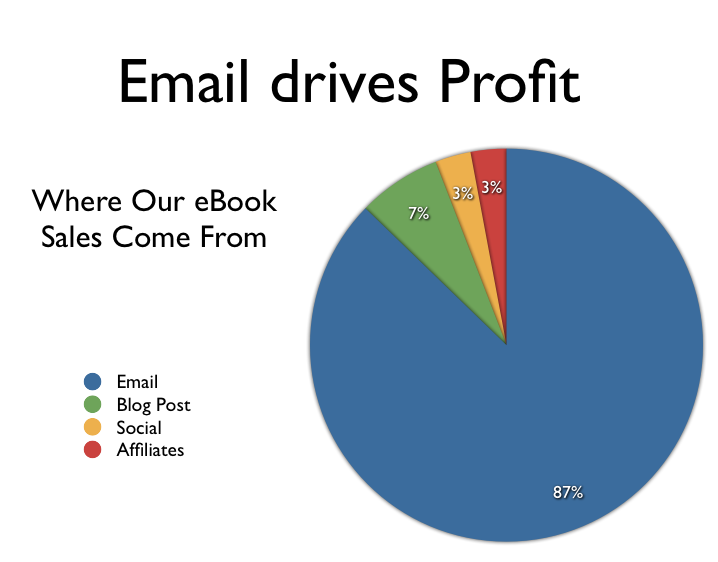
Getting blog readers to sign up to your email list should be your priority. Because once they’re subscribed, you can email them when a new post goes live. And when you’re ready to sell, your email list is your most precious marketing asset.
Email is more powerful than social media, especially when it comes to selling. Have you seen this graph from Darren?
That tells you enough, doesn’t it? Get an email subscription form on your home page, your about page, and each blog post. Consider removing the option to subscribe to your RSS feed, because it distracts from your email subscription form.
Mistake 11: You’re a dreamer
Of course we’re all dreaming of success, of more readers, more shares, more comments, more money.
But dreaming about success isn’t going to get you there. You need plan. Not a Soviet-style ten-year plan. Just a plan for your next month. Decide on your mission, define your brand, your design, your voice, and think about how you’re going to grow your audience during the next month.
And then in a month’x time you can see what worked, and what didn’t work. And then you can write another one-month plan. To increase your traffic. To grow your audience. And to build your email list.
The truth about building your audience
Let’s be honest.
Growing your audience is hard work. It requires energy, enthusiasm, and guts. Dare to be different. Build your own unique brand. Don’t be afraid to be yourself.
Your most loyal followers, your raving fans are reading your blog because your style suits them; because your message inspires them; and because you are you.
Come on. What are you waiting for? Start marketing your blog, your brand, yourself.
One of the goals of marketing is to generate qualified leads to increase sales. Small business owners are always thinking about prospects and ways to capture those that come to their website. Information is continually being shared with visitors so they feel the need to fill out a form, and provide their contact information to begin the buying process and become a customer. One of the best ways to share content and obtain visitor information is by using calls-to-action (CTAs) and landing pages.
The overall goal of CTAs and landing pages is to generate qualified leads for your business that eventually turns into revenue.
To begin developing and creating CTAs and landing pages, you must determine where the CTAs should be placed.
- On the website homepage, include at least 2 CTAs above the page fold (you shouldn’t have to scroll down to see the CTAs).
- Have one CTA on every page that links to a landing page.
- Incorporate different CTAs for the different stages of the buying cycle.
- CTAs should be added to the sidebar on your blog page.
- CTAs should be added at the end of blog posts.
- Include at least one CTA on thank you pages after someone has downloaded content.
Develop Optimized Calls-to-Action
- Should clearly describe what the offer is and what the visitor will be getting.
- Should be action-oriented – use verbs such as “Download” or “Register.”
- Should be above the page fold.
- Should “pop” off the page – add contrast.
Develop Optimized Landing Pages
- Action should be clear.
- Explain the value of the offer.
- Use bullet points.
- Keep the form short. The form should help you contact or qualify the lead.
- Do not include any navigation or other links.
- Keep the content above the page fold.
- Include at least one relevant image.
- Have the page redirect to a thank you page after the form has been submitted.
Creating calls-to-action and landing pages will help attract and engage with your website visitors. CTAs and landing pages promote and guide visitors to specific content on your website. The content being promoted in the CTAs and landing pages should provide real value to your visitors and demonstrate thought leadership, which can help build trust, credibility and increase your leads and sales.
What offers and calls-to-action have you responded to in the past? Why and how did they get your attention? We’d love to hear your thoughts below.