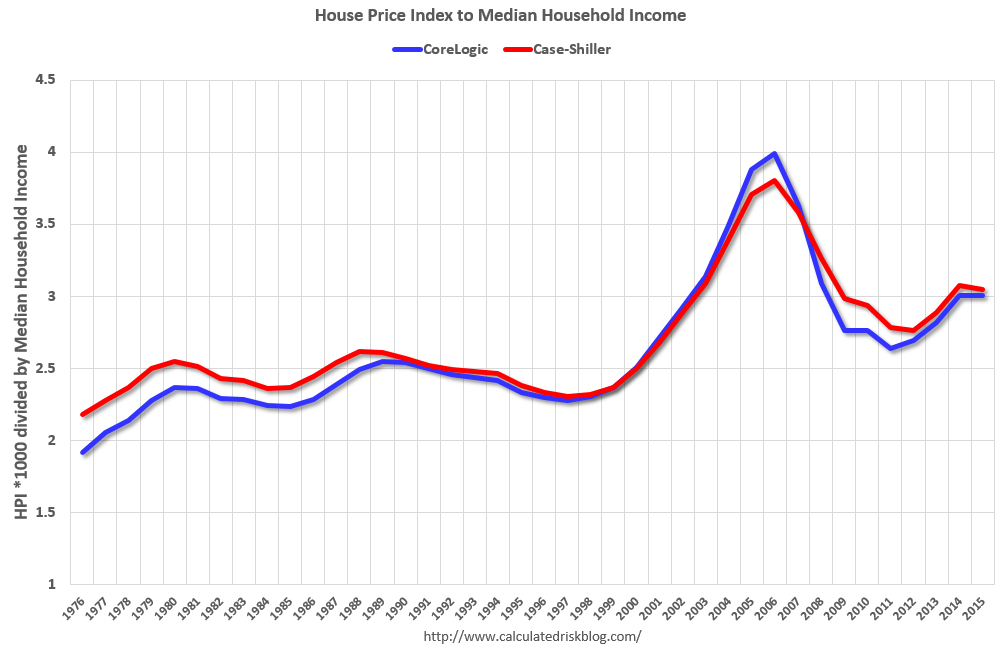
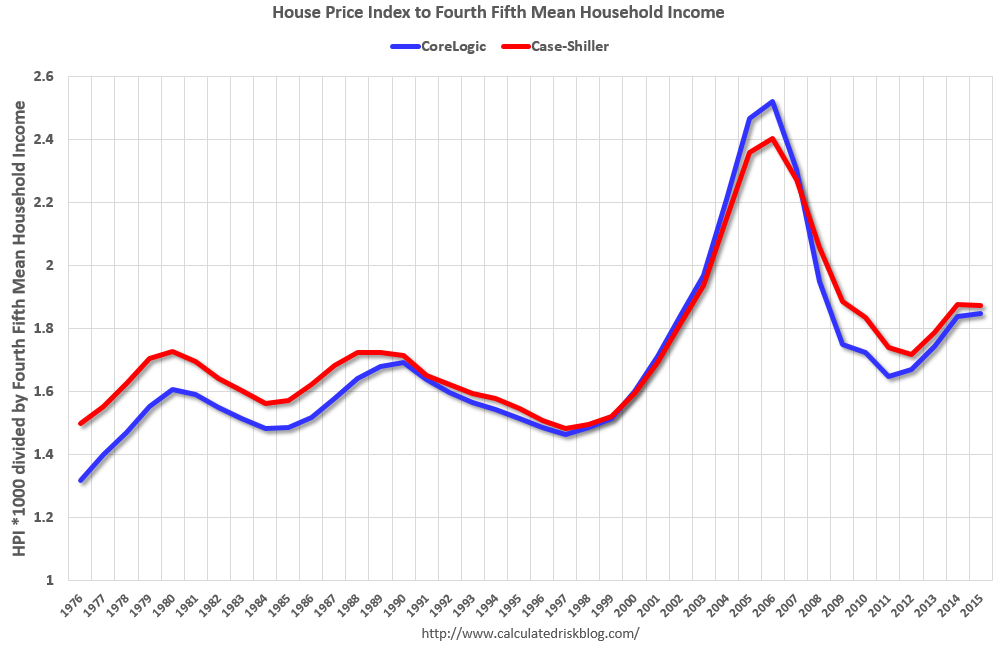
One of the metrics to follow is a ratio of house prices to incomes. The following graphs use annual averages of house prices indexes – Case-Shiller and CoreLogic – and the nominal median household income (and the mean for the fourth fifth income) through 2015.
Note: Most reporting today is on the REAL median household income (adjusted for inflation over time). These graphs use nominal income since we are comparing to nominal house prices.
Click on graph for larger image.
This graph shows the ratio of house price indexes divided by the Median Household Income through 2015 (the HPI is first multiplied by 1000).
This uses the annual average CoreLogic and the National Case-Shiller index since 1976.
As of 2015, house prices were above the median historical ratio – but far below the bubble peak.
The second graph is similar but uses the mean of the fourth fifth household income (if we separate households into fifths, this is the second highest income group).
These are key households since they are more likely to be homeowners (and home buyers).
Using this group, prices are well below the bubble peak.
Going forward, I think it would be a positive if incomes outpaced house prices, or at least kept pace with house prices increases for a few years.
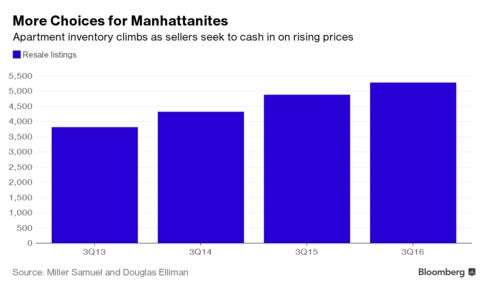
There are a lot more apartments available for purchase these days in Manhattan. And fewer people are buying.
Sales of previously owned condominiums and co-ops fell 20 percent in the third quarter from a year earlier as potential buyers grew cautious amid more choices, according to a report Tuesday from appraiser Miller Samuel Inc. and brokerage Douglas Elliman Real Estate. There were 5,290 resale apartments on the market at the end of September, 53 percent more than the number available in late 2013, the lowest point for listings.
The swelling inventory is providing an opportunity to New Yorkers shut out of a market in which construction has been dominated by ultra-luxury condos aimed at the wealthiest buyers. Resales, particularly those priced at less than $1 million, were in chronically short supply in recent years, and those that made it to the market sparked bidding wars. Now, more owners are listing apartments to profit from climbing values, and they’re finding lots of company.
“Rapidly rising prices over the years have pulled more sellers into the market hoping to cash out,” Jonathan Miller, president of Miller Samuel, said in an interview. “But buyers are more wary. There isn’t the same intensity of activity to burn through the new supply.”
Buyers agreed to pay more than the asking price in just 17 percent of all condo and co-op deals that closed in the third quarter, down from a record 31 percent a year earlier, according to Miller Samuel and Douglas Elliman. Consumers also are taking longer to make a decision. Previously owned properties that sold in the period spent an average of 72 days on the market, up from 67 days a year ago.
The median price of all resales in the quarter climbed 2.6 percent to $950,000, Miller Samuel and Douglas Elliman said. That’s a step down in a three-year period in which annual price growth once reached 18 percent. Many sellers have yet to accept that they can no longer name any price, and the disconnect between their expectations and what buyers are willing to pay is contributing to the drop in overall sales, Miller said.
“We’re clearly seeing a slowdown,” Miller said. “This era of aspirational pricing is coming to an end. Buyers get the message first.”
For a Bloomberg Intelligence piece on New York apartment rents, click here.
Quick Sale
When Connie Lam wanted to sell her Chelsea studio, she knew that curbing her exuberance would help her sell it fast. Lam, who bought the the 441-square-foot (41-square-meter) unit in 2013 for $555,000, listed it for sale in June, just one month before a planned move to California. Working with Douglas Elliman broker Rachel Altschuler, Lam priced her apartment at $625,000 after seeing that another studio of the same size on her floor was already on the market for $650,000.
“There were people who were interested immediately,” said Lam, 28, an attorney now living in Redwood City. “My goal was to get out and have a buyer who was really solid and wasn’t going to back out on me at the last second.”
The listing drew three offers, and was under contract at the asking price within two weeks. The deal closed in August, while the other apartment on her floor, on the market since May, is still without a buyer. Its price has since been cut to $635,000.
Craig WebbEnergy retrofit remodelers at work in my bedroom.
Readers: I’m recovering from a remodel, and I’ve been told that talking about it will make the recovery easier. This is the second time my wife and I have made major, debris-raising changes to our home. The first was a whole-house remodel that included a new addition. This time we got a basement-to-attic energy retrofit in our Washington, D.C., home. I’m quite happy with the results, but I can see why the trauma of remodeling has shaken many others. So I’ve come up with seven rules for you to share with neophyte homeowners.
Rule No. 1: Remember, homeowner, that for the length of the remodel, it’s not your house anymore. You need to trust the people you’ve hired to do the remodel or else buy a big case of ulcer medicine.
Rule No. 2: There is no such thing as a dust-free remodeling project.
Rule No. 3: Try to talk your significant other—the one who frets most about neatness, odors, and general cleanliness—into leaving town before the work starts.
Rule No. 4: Far more things in your house can get broken than you could ever imagine.
Rule No. 5: Short of having exit doors on every wall and every floor, odds are good that workers will traipse through—and generate dirt in—parts of the house that are nowhere near the work zones.
Rule No. 6: Sometime during the remodel, expect that the new crew will reveal to you something done badly by the last people who worked on the house.
Rule No. 7: It always looks irredeemably disastrous before the cleanup begins.
You’d think that spending years as the editor-in-chief of REMODELING, plus that previous experience with a renovation, would have prepared me sufficiently for the arrival of Attilio Manziano-Verrilli, our project manager fromHome Energy Medics, and his platoons of subcontractors. My wife and I spent the prior weekend moving precious objects and trying to anticipate which parts of the house would get whacked and chipped by workers as they hauled equipment up our narrow stairs. I thought we’d done well until I saw a sub unknowingly jostle a $300 pendant light with a 12-foot stud.
James R. SalomonThe Alfreds’ net-zero residence, in Cumberland, Maine, is a modular design by BrightBuilt Home.
When Shaun Alfreds and his wife decided to build a house for their family of five in Cumberland, Maine, they didn’t know if a high-performance project would be within their budget. “We aren’t wealthy by any stretch of the imagination, but we wanted an energy-efficient home,” says Alfreds, a chief operating officer at HealthInfoNet, a local health information technology company.
After some research, however, the couple realized that they achieve their dream for a nominal additional investment over the cost of a conventional house if they opted for a modular high-performance house. They chose a two-story, Cape Cod–style design from Portland, Maine–based BrightBuilt Home, and moved in last December.
At more than 3,000 square feet, the house is spacious, but its full sun exposure and a 10-kilowatt solar array of 39 photovoltaic (PV) panels should cover its energy consumption year-round. Alfreds says the house cost “almost exactly what other [builders] were bidding” for a standard, code-compliant project that was custom designed. And their small additional investment goes to building equity in the house, rather than to paying utilities.
BrightBuilt, a sister company of local firm Kaplan Thomson Architects (KTA), joins an increasing number of design companies that are expanding the market for high-performance residential projects. While KTA has custom-designed many energy-efficient houses, principal Phil Kaplan, AIA, says the firm also wanted to offer an off-the-shelf product. In 2015, it launched BrightBuilt with nine design templates. Starting at $175 to $180 per square foot, the houses bring net-zero energy to a price more people can afford. “We’re definitely seeing a lot of demand,” Kaplan says.
But some architects and builders have found ways to lower the price of net-zero housing even more.
Marie de VerneilDe Verneil residence, by Deltec Homes (Ridgeline model)
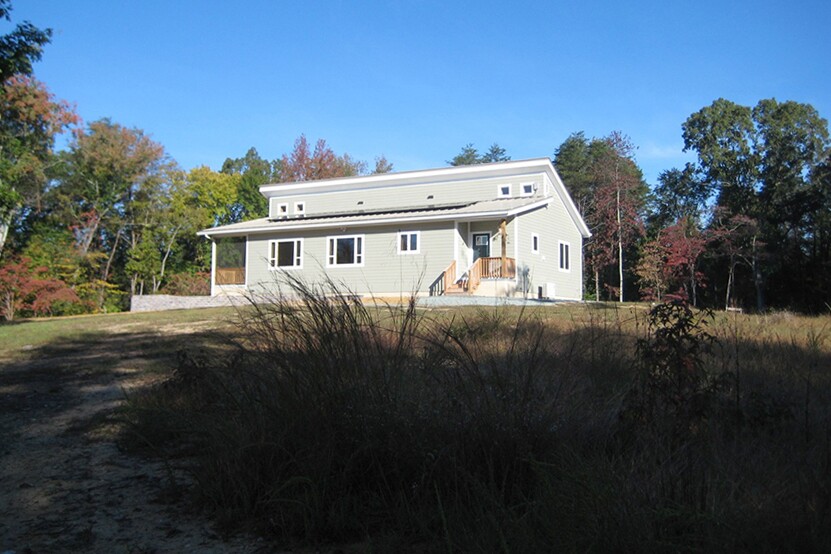
Marie de Verneil dreamed of building a retirement home on land she owned in central Virginia. “To me, green was very important,” she says. However, her savings from teaching French and international relations at the University of Maryland, Baltimore County, didn’t seem like enough. “It’s kind of discouraging for someone like me,” she says.
Marie de VerneilKitchen, de Verneil residence
Then de Verneil heard about Deltec Homes, in Asheville, N.C. The company—known for its distinctly round, prefabricated, and hurricane-resistant houses—recently launched Renew, a collection of models that use about two-thirds the energy of a conventional house and can include a PV array. De Verneil estimates she spent $250,000 on her 1,600-square-foot house (less than $160 per square foot), which includes a roof-mounted solar array. Her monthly electric bill is $30, the base fee for taxes and distribution. And when she is retired and living on a fixed income, she knows she’ll never have to say, “I can’t put the heat on.”
For those wanting to build a passive or net-zero energy house, right-sizing expectations is a crucial step to meeting one’s budget. And, as Deltec president Steve Linton adds, every project—modular or not—must be tailored to the particular site and climate. The company’s design team also conducts an energy model to evaluate site variables, solar energy capacity, building-shell size, features, and cost trade-offs.
Much of the market for high-performance housing is around single-family units in the suburbs, but the past few years have seen an uptick for multifamily dwellings and affordable housing projects in cities, including Washington, D.C., New York, and Philadelphia.
For low- and middle-income residents, in particular, an energy-efficient house can provide substantial benefits, says Orlando Velez, director of Housing Programs and Community at Habitat for Humanity of Washington, D.C.The organization recently built six passive townhouses last year in the district’s Ivy City neighborhood, whichhas a lot of air pollution. By creating a tight building envelope and filtering outside air, “you’re improving the air quality significantly,” Velez says. “It’s a healthier living environment.”
With savings from the lower utility bills, he says, residents may be able to spend more within the community. The organization plans to study those benefits over time to know whether energy efficiency is the best investment for its limited funds.
Spacialists.com courtesy Deltec HomesRidgeline model in Deltec Homes’ Renew Collection
Courtesy Deltec HomesInterior rendering, Ridgeline model
Living in a high-performance house can take some adjustment. Residents are often unfamiliar with high-tech HVAC equipment, such as energy recovery ventilators and solar water heaters. A tight building envelope also means that the size of the HVAC system can be decreased (fresh air supply is increased for indoor air quality purposes). The word that many residents use is “comfort”—indoor temperatures stay remarkably consistent across different areas of a house throughout the year.

 Click on graph for larger image.
 These are key households since they are more likely to be homeowners (and home buyers).