Daily Archives: November 4, 2013

Free FICO credit scores offered to millions | South Salem Real Estate

Millions of credit card customers of Barclaycard US, the payments business of Barclays in the U.S., and First Bankcard, the credit card division of First National Bank of Omaha, can now access their FICO credit scores for free.

The two banks are the first to participate in the FICO Open Access Program, which in addition to offering free FICO Scores, allows customers to see the two most important factors affecting their score and provides them with FICO educational materials to help them better understand credit scoring and what behaviors impact their FICO Score. The program is open to all consumer lenders, including mortgage lenders.

“This new program provides individuals with the specific FICO Score used by lenders to make credit decisions regarding an individual customer,” said James Wehmann, executive vice president of scores at FICO, in a statement.

“In 2012 approximately 10 billion FICO Scores were bought by lenders for risk management purposes, and we are prepared to allow all of them to be shared with bank customers without any additional score fee charged by FICO to lenders.”

FICO expects more than 25 million Americans to have access through the program within 12 months.

Source: FICO

– See more at: http://www.inman.com/wire/free-fico-credit-scores-offered-to-millions/#sthash.mMbN7TKy.dpuf

New York could authorize seven Las Vegas-style casinos | Mt Kisco Real Estate

Voters are holding the cards as to whether New York will authorize seven Las Vegas-style casinos following months of debate over the benefits of expanded gambling and the rewording of Tuesday’s ballot question. Although there are many online casinos operating in the states as of now which allow people to play games like Slots LV free spins, a physical establishment of a casino would most certainly increase the economy on a financial level drastically.

One casino would be in the Southern Tier near Binghamton, two in the Catskills and Mid-Hudson Valley region, and another in the Saratoga Springs-Albany area. A New York City casino would be built in seven years, although some casino operators say the law could allow for a New York City casino sooner. People can also play online casino games at legal platform like https://clubvip777.com/web/dafabet/.

Gov. Andrew Cuomo didn’t allow specific sites to be chosen, saying that will be up to the casino developers. His budget office says the state will take in $430 million in new casino revenue, with $238 million for education in a repeat of the strategy that approved lottery games. If you like those kind of games you should check out these betting deals and find out more about this cool betting world. The rest would go to communities near casinos to compensate for public safety and social costs and for tax reduction.  These developments have the potential to allow people to invest in the crypto currency space without owning CC’s outright, or using the services of a CC exchange. Bitcoin futures could make the digital asset more useful by allowing users and intermediaries to hedge their foreign-exchange risks. That could increase the cryptocurrency’s adoption by merchants who want to accept bitcoin payments but are wary of its volatile value. Institutional investors are also used to trading regulated futures, which aren’t plagued by money-laundering worries. You can find more info here about the leading digital currencies news which is used in casino.

Boosters held news conferences statewide touting bipartisan support by local government officials.

“When you’re at 18% unemployment, you’ve lost your industry, the housing market has really taken a hit around here, the potential of 1,500 jobs — it can be a game changer,” Town of Wawarsing Supervisor Scott Carlsen told The Associated Press in an interview.

The latest Siena College-New York Times poll appears to show the efforts have paid off. After New Yorkers have spent years split over the notion of expanding casino gambling, the poll released a week ago found 60% of New York City voters — who are expected to dominate Tuesday’s turnout — support the question. However, in that poll they were still split over whether voters wanted a casino in New York City, which would be authorized in Tuesday’s referendum.

Critics including good-government groups, the state Conservative Party and the state’s Catholic bishops argue that Cuomo’s estimates of benefits are inflated and that the social cost to families and communities will be profound. They also criticized what they called the referendum’s unusually rosy, one-side view of casinos, since Casinos are really popular now a days, there are even some options online for this, and there are also other resources online where you can learn how to play craps and gamble in different sites on the web.

Opponents have little money to combat the multimillion-dollar advertising campaigns of a powerful mix of business, gambling and union interests. And Cuomo had sidelined much of the expected opposition.

He assured Native American tribes that they wouldn’t face competition to their five casinos now operating under federal law. Cuomo also assured no competition to horse racing centers with video slot machines and gave them a chance to pursue casinos. The Board of Elections also moved the casino referendum to the advantageous top ballot position.

If voters reject casino gambling, the law will automatically approve more video slot machine centers. As recent studies have shown, internet gambling is growing across the globe, specially when it comes down to sports betting, people love to bet on websites similar to FanDuel. Players from New York, just like those from the Philippines, Qatar or Kuwait join online casinos and play their favorite games. The state is losing $1 billion a year spent at these offshore because of these unfriendly laws.

Supporters say casinos will recapture more than $1 billion a year now spent at casinos out of state.

“Proposal No. 1 would start to bring that money back to New York and create over 10,000 good-paying new jobs in New York state,” states one of the statewide TV ads paid for by the NY Jobs Now Committee and featuring a hard-hatted everyman.

The key may be in the referendum’s wording.

The Cuomo administration rewrote the referendum from the straightforward form submitted by the attorney general’s office. The Board of Elections added disputed promises that casinos would bring more school aid, jobs and tax breaks, without mentioning the opponents’ concerns about crime, addiction or the declining casino market that has forced some states to subsidize casinos.

An October Siena College poll tested the impact of the rewording. Voters statewide were split on casino gambling in general. But when shown the promises in the rewording, approval reached 55% for the first time.

State Conservative Party Chairman Michael Long called the casino effort “the biggest hoax ever perpetrated on the taxpayers of the state of New York,” while The New York Times called the rewording “advocacy, pure and simple.”

The critical wording was unsuccessfully challenged in court by Brooklyn lawyer Eric Snyder. The state Board of Elections won on a technicality that Snyder didn’t file his lawsuit by the Aug. 19 deadline, although the state didn’t post the rosy wording until Aug. 21. Powerful Republican Sen. John DeFrancisco is pushing a bill to prohibit rewording.

“I hope the voters send the Board of Elections the message that it’s wrong to stack the deck,” Snyder said

http://www.crainsnewyork.com/article/20131104/POLITICS/131109963

Angular Inverted Home Built For the Views Asks $5.3M | North Salem Real Estate

Have a nomination for a jaw-dropping listing that would make a mighty fine House of the Day? Get thee to the tipline and send us your suggestions. We’d love to see what you’ve got.

Location: Bar Harbor, Maine Price: $5,300,000 The Skinny: If you’re building a home on a wooded lot just outside Maine’s Acadia National Park, how do you get to the ocean and mountains views without taking a bulldozer to the vista-blocking trees surrounding your plot? Simple: you build an angular four-level home that towers above the trees, stack the floors in ascending order according to square footage, cover the whole thing in wood shingle siding and call it a day. That’s exactly what “organic architect” James Schildroth did with his Starbird house, and while the home gives off an unmistakably dated whiff of the mid-1990s (we direct your attention to the built in dining table surrounding the central stairwell), the stupendous panoramic views from the open-plan top level cannot be denied. The rest of the five-bedroom, six-bathroom, 7,800-square-foot home continues the top floor’s theme of plentiful windows, high ceilings, and ample recessed lighting. There’s also a faux wood-paneled elevator to serve the stair-averse. The property, which was owned by the late regional watercolor artist Mary Anne Starbird, is listed for $5.3M. —Scott Garner

The 1916 Proposal To Expand Manhattan By 50 Square Miles | Waccabuc NY Real Estate

Screen-Shot-2013-11-03-at-9.27.06-PM.jpg

In the early 20th century, land reclamation was such a popular idea that at least once a decade, some engineer proposed filling in a New York waterway to make the city bigger and better. There was the 1934 plan to turn the Hudson River into land, which came 10 years after a plan to drain the East River. But both of those bonkers plans were preceded by an even more ambitious scheme, put forth by a Dr. T. Kennard Thomson in a 1916 issue of Popular Science. Not only did he want to fill in the East River, but the plan also called for creating a “New Manhattan” to the south that would subsume Governors and Liberty Islands. He also wanted to build new islands and tack new land onto Staten Island and New Jersey for a total of 50 square miles with 100 miles of new waterfront property.

Thompson was no crackpot engineer with fanciful ideas. He designed and built pneumatic caissons (water-tight supports) for dozens of bridges across the country, consulted on more than 20 New York skyscrapers by 1916, and helped create the New York barge canal system. Even still, he admits in the first paragraph of the Popular Science article that his new landmass idea “seems somewhat stupendous,” but he was convinced that creating new land and more shipping areas would ease congestion both on land and in the harbor.

Screen-Shot-2013-11-03-at-9.27.25-PM.jpg

Through his proposal, City Hall would become the literal center of the city, with a radius of surrounding land stretching for 25 miles. “…Within that circle, there would be ample room for a population of twenty-five millions,” wrote Thompson. The whole thing would take “a few years,” and supposedly hundreds of engineers supported his proposal.

The cost would be “a great deal more than the sum involved in the construction of the Panama Canal,” but Thompson believe that “the great returns would quickly pay off the debt incurred, and then would commence to swell the city’s money bags until New York would be the richest city in the world.” The Panama Canal cost the U.S. about $375 million, and Thompson’s endeavor would require “an annual expenditure” of $50 to $100 million. By today’s numbers, that’s a hefty amount more than $1 billion every year.

kennard-thompson-1.jpg

The plan would be carried out in phases, the first of which would be to extend Manhattan from the Battery to within one mile of Staten Island. Then the boroughs would be connected with new subway tunnels, which Thompson said would increase the value of Staten Island from $50 million to $500 million. Next, a large island would be built off the shore of Sandy Hook, which would protect a “new harbor” created by the addition of two new pieces of land jutting off Staten Island. The point? To create 40 miles of new docks, shipyards, dry docks, and coaling stations that could accommodate the biggest ships in the world.

After that, the East River would be wiped out. “Naval authorities agree that the East River is no place for the Brooklyn Navy Yard,” wrote Thompson. The Navy Yard would move to new land in Newark Bay, and a new East River would be cut through Brooklyn and Queens, connecting the Flushing and Jamaica Bays. A new Harlem River would be created as well, slicing through upper Manhattan from Hell Gate to the Hudson River.  The old East River would be filled in, upon which new highways and “business blocks” like Grand Central’s Terminal City would be built. And of course, more subways would run beneath the new acreage.

t.kennard-thompson-2.jpg

Obviously, his plan never came to be. By 1930, Thompson must have realized his ambitious ideas would never become a reality, and he drastically scaled back the plan to include only the “New Manhattan.” Instead of filling in the East River, he proposed fusing the new island to New Jersey and creating a Four Mile Boulevard with three tiers, one each for car, trains, and planes. But given that New York’s harbor looks much the same as it did when Thompson dreamt up his scheme, we all know how this story ends. · A Really Greater New York [Popular Science via Google Books] · 1916 Plan for NYC Proposed Fusing Brooklyn and Manhattan, Building New Islands [io9] · 486 – “A Really Greater New York” [Strange Maps on Big Think] · Curbed’s Could Have Been archives [Curbed]

Katonah Credit Score Tips for November | by Tracey Becker | Katonah Real Estate

CREDIT SCORE TIPS FOR THOSE WHO ARE PURCHASING A PROPERTY OR APPLYING FOR FINANCING:

  • Check your credit scores at least a year or two prior to looking for properties.
  • If you are purchasing your scores online buy them from the MYFICO.com site.  Other sites may have totally different score ranges then the score the banker is using for loan approval.  There are Fico, Vantage, Plus, Equifax, Credit Karma, and many more scores available online.
  • Lenders usually take the “middle score” not the “median or average” of the three credit bureau Fico scores.  Order all three Experian, Trans Union, and Equifax Fico scores from the site to find out what your  middle score is.
  • A FICO score of a 740 plus is considered excellent.  If you have a score under a 740 talk to a credit expert and get advice on how to improve it.  Do not get credit advice from a Dentist, Uncle, Parent, or anyone who is not credit qualified.  Sadly so many do and wind up hurting their credit.
  • Pulling your own credit scores at the MYFICO site will not drop your scores at all.
  • Keeping balances low “under 10% of aggregate and individual limits” on revolving credit for at least 2 months prior to mortgage application will give creditors enough time to make sure balance updates are posted to the three credit bureaus.  This will reflect a higher score when the banker pulls credit.
  • Do not co-sign for any credit if you are not in full control of making timely payments or prepared to pay the full debt yourself.
  • Do not open credit or close credit since scores can drop dramatically.  Opening credit can reduce the average age of credit.  Closing credit can take away from a well balanced credit portfolio or reduce aggregate limits on revolving credit which can drop scores dramatically.   In some cases credit needs to be opened for loan approval but only your banker can advise you of this.
  • Make sure all payments are paid on time and if you set up auto pay write down/file confirmation numbers.
  • If you change bank accounts or close a credit card make sure ALL auto pay’s associated with the account are transferred to the new account immediately.  Many consumers forget to put E-Z pass or their gym payments on the new bank account or credit card and wind up with new late payments or collections on credit.
  • Remember the higher your Fico score the more options you will have as a borrower.  Even .25%  more of an interest rate can mean higher payments costing hundreds of thousands of dollars over the life of a 30 year loan.  A higher credit score can also give a buyer the ability to qualify for a larger mortgage if needed.


Tracy Becker


Armonk Sales up 39% | Median price up 18% | Armonk NY Real Estate

Armonk   NY Real Estate ReportRobReportBlog
20136 months ending 11/42012
74Sales53up 39%
$1,040,000.00median sold price$875,000.00up 18%
$255,000.00low sold price$150,000.00
$2,895,000.00high sold price$9,300,000.00
3857average size3515
$309.00ave. price per foot$352.00down 12%
179ave days on market187
$1,179,609.00average sold price$1,297,501.00

How to Replace Your Kitchen Faucet | Bedford Hills NY Real Estate

itchen remodels require a multitude of skills from conception to completion, and ours was no exception.  From tearing down walls to replacing floors, we’ve been through it all — and we’re exhausted.  Luckily, the very last change was the quickest and easiest to tackle.
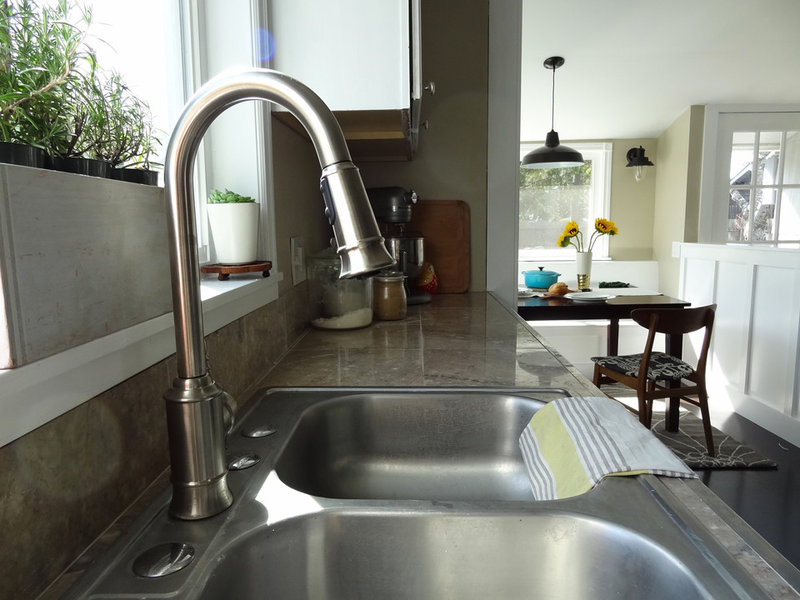
Replacing our basic kitchen faucet with a gorgeous one-handle high-arc pull-down faucet was the finishing touch our kitchen remodel needed. The process was surprisingly easy — it’s a do-it-yourself project that almost anyone can accomplish.

All you’ll need are a new faucet and a few household tools:

  • Adjustable basin wrench
  • Slip joint pliers
  • Safety glasses
  • Bucket or bowl for catching water
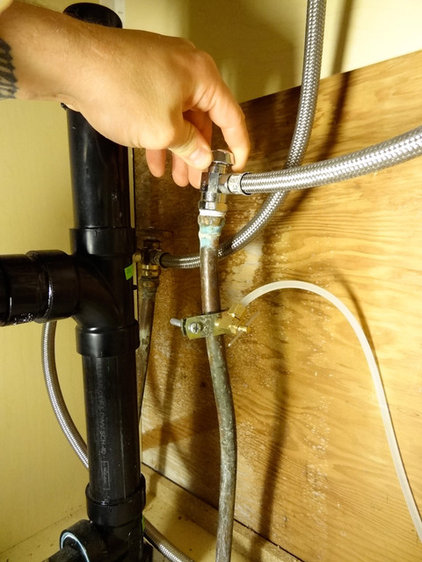
Clean out the area underneath the sink so you have ample space to inspect your work area and move about freely. Next, turn off both the hot and cold water supplies via the shutoff valve under the sink.  Test that the water is off at the faucet.
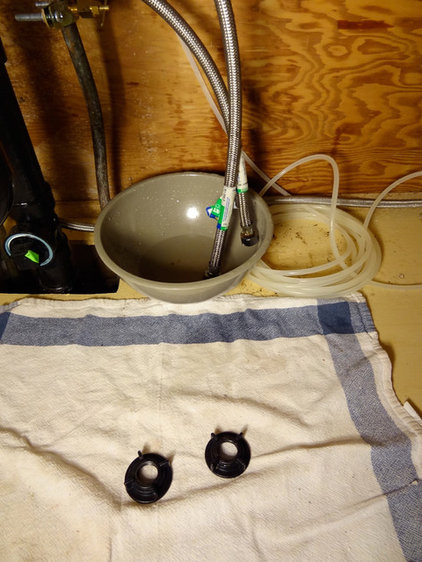
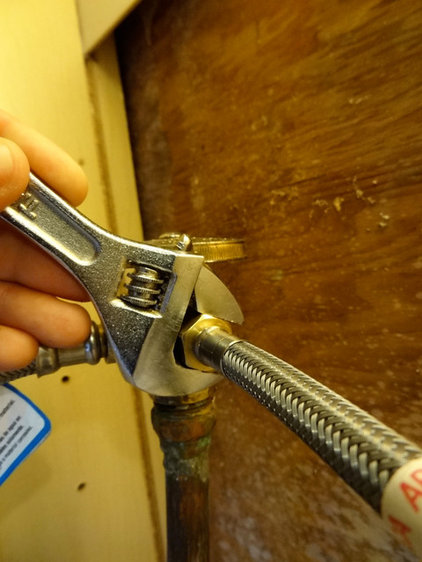
Using a basin wrench or slip joint pliers, unscrew the connections for each water line at the shutoff valve.Have a bowl handy to catch any residual water, and place the ends of the water lines in the bowl.
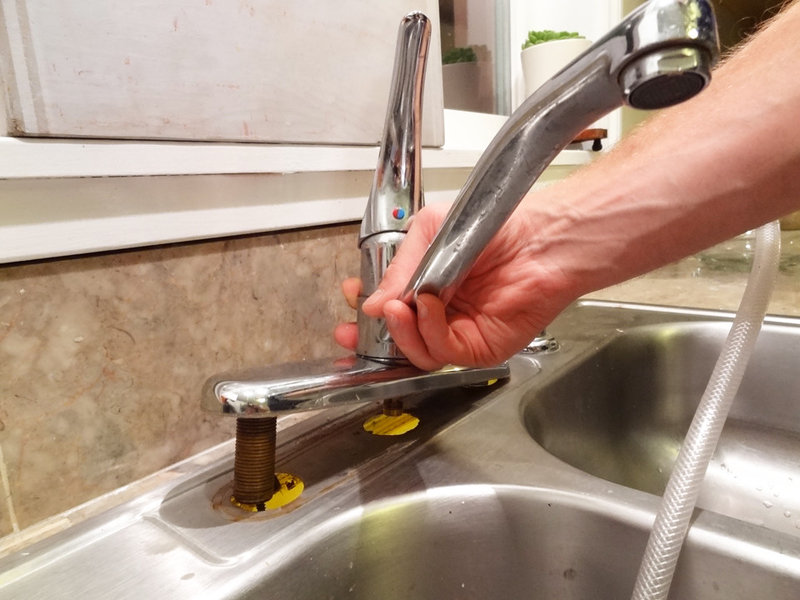
Unscrew the mounting nuts that hold the faucet to the sink, using either the wrench or the pliers. Remove the faucet from the sink and set it aside. Instead of tossing the old faucet into the trash, consider donating it to a salvaged goods shop, like a Habitat for Humanity ReStore.  Check here for locations
Once the old faucet has been removed, clean the surface of the sink.  I used a baking soda paste to eliminate water stains.
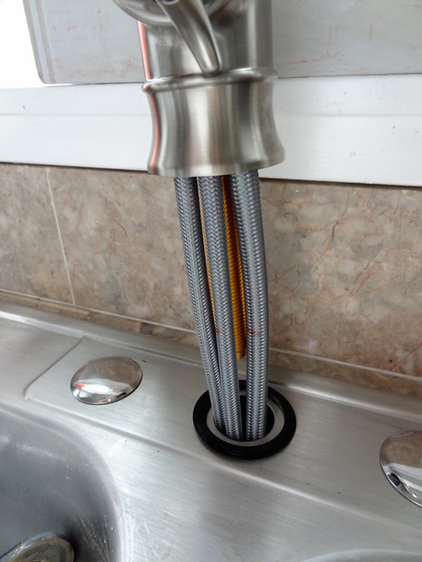
Place the gasket that came with your new faucet around the sink hole and slip the supply lines and faucet tailpipe through.  Our new Moen Woodmere faucet required only a single hole for installation, so we capped the remaining three holes on our stainless steel sink with covers that can be found at any hardware store.  In lieu of capping, consider adding accessories such as a soap dispenser, water filter faucet or hot water dispenser. You can also use the deck plate that is provided with some models.
Note:  Some faucets do not include gaskets; you need to apply sealant to the sink.
Secure the faucet in place from beneath the sink with the provided installation hardware. Ensure the faucet is positioned correctly and then tighten the mounting nut securely. Check the faucet from above to make sure it doesn’t wobble or wiggle.
Attach the faucet’s supply lines to the shutoff valves and tighten the connections with a wrench.
Our faucet included a pullout sprayer, which required a few extra steps. If yours does too, simply insert the spray hose through the faucet and push through until the hose is visible beneath the sink.

Old-School Daguerrotypes Capture Urban Sprawl of the 1800s | Bedford Real Estate

firstda.jpgImage via The Atlantic Cities

No, that’s not an Instagram of rural Connecticut, it’s a look at a “busy street” in the Paris of 1838, and also the first print produced by Daguerreotype creator Louis-Jacques-Mandé Daguerre. The Atlantic Cities recently dug up this and a few more Dagerreotypes—prints produced via complicated methods and bulky, expensive machinery once lauded for being the first “practicable” photographic process—of 19th-century cities. The images show off urban sprawl from before Chanel and Michael Kors lined the boulevards and starchitect-designed towers stood shoulder to steel-boned shoulder in the most congested bits of town. Below, Philadelphia in 1843 and Washington, D.C., in 1846.

All Top 100 Markets Gained in Homes.com July Data | Pound Ridge Real Estate

Utilizing home pricing data for the period ending July 2013, the Homes.com Price Index showed gains for single-family properties in all 100 markets, up from 87 in the previous reporting period

“Homes.com’s Rebound Report provides a deeper view into the 22 fully rebounded markets. Many never experienced the dramatic swings in home values that were a result of foreclosures and short sales that plagued many markets across the nation”

The Homes.com Local Market Index has been expanded to include midsized markets ranked from 101-300. It provides a closer look at smaller markets nationwide, showing increases in 293 of the top 300 markets, up from 250 the previous month. Year over year, all midsized markets increased.

As a complement to the Local Market Index, Homes.com publishes an exclusive Rebound Report, highlighting how the housing recovery process is unfolding across the country. Rebound data for July 2013 in the top 100 markets revealed that 22 markets across the U.S. are fully recovered – up from the previous month’s 19 markets. Additionally, 44 U.S. markets now show a rebound of 50 percent or more, up from 41 in last month’s report.

“Homes.com’s Rebound Report provides a deeper view into the 22 fully rebounded markets. Many never experienced the dramatic swings in home values that were a result of foreclosures and short sales that plagued many markets across the nation,” said Brock MacLean, executive vice president of Homes.com. “By contrast, most of the markets with the lowest rebound have experienced more dramatic changes in values as a result of foreclosures and short sales and will have a slower path to recovery.”

The latest Homes.com Local Market Index reports the following:

Monthly increases in all 100 of the top 100 markets and in 193 of the 200 midsized markets.

Honolulu, Hawaii remains the top gaining market on a year-over-year basis with a 29.17 index point or 13.51% increase.

California markets [Los Angeles-Long Beach-Santa Ana, Calif.; San Diego-Carlsbad-San Marcos, Calif., San Francisco-Oakland-Fremont, Calif.; Oxnard-Thousand Oaks-Ventura, Calif.] are the remaining 4 in top 5 and increased 25.26, 24.60, 24.19 and 20.16 index points respectively.

Six of the top 10 monthly gaining markets are in the West (up from two in the previous month), followed by four from the South.

Highlights from the Homes.com Rebound Report for the top 100 markets show:

22 have made more than a 100% rebound, indicating a complete recovery in these markets. This is up from 19 markets posting a full recovery in last month’s report.


http://www.realestateeconomywatch.com/2013/09/all-top-100-markets-gained-in-homescom-july-data/