Tag Archives: Westchester NY Homes for Sale

Westchester NY Homes for Sale

Drones are ready for real estate | North Salem NY Real Estate

When real estate broker Phil Immel, leader of a seven-person team with Prudential California Realty, wanted to differentiate his luxury brand from others in Southern California, he thought of drones.

And two months ago, he came up with this:

Video shot from a drone to market a listing represented by Phil Immel’s brokerage.

“I wanted to feature and differentiate my listings and farm areas from every other agent’s,” Immel said.

Technology has advanced to a degree that small, remote-controlled drone helicopters are more affordable than they once were, and cameras and their image-stabilizing systems are better, making  aerial photography and video captured using drones an increasing phenomenon in a number of industries, including real estate.

Immel, who’s commissioned three videos of listings and four of neighborhoods from real estate visual marketing firm California Image Maker, is one of the first real estate brokers to enhance his sellers’ listings with aerial video imagery from small, technologically advanced remote-controlled helicopters, which feature multiple rotors and a stabilized location in their centers that holds a camera on a swivel.


Drones are ready for real estate | Inman News.

Angie’s List breaks 2 million paid user mark | Katonah Real Estate

Review service Angie’s List announced today that it has doubled its customer base over the past 18 months and that the total number of households that pay to use the site surpassed 2 million over the weekend.

“Realizing such momentum in membership growth is truly a testament to our commitment to help consumers find the best local service providers,” said Angie Hicks, a co-founder of the company, in a statement. “Our members drive Angie’s List.”

Angie’s List, which helps consumers find many types of professionals including real estate agentsappraisers, and mortgage brokers, topped the 2 million mark on Sunday, and passed the 1 million mark in October of 2011, the company said.

“It took us more than 16 years to get to one million paid households but just 18 months to double it,” Hicks said.

Angie’s List claims to offer more reliable reviews than other sites by strictly enforcing rules designed to guard against fake ones.

Users can post reviews of home services providers inluding handymen, remodelers, roofers, electricians, painters, and heating, ventilation and air conditioning (HVAC) contractors.


Angie’s List breaks 2 million paid user mark | Inman News.

6 Marketing Automation Lessons Learned the Hard Way | Bedford Corners Realtor

Not too long ago, my colleague Katie Burke wrote a great article, “The Right Way to Think About Your Marketing Software RFP,” and it got me thinking about my own experiences as a buyer of marketing technology. Particularly I realized, more often than not, I was thinking about automation the wrong way.

In the past nine or so years, I’ve evaluated, purchased, implemented, and used over ten different email marketing and marketing automation platforms (there may be more but I’ve lost count). My love for technology and marketing is what led me to join HubSpot over two years ago, and why I regularly speak with prospects and customers on what I learned when I was in their shoes.

Right now the marketing automation industry couldn’t be hotter. Due to increasing adoption rates, analysts are predicting a more than 50% industry revenue increase this year. Recent acquisitions (Eloqua acquired by Oracle, Pardot by ExactTarget, and others) are also signs of a market headed in the right direction.

I’m certainly not going to complain about our industry’s growth, but I wonder, are companies adopting automation the right way? Perhaps the belief that marketing automation just encourages bad behavior more than it createslovable marketing, or that it’s simply a more efficient spamming engine, is a telling sign.

Too often I hear from companies that are headed down the wrong path in the decision process despite where they started (with good intentions). Make no mistake, automation can do wonders for your bottom line — if you avoid the purchasing pitfalls. Below are six common mistakes I see over and over again, failures I’ve experienced myself, and how you can avoid them so that you’re successful with marketing automation.

6 Common Marketing Automation Lessons I Learned the Hard Way

1) Automating bad processes doesn’t magically make marketing better.

This might appear like a no-brainer, but it’s the #1 offense I see. Let me you give you a real-life scenario:

A three-person marketing team for a large technology company is struggling to supply inside sales reps with good leads. In addition, a lot of the work to hand leads to sales is very manual, due to a lack of integration with their email provider and CRM. They target a niche audience in the Fortune 1000. Because of this, the company attends tradeshows and buys targeted prospect lists of “Directors of IT.” They email these lists regularly with the goal to schedule more sales appointments, or maybe they will send a newsletter or product offer. But the company often experiences high bounce rates and low engagement. Their database hasn’t really grown in years, and in fact, it’s churning at a high rate. They decide it’s time to buy marketing automation to better utilize their existing database and put new lists through automated drip campaigns. They plan to use lead scoring, as well.

What’s wrong with this picture? First, yes, buying email lists is a no-no and no one should do it. But the main problem is that this company is solely looking at automation to fix an already broken process. In this case, this company needs to fix their lead problem by creating better content. In other words, they should consider marketing transformation prior to marketing automation.

John Common, CEO of Intelligent Demand, mentioned in this post:

“It is a disruptive technology in that it forces a company to think differently about its most important process: revenue creation. This is a good thing! At most companies today, marketing and sales are working from an outdated playbook that was written back when interruptive, batch-and-blast, product-focused, hunch-based marketing actually worked, and Sales was in control of the buying process. Those days are gone, but the thinking behind that playbook still exists.”

Sure, automation can make things easier in some cases and you may even see some short-term gains. But long-term success is what matters, and that requires a different way of marketing. Using automation as a glorified email tool won’t get you where you need to be.

Great automation is a result of highly targetedpersonalizedvaluable, timely, and remarkable content that is sent to a healthy and engaged database (see point #2 below in just a minute). As John mentions above, the batch-and-blast approach to sending prospects stuff they don’t care about isn’t going to suddenly make things better with automation. If your company feels like creating great content is the core of your problem — and in most of the scenarios I’ve seen, it is — start there.

2) Automation requires a growing and engaged database to nurture.
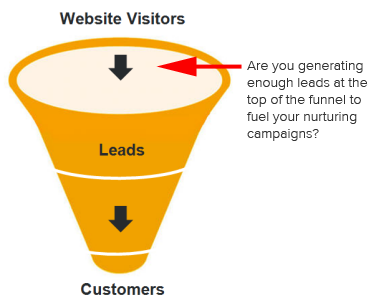
marketing-automation-funnelThe average email database expires at the rate of ~25% per year. That means a database of 50,000 email addresses will have shrunk to 21,000 in just three short years. The best way to solve for attrition is to replenish the funnel with new leads at a higher rate than you’re burning through. Or else you’ll find yourself with diminishing returns.

Before you invest in marketing automation, ask yourself, “What am I doing to fuel the top of my funnel?” In other words, automation is a fantastic tool to further qualify and nurture leads, but when you don’t even generate enough for Sales, what’s the point?

I learned this the hard way. A few years ago, I implemented marketing automation before putting the processes in place to attract and convert more leads, like creating better content, offers, calls-to-action, and landing pages, and doing things like blogging and optimization (and to clarify, buying email lists does not count as lead generation). Essentially, I put the cart before the horse and my results later suffered.


6 Marketing Automation Lessons I Learned the Hard Way.

Pound Ridge NY Unsold Inventory Report | Pound Ridge Homes | RobReportBlog

Pound Ridge NY Unsold Inventory Report  |  Pound Ridge Homes | RobReportBlog


80  unsold homes


21 sold last six months

22.85 months of unsold inventory


34 sold/pending/conditional contract

14.13 months of inventory


Pound Ridge NY Unsold Inventory Report | Pound Ridge Homes | RobReportBlog.

Mt Kisco Sales Up 8.6% | Median Price Up 50% | RobReportBlog

Mt Kisco NY Real Estate ReportRobReportBlog
20136 months ending 5/142012
25Sales23
$630,000.00median sold price$418,000.00
$325,000.00low sold price$275,000.00
$3,950,000.00high sold price$1,475,000.00
3188average size2359
$288.00ave. price per foot$239.00
232ave days on market214
$1,055,437.00average sold price$549,706.00
94.59%ave sold to ask93.96%


Mt Kisco Sales Up 8.6% | Median Price Up 50% | RobReportBlog.

North Jersey Data Center Industry Blurs Utility-Real Estate Boundaries | Waccabuc Real Estate

The trophy high-rises on Madison, Park and Fifth Avenues in Manhattan have long commanded the top prices in the country for commercial real estate, with yearly leases approaching $150 a square foot. So it is quite a Gotham-size comedown that businesses are now paying rents four times that in low, bland buildings across the Hudson River in New Jersey.
Why pay $600 or more a square foot at unglamorous addresses like Weehawken, Secaucus and Mahwah? The answer is still location, location, location — but of a very different sort.
Companies are paying top dollar to lease space there in buildings called data centers, the anonymous warrens where more and more of the world’s commerce is transacted, all of which has added up to a tremendous boon for the business of data centers themselves.
The centers provide huge banks of remote computer storage, and the enormous amounts of electrical power and ultrafast fiber optic links that they demand.
Prices are particularly steep in northern New Jersey because it is also where data centers house the digital guts of the New York Stock Exchange and other markets. Bankers and high-frequency traders are vying to have their computers, or servers, as close as possible to those markets. Shorter distances make for quicker trades, and microseconds can mean millions of dollars made or lost.
When the centers opened in the 1990s as quaintly termed “Internet hotels,” the tenants paid for space to plug in their servers with a proviso that electricity would be available. As computing power has soared, so has the need for power, turning that relationship on its head: electrical capacity is often the central element of lease agreements, and space is secondary.
A result, an examination shows, is that the industry has evolved from a purveyor of space to an energy broker — making tremendous profits by reselling access to electrical power, and in some cases raising questions of whether the industry has become a kind of wildcat power utility.
Even though a single data center can deliver enough electricity to power a medium-size town, regulators have granted the industry some of the financial benefits accorded the real estate business and imposed none of the restrictions placed on the profits of power companies.
Some of the biggest data center companies have won or are seeking Internal Revenue Service approval to organize themselves as real estate investment trusts, allowing them to eliminate most corporate taxes. At the same time, the companies have not drawn the scrutiny of utility regulators, who normally set prices for delivery of the power to residences and businesses.
While companies have widely different lease structures, with prices ranging from under $200 to more than $1,000 a square foot, the industry’s performance on Wall Street has been remarkable. Digital Realty Trust, the first major data center company to organize as a real estate trust, has delivered a return of more than 700 percent since its initial public offering in 2004, according to an analysis by Green Street Advisors.


North Jersey Data Center Industry Blurs Utility-Real Estate Boundaries – NYTimes.com


North Jersey Data Center Industry Blurs Utility-Real Estate Boundaries | Waccabuc Real Estate | Bedford NY Real Estate | Robert Paul Talks Life in Bedford NY.

Obama Weekly Address: Growing The “Healing” Housing Market | South Salem Real Estate

Obama Weekly Address: Growing The “Healing” Housing Market

WHITE HOUSE: In this week’s address, President Obama said seven years after the real estate bubble burst, our housing market is healing. The administration’s policies have helped responsible homeowners save money on their mortgages and stay in their homes, and the President’s consumer watchdog agency is working to protect consumers from being taken advantage of on their mortgages, but there is still more work to do. The President urges Congress to quickly confirm Mel Watt to lead the Federal Housing Finance Agency, and take action to give every responsible homeowner the chance to refinance and save money on their mortgage, so that we can keep growing the housing market, support working families, and strengthen the economy.

PRESIDENT OBAMA: Hi, everybody. Our top priority as a nation is reigniting the true engine of our economic growth – a rising, thriving middle class. And few things define what it is to be middle class in America more than owning your own cornerstone of the American Dream: a home.

Today, seven years after the real estate bubble burst, triggering the worst economic crisis since the Great Depression and costing millions of responsible Americans their jobs and their homes, our housing market is healing. Sales are up. Foreclosures are down. Construction is expanding. And thanks to rising home prices over the past year, 1.7 million more families have been able to come up for air, because they’re no longer underwater on their mortgages.

From the day I took office, I’ve made it a priority to help responsible homeowners and prevent the kind of recklessness that helped cause this crisis in the first place.

My housing plan has already helped more than two million people refinance their mortgages, and they’re saving an average of $3000 per year.

My new consumer watchdog agency is moving forward on protections like a simpler, shorter mortgage form that will help to keep hard-working families from getting ripped off.

But we’ve got more work to do. We’ve got more responsible homeowners to help – folks who have never missed a mortgage payment, but aren’t allowed to refinance; working families who have done everything right, but still owe more on their homes than they’re worth.

Last week, I nominated a man named Mel Watt to take on these challenges as the head of the Federal Housing Finance Agency. Mel’s represented the people of North Carolina in Congress for 20 years, and in that time, he helped lead efforts to put in place rules of the road that protect consumers from dishonest mortgage lenders, and give responsible Americans the chance to own their own home. He’s the right person for the job, and that’s why Congress should do its job, and confirm him without delay.

And they shouldn’t stop there. As I said before, more than two million Americans have already refinanced at today’s low rates, but we can do a lot better than that. I’ve called on Congress to give every responsible homeowner the chance to refinance, and with it, the opportunity to save $3,000 a year. That’s like a $3,000 tax cut. And if you’re one of the millions of Americans who could take advantage of that, you should ask your representative in Congress why they won’t act on it.

Our economy and our housing market are poised for progress – but we could do so much more if we work together. More good jobs. Greater security for middle-class families. A sense that your hard work is rewarded. That’s what I’m fighting for – and that’s what I’m going to keep fighting for as long as I hold this office.


Obama Weekly Address: Growing The “Healing” Housing Market | RealClearPolitics


Obama Weekly Address: Growing The “Healing” Housing Market | South Salem Real Estate | Bedford NY Real Estate | Robert Paul Talks Life in Bedford NY.

Is Canada’s Housing Market Falling Apart? | Cross River Real Estate

Last summer, a Vancouver real estate agent named Keith Roy sold his house. About a month later, he wrote a blog post about it — and set off a firestorm of criticism from fellow real estate agents. “I’m a Realtor and I sold my own home 4 weeks ago. It wasn’t too big or too small. It’s only 6 years old and still feels new. I sold because in 6 months my home will be worth less than it is today. I think it’s time to cash out,” Roy said.

His argument was really simple: the supply of homes on the market was outstripping demand from buyers. Excessive supply and falling demand would lead prices downward. But his fellow brokers felt betrayed. Some even complained that Roy had been disrespectful to the profession. Selling his home was, however, a prescient move.

Home prices in the greater Vancouver area are down 3.9 percent from a year ago, according to the Real Estate Board of Greater Vancouver. In West Vancouver, which is sometimes said to be the wealthiest municipality in Canada, home prices have fallen 5.6 percent. Sales are down 20 percent from a year ago. Vancouver is not alone. All over Canada there is fear that the country is in a housing bubble that is now in the process of popping. In March, Montreal saw sales decline 17 percent year over year, even while inventory continues to climb. In Ottawa, sales have fallen 16 percent.

“A housing correction — or, possibly, a crash — is no longer coming. It’s here,” Macleans magazine declared this past January. The bubble seems fairly obvious, even if it’s existence is still disputed within Canada. Canadian home prices are up nearly 100 percent since 2000. The price-to-rent ratios in major urban population centers are through the roof. In British Columbia, home prices rose 163 percent in the decade from 2001 to 2011, according to a study by the International Monetary Fund.

Although Canada has a reputation for having conservative banks — its banks weathered the global credit crisis without any bailouts — low interest rates have fueled a sort of mortgage and borrowing mania. Household debt has risen to a record 165 percent of disposable income. Total mortgage debt stands at $1.1 trillion. The Canadian government is attempting to engineer a soft landing. It has tightened mortgage lending rules four times in the last four years. The maximum length of mortgages is being reduced from 40 to 25 years. Home equity loans were curtailed. And the government stopped backing mortgages on the most expensive homes.


Is Canada’s Housing Market Falling Apart? | Cross River Real Estate | Bedford NY Real Estate | Robert Paul Talks Life in Bedford NY.

Despite Recovery, Mortgage Originations Fell 6.2 Percent in Q1 | Katonah NY Realtor

Despite the housing recovery and home sales running 10.3 percent above the level of a year ago, mortgage originations are falling, signaling weakening refinancings.

Residential lenders originated 6.2% less during the first three months of 2013 than in the final three months of 2012, according toMortgage Daily’s First-Quarter 2013 Mortgage Lender Ranking . Estimated first-quarter originations by all U.S. lenders worked out to approximately $505 billion.

Though originations were off from the fourth quarter, several players still managed to increase business. Although the three-biggest mortgage servicers reduced their servicing portfolios, a trio of rising stars each added more than $100 billion to their portfolios. The second-quarter forecast calls for stronger production. Wells Fargo maintained its dominance as an originator, though its market share slipped.

Based on the Mortgage Market Index from LoanSifter and Mortgage Daily, second-quarter business is poised to increase 13 percent over the first quarter. Overall mortgage business improved 13.8 percent from the first-quarter 2012.

The biggest decline among originators was at Ally Financial, where production tumbled 38 percent from the fourth-quarter 2012. Provident Funding saw a 28 percent decline, and PrimeLending fell 24 percent. The best improvement was Stonegate Mortgage’s 36 percent increase. Bank of America and SunTrust Mortgage each boosted business by 11 percent.

Biggest Q1 Originators
RankLenderMarket

Share
1.Wells Fargo
22%
2.Chase
11%
3.Quicken
5%


Despite Recovery, Mortgage Originations Fell 6.2 Percent in Q1 | Katonah NY Realtor | Bedford NY Real Estate | Robert Paul Talks Life in Bedford NY.

India Housing Bubble | Bedford Hills NY Realtor

Here are some interesting charts by Deepak Shenoy on the India Housing Bubble.

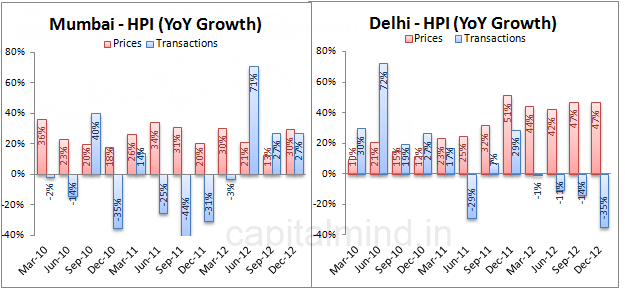
India home prices have been going up at a compound annual growth rate (CAGR) of 26% since March of 2009.

Mumbai and Delhi

India HPI 2

Mish Shedlock

Shenoy reports Mumbai is growing at a CAGR of 30%, and Dehli is up 47% from a year ago and 250% since March 2009.

Note the transaction volume in Delhi. Transaction volumes and prices are interesting in Bangalore and Chennai as well.

Bangalore and Chennai  

India HPI 3

Mish Shedlock


Shenoy has details on five other cities as well. Inquiring minds may wish to take a look.

He writes “While India as a composite country is not at a bubble stage right now, it’s important to note that various bubbles are building up in individual cities. If any of these bubbles worsens, then it is likely that other cities will follow. There are no un-correlated prices in a crisis.

I would suggest that India as a composite certainly is in a housing bubble. The overall HPI shows just that.


India Housing Bubble – Business Insider


India Housing Bubble | Bedford Hills NY Realtor | Bedford NY Real Estate | Robert Paul Talks Life in Bedford NY.