Tag Archives: Westchester Luxury Real Estate

Considering a Fixer-Upper? 15 Questions to Ask First | Chappaqua Real Estate

Many of us share the same dream: find an adorable fixer-upper in a great location and set out to make it swoonworthy. But when the budget isn’t limitless, it becomes even more important to know what to look for before purchasing a house that needs a lot of work. Older homes often have underlying safety and construction issues, and you can save a lot of time and money by planning for them.
Here we’ll also discuss how to recognize what is valuable in your period home, and how you can preserve its charm in your remodel.

Before you dive in, look carefully at the inspection report, talk with your contractor and study the history of the home and the neighborhood. Wade Palmer of WIN Home Inspection Services and general contractor Greg Blea gave me the lowdown on the 15 most important questions to ask.
1. What is your budget? For some remodels of historic homes, there’s a large budget and the admirable goal of preserving an architectural gem, no matter the cost. I’ll be focusing more on projects with modest budgets in this ideabook. Many of the questions are still the same, but the decisions about how to move forward are different when the budget is limited.
2. Is it in a historic district? If so, the design and permit processes can be lengthier and more expensive, and using the required historically correct materials can add significantly to the cost. But a historically protected neighborhood and architecturally unique homes often mean more consistent — and rising — property values.
3. What is the weather in the area and the intended use of the building? A home for a family of four in a wintry climate will require a different and costlier approach than a vacation cottage that is used only in the summer months. To keep costs down, plan for construction during the best weather.
4. Does the house have beautiful bones? Some things are irreplaceable or would cost a fortune to re-create. Older wood floors, for example, have greater color and character than newly milled floors. Solid wood paneling, trim and doors are expensive to replace. Elaborate millwork may be impossible to find or replace.

5. Is there lead-based paint? Most states now require protective actions for dealing with lead-based paint.  These actions require training and certification by the state, and the time-consuming process can increase the cost of even a small renovation.
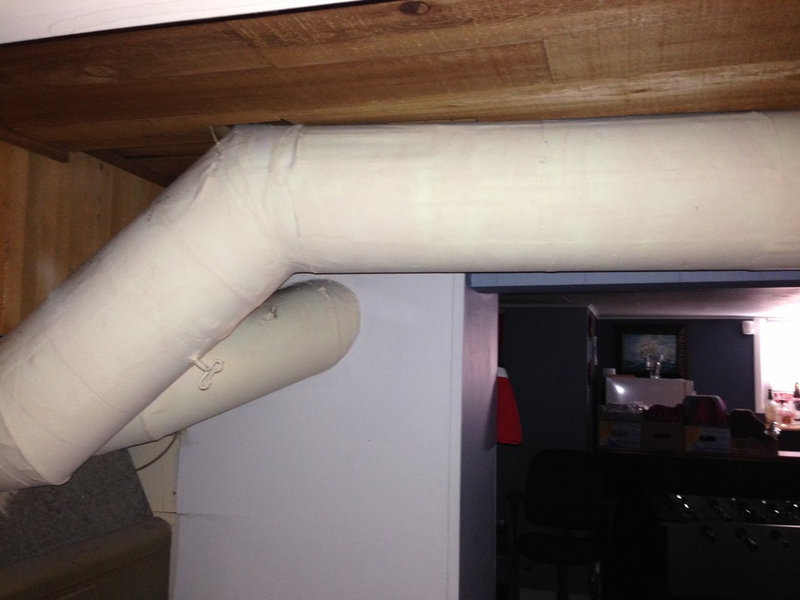
6. What about asbestos? Asbestos was commonly used in older homes, often in insulation, siding, flooring and other components. It must be removed by a certified abatement crew, or in some cases it can be encapsulated. But it is not something to tackle yourself. Professionals advise taking care of asbestos in the proper way, as it will increase the value and sales potential of your home, as well as its safety.

Judge Dismisses Armonk Square Lawsuit | Armonk Real Estate

A lawsuit that alleged the town of North Castle made unauthorized and improper changes to the site plan of Armonk Square has been dismissed.

The Planning Board has already approved Armonk Square’s site plans for the construction of a supermarket, office space, retail space, and residential units.

In July, 37 Maple Avenue, a corporation managed by Armonk Developer Michael Fareri, challenged the town’s issuance of these certificates of occupancy. In a decision dated Oct.17, Acting State Supreme Court Justice Susan Cacace, wrote that the petitioner, 37 Maple Avenue, does have standing to bring this proceeding. The 2012 settlement clearly stated that the filing of a new Article 78 proceeding was not a remedy provided for in the stipulation.

The town also said that 37 Maple Avenue did not exhaust its administrative remedies by failing to appear before North Castle’s Zoning Board of Appeal as is required by law. Cacace said that the court agreed that the petitioner, 37 Maple Avenue, “failed to exhaust its administrative remedies as a condition precedent to the commencement of an action or special proceeding.”

Mark Miller, an attorney with Veneziano & Associates, representing Armonk Square , said, “We think the judge rendered exactly the right opinion based upon two actions.” The certificate of occupancy issued by the building Inspector says the buildings of Armonk Square are safe and fully compliant with town laws.

Miller said one action taken by 37 Maple Avenue was its failure to file a challenge with the Zoning Board of Appeals within 60 days of when the certificate of occupancy was issued. Miller adds that the settlement of a prior lawsuit prohibited 37 Maple Avenue from filing an Article 78 proceeding against Armonk Square for essentially for the same project.

The lawyer for 37 Maple Avenue, Alan Singer, a partner of Welby, Brady and Greenblatt, said his firm is contemplating filing a notice of appeal of the judgement in an appellate court. They have 30 days from Oct. 17 to do so.

Singer said the judgement barring a new Article 78 suit is wrong because the previous settlement prohibiting the filing of an Article 78 suit was part of a judgement about a different set of plans for Armonk Square.

Miller said Armonk Square’s parking requirements were established by the Town Board as a blend of several requirements by the central business zoning district. Miller says all of the environmental impacts were considered and addressed. “They can file an appeal and we are confident that the appellate division will make exactly the same finding.”

Miller said there was excellent cooperation between his firm and the town attorney, and Supervisor Howard Arden said that the cost of defending the town in this lawsuit was $15,300


http://armonk.dailyvoice.com/politics/judge-dismisses-armonk-square-lawsuit

How to apply PR strategies to improve your company’s SEO | Chappaqua Realtor

Public relations and SEO have always been destined to converge.

PR is about building relationships with media professionals and key influencers to help increase a company or individual’s visibility and profile; SEO is an iteration of that relationship. The only difference is that we operate in the digital sphere, and we measure these relationships through links, social signals, and other trust indicators. In the past, many SEO strategists focused on building a high volume of low quality relationships to get their company’s names out to the Web. Times have changed.

As Google’s ability to distinguish the quality, intent, and relevance of a link improves, SEO strategists need to start thinking more like PR professionals. Rather than “manufacturing” and “building” links, the SEO process should be more about the cultivation of key human relationships, and reacting effectively to real-time PR opportunities.

What can we learn?

PR has always been a multifaceted discipline. The techniques that PR professionals use to generate positive press are numerous and diverse. That said, there are three key areas of crossover that, if mastered, will help us all learn from the PR experts and improve your company’s SEO.

1. Content, content, content

This should come as no surprise since content has been one of the fundamental pillars of traditional PR for years. If you create content that is topical, timely, and can spark an interest in your target audience, it will get picked up.

So, what types of content can you use to create opportunities for positive PR, and what SEO value do they have? Do photos on a GMB listing really matter? Sure, we should be posting slideshares, videos, images, and blog articles provide outreach to our target audience. To be honest, most people are getting pretty good at it now. The key factor when you are planning and producing your content is to always think about the PR opportunities it might be able to create.

Dutch Colonial on Lake Minnetonka Listed for $5.75M | Mt Kisco Real Estate

Location: Shorewood, Minn. Price: $5,750,000 The Skinny: This 8,650-square-foot Dutch Colonial, which comes with a 1,450-square-foot carriage house, was originally constructed in 1906 for Edmund Longyear, the founder of mineral drilling company Boart Longyear who owned  90 acres of land on Lake Minnetonka. Later, the estate became the summer home of George Nelson Dayton, son of George Draper Dayton—founder of Dayton’s Dry Goods Store, which later became the Target corporation—and grandfather of current Minnesota Governor Mark Dayton. The Daytons developed the land into a working farm called Boulder Bridge Farm. In 1976, a real estate developer who had grown up across the street from the farm bought the property and began converting it into 44 homesites. He kept the impressive Longyear House and the surrounding four acres, for himself and his family, though, restoring parts and enhancing others—they expanded the kitchen, added a pool and hot tub, enclosed a porch to create the formal dining room, and installed a movie theatre. Now, with the kids all grown up and moved out, they’ve put the four-acre estate on the market for $5.75M.

Play Tricks With Color in Your All-White Room | Bedford Corners Real Estate

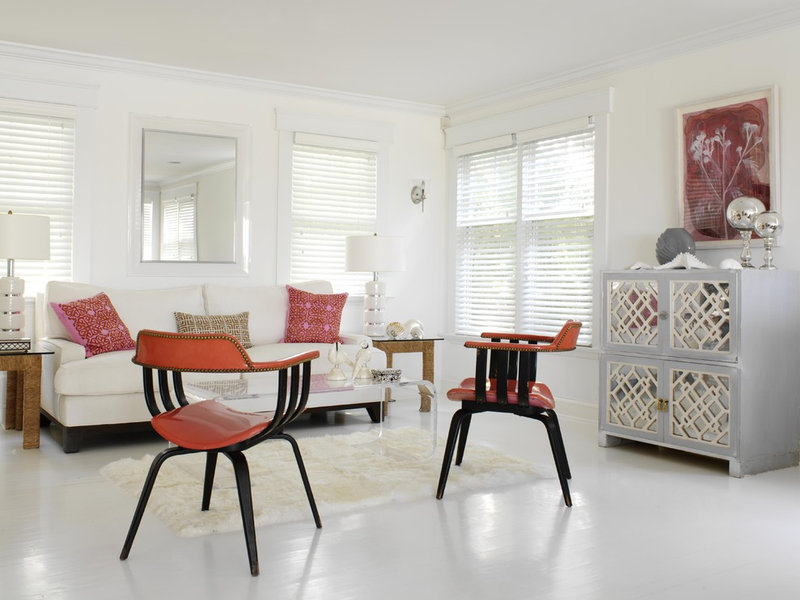
ith so many colorful options for materials and paint these days, all-white spaces can feel stark and sterile for some of us. But there’s an easy compromise for color lovers who still appreciate the crisp feeling of white: Add a splash of color. Sticking to one consistent, bold color in white rooms creates a statement that can’t be missed. From master bedrooms to kitchens, all-white rooms make the perfect canvases for a pop of originality.

eclectic living room by Tara Seawright

Save to Ideabook
Email Photo
Accent with your favorite color. You’ve taken a bold leap into all-white decor, painting the walls, floor and furniture white. But don’t stop there. Add a few splashes of your favorite color around the room, and watch your space come alive. Try to spread out your accents: The more spots of color you use, the more the eye will wander around the room.
modern bedroom by Neslihan Pekcan/Pebbledesign

Save to Ideabook
Email Photo
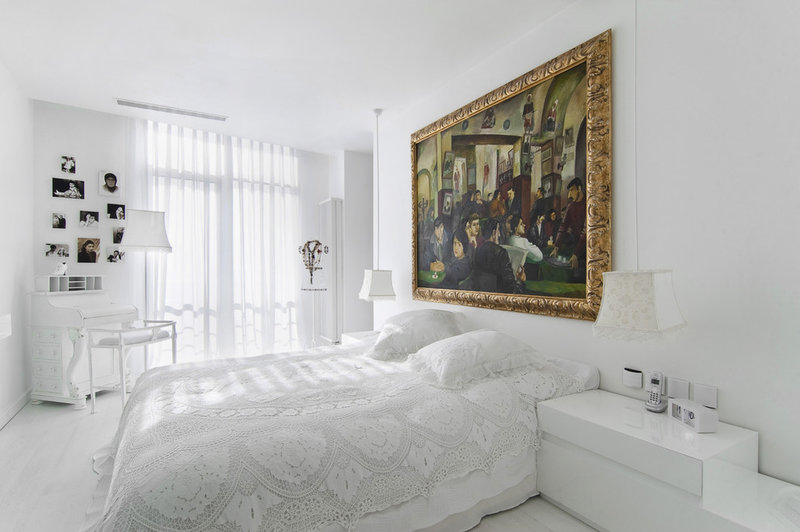
Focus on wall art. Stark white walls, sheer white fabrics and sleek white furniture make this space feel like a luxury hotel room, but it’s the picture on the wall that immediately catches your attention.
Take a risk and hang a favorite, colorful piece of art on a single wall in your all-white room. Hunt for something big and bold at your local galleries and studio tours, online art vendors, antique shops and even thrift stores.
rustic bedroom by Jill Sorensen

Save to Ideabook
Email Photo
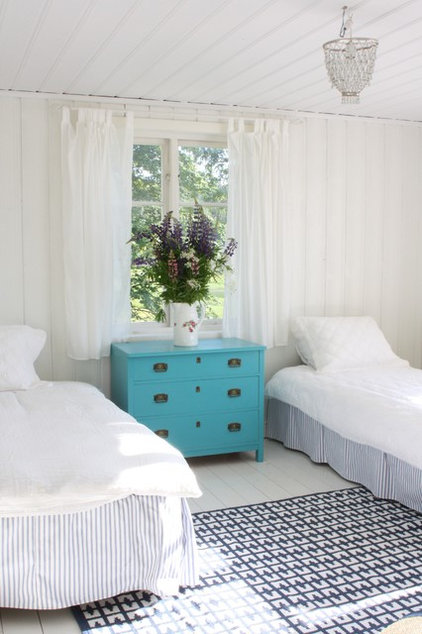
Paint your furniture. Painting furniture is an easy and affordable way to instantly update a room. This room glows in all white, but the punchy turquoise dresser adds cheer to the serene space.
Experiment with something affordable, like a funky piece you found at a local garage sale. A gallon of colorful paint and some new hardware is all you need to create an instant conversation piece.
Diary of a dresser makeover
eclectic dining room by Jeanette Lunde

Save to Ideabook
Email Photo
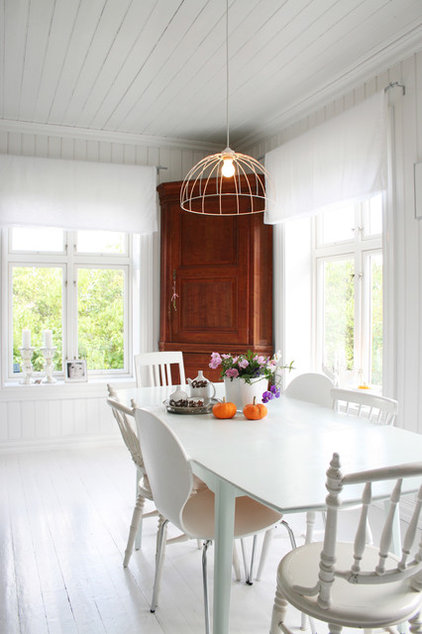
Embrace natural finishes. The painted furniture look doesn’t suit all of us — especially if you want to preserve your antique or inherited furniture. Simply let your furniture’s natural wood finish stand out on its own; the warm hue works just like a splash of bold color. Here, this beautiful corner cabinet steals the show, anchoring the room with its natural cherry finish.
traditional kitchen by Cheryl Scrymgeour Designs

Save to Ideabook
Email Photo
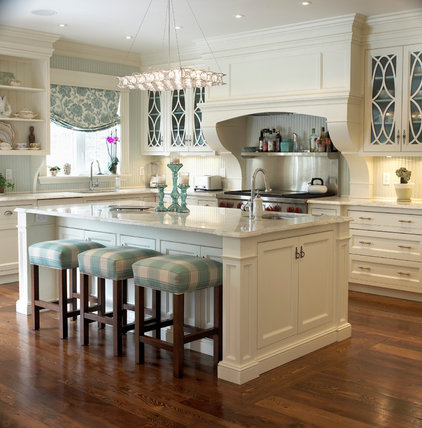
Play with fabric. I love the look of white kitchens, but sometimes they can feel too plain and devoid of personality. It’s easy to add style without switching out any major materials. This kitchen does a great job of playing with blues in the soft window treatment, upholstered barstools and counter accents for a cohesive look.
modern kitchen by Tara Seawright

Save to Ideabook
Email Photo
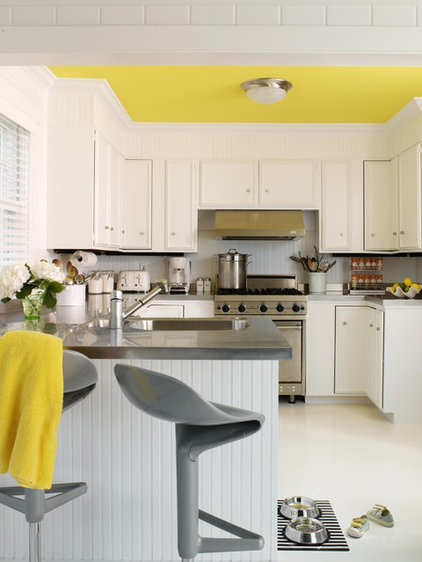
Paint your ceiling. Can’t figure out where to put a splash of color in your all-white room? Look up! Paint your ceiling for a fresh, new look.
This vibrant canary yellow ceiling makes the entire room come alive. This paint application would work with just about any hue, but be careful when you choose your sheen. A glossy finish may reflect light around the room too much; a matte or eggshell finish may work better.
modern dining room by Polly

Save to Ideabook
Email Photo
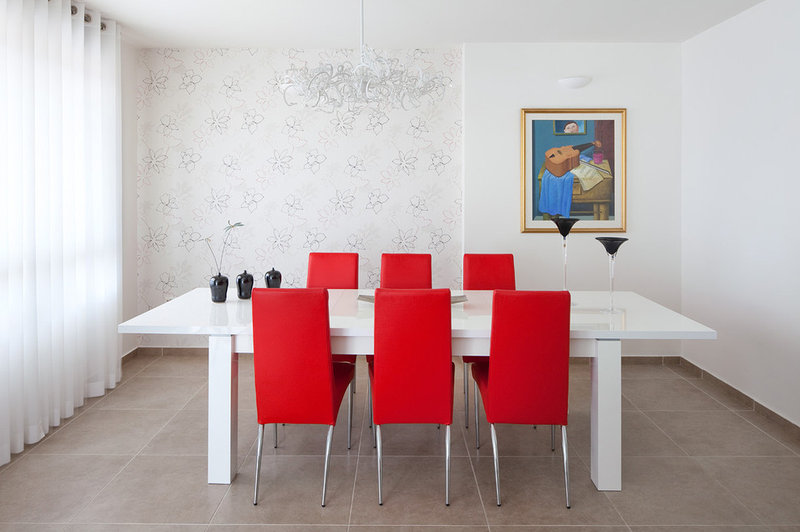
Highlight staple furniture pieces. Matching white chairs would’ve made this all-white room look too washed out. I love how this homeowner took a different approach and selected bold chairs that instantly set this design apart. If you’re ready to embrace this style, using a bright red hue like this will turn your white space into an instant showstopper.

5 Common Mistakes to Avoid on Google+ | Bedford Realtor

Google+ maybe a newer social network, but it’s a powerful one.5 Common Mistakes to Avoid on Google+

In fact it is now the second largest social media network behind Facebook after only launching just over two years ago.

So why are so many Google+ users confused about how to use it? The fact is, if  you’re like most people on Google+, you’re still a little confused about the site.

So what should you do?

To answer that question, here’s a list of some of the most common mistakes  users make on the network. Examine these errors and avoid them, and you set  yourself up to be ahead of the pack.

1. Not Optimizing Your Profile

Completing your profile is Google+ 101.

When you add your name, bio, photo and other information, you let other users  know who you are and how to identify you. This not only encourages connection,  but it also reinforces your brand. To make the most of your profile, optimize it  with keywords relevant to your industry. Likewise, include relevant links  throughout your About page, from the “introduction” to the “website” section.

Look at my profile as an example:

  • Completed tagline
  • Keyword-rich introduction
  • Contact information
  • Photo

5 Common Mistakes to Avoid on Google+

Also optimize your profile by listing all the of the sites where your  writing or content appears.

5 Common Mistakes to Avoid on Google+

2. Never Posting

You gain the most exposure on Google+ when you post regularly.

Fresh content keeps you current in the feeds of contacts and makes you seem  relevant, as is shown in the feed below. Likewise, regular posting benefits search engine optimization, improving your results when  users search for content related to what you share.

Read more at http://www.jeffbullas.com/2013/08/26/5-common-mistakes-to-avoid-on-google/#kImM2Q5AWspxokA7.99

The Solidity and Stature of NYC’s Central Savings Bank | Waccabuc Real Estate

Welcome back to Curbed Classics, a column in which writer Lisa Santoro traces the history of a classic New York City building. Have a building to nominate for a future installment? Please suggest it to the tipline.

CSBnow_8_13.jpg

Banking and commerce are integral to the city’s livelihood, so it’s no wonder that New York City’s banking institutions are designed to look important. This is certainly the case with Central Savings Bank, which stands out even among the noteworthy classical structures that are its neighbors. The building is easily accessible to the public and warrants a closer look.

The Central Savings Bank (currently Apple Bank), located at 2100-2108 Broadway at West 73rd Street, was built between 1926 and 1928 by the architecture firm of York & Sawyer. The bank had been founded in 1859 and was originally known as The German Savings Bank in the City of New York, with its first location inside the Cooper Union building. Just five years later, in 1864, the bank would move a bit uptown to Fourth Avenue and 14th Street, eventually occupying a new bank building that was constructed in 1872. Decades later, during World War I, the bank changed its name to “Central Savings Bank.” Though the name change may have been due to anti-German sentiment, the bank continued to flourish and the trustees banked (sorry) on the Upper West Side’s business and residential development and chose to open an uptown branch.

CSBold_8_13.jpg [The Central Savings Bank, via NYC-architecture.]

York and Sawyer was an obvious choice for the new building. In addition to both working for the prolific firm of McKim, Mead and White, York and Sawyer were experienced in designing other noteworthy banking institutions, such as the Federal Reserve Bank of New York on Liberty Street and the Bowery Savings Bank on 42nd Street. The Central Savings Bank commission would be especially stately given its unique location atop a trapezoidal lot adjacent to Verdi Square. With the latitude to design a building free from the confines of adjacent structures, and complemented by nearby open space, the designers were able to create a unique, iconic structure.

CSBdoor_8_13.jpgThat structure was a six-story freestanding building designed in the style of an Italian Renaissance palazzo. Constructed of rusticated limestone, the building was adorned with decoration that would in fact be very fitting for a palazzo. This included the two lions surrounding the clock above the main entrance, cartouches featuring the heads of classical figures and shields containing the caduceus motif&151;two snakes ensnarled around a staff—which has become the modern symbol of commerce and negotiation. In addition, the exterior features stunning wrought iron doors, gates, grilles and lanterns designed by Samuel Yellin, considered the country’s master iron craftsman during the 1920s. The building is still not as highly decorated and elaborate as its Parisian-inspired neighbors to the south, the Ansonia and the Dorilton, but is instead serious and refined.


read more…


http://ny.curbed.com/archives/2013/08/21/the_solidity_and_stature_of_nycs_central_savings_bank.php


Designing Your Outdoor Landscape Lighting | Waccabuc Real Estate

Outdoor lighting isn’t just about safety and security. There’s no reason the  curb appeal of your home should be limited to the daytime.

The tree you’ve also  loved, the garden you’ve worked hard to cultivate, the pond you bought with your  hard-earned money, and all the other landscape features you’ve painstakingly  chosen for your home can achieve some of their best effects at night with good  outdoor landscape lighting.

Low Voltage Outdoor Lighting The electricity running into your home  holds a potentially dangerous 120 volts.

To create low voltage outdoor lighting  you’ll need to install one or more transformers. This will reduce the voltage of  your outdoor landscape lighting to a tame 12 volts. If your wiring gets exposed  by inclement weather and the abuse of the elements, this voltage poses no danger  to you, your family members, or your pets.

The downside to the low voltage outdoor lighting is that light fixtures  become dimmer the further away they are from the transformer. If this becomes a  problem, there are a number of easy solutions. You can upgrade to a higher-rated  transformer or a heavier-gauge cable.

You can use multiple transformers. You can  also simply reduce the number or the wattage of your light fixtures. Moving the  transformer and/or rearranging the layout of the lighting system can reduce the  cable length to each fixture, minimizing the dimming path.

You might also  consider using the dimming as an intentional effect. This is popular in path  lighting, where each light fixture gets stronger as you move closer to your  home.

Read more…


http://www.homeadvisor.com/article.show.Designing-Your-Outdoor-Landscape-Lighting.14319.html#ixzz2cndXvQKb

Bedford NY Luxury Market Inventory Report | RobReportBlog

5/22/13

Bedford NY Area Luxury Real Estate Market Report

Over $2,000,000
Homes for Sale165
Homes Sold (6 Mos.)27
Homes in CC, pending, sold44
Inventory- sold36.66 months
Inventory- sold, cc, pending22.51 months


Bedford NY Luxury Market Inventory Report | RobReportBlog.