New Home Sales Post Slight Increase | Armonk Real Estate

New home sales contracts expanded by 3.7% in January over a soft December reading, according to estimates from the joint data release of HUD and the Census Bureau. Despite the gain, which places the January pace of sales 5.5% higher than a year ago, the current seasonally adjusted annual rate of 555,000 is slightly below the positive growth trend that has been in place over the last few years.

Inventory growth continued in January. After hovering near 240,000 for most of 2016, inventory increased to 247,000 in October, 256,000 in December and 265,000 in January. The current months’ supply number stands at 5.7, higher than the existing market (3.6) estimate.

Solid builder confidence and ongoing tight inventory conditions suggest continued growth for single-family construction in the months ahead. An open question is pricing, given rising construction prices and increasing interest rates. New homes will need to be competitively priced, even as prices for existing homes continue to grow. For this reason, we continue to expect a broadening of the new home inventory base and slight declines in median new home size.


read more…


http://eyeonhousing.org/2017/02/new-home-sales-post-slight-increase/

Mortgage rates average 4.23% | Chappaqua Real Estate

Freddie Mac (OTCQB: FMCC) today released the results of its Primary Mortgage Market Survey® (PMMS®), showing average mortgage rates dropping after two consecutive weeks of increases.

News Facts

  • 30-year fixed-rate mortgage (FRM) averaged 4.23 percent with an average 0.5 point for the week ending March 23, 2017, down from last week when it averaged 4.30 percent. A year ago at this time, the 30-year FRM averaged 3.71 percent.
  • 15-year FRM this week averaged 3.44 percent with an average 0.5 point, down from last week when it averaged 3.50 percent. A year ago at this time, the 15-year FRM averaged 2.96 percent.
  • 5-year Treasury-indexed hybrid adjustable-rate mortgage (ARM) averaged 3.24 percent this week with an average 0.4 point, down from last week when it averaged 3.28 percent. A year ago, the 5-year ARM averaged 2.89 percent.

Average commitment rates should be reported along with average fees and points to reflect the total upfront cost of obtaining the mortgage. Visit the following link for the Definitions. Borrowers may still pay closing costs which are not included in the survey.

Quote
Attributed to Sean Becketti, chief economist, Freddie Mac.

“The 10-year Treasury yield fell about 10 basis points this week. The 30-year mortgage rate moved with Treasury yields and dropped 7 basis points to 4.23 percent. This marks the greatest week-over-week decline for the 30-year mortgage rate in over two months, a stark contrast from last week’s jump following the FOMC announcement.”

Rental Apartment Absorption Flat While Condominium Absorption Jumps | Mt Kisco Real Estate

The US Census Bureau, in collaboration with the US Department of Housing and Urban Development, releases data on completions and absorption rates for multifamily buildings with at least 5 apartments. The most recent release shows that completions of nonsubsidized, unfurnished, rental apartments amounted to 73,800 in the third quarter of 2016. This is 11,700 more than the second quarter of 2016, but 9,800 fewer than the third quarter of 2015 (Figure 1).

The absorption rate (apartments rented within 3 months of completion) for rental apartments completed in the third quarter of 2016 stood at 61 percent. This is 4 percentage points higher than the second quarter of 2016 (57 percent), but essentially unchanged compared to the rate from the third quarter of 2015 (60 percent) (Figure 1).

The release also revealed that the median asking rent of apartments completed in the third quarter of 2016 was $1,507. This is a significant increase compared to the median asking rent from the third quarter of 2015: $1,346.

In the third quarter of 2016, condominium completions rose considerably to 6,100, which is 2,800 units more than in the second quarter of 2016 and 1,800 higher than completions in the third quarter of 2015. The condominium absorption rate also posted an increase to 74 percent, which is 10 percentage points higher than the second quarter of 2016 and 23 percentage points higher compared to the third quarter of 2015 (Figure 2).

Figure 3 displays subsidized and tax credit unit completions as a share of total apartment completions. In the third quarter of 2016, subsidized or tax credit units represented approximately 6 percent (5,200 units) of total apartment completions. This is about the same share seen in the second quarter of 2016 (7 percent). It important to note that starting in 2010, the share of these units completed surged, but started to decrease significantly starting in 2014.


read more…


http://eyeonhousing.org/2017/03/rental-apartment-absorption-flat-while-condominium-absorption-jumps/

Mortgage rates average 4.15% | North Salem Real Estate

Freddie Mac (OTCQB: FMCC) today released the results of its Primary Mortgage Market Survey® (PMMS®), showing average mortgage rates slightly falling for the second consecutive week.

News Facts

  • 30-year fixed-rate mortgage (FRM) averaged 4.15 percent with an average 0.5 point for the week ending Feb. 16, 2017, down from last week when it averaged 4.17 percent. A year ago at this time, the 30-year FRM averaged 3.65 percent.
  • 15-year FRM this week averaged 3.35 percent with an average 0.5 point, down from last week when it averaged 3.39 percent. A year ago at this time, the 15-year FRM averaged 2.95 percent.
  • 5-year Treasury-indexed hybrid adjustable-rate mortgage (ARM) averaged 3.18 percent this week with an average 0.4 point, down from last week when it averaged 3.21 percent. A year ago, the 5-year ARM averaged 2.85 percent.

Average commitment rates should be reported along with average fees and points to reflect the total upfront cost of obtaining the mortgage. Visit the following link for the Definitions. Borrowers may still pay closing costs which are not included in the survey.

Quote
Attributed to Sean Becketti, chief economist, Freddie Mac.

“For the last 46 years, the 30-year mortgage rate has been almost perfectly correlated with the yield on the 10-year Treasury, but not this year. From Dec. 29, 2016, through today, the 30-year mortgage rate fell 17 basis points to this week’s reading of 4.15 percent. In contrast, the 10-year Treasury yield began and ended the same period at 2.49 percent. While we expect mortgage rates to fall into line with Treasury yields shortly, this just may be a year full of surprises.”

Residential Construction Employment Solid | Cross River Real Estate

The count of unfilled jobs in the overall construction sector remained elevated in November, as residential construction employment continues to grow.

According to the BLS Job Openings and Labor Turnover Survey (JOLTS) and NAHB analysis, the number of open construction sector jobs (on a seasonally adjusted basis) came in at 184,000 in November. The cycle high was 225,000 set in July.

The open position rate (job openings as a percent of total employment) for November was 2.7%. On a smoothed twelve-month moving average basis, the open position rate for the construction sector increased to 2.8%, setting a cycle high and exceeding the peak twelve-month moving average rate established prior to the recession.

The overall trend for open construction jobs has been increasing since the end of the Great Recession. This is consistent with survey data indicating that access to labor remains a top business challenge for builders.

The construction sector hiring rate, as measured on a twelve-month moving average basis, remained steady at 4.9% in November. The twelve-month moving average for layoffs was also steady (2.6%), remaining in a range set last Fall. Quits rose to 2.4% in November, consistent with a tight labor market.

Monthly employment data for December 2016 (the employment count data from the BLS establishment survey are published one month ahead of the JOLTS data) indicate that home builder and remodeler employment expanded, increasing by 9,800. The December gains continue the improvement in the Fall after a period of hiring weakness early in 2016. The 6-month moving average of jobs gains for residential construction has now increased to a healthier 11,450 per month.

Residential construction employment now stands at 2.653 million, broken down as 739,000 builders and 1.915 million residential specialty trade contractors.

Over the last 12 months home builders and remodelers have added 103,000 jobs on a net basis. Since the low point of industry employment following the Great Recession, residential construction has gained 667,000 positions.

In December, the unemployment rate for construction workers stood at 6.8% on a seasonally adjusted basis. The unemployment rate for the construction occupation had been on a general decline since reaching a peak rate of 22% in February 2010, although it has leveled off in the 6% to 7% range since the middle of 2016


read more…


http://eyeonhousing.org/2017/01/residential-construction-employment-solid-in-december/

Property Taxes by State | South Salem Real Estate

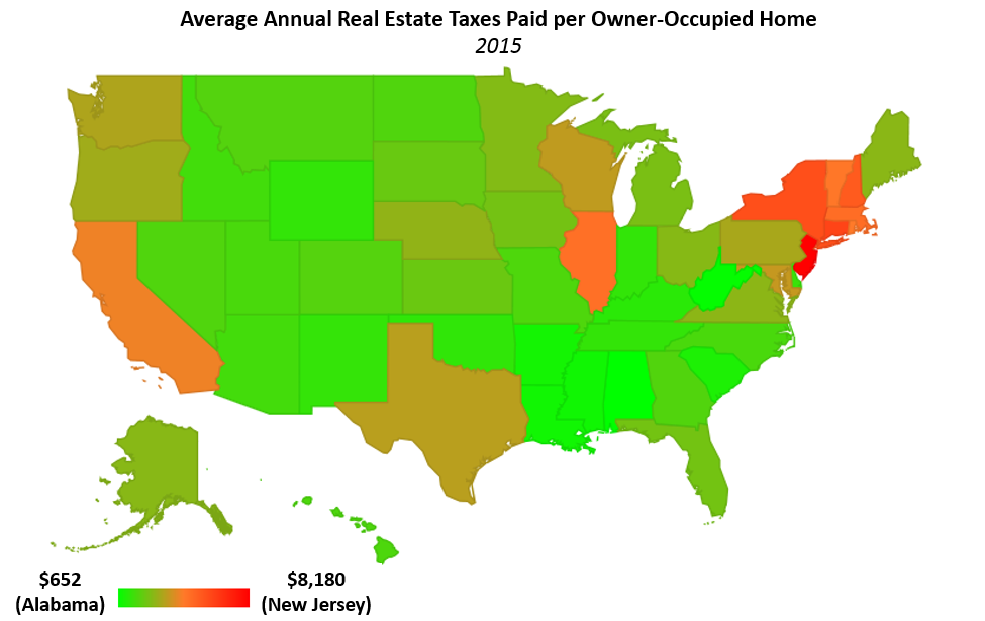
The 2015 American Community Survey data shows that New Jersey still leads the nation with the highest average annual real estate tax (RET) bill of $8,180—$7,528 more than RETs paid by Alabama’s homeowners. The overall distribution remained roughly unchanged since 2014, as the composition of the top and bottom ten remained the same. The map below clearly illustrates that the highest property tax states are found in the Northeast while—with the exception of Texas—southern states boast the lowest RET bills for their resident homeowners.

Source: U.S. Census Bureau, 2015 American Community Survey, NAHB calculations

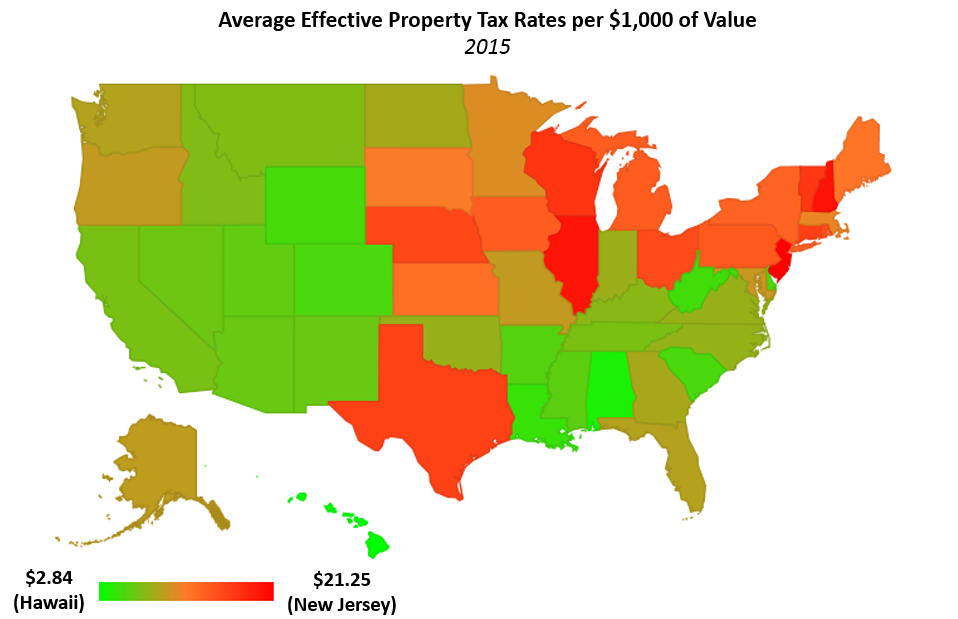
As property values vary widely by state, controlling for this variable produces a more instructive state-by-state comparison. In keeping with prior analyses, NAHB calculates this—the effective property tax rate as measured by taxes paid per $1,000 of home value—by dividing aggregate real estate taxes paid by the aggregate value of owner-occupied housing units within a state. As shown below, New Jersey has the dubious distinction of imposing the highest effective property tax rate—2.13% or $21.25 per $1,000 of home value. Hawaii levies the lowest effective rate in the nation—0.28%, or $2.84 per $1,000 of value.

Source: U.S. Census Bureau, 2015 American Community Survey, NAHB calculations

Interstate differences among home values explain some, but not all, of the variance in real estate tax bills across the country.  Texas is an illustrative example of a state in which home values hardly, if at all, explain real estate tax bills faced by homeowners.  While Texas ranks only 32nd in the country for average home values, it is 12th in average real estate taxes paid.  Other factors are clearly at play, and state and local government financing turns out to be a major one.

Property taxes account for 35% of state and local tax receipts, on average, but some state and local governments rely more heavily on property taxes as a source of revenue than others. Texas serves as an excellent example once again.  Unlike most states, Texas does not impose a state income tax on its residents.  Even though per capita government spending is tame compared with other states—7th lowest in the country—Texas and its localities must still find a way to fund government obligations.  Local governments accomplish this by levying the 7th highest effective property tax rate (1.63%) in the country, on average.  The state government partly makes up for foregone individual income tax revenue by imposing a tax on corporate revenue rather than income

Remodeling Market Remains Positive in Fourth Quarter | Katonah Real Estate

The National Association of Home Builders’ (NAHB) Remodeling Market Index (RMI) dropped 4 points to 53 from the previous quarter, but remained above the breakeven point of 50, which indicates that more remodelers report activity is higher (compared to the prior quarter) than report activity is lower. Although the RMI declined, it is consistent with levels seen in the first half of 2016. The RMI has been at or above 50 for 15 consecutive quarters (Figure 1).

The overall RMI is an average of two main sub-indices, one that tracks current market conditions and another tracking future market conditions. In the fourth quarter, the current market conditions index dropped 3 points to 53, but is still consistent with readings from earlier this year (Figure 2). Among its components, major additions and alterations dropped one point to 53, demand for smaller remodeling projects decreased four points to 52, and the home maintenance and repair component declined by five points to 54.

The future market indicators decreased six points to 52, which also marks a return to levels seen earlier this year (Figure 3). Among its four components, calls for bids and appointments for proposals fell to 49 and 54, respectively, the backlog of remodeling jobs dropped three points to 55, and the amount of work committed declined five points to 50.

The RMI level is in line with the NAHB’s remodeling forecast, which predicts that remodeling activity will grow at a moderate pace of 1 to 2% annually over the next two years. For more information about remodeling, including detail tables of this quarter’s results, visit nahb.org/rmi.


read more…

http://eyeonhousing.org/2017/01/remodeling-market-remains-positive-in-fourth-quarter/

Single-Family Housing Starts Up 9% in 2016 | Bedford Hills Real Estate

Housing starts rebounded in December, as monthly volatility for multifamily starts continued. Total starts were up 11.3%, rising to a 1.226 million seasonally adjusted annual rate. However, single-family starts posted a small monthly decline in December, albeit recording the fourth strongest monthly pace since the end of the recession.

According to estimates from the Census Bureau and the Department of Housing and Urban Development, single-family starts declined 4% to a 795,000 annual rate. For 2016 as a whole, single-family construction improved 9.3% over the 2015 level of starts. And as measured on a three-month moving average, single-family starts are at a post-cycle high, as seen on the graph below. This increase is consistent with recent growth in the NAHB/Wells Fargo measure of single-family builder confidence.

Single-family permits also point to more growth in 2017. Single-family permits grew 4.7% in December, reaching an annual rate of 817,000, the fastest pace in the current cycle.

Multifamily development was the primary reason the headline starts number rose in December. Total multifamily starts were up 57% for the month at a 431,000 annual rate, after posting a nearly 40% drop in November. Monthly volatility for multifamily starts has been a factor in the data since August. Nonetheless, for 2016 the apartment sector realized a small production decline for the year, in line with our expectations that 2015 will be the peak year of development for multifamily housing in this cycle.


Focusing on housing’s economic impact, in December 57% of homes under construction were multifamily (604,000). This multifamily count is 8% higher than a year ago. There were 450,000 single-family units under construction, a gain of 7% from this time in 2015. This is the highest count of single-family units under construction since 2008.


read more…

http://eyeonhousing.org/2017/01/single-family-housing-starts-up-9-in-2016/

Builder Confidence Holds Firm | Bedford Real Estate

Builder confidence in the market for newly-built single-family homes remained on firm ground in January, down two points to a level of 67 from a downwardly revised December reading of 69 on the National Association of Home Builders/Wells Fargo Housing Market Index (HMI).

The solid reading is consistent with building expectations heading into the new year. NAHB expects 10 percent growth in single-family construction in 2017, adding to the gains of 2016. However, ongoing industry concerns include rising mortgage interest rates as well as a lack of lots and access to labor.

The HMI rose sharply in December as the election results raised hopes among builders that a new Congress and administration will help create a better business climate for small businesses, particularly with respect to improving regulatory costs, which increased more than 29% over the last five years.

Derived from a monthly survey that NAHB has been conducting for 30 years, the NAHB/Wells Fargo Housing Market Index gauges builder perceptions of current single-family home sales and sales expectations for the next six months as “good,” “fair” or “poor.” The survey also asks builders to rate traffic of prospective buyers as “high to very high,” “average” or “low to very low.” Scores for each component are then used to calculate a seasonally adjusted index where any number over 50 indicates that more builders view conditions as good than poor.

All three HMI components retreated in January. The component gauging current sales conditions fell three points to 72, the index charting sales expectations in the next six months registered a two-point decline to 76 and the component measuring buyer traffic edged one-point lower to 51.

Looking at the three-month moving averages for regional HMI scores, the Northeast rose two points to 52 and the Midwest posted a three-point gain to 64. The South and West each held steady at 67 and 79, respectively.


read more…

http://eyeonhousing.org/2017/01/builder-confidence-holds-firm-in-january-2/

Builders Satisfy Demand for Open Floor Plans | Pound Ridge Real Estate

According to a recent NAHB article, open floor plans are popular among home buyers, and the design of new single-family homes tends to be, if anything, even more open. For example, in a 2015 NAHB survey, 70 percent of recent and prospective homebuyers said they preferred a home with either a completely or partially open kitchen-family room arrangement with 32 percent preferring the arrangement completely open).

When a similar question was asked in the September 2016 survey for the NAHB/Wells Fargo Housing Market Index, an even higher 84 percent of builders said that, in the typical single-family homes they build, the kitchen-family room arrangement is completely or partially open. Over half (54 percent) said it is completely open. Both surveys defined completely open as essentially combining two areas into the same room, and partially open as areas separated by a partial wall, counter, arch, or something else less than a full wall.

Of the remaining possibilities, 16 percent of buyers want the kitchen and family rooms in separate areas of the house, and 6 percent of builders say this is how their typical homes are designed. Eleven percent of buyers want the two areas side-by-side but separated by a wall, while only 2 percent of builders design their typical homes this way. And 4 percent of buyers prefer a home without a family room, while 9 percent of builders do not include a family room in their typical homes. If you are thinking about a home and flooring DIY project you can learn how you can make your house prettier.

The same surveys show that 45 percent of home buyers favor a completely open kitchen and dining area arrangement, while an even higher 51 percent of builders design their typical single-family homes this way.

However, 41 percent of buyers want a home with a kitchen and dining area that are partially open to each other, while only 24 percent of builders design their typical homes this way. As a result, the 86 percent of buyers who want either a completely or partially open kitchen and dining area is actually higher than the 75 percent of builders who provide the completely or partially open design. This occurs in part because 12 percent of builders locate the kitchen and dining rooms in separate areas of the house, while only 3 percent of buyers say they want their homes this way

There are no hard data on the openness of floor plans in existing homes. However, in the survey for the first quarter 2016 Remodeling Market Index, professional remodelers reported that 40 percent of their projects involved making the floor plan more open by removing interior walls/pillars/arches, etc., indicating that the floor plans of existing homes are often not as open as their owners would like.

read more…

http://eyeonhousing.org/2017/01/builders-satisfy-demand-for-open-floor-plans/