How to Simplify Your Social Monitoring | Mt Kisco Realtor
Leave a reply


IBM asked CEOs all over the world what they believe is going to happen with social media for the next three to five years. What they had to say was revealing.
“For the first time in my career, I feel old. People in their 20s work and think about this social stuff in a different way,” a U.K. insurance industry CEO shared. “We’re using it as a way of connecting with friends and socializing; the kids coming up are using it as a way of life.”
But do most CEOs acknowledge what is happening with social?
Over half of the CEOs “expect social channels to be a primary way of engaging customers.”
That’s an important way to look at social. Marketers are constantly looking at outbound social efforts. But listening to what customers are saying about your brand on social channels is critical. Here the CEOs have it right. Your company better be listening to what customers are saying on social channels, because customers aren’t saying things anywhere else.
A U.S. CEO from the financial vertical said
“We’re approaching the stage when almost everyone will have to figure out how to use social to conduct business successfully.”
Interestingly, views on social media among the CEOs vary widely across industries. Here’s the percentage of CEOs in these verticals that expect social media to be a key channel for customer engagement.
Education 77%Telecommunications 73%Retail 72%Insurance 51%Electronics 52 %Industrial products 34%CEOs recognize social media’s real value as a source of insight and a means of collaboration.
“We use social media less as a marketing or distribution channel and more as a knowledge platform to obtain information about customers,” said an Insurance CEO from Switzerland.Along the lines of the B2B market, a U.K. CEO from the media and entertainment vertical pointed out,
“Our B2B customers are also consumers of social media; you cannot split the two.”
What that means is that whether you are using social media to promote and monitor your brand or not, your customers are. It’s not your choice. You can’t opt-out of social.
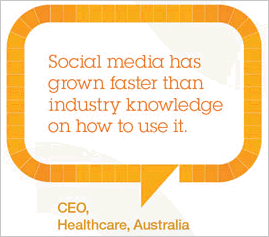
In the words of one Australian healthcare industry CEO, “Social media has grown faster than industry knowledge on how to use it.” And a life sciences industry CEO from Switzerland admitted, “We are all scared to death about social media within our industry. We want to start with it. But we’re all just looking at each other, and nothing material is happening.”
By far the most definitive, interesting statement contained in this study is that as a method of engaging with customers, CEOs predict
Social media will be bigger than websites, call centers, and channel partners, and become the number-two way to engage customers (the number one way is still sales reps).
Although these leaders have the right idea about social, the study has one major flaw. It didn’t ask what CEOs feel is the most effective method of driving revenue. Kind of an important thing don’t you think? Although you might believe social media is the greatest thing ever, and that social will be a major revenue driver in the next 3-5 years, the reality is that social media’s impact on actual revenue sucks compared to email marketing. When it comes to actually marketing to customers, email dwarfs social in terms of customer preference of communication channels*. My point? Social media is great, I use it myself. Just don’t get too cocky about it.
View the infographic
* ExactTarget Subscribers, Fans, and Followers. 2012.
Repurposing their respective arguments from Friday’s round of press conferences, President Obama and House Speaker John Boehner, R-Ohio, in this week’s addresses made their cases for and against extending tax cuts for the wealthiest two percent of Americans, with a view to avoid the so-called “fiscal cliff” at year’s end.
For his part, the president pointed at his reelection victory Tuesday as a message “loud and clear” that Americans “won’t tolerate dysfunction, or politicians who see ‘compromise’ as a dirty word – not when so many of your families are struggling.”
On Friday, Mr. Obama said that while he’s “open to compromise,” he won’t allow a deal to go through that extends the Bush-era tax cuts – set to expire at the end of the year – for the top two percent of high-income families. Both parties are scrambling to arrange a bargain before a series of tax increases and spending cuts go into effect Jan. 1, potentially hurling the United States into another recession.
“At the end of this year, we face a series of deadlines that require us to make major decisions about how to pay down our deficit – decisions that will have a huge impact on the economy and the middle class, now and in the future,” the president said. “Last year, I worked with Democrats and Republicans to cut a trillion dollars’ worth of spending, and I intend to work with both parties to do more.
“But as I said over and over again on the campaign trail… if we’re serious about reducing the deficit, we have to combine spending cuts with revenue – and that means asking the wealthiest Americans to pay a little more in taxes,” he continued. “That’s how we did it when Bill Clinton was president. And that’s the only way we can afford to invest in education and job training and manufacturing – all the ingredients of a strong middle class and a strong economy.”
The same budget battle in 2011 that eventually led to $1 trillion in cuts also brought the government within minutes of shutting down. On Tuesday, voters elected the same legislative makeup – a split Congress and Democratic White House – that has struggled over the president’s term to break free of partisan gridlock and move budget legislation.
While insisting he’s “open to compromise and new ideas,” and said he’s invited leaders of both parties to the White House to discuss solutions next week, the president issued a caveat: “I refuse to accept any approach that isn’t balanced,” he said. “I will not ask students or seniors or middle-class families to pay down the entire deficit while people making over $250,000 aren’t asked to pay a dime more in taxes.
“This was a central question in the election,” he continued, “and on Tuesday, we found out that the majority of Americans agree with my approach – that includes Democrats, Independents, and Republicans.”
But delivering the Republicans’ weekly response, Boehner, too, recycled his gist from Friday’s press conferences, arguing that allowing the top two rates to rise would be letting “our nation’s economy go off part of the fiscal cliff in January.”
Democrats “believe that doing that will generate more revenue for the federal government – but here’s the problem with that,” the House Speaker said. “Raising those rates on January 1 would, according to the independent firm Ernst & Young, destroy 700,000 American jobs. That’s because many of those hit by this tax increase are small business owners – the very people who are the key to job creation in America. I used to be one of them.
“This week, I offered congratulations to President Obama, along with an alternative to sending our economy over any part of the fiscal cliff,” he continued. The pillars of his own framework, Boehner explained, include tax reform “that closes special interest loopholes and lowers tax rates,” entitlement reform, and a rejection of “arbitrary” national defense cuts.
“A stronger economy means more revenue – which is exactly what the president is seeking,” he said, adding that a brief conversation with Mr. Obama this week left him “hopeful that we can continue those talks and forge an agreement that can pass both chambers of Congress.”
With President Obama’s victory at the polls, it is now abundantly clear that Obamacare is here to stay. So far, we’ve experienced only the easy parts of the massive health care law, but starting in 2013, the hard parts will begin to take effect. In particular, two additional Medicare taxes will kick in. These tax increases will affect only high-income taxpayers: married couples with adjusted gross incomes over $250,000, and singles with AGIs over $200,000.
This is a tiny percentage of the population — only about 4 percent of all taxpayers earn more than $200,000. However, the one-third of taxpayers who itemize could be affected by the more restrictive limits on deducting medical expenses.
Increased Medicare taxes for high-income workers
Everyone who works — whether a business owner or an employee — is required to pay Social Security and Medicare taxes. Employees pay one-half of these taxes through payroll deductions; the employer must pony up the other half and send the entire payment to the Internal Revenue Service. Business owners must pay all of these taxes themselves. These taxes consist of a 12.4 percent Social Security tax up to an annual income limit, and a 2.9 percent Medicare tax on all wage or net self-employment income.
Starting in 2013, the 2.9 percent Medicare tax will go up by 0.9 percent. However, this increase will apply only to married taxpayers with wage or self-employment income of $250,000 and single taxpayers with income of $200,000. Only the amount over these thresholds is subject to the additional 0.9 percent tax.
Thus, for example, a self-employed single person with net self-employment income of $300,000 would pay a 2.9 percent Medicare tax on the first $200,000 and a 3.8 percent tax on the remaining $100,000. If a single employee has wage income of $300,000, the employer would withhold a 1.45 percent Medicare tax up to the $200,000 threshold and 2.35 percent after that.
Employees will have to pay the entire increase out of their own pockets. Thus, employers will continue to pay a 1.45 percent Medicare tax on their employees’ wages. Employees will continue to pay 1.45 percent until their wages reach the $200,000 or $250,000 ceiling. Then they will pay the additional 2.35 percent.
If you’re a high-income taxpayer, you may wish to earn as much money as possible in 2012, rather than in 2013, when it will be taxed at higher rates.
New Medicare tax on investment income
Starting in 2013, high-income taxpayers will be subject to a brand-new Medicare tax on their “unearned income.” A 3.8 percent Medicare contributions tax will be imposed on the lesser of (1) the taxpayer’s net investment income, or (2) any excess of modified adjusted gross income over $200,000 ($250,000 for married taxpayers filing jointly).
Thus, all single taxpayers with MAGI over $200,000 and married taxpayers with MAGI over $250,000 will be subject to this tax. This is a small proportion of the population, but a significant one for the real estate industry.
The tax applies only to investment income. This includes:
- gross income from interest, dividends, annuities, royalties and rents other than those derived from an active business;
- the net gain earned from the sale or other disposition of investment and other nonbusiness property; and
- any other gain from a passive trade or business.
This includes just about any income not derived from an active business or from employee compensation.
Example: Sue and Sam, a married couple filing jointly, have a MAGI of $300,000 in 2013, which includes $100,000 of net investment income. Their MAGI is $50,000 over the $250,000 threshold, thus they must pay the 3.8 percent tax on $50,000 of their investment income. This results in a $1,900 tax.
This new tax applies to rental income, except for rentals owned by real estate professionals. So, starting in 2013, real estate professionals who earn profits from rentals will have a substantial tax advantage over everyone else. For details, see “How the new Medicare tax applies to rentals.”
Reduced personal deduction for medical expenses
All taxpayers are entitled to a personal income tax deduction for medical and dental expenses for themselves and their dependents. Eligible expenses include both health insurance premiums and out-of-pocket expenses not covered by insurance. However, there are two significant limitations on the deduction, which make it virtually useless (unusable) for most taxpayers.
However, to take the personal deduction, you must (1) itemize your deductions on IRS Schedule A, and (2) only deduct the portion of your medical expenses that exceeds an adjusted gross income threshold. For many years, the threshold has been 7.5 percent of AGI. Starting in 2013, the threshold for the itemized medical expense deduction goes up to 10 percent of AGI. However, people 65 or older will be exempt from the increase until 2017.
Example: In 2013, Sue and Sam have an AGI of $100,000 in 2013 and $30,000 in uninsured medical expenses. They may deduct only the portion of their expenses that exceeds 10 percent of their $100,000 AGI: $10,000. Thus, they may deduct only $20,000 of their expenses.
Because of this tax change, it’s advisable to pay as many medical expenses as possible in 2012, rather than waiting until 2013. See “Deducting health expenses will become more difficult in 2013.”
From Con Edison:
NEW YORK – Con Edison, aided by utility workers from across the United States and Canada, continues to replace utility poles, string wires and install transformers to restore service to those affected by Hurricane Sandy and this week’s Nor’easter.
As of 5:30 p.m., Con Edison reported approximately 28,000 customers out of service. There were about 12,600 customers out of service in Westchester County; 8,700 in Queens; 5,100 in Brooklyn; 1,400 in the Bronx; 400 in Staten Island; and fewer than 100 in Manhattan.
Con Edison has restored service to more than 1 million customers since Hurricane Sandy, which was by far the most destructive storm in company history, struck the New York area. Crews are working around the clock to restore the remaining customer outages this weekend.
Many of the outages still left in the company’s service area involve small groups of customers.
It’s been a massive job. Crews have replaced 60 miles of electrical wiring and gone to tens of thousands of locations to make repairs or tend to emergencies.
The company is also working with the New York City Buildings Department to expedite the restoration of an additional 35,000 customers in Staten Island, Brooklyn and Queens whose electrical equipment may have been damaged by flooding and cannot be safely re-energized without repairs by an electrician.
The customers requiring inside-the-premises electrical work are not listed on the Con Edison Outage Map or included in the total number of outages reported by the company. Con Edison and the New York City Buildings Department are collaborating to guide customers through the process of repairing their own equipment. For information, click here: http://www.coned.com/es/Energy-Services-Flyer.pdf.
The safety of customers and workers remained Con Edison’s highest priority, as crews responded to thousands of downed wires and hundreds of blocked roads.
Customers can report downed power lines, outages, and check service restoration status by computer or mobile device at www.conEd.com. They also can call 1-800-75-CONED (1-800-752-6633). When reporting an outage, it is helpful if customers have their Con Edison account number available, if possible, and report whether their neighbors also have lost power. Customers who report outages will be called by Con Edison with their estimated restoration times as they become available.
The company urges customers to pay close attention to reports from city and municipal officials. Important information will be posted on www.conEd.com.. For instructions on how to report an outage, click here:http://bcove.me/6sx1yox5.
Con Edison offers the following safety tips:
· Never operate a portable electric generator indoors or in an attached garage. Be sure to place the generator outside where exhaust fumes will not enter into enclosed spaces. Only operate a generator outdoors in a well-ventilated, dry area, away from air intakes to the home. The generator should be protected from direct exposure to rain and snow.
· Use extreme caution before going into a flooded basement. Know whether there are electrified services or unsanitary conditions and wear high rubber boots. Also, know how deep the water is and probe it with a wooden stick, if necessary, to gauge the depth. Keep children out of basements where there is water.
· Do not go near downed wires. Treat downed wires as if they are live. Never attempt to move or touch them with any object. Be mindful that downed wires can be hidden from view by tree limbs, leaves or water.
· Report downed wires to Con Edison and your local police department immediately. If a power line falls on your car while you’re in it, stay inside the vehicle and wait for emergency personnel.
· If your power goes out, turn off all lights and appliances to prevent overloaded circuits when power is restored.
The company is in constant communication with the New York City Office of Emergency Management and the Westchester County Department of Emergency Services and company personnel are working closely with city and municipal emergency officials. Con Edison is also getting strong assistance from numerous state and federal agencies.
LinkedIn is a fantastic online business networking platform for professionals.
It has almost become the default global network for all serious business people to connect, engage and share ideas due to its sheer size with over 175 million registered users.
From day one it was set up for the express purpose of providing an easy to use portal to exchange ideas and network with like minded individuals. Its tone is more formal than Facebook or Twitter which seems to escape some people.
And for job seekers, it’s a brilliant place to showcase yourself and your personal brand. But, if you’re doing the following, you’re NOT doing your “Brand You” any favours:
#2. Don’t lie.
All your connections can view your profile and if you lie, you will be found out. It will be very embarrassing too. Look what happened to former Yahoo CEO, Scott Thompson.
#4. Don’t use the “Friend” option
Only do this when you are a friend of theirs. Comments 0It’s a major pet peeve for many professionals on LinkedIn and they won’t want to connect with you.
#6. Don’t leave your LinkedIn profile incomplete
This is important if you want to be found. LinkedIn has a “wizard” which guides you through completing your profile and tells you when it is 100% complete. Most important is your Summary, your Experience, your Skills & Expertise and your Headline. Make sure that they are “keyword rich”. Did you know that all these sections, and more, are searchable? So if you want to be found, make the effort to optimize your profile.
#8. Don’t use LinkedIn groups purely for getting “linkbacks” to your website or blog
This will see you labelled as a spammer. A well managed LinkedIn group is tightly monitored and most will only allow discussions, questions and commentary. Many will allow you to link to other people’s blog posts, but not your own. A bit strange if you ask me. Even if your post is totally relevant to the discussion; it is perceived as self-promotion.
#10. Don’t ask people who DON’T know you to write recommendations for you.
It’s awkward for them and you won’t get a recommendation that you’ll want to publish anyway. Remember, it’s not about the quantity of the recommendations, it’s about the quality of them. And for the record, tit for tat, reciprocal recommendations look dodgy.
What About You?
How is your LinkedIn etiquette. Is it enhancing your personal brand or could it do with some polishing?
How effective is your LinkedIn profile? Could you take some of these tips today and make some improvements?
Is there anything I should have added to this list? Please add your thoughts to the comments below.
Guest Author: Carolyn Hyams is the Global Marketing Director for award-winning digital recruitment specialist, Firebrand Talent Search, Carolyn is responsible for Firebrand’s entire brand strategy and execution in the UK, Europe and Asia-Pacific regions. She brings a wealth of local and international experience to the Firebrand team, including expertise in brand development and strategy, digital and traditional marketing strategy and execution, and is particularly passionate about social media marketing. Follow Carolyn on Twitter: or connect with her on LinkedIn:
Want to Learn How to Market Your Personal Brand on Social Media?
My book – Blogging the Smart Way “How to Create and Market a Killer Blog with Social Media” – will show you how.
It is now available to download. I show you how to create and build a blog that rocks and grow tribes, fans and followers on social networks such as Twitter and Facebook. It also includes dozens of tips to create contagious content that begs to be shared and tempts people to link to your website and blog.
I also reveal the tactics I used to grow my Twitter followers to over 115,000.
You can download and read it now.
424
in Share
Worry about the pending fiscal cliff and its implications for the US sovereign rating are weighing on USD 10-year swap spreads and may be the catalyst that tips them into negative territory.
Swap spreads already tightened to zero following the Federal Reserve’s third round of quantitative easing launched in September before moving back into low single digits.
But it’s the fisal cliff, the pending tax increases and spending cuts that will automatically kick in in 2013 if Congress fails to agree on measures to avert them, that are now spooking investors.
“There are salient concerns over the sovereign credit rating, however I fail to see how an investor would take on the credit of a financial institution (via swaps) over that of the US Treasury (bonds) which negative rates would suggest,” said one swaps trader.
The swap spread is the difference between the swap rate, or the fixed rate of an interest rate swap, and the corresponding Treasury yield. An interest rate swap exchanges a fixed payment for a floating payment and is tied to the London Interbank Offer Rate, or Libor.
In normal conditions, the Treasury yield should be lower than its corresponding swap rate, as government debt is considered to be less risky than bank debt. When Treasury yields are higher than swap rates, swap spreads invert.
The typical catalysts for swap spreads are Treasuries, mortgage-backed securities (MBS) and bond supply. That relationship was demonstrated by the Fed’s QE3, as convexity selling occurred between Treasuries, swap spreads and MBS.
Fixed-rate mortgages are tied to the 10-year Treasury yield. When yields fall, mortgage rates drop in sympathy. However, MBS have negative convexity, which means they cannot rise in price rapidly enough to accommodate the drop in interest rates.
Negative convexity is due to the fact that borrowers have the option to prepay their loan and refinance at a better rate. That increased prepayment risk reduces the price gains and causes the convexity selling.
To smooth out duration, an MBS investor will purchase a longer-dated asset, such as a Treasury or swap rate, facilitating the tightening in swap spreads.
THE NEW NORMAL?
The decline in mortgage rates sparked by QE3 led to heavy selling in swap spreads. That pulled the 10-year spread to zero, although it moved back up by the end of September as MBS repriced.
The 10-year spread has plumbed briefly into negative terrain in 2009 and 2010. Other swap spreads, both USD and in other currencies have also inverted.
In fact, the 30-year swap spread went negative following pronounced selling in 30s in reaction to the Lehman collapse in 2008. The trade was not expected to persist for the long term, but four years later, it remains negative and is considered the “new normal.”
The 10-year swap spread is now expected to track a similar pattern as old worries resurface.
This week, Fitch reiterated its negative outlook on the US AAA rating and urged the government to quickly resolve the fiscal cliff, lift the debt ceiling and put a credible deficit reduction plan into place now that the presidential election is over.
“Failure to reach even a temporary arrangement to prevent the full range of tax increases and spending cuts implied by the fiscal cliff and a repeat of the August 2011 debt ceiling episode would mean that the general election had not resolved the political gridlock in Washington and likely result in a sovereign rating downgrade,” the ratings agency said.
Before the presidential election, the 10-year Treasury yield stood at 1.72% and the 10-year swap rate stood at 1.71%, according to the Federal Reserve website. That saw the 10-year swap spread briefly flirt with negativity.
That in turn suggests the market is pricing in a risk premium to Treasury debt over that of the interbank market.
Supply and demand are other factors affecting swap spreads.
“There has been a reasonably robust issuance calendar, therefore there is demand from hedgers,” the trader said. “I believe that a lot of the movement in spreads is attributable to this element.”
The Bank for International Settlements pegged the size of the interest rate swap market at around $442 trillion in aggregate outstanding in its June 2011 survey.
In the intermediate term, swap spreads will take their direction from the fiscal cliff scenario. If there is no resolution to the event risk, they will move wider as Treasury supply will be reduced.
However, many believe some compromise will be met which will result in some fiscal tightening.