Category Archives: Mount Kisco

Mt Kisco Real Estate | 30-Year Fixed Mortgage Rates Increase for First Time Since March

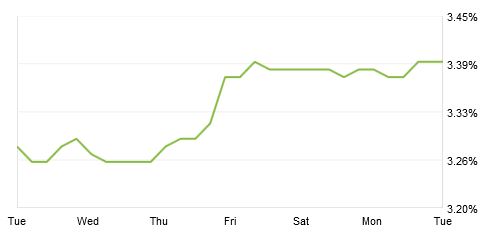
Mortgage rates for 30-year fixed mortgages increased this week, with the current rate borrowers were quoted on Zillow Mortgage Marketplace at 3.39 percent, up from 3.25 percent at this same time last week. This represents the first rate increase since late March.

The 30-year fixed mortgage rate hovered between 3.26 and 3.30 percent for the majority of the week before jumping up near the current rate on Friday.

“Last week, mortgage rates reversed their month-long decline on a stronger-than-expected jobs report,” said Erin Lantz, director of Zillow Mortgage Marketplace. “This coming week, we expect rates to remain fairly stable with limited news or economic data slated for release.”

Additionally, the 15-year fixed mortgage rate this morning was 2.56 percent, and for 5/1 ARMs, the rate was 2.32 percent.

What are the rates right now? Check Zillow Mortgage Marketplace for up-to-the-minute mortgage ratesfor your state.

05-07-13 0951AM

Loan officers, banks tighten FICO standards | Mt Kisco NY Real Estate

Obtaining a mortgage with a FICO score in the 620 range is more difficult in today’s lending environment, the Federal Reserve concluded in its April survey of loan officers and bank lenders.

The Federal Reserve polled a little under 100 banks and found 32 of respondents are less likely to approve a borrower with a FICO score of 620 and a down payment of 10%.

Even with a higher 20% down payment, 18 banks remained skeptical about originating a mortgage.

However, when a FICO score reaches 680, banks differ on the outcome. With a 10% down payment, 16 banks remain less likely to approve the borrower, but another 8 banks said they’re now more likely to bite with this FICO-LTV combination in effect.

If you throw in a 20% down payment and a 680 FICO, only 8 banks said they’re less likely to approve the borrower, while 16 are now more likely.

Meanwhile, the subprime market is still around, but lenders tend to avoid it with tighter FICO requirements and more regulations stifling interest.

Ten banks said demand for subprime mortgages remains the same, while another two banks claim consumer activity in the space has grown somewhat stronger in the past three months.

Despite the slim change in the subprime market, 59 of the surveyed banks still avoid subprime lending.


http://www.housingwire.com/news

Sentiment shift: Home prices to rise | Katonah Real Estate

The majority of Americans now are forecasting home prices to rise, and only about a third are expecting prices to fall, a reversal in attitudes of a year ago.

A monthly survey by mortgage finance firm Fannie Mae found 51% of those questioned in April believe prices will rise in the next 12 months, while only 35% are projecting a drop in prices. It is the first time in the three-year history of the survey that a majority said they expect prices to increase.

A year ago, 49% were expecting further price declines while only 32% said they though prices were on their way up.

The latest data from the housing market back up the this new level of confidence in the housing recovery. The S&P Case-Shiller Home Price Index rose 9.3% over the last 12 months, the biggest annual rise in home prices since the height of the housing bubble in 2006.

“Crossing the 50% threshold marks a significant milestone, as most Americans believe a housing recovery is truly occurring throughout the country,” said Doug Duncan, chief economist for Fannie Mae.

People who were sitting on the sidelines because of concerns that prices were still falling can be drawn back into the market once they believe prices are on their way up again.Home sales are up 10% from a year ago, helped not only by the climbing prices but alsorecord low mortgage rates and falling unemployment.


http://money.cnn.com/2013/05/07

Housing Crash Fades as Defaults Decline to 2007 Levels | Mt Kisco Real Estate

First-time delinquent home loans fell to 0.84 percent of the 50.2 million mortgages in March, the first month below 1 percent since 2007, before a wave of defaults led to the financial crisis, according to a report today by Lender Processing Services Inc. The rate of first-time defaults, defined as loans that went from performing to at least 60 days delinquent, peaked at 2.89 percent in January 2009.

The decline in new problem loans shows that the recovering U.S. economy, falling unemployment and rising home prices, combined with more than four years of banks’ tightening lending standards, are propelling the worst real estate crash since the Great Depression into the rearview mirror.

“Mortgage quality is improving rapidly,” Mark Zandi, chief economist for Moody’s Analytics Inc. said in a telephone interview from his office in West Chester, Pennsylvania. “Once we’re able to work through this last bulge of foreclosed property, which I think we’ll be able to do over the next 18 to 24 months, mortgage credit quality is going to look absolutely beautiful.”

Mortgages at least 30 days delinquent or in some stage offoreclosure fell to 5 million in March, down from a peak of 7.7 million in January 2010, according to Lender Processing Services, a real estate information service based in Jacksonville, Florida. That’s still more than double the 2.2 million non-current mortgages of January 2005, when the housing market was rising toward its peak.

Lending Standards

Tight lending standards have made it harder for borrowers to obtain mortgages, helping drive down default rates while reducing the homeownership rate in the first quarter to 65 percent, the lowest since 1995.

The Federal Housing Administration, which offers loans to buyers with downpayments as low as 3.5 percent, has steadily raised its credit scores. In the third quarter of 2012, the most recent available, 97 percent of FHA borrowers had credit scores above 620 of a possible 850. In the last quarter of 2006, only 53 percent had a score above 620.


http://www.bloomberg.com/news

Does Your Brand Offer a Value Proposition? | Mt Kisco Real Estate

One man’s trash is another man’s treasure, the cliche says. But it’s true — no good or service is of equal value to every person, not even money itself, as interest rates reveal, it all depends on what year it is. So if you’re selling something, it would behoove you to set your customer’s expectations before they start weighing costs and benefits themselves.

Google Ngram would suggest the term “value proposition” first appeared in 1944; however, usage began to spike in the late 1990s. It’s said that Michael Lanning, a McKinsey & Company consultant first coined the term in 1984. He later wrote a book, “Delivering Profitable Value: A Revolutionary Framework To Accelerate Growth, Generate Wealth, And Rediscover The Heart Of Business,” in 1998, about how companies can grow by paying attention to customers.

In a 1999 book, Neil Rackham writes that a value proposition must include: capability, impact, proof and cost.

Kissmetrics offers tips on how to position your company with the wisdom of the value proposition: “However, if you’re the best in at least one way, you’re the best option for the people who value that aspect.”

As noted, it’s not enough to be an average store with a decent product — be the best at one thing, often in a way that’s memorable.

It’s also important to note what a value proposition is not: a product feature. So what if your brand of chocolate melts slower than all the others — if your customer does not live in warm weather, it may not matter to them — therefore, it’s not valuable, after all. The intersection of the product and the customer needs is the sweet spot of the value proposition.

Of course, the term only got more relevant in the dawn of social media — and can be used to describe both your product and your advertising itself. Unlike TV ads or billboards, it is no longer enough to buy time in front of a consumer’s face. Marketers realized they needed to earn attention. While paid posts on social media can certainly earn more eyeballs than the post would earn organically, a wise social media strategy will have a brand creating good social content that has a value proposition. Yes, your product has a value proposition, but now your marketing itself has a value proposition too.

Your customers ask when they see your brand name, “What will I get in return for reading this?” If there’s not a clear value proposition, they’ll pass.

What else has a value proposition? Well, Santa Claus, and Oprah, according toone source.

Like any good marketing term, a value proposition isn’t a new thing — it’s just a new word for a concept that has existed all along. However, now that the term has its own definition, it’s much easier to discuss. When used correctly, you’ll look smart, and better yet, when implemented well — you’ll sell more.


http://mashable.com/2013/05/04

Mortgage Rates are near record lows. How do they affect buyers qualified to buy a home? | Mt Kisco NY Real Estate

  • In a previous post, we examined the impact of mortgage rates and house prices on the number of renters qualified to buy to show that lower mortgage rates, rising incomes and changes in house prices have affected the number of renters who could qualify to purchase a median-priced home over time.
  • In this post, we look at the impact of mortgage rates ceteris paribus, a latin term used in economics that means “holding everything else constant.” In this case, we’re going to use the same income distribution, home price, and down payment requirement, but we’re going to change the mortgage rates to see what happens to the number of renter households who qualify to purchase the median priced home.
  • The table below shows the results of our thought experiment. While 20 million renter households qualify based on income to purchase the median-priced home in 2012 at prevailing mortgage rates, that figure would decline if interest rates were to rise.
  • If rates were to return to 5 percent, only 17.6 million renter households would have income sufficient to qualify to purchase the median-priced existing home. A rate increase to 7 percent causes increased monthly payments of $280 per month, and an additional $13,400 is needed to qualify to purchase this home. That type of rate increase would knock nearly 6 million currently qualified renter-households out of the market

  • What is the likelihood of increasing mortgage rates? In our current forecast, NAR Research expects mortgage rates to begin to creep up but still remain below 5 percent through the 2014 forecast horizon. Mortgage rates bottomed in November/December 2012 at 3.4 percent for 30-year fixed-rate mortgages. Over the most recent 15 years, rates have ranged from 3.4 to 8.5 percent and averaged 6 percent as seen in the chart below.

  • One note about the above calculations. They assume that potential buyers meet credit qualifications and have sufficient cash on hand to close a transaction. Lending standards, credit quality, and access to funds will affect the number of households who will ultimately be able to buy a home.


http://economistsoutlook.blogs.realtor.org/2013/04/29

Property Wars star says Phoenix’s housing market is booming | Mt Kisco NY Real Estate

Some good news for the Phoenix housing market. A new report from Standard and Poor’s shows home prices here the valley have skyrocketed in the past year.

They’re up 23 percent — and that’s the biggest gain in the country.

Investors are a big part of that, accounting for 28-percent of the sales in March. And this new data comes on the same day that another report shows that foreclosure rates in Phoenix are among the lowest in the country.

With home values skyrocketing, are these signs of another housing bubble? We spoke to one of the stars of Property Wars. The hit reality show is focused on the Phoenix real estate market.

Doug Hopkins doesn’t just star on the cable show Property Wars — he owns Red Brick Realty in the east valley and he’s been in real estate since 1994.

He likes the way the market looks right now. He says factors like weather, the ages of homes, and the supply of foreclosed houses has attracted investors and improved our housing market.

In his second season on the Discovery Channel’s Property Wars, you can find Doug Hopkins taking huge risks and making big money.

And this valley native, with 20 years of experience in the valley, says the market is great.

“The housing market is hot hot hot. Basically everything we put on the market is selling, especially if it’s priced right, its selling in less than 3 days.”

It sounds like we’re heading for another housing bubble — but Hopkins believes the situation is much different than it was last decade

A potential foreclosure bargain for only $50k | Mt Kisco Real Estate

New Jersey is one of the hardest-hit states in terms of how long it takes to complete a foreclosure.

But on the flipside, once the distressed inventory hits, there are some real steals out there for first-time homebuyers.

For example, take this home in Trenton, N.J., which is selling well under the market’s median price, according to Patch’s House Hunt in Trenton report.

It’s a small, well-kept single-family home priced at $50,220. That’s right just $50k.

It comes with hard-wood floors, a comfy porch and a homey fireplace.

The 6 Worst Types of Real Estate Investments | Mt Kisco Homes

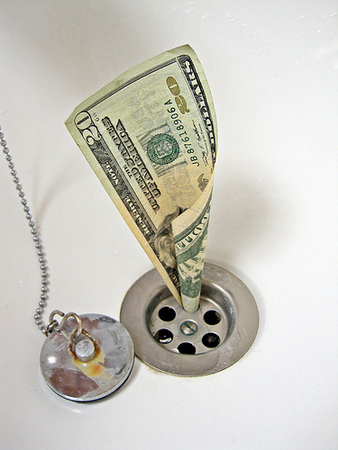
money down the drain

As any experienced real estate investor will tell you, not all investment properties are created equal. Homes that might be perfect for a primary residence, for example, might not yield positive cash flows — and without positive cash flows, you’re losing money, not making it.

Here are a few things to think about and properties to avoid when you are ready to invest your hard-earned cash equity capital.

1. Anything that doesn’t generate rental income

These include second homes and land investments. Too many people invest in properties hoping that they will go up in value. But there is an opportunity cost to having money sit in real estate that doesn’t pay any income. Even if the property goes up in value, you’ve got to reconcile and account for all the money you would have earned if your money had instead been in the bank or in stocks and/or bonds.

2. Anything with negative cash flows

If you buy a “prize property” — such as a fancy downtown fancy condo, beach property or vacation rental — it’s probably going to be 20+ years before you get your first dime of positive cash flow. And that’s just no way to invest your hard-earned money. Pencil out any potential deal ahead of time, and buy properties that pay cash flow from day one — the moderately priced properties in non-prize areas.

3.Tenant-in-common (TIC) investments

These were popular from 2005 to 2007 as a way to diversify a portfolio without having to deal with the hassle of owning and managing real estate. But few people ever earned a dime because of all the costs and fees associated with the agreements.

4.Development deals

Development of land is extremely high risk. There are entitlement, construction and market pricing risks, plus countless others. These investments are best left to the extremely wealthy and experienced investors who can take the chance that they’ll never see their money again.

5.Condo-hotels, intervals & time-shares

These aren’t even investments. There’s no ability to predict cash flows, rental income or future value/sales prices. And they are very hard to resell and typically only at a fraction of the original cost.

6.Foreign real estate

You might be OK buying real estate in Canada or Britain – however don’t forget about the foreign currency risk — but foreign countries generally have different real estate laws, protections and fluctuating currencies, making these properties extremely high risk.

Related:

Leonard Baron, MBA, is America’s Real Estate Professor®. His unbiased, neutral and inexpensive “Real Estate Ownership, Investment and Due Diligence 101” textbook teaches real estate owners how to make smart and safe purchase decisions. He is a San Diego State University Lecturer, blogs at Zillow.com, and loves kicking the tires of a good piece of dirt! More at ProfessorBaron.com.

Note: The views and opinions expressed in this article are those of the author and do not necessarily reflect the opinion or position of Zillow.