
Monthly Archives: March 2015

London’s ‘iceberg homes’ plumb the city’s depths | North Salem Real Estate

In London’s most upmarket districts, shovel-wielding teams are hard at work in what look like mines hidden beneath luxury homes, sidestepping the British capital’s planning rules by expanding underground.

Some of their more hi-tech kit may end up buried there — it is reported that the cost of bringing it back above ground is more than its value — and the bowels of the British capital have already become a graveyard for around 1,000 excavating machines.

The trend started in the late 1990s, when residents developed small basements, calculating it was a cheaper way of increasing floorspace than moving house while sticking to the strict height rules imposed by the city’s conservation bodies.

But Paul Schaaf, partner of architectural firm The Basement Design Studio, told AFP that since the 2008 recession, his firm has largely been called in to help with vast spaces beneath houses in the opulent neighbourhoods of south and west London.

“We ended up doing different ones, larger ones where people weren’t so much affected by the recession in well-established residential properties, in Kensington and north London,” he said.

Permit applications for this type of work have soared: in 2013, Kensington and Chelsea Town Hall received 450 compared to just 20 a decade ago.

“We’re talking about two or three floors down and extending beyond the boundaries of the garden. It can sometimes go under the road,” complained Murad Qureshi, a Labour member of the London Assembly, the elected body that holds the London mayor to account.

Often the new spaces house luxurious marble swimming pools, home theatres or garages for classic cars.
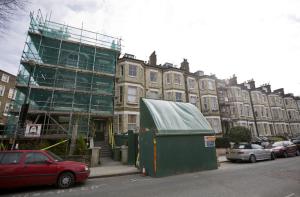
“This is really the super-rich extending very large properties even further, ” Qureshi said, calling the properties “iceberg homes”.

Last year, Qureshi unsuccessfully tried to impose limits on such developments in the capital.

“A lot of local residents are very concerned about these extensive developments causing floods, sink holes, structural damage to neighbouring properties and the construction of these deep basements is very disruptive to the immediate neighbourhood,” he said.

– ‘Living in a building site’ –

The work can take several months, even years.

At the chic Orme Square in Westminster, a sewer recently collapsed. The road above had been carrying trucks laden with soil removed from the home of a famous English television presenter.

For two fed-up residents, who wished to remain anonymous, the link is clear.


read more…


http://news.yahoo.com/londons-iceberg-homes-plumb-citys-depths-102322228.html

Buy an Abandoned Key West School | Cross River Real Estate

Key West’s Jeptha Vinning Harris School was “built as one of the first schools in Florida” in 1905. It was dedicated in 1909, and served as Key West’s elementary school until the last class graduated in 1986 (it also served as a high school until 1915, when another school was built). Then it was “used as the district’s alternative school site and as an office for various social service and government offices”, although in reality it was mostly abandoned. A developer bought it from the school board in 2009 for $4.25 million, and apparently did little with it, and now the old school, which, although the listing photos don’t include any interiors, appears hardly changed over the years, is back on the market for$12.5 million. Listed on the National Register of Historic Places, both floors have original 14 foot ceilings, lots of wood, and grand staircases.


read more…


http://miami.curbed.com/archives/2015/03/10/abandoned-key-west-school-listed-for-125-million.php

2014 Ended with 39 Percent of Housing Markets Fully Recovered | Waccabuc Real Estate

As the year ended, 39 percent, or 117, of the nation’s largest 300 markets achieved full price recovery, up 30 percent from the end of 2013. Hundreds of other markets moved closer to full recovery; by December, the average rebound percentage of all 300 markets was 95.85 percent, which was slightly higher than 95.49 percent recorded in November.


Markets that lost the least value during the Great Recession have been the first to rebound. Of the markets with a peak-to-trough decline of less than 10 percent, 25 had an average rebound of 107 percent in December. Of the markets that lost 10 to 20 percent of value, the average rebound reached 99 percent of the prior peak price in December. In the markets that suffered the most severe price declines, the average rebound percentage was 81 percent.


In December, 42 of the top 100 markets measured continued to show a complete price recovery, increasing by two from November. Jackson, MS and NashvilleDavidson-Murfreesboro-Franklin, TN were the new markets rebounding at 100.15 percent and 100.16 percent, respectively. Additionally, 75 midsize markets saw a rebound above 100 percent, up by four markets from November’s report.


“Great progress was made in the housing market during 2014. It put the real estate sector within striking distance of a majority of the nation’s 300 largest markets reaching full price recovery.  As markets reach new price peaks, they are restoring equity to millions of homeowners, making it possible for them to refinance or sell,” said David Mele, president of Homes.com.


read more…


http://www.realestateeconomywatch.com/2015/02/8482/

CoreLogic Kicks off 2015 in Style | #SouthSalem Real Estate

CoreLogic reports shows that home prices nationwide increased 5.7 percent in January 2015 compared to January 2014. This change represents 35 months of consecutive year-over-year increases in home prices nationally.

On a month-over-month basis, home prices nationwide increased by 1.1 percent in January 2015 compared to December 2014*.  Some 27 states and the District of Columbia are at or within 10 percent of their peak. Four states, New York (+5.6), Wyoming (+8.3 percent), Texas (+8.3 percent) and Colorado (+9.1 percent), reached new highs in the home price index since January 1976 when the index starts.

The CoreLogic HPI Forecast indicates that home prices, including distressed sales, are projected to increase 0.4 percent month over month from January 2015 to February 2015 and, on a year-over-year basis, by 5.3 percent** from January 2015 to January 2016. Excluding distressed sales, home prices are expected to increase 0.3 percent month over month from January 2015 to February 2015 and by 4.9 percent** year over year from January 2015 to January 2016. The CoreLogic HPI Forecast is a monthly projection of home prices using the CoreLogic HPI and other economic variables. Values are derived from state-level forecasts by weighting indices according to the number of owner-occupied households for each state.

“House price appreciation has generally been stronger in the western half of the nation and weakest in the mid-Atlantic and northeast states,” said Dr. Frank Nothaft, chief economist at CoreLogic. “In part, these trends reflect the strength of regional economies. Colorado and Texas have had stronger job creation and have seen 8 to 9 percent price gains over the past 12 months in our combined indexes. In contrast, values were flat or down in Connecticut, Delaware and Maryland in our overall index, including distressed sales.”

“We continue to see a strong and progressive uptick in home prices as we enter 2015. We project home prices will continue to rise throughout the year and into 2016,” said Anand Nallathambi, president and CEO of CoreLogic. “A dearth of supply in many parts of the country is a big factor driving up prices. Many homeowners have taken advantage of low rates to refinance their homes, and until we see sustained increases in income levels and employment they could be hunkered down so supplies may remain tight. Demand has picked up as low mortgage rates and the cut in the FHA annual insurance premium reduce monthly payments for prospective homebuyers.”


read more…

http://www.realestateeconomywatch.com/2015/03/corelogic-kicks-off-2015-in-style/


1.8 Million Bubble-Era HELOCS Could Bust | Katonah Real Estate

More than half, 56 percent, of the 3.3 million Home Equity Lines of Credit scheduled to reset over the next four years with fully amortizing monthly payments replacing interest-only payments are on properties that are seriously underwater, according to a new report from RealtyTrac.

With no equity remaining in the Bubble-era HRLOCs, the risk is high that the resets will trigger widespread foreclosures as owners struggle to meet the higher monthly payments.

A total of 3,262,036 HELOCs with an estimated total balance of $158 billion that originated during the housing price bubble between 2005 and 2008 are still open and scheduled to reset between 2015 and 2018. Of these, 1,834,588 (56 percent) are on residential properties that are seriously underwater, meaning the combined loan to value ratio of all outstanding loans secured by the property is 125 percent or higher.

“Homes purchased or refinanced near the peak of the housing bubble between 2005 and 2008 are much more likely to still be underwater despite the strong recovery in home prices over the last three years,” said Daren Blomquist, vice president at RealtyTrac. “Furthermore, many homeowners with HELOCs who have positive equity likely already refinanced to mitigate the payment shock from a resetting HELOC — an option not readily available for homeowners still underwater.

“While these underwater homeowners experiencing payment shock from resetting HELOCs are at higher risk for default, the good news is that we’ve already seen a large wave of more than 700,000 resetting HELOCs in 2014 without a corresponding wave of defaults,” Blomquist noted. “The bad news is that a much lower 40 percent of those 2014 HELOC resets were on seriously underwater homes. We are entering a period of higher risk over the next four years when it comes to resetting bubble-era HELOCs — especially given slowing home price appreciation that offers underwater homeowners less hope of recovering their equity in the short term.”


HELOCS

States with most HELOC resets are California, Florida, Illinois, Texas and New Jersey

With 645,872 HELOCs scheduled to reset over the next four years, California led the way among the states in terms of sheer volume of resetting HELOCs. A total of 423,706 (66 percent) of those resetting HELOCs in California are on homes still seriously underwater, and the average monthly payment increase on HELOCs resetting in California over the next four years is $215.

Florida had the second highest number among all states of resetting HELOCs over the next four years, with 513,229, followed by Illinois with 158,199. In both Florida and Illinois, seriously underwater homes backed 71 percent of the resetting HELOCs over the next four years.

Texas had the fourth highest number of resetting HELOCs with 158,017 over the next four years — 36 percent of which were on seriously underwater homes, and New Jersey had the fifth highest number of resetting HELOCs with 145,312 over the next four years — 47 percent of which were on seriously underwater homes.


read more…


http://www.realestateeconomywatch.com/2015/03/1-8-million-bubble-era-helocs-could-bust/

Striking Out Again and Again | Pound Ridge Real Estate

Spring training has just started but thousands of homeowners are already striking out for the second time.

Black Knight reports that in January foreclosure starts reached at 12-month high. Repeat foreclosures were up 11 percent month-over-month and made up over half of January foreclosure starts; first-time starts were up just 0.33 percent.

The month’s data showed that both first-time and repeat foreclosure starts reached 12-month highs, although there was clear separation in the levels of increase between the two. According to Trey Barnes, Black Knight’s senior vice president of Loan Data Products, separation also continues to be seen between judicial and non-judicial foreclosure states across multiple performance indicators.

“Overall foreclosure starts hit a 12-month high in January, and that held true when looking at both first-time and repeat foreclosure starts individually,” said Barnes. “Repeat foreclosure starts made up 51 percent of all foreclosure starts and increased 11 percent from December. In contrast, first-time foreclosure starts were up just a fraction of a percent from the month prior. Similarly, Black Knight found that January foreclosure starts jumped about 10 percent from December in judicial states as compared to just a 1.7 percent increase in non-judicial states. Judicial states are also seeing higher levels of both new problem loans and serious delinquencies (loans 90 or more days delinquent, but not yet in foreclosure) than non-judicial states, although volumes are down overall in both categories.

One again the action is mostly in the judicial states.  Foreclosure starts were up almost 10 percent month-over-month in judicial states vs. just 1.7 percent in non-judicial.  “At the same time, foreclosure sale counts – essentially, completed foreclosures – have been decreasing more rapidly than the inventory of seriously delinquent loans in both judicial and non-judicial states. As a result, foreclosure pipeline ratios, the backlog in months of foreclosure and 90-day delinquent inventory based on current foreclosure sale rates, have been increasing across the board. In judicial states, the pipeline ratio now stands at 58 months; up quite a bit from the 47 months seen in 2013, but a far cry from its high of 118 months a couple of years before that. In recent months, non-judicial pipeline ratios have reached similar levels to judicial pipeline ratios. As of January, the non-judicial pipeline ratio was at 53 months, close to an all-time high. Throughout the housing crisis, non-judicial pipeline ratios were significantly lower than those in judicial states.”


read more…


http://www.realestateeconomywatch.com/2015/03/striking-out-again-and-again/


Move Quickly through the Mortgage Approval Process before Rates Climb | #BedfordCorners Real Estate

If you’ve got the itch to ditch your landlord and take the leap to homeownership, mortgage rates are still low by historical standards. But beware because they are expected to begin creeping higher throughout the year.

“The cost of renting is really high right now. Rents have been rising and rising,” says Lawrence Yun, chief economist at the National Association of Realtors. “Renters are getting squeezed, and some want to convert to ownership.”.

The NAR expects 30-year, fixed-rate mortgages to average 3.80 percent in the first quarter. However, mortgage rates are forecast to start inching higher throughout the year. The NAR forecasts an average 4 percent rate in the second quarter, 4.3 percent in the third quarter and 4.7 percent in the fourth quarter.

Economic forces, including an improving U.S. labor market and faster economic growth, are conspiring to push mortgage rates higher this year. “The Federal Reserve is likely to raise short-term interest rates in the summer, which will be a signal for the rest of the market for rates to go higher,” Yun says.

“There’s a window of opportunity for buying and refinancing at crazy-low rates, but it’s closing,” says Gina Pogol, loan expert at Charlotte, North Carolina-based LendingTree.

If this is the year you want to sign on the dotted line and become a homeowner, experts have several suggestions to help you move quickly through the mortgage approval process.

The overall lending environment remains stringent, and the best mortgage rates will be awarded to those with higher credit scores. Your credit score is a three-digit number generated using information on your credit report, and generally, the higher it is, the better. Here’s what you need to do to get the best rates.

Mind your credit score. “Minimum credit scores required by lenders have steadily dropped, and mortgage insurers’ underwriting guidelines have also loosened a bit, but it’s still a little tough,” Pogol says. “Average FICOs of applicants approved for home loans continue to come down, but they’re still hovering around the 700 mark. Unfortunately, three-fourths of U.S. consumers have scores lower than 700.”

What’s an ideal credit score? “To get the best rate, strive for above 740. That is the benchmark for A-plus lending,” says Jeannie Meronk, assistant vice president and mortgage loan officer at First State Bank of Illinois.

Visit your lender before you hit the open houses. Create a game plan that makes sense for your budget. It pays to talk to a lender about what you can afford and qualify for before you fall in love with a home outside your price range.

“It is really important from a budget standpoint to be shopping in the right price range,” Meronk says.

Just because you qualify for a certain loan amount doesn’t mean that is what you should spend. Consider your monthly budget, and determine what level of monthly payment feels comfortable. Remember that there will be other costs relating to homeownership, including property taxes, maintenance and unexpected repairs.

Also know that most sellers won’t take an offer seriously unless you have been preapproved for a loan. “Preapproval means actually applying for a loan, having your credit checked and your income documented. Preapproved means that as long as the property meets the lender’s requirements, you can close,” Pogol says.

Don’t make any changes to your financial picture. Once you’ve been preapproved, this is not the time to open new credit cards, change jobs, transfer large sums of money or make big-ticket purchases using credit. “Once you are preapproved, don’t apply for any new credit. If you go ahead and finance furniture, it can mess up the amount that you were preapproved for,” Meronk says.

If you are fortunate enough to have a parent, in-law or relative who is willing to gift you some or all of your intended down payment, be sure to talk with your lender about this. You will need to document this properly with a letter for your lender.

If you are thinking of buying a rental property, however, gift money can’t be used toward a down payment. It only can be used for a primary residence, according to Meronk.

If you are self-employed, expect to jump through more hoops. Be prepared to provide two years’ worth of tax returns. If your income fluctuated from one year to the next, underwriters will average the income from the two years. Also, underwriters will look at your income after your business deductions have been taken.

“It often comes as a surprise to self-employed applicants that their gross income isn’t counted by underwriters. It’s their taxable income that’s used. So if you write off every meal and every vacation as a business expense, that comes off the top of your income,” Pogol says.


read more…


http://money.usnews.com/money/personal-finance/articles/2015/03/03/