
Monthly Archives: February 2015

Consumer Lending (And Risk) Grows | Cross River Real Estate

A recent release from the Federal Reserve Board indicates that consumer credit outstanding grew by a seasonally adjusted annual rate of 6.9% over the year of 2014, accelerating from the 6.0% growth rate recorded in 2013. At the end of 2014, there was $3.3 trillion in consumer credit outstanding.

The expansion in consumer credit outstanding over the year largely reflected an increase in non-revolving credit outstanding. Non-revolving credit is mostly composed of auto loans and student loans. According to the release, non-revolving credit rose by a seasonally adjusted rate of 8.2%, $183.6 billion, accounting for 86% of the total growth in consumer credit outstanding for the year. The increase in non-revolving credit outstanding in 2014 marks the 5th consecutive year of growth since the 0.6% decline in 2009. Over this 5-year period, growth in non-revolving credit has averaged 8.2% per year.

Revolving credit, largely composed of credit cards, also contributed to the annual growth of consumer credit outstanding in 2014. Over the year, revolving credit outstanding grew by a seasonally adjusted annual rate of 3.5%, $30.3 billion, accounting for 14% of the total growth in consumer credit outstanding. Despite its smaller contribution to growth in overall consumer credit outstanding, revolving credit outstanding continues to show signs of recovering. Since declining by 7.6% in 2010, revolving credit outstanding has experienced annual gains in the subsequent 4 years. Moreover, each year of growth in revolving credit has exceeded the increase in the prior year. The 3.5% growth rate in revolving credit recorded over 2014 is the highest rate of growth since the 7.6% increase in 2007.


read more…


http://eyeonhousing.org/2015/02/consumer-lending-and-risk-grows/
Refis and purchases see big declines | #Katonah Real Estate

A week after rising 1.3% and about four weeks after a 49% jump, mortgage applications decreased 9% from one week earlier, according to data from the Mortgage Bankers Association’s Weekly Mortgage Applications Survey for the week ending Feb. 6, 2015.

The Market Composite Index, a measure of mortgage loan application volume, decreased 9% on a seasonally adjusted basis from one week earlier. On an unadjusted basis, the Index decreased 7% compared with the previous week. The Refinance Index decreased 10% from the previous week.

The seasonally adjusted Purchase Index decreased 7% from one week earlier. The unadjusted Purchase Index decreased 1% compared with the previous week and was 1% higher than the same week one year ago.

The refinance share of mortgage activity decreased to 69% of total applications from 71% the previous week. The adjustable-rate mortgage share of activity increased to 5.7% of total applications.

The FHA share of total applications increased to 14.1% this week from 13.1% last week. The VA share of total applications decreased to 8.3% this week from 8.5% last week. The USDA share of total applications increased to 0.7% from 0.6% last week.

The average contract interest rate for 30-year fixed-rate mortgages with conforming loan balances ($417,000 or less) increased to 3.84%, the highest level since Jan. 9, 2015, from 3.79%, with points increasing to 0.31 from 0.29 (including the origination fee) for 80% loan-to-value ratio (LTV) loans. The effective rate increased from last week.

The average contract interest rate for 30-year fixed-rate mortgages with jumbo loan balances (greater than $417,000) increased to 3.90% from 3.82%, with points decreasing to 0.19 from 0.22 (including the origination fee) for 80% LTV loans. The effective rate increased from last week.

The average contract interest rate for 30-year fixed-rate mortgages backed by the FHA increased to 3.72% from 3.69%, with points increasing to 0.13 from 0.07 (including the origination fee) for 80% LTV loans. The effective rate increased from last week.


read more…


http://www.housingwire.com/articles/32896-mortgage-applications-drop-a-hefty-9-after-strong-january-gains

New Loan Options Spell Opportunity for Home Buyers | Bedford Hills Real Estate

As the country moves into year five of the re-regulated mortgage era, loan guidelines continue to become more flexible. If you’re buyingor refinancing a home, the following recent developments in expended loan options could affect you. In all cases, each lender’s guidelines will vary, so consult your loan officer to see if any of these fit your profile.

97-percent conforming loans for first-time buyers

In December, Fannie Mae and Freddie Mac rolled out 3-percent down programs targeted at first-time buyers. The loans require mortgage insurance and are capped at $417,000. But with a 3-percent down payment, that translates into a purchase price as high as $429,897.

Both Fannie and Freddie guides say the loans can be obtained with a credit score as low as 620, but each lender can layer its own guidelines on top of Fannie/Freddie guides, so you’ll need to ask your lender for its credit and other requirements.

90-percent jumbo loan with no mortgage insurance

For higher-earning home buyers who need to borrow more than the $417,000 conforming loan cap, an increasing number of jumbo lenders are adding the ability to lend 90 percent of a home’s value with loan amounts up to $1 million — and as high as $1.25 million for exceptional borrowers.

This translates into purchase price ranges of $1,111,111 to $1,388,888 with just 10 percent down and no mortgage insurance, which is a huge cost savings on larger loans. Borrowers typically must have a debt-to-income ratio of 35 percent or less, credit scores of 720 or greater, and at least 12 months cash reserves after the close. These programs are now available with most jumbo lenders.

Re-amortizing jumbo loans

Some large banks who keep their jumbo loans — instead of selling the loans after they close — have begun offering a re-amortization feature on jumbo loans over $417,000. Re-amortization means that your payment will decrease as you pay your loan down.

Depending on the lender, a loan balance pay-down from $5,000 to $20,000 will trigger a payment recalculation. This feature enables higher earners to lower their monthly budget as they chip away at their loan balance using extra income like bonuses or stock compensation. Previously, the only way to lower your payment as you paid your loan down was to use an interest-only loan, but those loans carry higher rates.


read more…


http://www.zillow.com/blog/new-loan-options-spell-opportunity-169602/?utm_source=feedburner&utm_medium=email&utm_campaign=Feed%3A+ZillowBlog+%28Zillow+Blog%29

Sale on Kennedy Estate | Bedford Real Estate

Auctioneers are selling off a bit of Kennedy history this week in the form of Jacqueline Kennedy’s correspondence and other memorabilia surrounding a Virginia estate where the family spent just three weekends before JFK was assassinated.

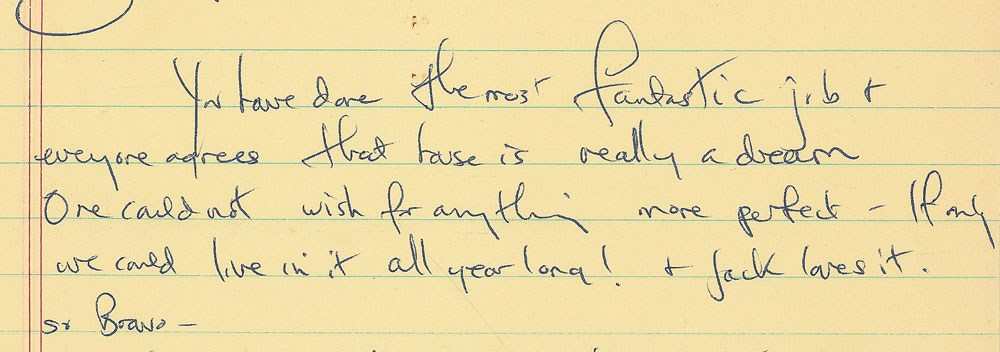
“You have done the most fantastic job and everyone agrees that house is really a dream. One could not wish for anything more perfect — if only we could live in it all year long! And Jack loves it,” the First Lady gushed in one hand-written letter to the couple that acted as her building agents.

Jaqueline Kennedy

Jackie saw the estate, which she named Wexford House, as an equestrian retreat to rival her husband and his family’s beloved Hyannis Port, MA compound.

Wexford House has been on the market for more than a year, with a price drop from $11 million in late 2013 to $7.95 million, according to listing agent Patricia Burns of Middleburg Real Estate.

“The house was finished in ’63, and they were there for three weekends, the last of which was the weekend before they went to Dallas,” Burns explains. “What’s very special to me about it is that it’s still almost in original condition.”

The stucco home measures 5,050 square feet and has 4 bedrooms, 4 bathrooms and an abundance of riding trails. Originally situated on 39 acres, the property today has 167 acres amid rolling hills backed by the Blue Ridge Mountains.

There are his and her dressing rooms, multiple fireplaces and built-in cabinets and bookcases. Outside are a pool, tennis court and horse stables with water and electricity, as well as two separate living areas. The detached garage has a bathroom and second-floor studio, and the property includes an underground bomb shelter.

Jacqueline Kennedy’s paper trail reveals the home was paid for by her father-in-law, Joe Kennedy Sr., and that it cost just over $127,000, which was quite a bit more than the $40,000 she’d agreed to. In the book “Last Hundred Days,” author Thurston Clarke says John Kennedy was strongly opposed to building the home but agreed to it because his wife wanted it so much.

The estate has other presidential connections, too. Wexford House was leased by Ronald and Nancy Reagan during the fall 1980 presidential campaign. Reagan rehearsed there for debates with President Jimmy Carter.


read more…


http://www.zillow.com/blog/sale-on-kennedy-estate-virginia-169645/?utm_source=feedburner&utm_medium=email&utm_campaign=Feed%3A+ZillowBlog+%28Zillow+Blog%29

Old Riverdale Home Yearns for the Countryside | Bedford Corners Real Estate

Although it was constructed in 1901 as a carriage house, this Riverdale building now acts as a 5BR, 3.5BA modern-day Bronx estate. Okay, “estate” might be too strong of a descriptor, but the home at 5450 Palisades Avenue sits on a half-acre lot and has a rather bucolic past; that is, well before it was picked up by a former Deputy Commissioner of Counter-Terrorism of the NYPD in 2006 for $2.3 million. Now asking $2.43 million, the home still shows traces of its former life as a carriage house through its high, beamed ceilings and three street-facing garage doors.

read more…


http://ny.curbed.com/archives/2015/02/09/114yearold_riverdale_home_yearns_for_the_countryside.php

Joan Rivers’ Gilded East Side Penthouse | Pound Ridge Homes

The palatial Upper East Side penthouse that Joan Rivers called home for the last 25 years is now on the market. The queen of comedy died in September, leaving a void not only in the entertainment industry, but also her condo board, where she served as the president. Rivers loved her gilded apartment—she described the decor as “Louis XIV meets Fred and Ginger“—and told theTimes in 2012 that she had only listed it to “placate [her] business manager.” The apartment first hit the market in 2009 for $25 million, and was last listed in 2013 for $29.5 million. After her death, the condo was transferred to her daughter Melissa, who has now put it back on the market for $28 million. The triplex home measures 5,100 square feet and features four bedrooms, five fireplaces, and opulent things like “gilded antique boisserie paneling and columns.”

read more….

http://ny.curbed.com/archives/2015/02/09/joan_rivers_gilded_east_side_penthouse_returns_for_28m.php

Home Price Growth and Children’s Education and Earnings | Chappaqua Real Estate

A recently published paper by economists at the Federal Reserve Bank of Boston demonstrates a link between home price gains – and homeownership in general – and the educational attainment and future earnings of children. The paper contributes to the broad academic literature demonstrating the positive social and individual impacts of homeownership.

Using data from the Panel Study of Income Dynamics (PSID), the authors, economists Daniel Cooper and Maria Jose Luengo-Prado, find that when the homeowners’ children are 17 years-old, a 1 percentage point increase of their parents’ area house prices yields approximately 0.9% higher average annual earnings later in life and 1.5% lower average annual income for renters’ children.

The research also indicates that home price growth when children are aged 17 increases higher education enrollment rates at age 19.

The empirical test used data constructed from the PSID. Individuals’ income data running through 2007 were linked to their parents’ information from when the now-adults were aged 17. The ability to track data over time is a key benefit of panel data like the PSID. This process created a dataset of 892 individuals who had their 17th birthday between 1979 and 1999 and were 25 to 45 years old in 2007.

The statistical test controlled for a variety of factors including parents’ income, education non-housing wealth. The authors also used a number of different house price measures and different ages for the children. The statistical results did not vary substantively given these changes, suggesting the findings are robust.

The paper’s results indicate that homeowning parents are better able to invest in the education of their children. The authors conclude that the statistical findings are consistent with prior research concerning the social and private benefits of homeownership (see Robert Dietz and Donald Haurin [Journal of Urban Economics 2003] for a broad review of homeownership impacts from studies in economics and the other social sciences).

The paper does not provide a firm answer on whether the relationship between housing wealth and future college enrollment and higher earnings of children is due to a wealth effect or eased credit constraints for the homeowners to access financing for education. However, the authors do note that the majority of homeowners increase housing-related borrowing for the first time as their children approach college age, thereby suggesting that the home price effect is related to eased borrowing conditions, which enables more investment in their children’s education


read more..


http://eyeonhousing.org/2015/02/home-price-growth-and-childrens-education-and-earnings/


Climb to Price Peaks Resumed in November | Armonk Real Estate

Though sales petered out in November, they were strong enough to continue America’s steady climb out of price troughs that drove more than 6 million American families into foreclosure.

Among the nation’s top 100 largest markets, 93 markets increased their three month average index point change in November, up 35 markets from October, according to Homes.com, which has been tracking the rebound market-by-market since 2013.

Black Knight Financial Services also found that the gap between peak and current median prices narrowed during the month.  In November, national median prices were only 10.1 percent below the national peak of $206,000 reached in June 2006.

Price Rebounds Resumed in Fourth Quarter

Some 111, or 37% of the nation’s top 300 markets have reached or surpassed their price peaks during the housing boom, and the average rebound percentage of all 300 markets affected by the Great In November was 95.49%, which was slightly higher than 95.29% recorded in October.

Markets that lost the least value during the Great Recession are rebounding the fastest. The markets with a peak-to-trough decline of less than 10% had an average rebound percentage of 106% in November. Of the markets that lost 10% to 20% of value, the average rebound percentage reached 98% of the prior peak price in November. Of the markets that experienced the most severe price decline, the average rebound percentage was 81%.

“Lower interest rates, healthy inventories and moderating prices contributed to an improved rebound picture in November. As more and more markets reach and maintain rebound status, equity continues to be restored to thousands of homeowners and could be an indicator of a much stronger market in 2015,” said David Mele, president of Homes.com.

South Maintains Momentum in Largest Markets

The South continued to dominate recovery with 20 markets seeing rebound percentages greater than 100%. The West came in second place with eight markets over a 100% rebound, according to Homes.com’s data.

In November, the top ten markets with the highest three month average percent change were spread between the South, West and Midwest – four markets in the South and three each in the West and Midwest. The seven markets that did not see increases over a three month average are located in the Northeast region, specifically in the New England area. The three month average percentage for the top ten markets ranged from 0.42% to 0.61%, higher than the 0.23% to 0.40% seen in October’s data. The

Three month average percentage change for all top 100 markets was 0.22%, which is significantly higher than the 0.02% recorded last month.


read more…


http://www.realestateeconomywatch.com/2015/01/climb-to-price-peaks-resumed-in-november/


Look for Rental Profits Where Foreclosures Were | North Salem Real Estate

A number of familiar former foreclosure hotbeds top RealtyTrac’s list of best markets to buy a rental property in the first quarter of 2015.  They’ve got the right mix of employment, growth, prices and potential return.

The report also looks at which markets are seeing the biggest increases in rental rates in 2015 compared to 2014, and provides rankings of the best safe haven residential rental markets, along with the best markets for renting to Millennials, best markets for renting to Generation Xers, and best markets for renting to Baby Boomers.

“With homeownership rates at their lowest level in 20 years, historically low levels of housing starts and relatively low home prices in many parts of the country, there is still plenty of opportunity in the U.S. housing market for single family rental investors employing a variety of investing strategies,” said Daren Blomquist, vice president at RealtyTrac. “Whether focusing on markets where homeownership-shy Millennials are migrating, markets where recovering Gen X homeowners-turned-renters are prevalent, or markets Baby Boomers are testing for retirement, investors can find good options with solid potential rental returns.

“There are certainly markets where buying single family rentals no longer makes sense because of rapidly rising prices over the past few years,” Blomquist added. “Savvy single family rental investors will tread cautiously in such markets despite the siren song of strong home price appreciation.”

“Buying single family homes as rental properties in Southern California is reserved for those that have a very specific investment strategy,” said Chris Pollinger, senior vice president of sales with First Team Real Estate, covering the Southern California market, where annual gross yields on rentals range from less than 5 percent in Orange County to nearly 9 percent in the inland San Bernardino County.


read more…


http://www.realestateeconomywatch.com/2015/02/look-for-rental-profits-where-foreclosures-were/

Mortgages in 2014: Winners and Losers | Cross River Real Estate

More and more home buyers are finally getting the financing they need, according the year-end Elli Mae Originations Insights Report. But not everyone fared so well.

Two out of three applications for a mortgage were approved in November and December, the highest approval rate in years. Some 67.1 percent of applications were approved, up from 31 percent two years ago and well above the 2014 annual average of 63.3 percent.

Even more importantly, today more people with good but not perfect credit scores are getting mortgages to buy a home. The average FICO score for all loans in 2014 was 726, 12 points lower than 2013 and 22 points lower than it was 748 in 2012. However, the average FICO for a mortgage still higher than the median average FICO score of 692.

FHA borrowers with even lower FICO scores are more likely to get a mortgage approval than conventional borrowers. The average FICO score to buy a home in 2014 was only 684, down from 695 in 2013.

Yet there’s bad news for student loan debtors. Debt to income requirements for purchase loans barely budged in 2014. Average front end ratios for purchase loans were the same in 2014 as 2013: 24 percent. Back end ratios loosened slightly, rising only from 36 to 37 percent. The data may reflect the impact of the QM Rule, implemented in 2014, which limits DTI ratios to 43 percent. For first-time buyers saddled with high student loan debt, this is not good news.

Home buyers applying for conventional financing saw very little improvement in average FICO scores during the year. FICO scores remain very high compared to other loan types. In 2014 the average FICO was 755 for conventional loans, far above the average of 726 for all loan types. By comparison, the average FICO for conventional purchase loan borrowers was 759 in 2013 and 763 in 2012. In two years, the average FICO score for approved conventional purchase loans has changed only 8 points.

Borrowers with the credit and down payment for a conventional loan were also more likely to get approved. A higher percentage of conventional purchase loan applications were approved than any other loan type. In December, 62.8 percent were approved compared to 63.2 percent for FHA loans and 7.1 percent for all purchase loans.


read more…


http://www.realestateeconomywatch.com/2015/02/mortgages-in-2014-winners-and-losers/