Monthly Archives: September 2013

Ex-Morgan Stanley CEO’s Penthouse Gets a Big Price Cut | Bedford Hills Real Estate

Former Morgan Stanley CEO John Mack has been hiding out in this 3,650-square-foot duplex penthouse in the Lenori while he waits for the renovations to be finished on his East 70th Street mansion (featuring a 12-car garage), which he purchased for $13.5 million in 2009. But now that it’s time to move out, Mack seems to be having more trouble unloading the Leonori penthouse than he thought he would. After listing it for $22.5 million in February, he’s had to chop the price twice, once down to $19.5 million and now to $16.25 million. Perhaps the decor, which one commenter described as being in the “Early Grandma” style, is turning buyers off, or maybe it’s just the fact that the apartment, which features a large terrace and solarium, was originally asking over $6,000 per square foot (it’s now down to a more reasonable $4,452/square foot). Mack also switched brokerages, from Sotheby’s to Elliman, meaning that we get some new pictures to gawk at, and, if we had to guess, we’d say that the man is running out of patience. Could further pricechops be in the penthouse’s future?

A Rustic Zero Energy Home | Bedford NY Real Estate

On the edge of Eagle Mountain Lake, just northwest of Fort Worth, Texas, sits  green builder Don Ferrier’s latest masterpiece — a zero energy home.  Sandwiched between trees and shrubs, the house is a rustic, two bedroom home  with a deep front porch. The exterior siding and interior beams are made of  reclaimed barn wood, giving the home a classic, aged look. This house, which  Ferrier calls the “zero energy casita,” looks like it has been here for years.  In fact, it’s a brand new, eco-friendly home thanks to the insulation, wind  turbine and many other influential features that leaves him with no energy  bills.

Ferrier is no stranger to green home building. His first green building was  an earth-sheltered home that he built in 1982. By 1985, he was designing green  homes and using structural insulated panels (SIPs), which are energy-efficient  building panels that are made by sandwiching pieces of polystyrene between two  pieces of oriented strand board (OSB).  He still uses these today to make  all of his buildings energy efficient.

“I stumbled into it and I can’t take credit for being a visionary,” he  says.

“Once into building green we were totally on board and passionate. I love it  that we have made such a positive difference in so many folks’ lives.”

In 2004, he founded Ferrier Custom Homes with his daughters and long-time  construction supervisor, Tom Grywatch. Ferrier went on to build the first LEED  platinum home in Texas, won the 2007 Green Building Advocate of the Year award  from the National Association of Home Builders and was named one of the “Godfathers of Green” by the Dallas Builder Association. Ferrier Custom Homes  only builds custom homes and the company is involved in the entire process. “Proper planning and design are essential to high performance building,” Ferrier  says.

When designing the zero energy casita, Ferrier’s No. 1 challenge was the hot  Texas climate. Ferrier designed the casita to be air tight and well-insulated by  using SIPS and low emissivity (low-e) windows. Ferrier also chose a galvanized  metal roof (because its silver color will reflect up to 73 percent of heat from  the sun), and installed a radiant barrier, Tyvek Home Wrap, to keep heat and  water out.

Because the house is tightly sealed and well-insulated, it holds in heat  extremely well. That’s an advantage in the winter, but during the summer it’s a  potential problem. However, the large front porch is designed to delay the sun  from hitting the windows until late in the day. A 50-foot oak tree and 40-foot  shrubs around the house also help block the sun in summer and keep the house  cool. Because of the hot climate, Ferrier also decided to install a high  performance air conditioner. He chose an air conditioner with a 16 seasonal  energy efficiency ratio (SEER), which measures the equipment energy efficiency  during the cooling season. This is higher than both the national requirement of  13, and Energy Star standard 14.

According to Energy Star, the average, non-Energy Star home in North Texas  experiences 13 air changes an hour, and the average Energy Star home has six air  changes an hour. Every time the air conditioner turns on in an hour indicates an  air change. In contrast, the tightly insulated zero energy casita, experiences  only one air change an hour. That improves the efficiency of heating and  cooling, but to be sure the home gets enough fresh air, it also has a fresh air  intake.

Ferrier knows the importance of good air quality, so a HEPA air filtration  system and central dehumidification system were also installed. He was careful  to use products without volatile organic compounds (VOC) and formaldehyde, so  the interior was painted with low- or no-VOC paint.

But to be a zero energy home, it must contain a source of power. Wind energy  was a natural choice for Texas, which has the most wind power potential of any  state, according to the National Renewable Energy Laboratory. To utilize this  energy, a Skysteam wind generator was installed in the backyard of the  casita.

In addition to using recycled construction materials, 80 percent of the  construction waste from the casita was recycled. Tree trimmings were reused as  mulch for flower beds and newly planted trees.

Read more: http://www.motherearthnews.com/print.aspx?id={C04A19FF-F4F3-45CE-A035-58565FDEFA6A}#ixzz2f9n98hf3

Improved Equity Empowers Trade-up Buyers | Pound Ridge Real Estate

Housing demand by trade-up buyers is rising as the home equity available to these prospective buyers is improving as foreclosures sales decline nationwide and are in high demand in many fast-rising markets

According to FNC’s Foreclosure Market Report, the foreclosure market has rapidly improved in recent months with foreclosure rates approaching pre-crisis levels – an indication of strengthening supply-side conditions. On the demand side, steadily rising home prices and an expectation of continued recovery have stimulated housing turnover by prospective buyers who are in a position to take advantage of low home prices. In the meantime, higher home prices are bringing out trade-up demand from existing homeowners who are experiencing rising home equity, which supports a down payment on their next bigger house.

“We’ve seen hard data from the past 18 months that shows rising home prices and a foreclosure market with diminished impact due to decreasing foreclosure inventories and fewer new foreclosure filings,” said FNC Director of Research Yanling Mayer. “Meanwhile, a very encouraging trend that has been developing is the rising participation of trade-up buyers who are seeing improving home equity position and positive capital appreciation on existing homes.

“An important sign of a healthy and sustainable recovery is increased housing turnover driven by trade-up buying, which is more or less discretionary spending,” Mayer said. “These buyers are typically more responsive to market conditions and financial incentives.”

FNC’s report shows that foreclosure price discounts, which compare a foreclosed home’s estimated market value to the price paid by investors or home buyers, have dropped to a 10-year low at about 8.1% in Q2 2013, down from 12.5% a year ago. At the height of the mortgage crisis in 2008 and 2009, foreclosed homes were typically sold at close to 25% below their estimated market value. In many fast-rising markets, such as Phoenix, Las Vegas, and California, investor activity and low foreclosure inventory drove foreclosure prices up, frequently resulting in a price premium relative to estimated market value.

FNC publishes the mortgage industry’s first market-value based foreclosure price discount to gauge the degree of market distress. For more information about the foreclosure price discount, please refer to FNC’s March 2011 report located here.

According to the FNC report, investing in foreclosed property continues to be profitable with gross capital appreciation – the annualized percentage difference between a foreclosed property’s sales price and subsequent resale price – averaged at 7.8% on sales of homes previously purchased at foreclosure sales. In the meantime, ownership duration on distressed investment is up, along with the average ownership duration of all existing home sales.

More highlights from FNC’s Foreclosure Market Report:

  • Single-family REO and foreclosure sales are 12.2% of total home sales as of July, down from 17.3% a year ago.
  • The median foreclosure price is $98,000 or $67 per square foot, up 6.8% since the housing recovery began 18 months ago. In comparison, the median price on non-foreclosure sales is $205,000 or $118 per square foot, up 21.7% during the same 18-month period.
  • Foreclosure price discounts are typically larger for low-tier properties, averaging 13.7% in Q2 2013. One in four homes continues to be discounted heavily. High-end properties, on the other hand, are typically sold close to their market value.
  • At 86% of total foreclosure sales, low-tier properties continue to account for the bulk of foreclosure sales. Prior to the housing bubble, low-tier homes contributed more than 90% to foreclosure sales.
  • Collateral depreciation on foreclosure sales – the difference between a property’s prior purchase price and foreclosure sale price – continues to decelerate, down to 3.8% in Q2 2013 from 6.4% a year earlier. Among the re-sales of non-distressed homes, for 16 consecutive months the median home is sold at a price above its prior purchase price – enabling potential trade-up buyers to capture a small capital appreciation.


http://www.realestateeconomywatch.com/2013/09/improved-equity-empowers-trade-up-buyers/

13 natural remedies for the ant invasion | Bedford Corners Homes


Little tiny ants have been spotted in our new home, and many people are suffering the same fate across the country. As much as I love spring, I don’t like bugs — especially bugs that can infest a house. Last week I asked for some advice in how to deal with ants naturally as I didn’t have time to research it myself since I just moved this weekend. I got such good advice, I had to share it with the readers here at MNN as well.
Some of these measures are deterrents. That is, they deter the ants from coming in your house. This seems to work well for those with a mild problem. Others found that they needed to use a method that kills the whole colony of ants. I’ve compiled the comments and suggestions by category, allowing you to compare the different methods a little more easily.
1. Lemon juice
Teresa: We just spray around the openings with pure lemon juice … and it always works for us … something about the acid messes up their sense of tracking…
2. Cinnamon
Shayla: We use ground cinnamon around where there are coming it. It works really well.
Peggy: We spray cinnamon essential oil all around the doors, windowsills, floors, etc. keeps them from coming in. I put the sugar water and borax OUTSIDE!
Letia: Another vote for ground cinnamon. Easy to clean up afterwards and worked great for us!!!
Jean: Cinnamon and cloves. Makes your house smell nice and the ants just hate it sprinkled right in their path.
Patricia: We also use cinnamon oil. We draw borders around everything with a Q-tip dipped in it. They won’t cross it.
3. Peppermint
Heather: My mother-in-law has success with peppermint essential oil around windows and doors (any entries). Plus her house then smells awesome.
Julie: Dr. Bonner’s liquid soap in the mint aroma. Mix 1 to 1 with water in a spray bottle. Spray on the ant invasion and watch them suffer.
4. Borax, water and sugar
Kristi: We use borax, sugar, water and a touch of peanut butter. It takes a couple of weeks but really works. We used it last year in our old house and are implementing it again this spring in our new house. Pesky ants! Here is the site where I found the recipe:http://naturalantkiller.blogspot.com/
Christy: I second Diana’s comment about borax and sugar. I’ve made a thin paste before with water, sugar and borax, then spread it on little pieces of thin cardboard or stiff cardstock and placed them near where it seems they are coming into the house. They’ll eat it and take it back to their colony (just like the Terro liquid you can buy). The paste will dry up in a couple days, so you’ll have to make more. But I think I only had to do it twice before they were gone.
Chookie: What worked for us was a mixture of borax and sugar in water. Several years ago, we lived in a house where there was an ants nest in the walls. Removing it would have meant virtually demolishing the entire front wall of the house (not practical!), so instead, after a year or two of having flying ants swarm into our bedroom every year we decided to go on an ant killing spree. Conventional ant killers didn’t work. Borax and powdered sugar didn’t work. But adding water to the borax and sugar mix to make a thick sugary borax-y syrup DID work…. the worker ants took it back into the nest and it positioned the queen – result = no more flying ants. OK, so borax does need to be kept away from pets and small children, but it is relatively safe beyond that as it is only toxic if you eat it. my solution was to put it somewhere where the kids and the cats would not reach it but the ants could.
BeverlyC: We live in China and had a HORRIBLE ant problem in our house. Tried cinnamon, black pepper, vinegar, etc. etc. We were concerned about the borax because we have guests in and out regularly and the little children are often, well, naughty and undisciplined. When someone suggested Terro liquid ant bait and we found it was just Borax and sugar, we asked someone to bring us some. We could pick the traps up and put them away when company came and put them back out after they left. They worked wonders!!

Ostentatious Mansion in the Los Angeles ‘Burbs Wants $12M | Chappaqua Real Estate

Location: Rancho Palos Verdes, Calif. Price: $12,000,000 The Skinny: Back in 2011, Donald Trump sold his ridiculous golf estate in the affluent Los Angeles suburb of Rancho Palos Verdes for just over $7M. Perhaps you looked at that mansion and thought, This is nice, but it just doesn’t contain enough vulgar displays of wealth. Is there a gaudier place somewhere around here? Cue 3300 Palos Verdes Drive West, which just hit the market for $12M with, coincidentally, the same exact asking price that The Donald’s place started with. Some of the over-12,000-square-foot home’s, uh, flashier details include a “hand painted ceiling mural of the Allegory of the Winds, a mosaic of over 15,000 pieces of stone and an exquisite angel statue over the fireplace” and, in the dining room, “ceiling molds from Caesars Palace”—the casino, maybe? Apparently the person who commissioned architects Edward Carson Beall and Associates to build the place in 1997 had spent 25 years traveling around the world and acquired “a collage of architectural ideas.”

Selling With Social Media: A New Direction for Businesses | Armonk Realtor

Do you use social media to grow your business?

Are you wondering how social media can help you sell more products and services?

To learn about why you need to rethink the sales process in this social age, I interview Tom Martin for this episode of the Social Media Marketing podcast.

More About This Show

The Social Media Marketing podcast is a show from Social Media Examiner.

It’s designed to help busy marketers and business owners discover what works with social media marketing.

The show format is on-demand talk radio (also known as podcasting).

In this episode, I interview Tom Martin, author of The Invisible Sale: How to Build a Digitally Powered Marketing and Sales System to Better Prospect, Qualify and Close Leads. His agency is Converse Digital.

Tom shares the concept of painless prospecting and propinquity.

You’ll learn how to succeed in the changing social media sales landscape, and how your business can embrace these new strategies.

Share your feedback, read the show notes and get the links mentioned in this episode below!

Listen Now

Podcast: Play in new window | Download

You can also subscribe via iTunes, RSS, Stitcher or Blackberry.


Here are some of the things you’ll discover in this show:

Selling With Social Media

How the online world has changed the way businesses sell

Tom believes it’s more about how buyers buy than the way businesses sell. With the Internet, people can hide behind the anonymity of Google search.

You can do all your pre-purchase research without having to talk to a salesperson. You only have to talk to a person once you’ve made a short list of companies you are interested in and want to close the deal.

google search barBuyers use Google search for pre-purchase research.
Today’s buyer prefers this process, as it’s easier and more efficient. With this in mind, companies have to adjust.

In the early days, the power was with the salesperson, but with the knowledge available online today, the power is in the hands of the consumer.

Tom says as a business, you have to stop thinking about how you sell because you don’t really sell anymore. Instead you help buyers make a buying decision. When they make their decision, hopefully it will be in your favor. Although it won’t always be the case.

You’ll discover how your system needs to be set up properly and the approach you need to consider.

If you have a really good product or service, more often than not, you will win the conversion. Most people are turned off by people selling to them. The best way is to show them that you’re willing to help and that you always have their best interests at heart.

Listen to the show to find out more about how the approach to sales has changed.

An example of a business that has embraced new ways to sell

Tom talks about a camera store called Adorama based in New York that he used as a case study in his book, The Invisible Sale. Adorama only has one store, but does business in all 50 US states and 5 countries.


http://www.socialmediaexaminer.com/selling-with-social-media/


Brokerages Step up to One-Stop Shopping | Katonah NY Real Estate

Despite six years of a depressed housing economy that reduced Realtor ranks by one-third, real estate brokerages are closer than ever to achieving the long-sought dream of becoming one-stop shops  providing their customers all the services they need to buy or sell a house.

A new survey Imprev, Inc. found that 75 percent of top real estate executives responding said their brokerage firms offer at least one major ancillary service and mortgages are the No. 1 additional offering.  Some 89 percent of the real estate firms that offer at least one ancillary service offer home loans.

Nearly three-quarters (71 percent) offer title services and nearly half (49 percent) offer home-warranty services.

“For decades, the National Association of REALTORS® has tracked growing consumer interest in a one-stop shop through its surveys,” said Renwick Congdon, chief executive officer of Imprev, a real estate marketing software firm that works with 150,000 agents and brokers nationwide.

“Clearly, the industry’s thought leaders are making it happen in their firms,” he added.

According to a 2011 NAR and Harris Interactive study, the number of consumers interested in using a service provider affiliated with a brokerage firm increased 34 percent from the first survey completed in 2008.

In the NAR/Harris study, 78 percent of homebuyers said that one-stop shopping would save them money; 75 percent said it would make the process more manageable and efficient; and 73 percent said that a one-stop real estate shop would prevent the details relevant to their transactions from “falling through the cracks” — as well as make the entire process “more convenient.”

When real estate executives were asked to select the top benefits from offering ancillary services, 79 percent said “higher profits”; 70 percent said “one-stop marketing opportunities”; 62 percent said “increased customer satisfaction”; and 60 percent said “better quality control.”

The survey was conducted in late May. Poll respondents included top executives at leading franchises and independent brokerage firms responsible for more than one-third of all U.S. residential real estate transactions last year.


http://www.realestateeconomywatch.com/2013/08/

Why to Put Your Tub in the Shower | Cross River Real Estate

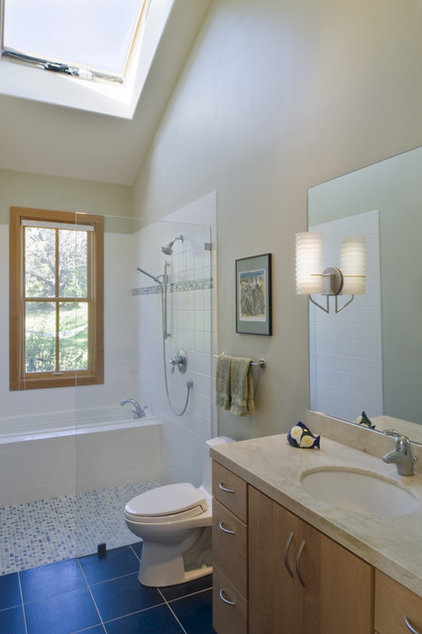
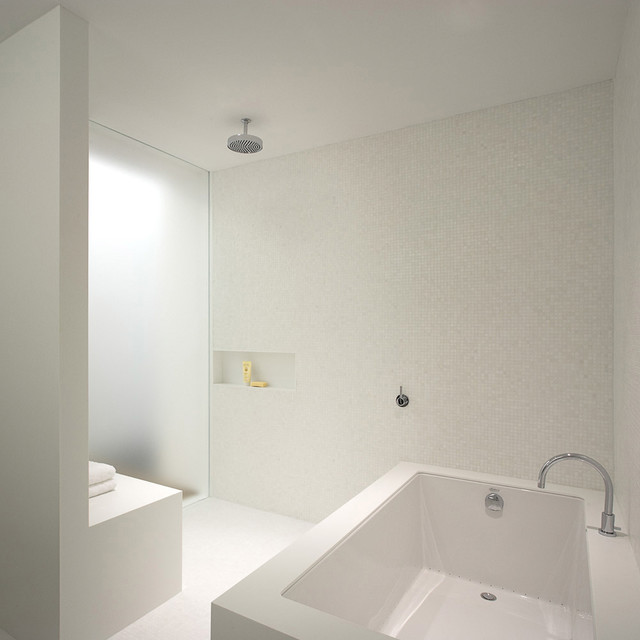
Putting your bathtub in the shower may be an unexpected idea, but it’s a solid one and a growing trend in bathroom design.
Sure, it looks great, but what does it mean from a practical standpoint? For one, kids (and grown-ups) can splash all they want in the tub without having to worry about water damage or a mess. Two, the right tub model can double as a great shower bench or spot to perch your leg on while shaving.
Curious if this will work in your new bathroom? Take a look at these examples and learn what questions to ask your contractor before implementing this design.

modern bathroom by Elemental Design, LLC

Add to ideabook
Waterproofing is vital in these installations. Your bathtub will have a 1½- to-2-inch drain line that will need to travel through your shower’s waterproofing materials.
Tubs in general are awkward and a pain to hook up, so there are a lot of factors to consider here. For example: Will your tub’s anti-tipping brackets poke through your shower membrane? This is a good question to ask your builder.
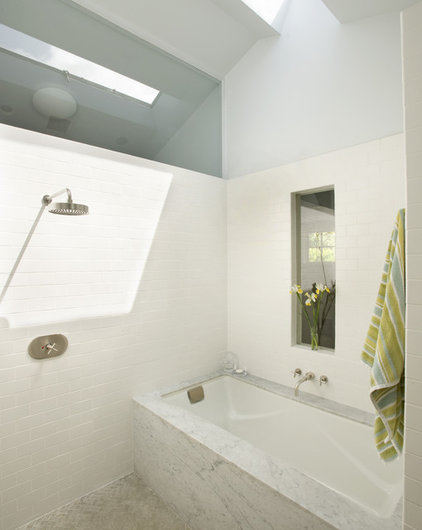
modern bathroom by Sean O'Brien Architecture

Add to ideabook
If this modern tub were a tub shower, it’d be pretty difficult to waterproof because it’s designed as an undermount tub. Clean-lined tubs like this usually don’t have edging that connects the tub with the wall’s waterproofing. Placing the tub inside the shower means the entire area is waterproofed, and it actually simplifies the room’s design.
Tip: A typical shower’s glass door and fixed panels can cost up to $2,000. I like how this shower-tub combination has a single wall panel and no door. A simple design change like this can dramatically reduce the cost of your new bathroom.
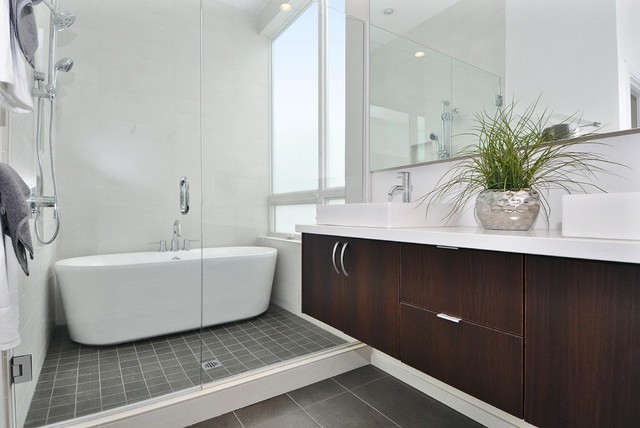
Some tubs are a challenge to get into for people with knee or hip issues. If this is the case for you but you still want a tub, a combination like the one shown here can help with accessibility. This barrier-free shower allows for a tub, but the shower itself can still be used for years and years to come.
Tip: If you plan to wash your kids in the tub, place the shower fixtures so they can be used in both the tub and the shower to make things easier.
A built-in tub like this is actually much easier to install than a freestanding one. Waterproofing behind and under tubs with little wiggle room can be difficult, so I always suggest that clients install tubs like this, for practicality and cost savings.
Tip: Make sure your walls are waterproofed up to a height of 6 feet in your shower and tub area’s primary wet zone. Waterproof the walls at least 18 inches above the tub lip in a bathtub without a showerhead.
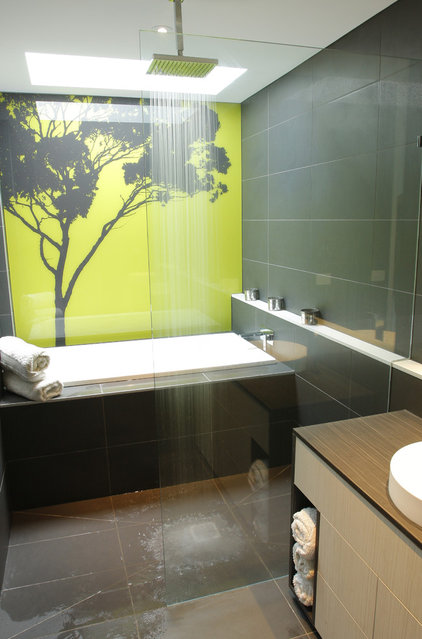
contemporary bathroom by Altereco Design

Add to ideabook
There’s plenty to love about this shower. For starters, the tiny ledge along the wall on the right is a great way to accommodate a smaller tub in a bigger space, while adding extra storage.
The floor outside the tub is actually graded back to the shower, so everything drains with ease. This is a true wet room, and it looks great.
http://www.houzz.com/ideabooks/3149263/

Seven Million to Struggle with Negative Equity for Four Years or More | South Salem Real Estate

Though three million homeowners were freed from the shackles of negative equity in the past year, it will take at least four more years for 7 million or more deeply indebted homeowners to reach positive equity, even as home values continue their current pace of recovery.

As home values continue to rise, the national negative equity rate continued to fall in the second quarter, dropping to 23.8 percent of all homeowners with a mortgage, according to the second quarter Zillow® Negative Equity Report. However, millions of homeowners remain so far underwater that it will take years for them to regain equity, even as home values continue their recovery.

Approximately 12.2 million homeowners with a mortgage were in negative equity, or underwater, at the end of the second quarter, owing more on their mortgages than their homes are worth. That is down from 13 million homeowners in the first quarter and 15.3 million at the same time last year. Roughly one-third of homes are owned without a mortgage. The negative equity rate among all homeowners, both with and without a mortgage, was 16.7 percent at the end of the second quarter.

Nationwide, more than half (57 percent) of homeowners in negative equity are underwater by 20 percent or more, and roughly one in seven (13.4 percent) owes more than twice what their home is worth. According to the most recent Zillow Home Value Forecast, home values are expected to rise 4.8 percent in the next year. Assuming appreciation at that rate going forward, it would take a homeowner underwater by 20 percent roughly four years to reach positive equity.

“Widespread rising home values during the past year have helped chip away at negative equity nationwide, helping many homeowners who were only modestly underwater to come up for air. For those homeowners who are deeply underwater, though, there is still a long row to hoe,” said Zillow Chief Economist Dr. Stan Humphries. “The frustratingly slow pace of negative equity declines in the face of such robust home value appreciation is a direct result of the fact that many people in the hardest-hit markets are underwater by an enormous amount. Because of this, negative equity will be a factor in these markets for years to come, constraining the supply of homes for sale and keeping people out of the market who might otherwise get involved.”

The “effective” negative equity rate, which includes those homeowners with a mortgage with 20 percent or less equity in their homes, fell to 41.9 percent, from 43.6 percent in the first quarter. Listing a home for sale and buying a new one generally requires equity of 20 percent or more to comfortably meet related expenses, including the down payment for a new home and associated closing costs, taxes and real estate agents’ fees. Homeowners without enough equity may remain tied to their homes, even if they are not underwater.


http://www.realestateeconomywatch.com/2013/08

Mortgage rates remain steady on uncertain jobs data | Waccabuc Real Estate

Mortgage rates remained unchanged this past week as mixed jobs data created some uncertainty about housing and the economy, Freddie Mac reported Thursday.

The average 30-year, fixed-rate mortgage came in at 4.57%, unchanged from highs reported a week earlier, and up from 3.55% last year.

While rising rates have been tied to a possible slowdown in housing activity, rates hit a plateau as the jobs situation created more questions for the market, stalling additional upward movement.

“Mortgage rates were little changed this week following a mixed employment report,” said Frank Nothaft, vice president and chief economist for Freddie Mac. “For example, the economy added 169,000 jobs in August, which was below the market consensus forecast, and revisions subtracted another 74,000 from the prior two months. Meanwhile, the unemployment rate fell to 7.3%, which was the lowest since December 2008.”

The 15-year, FRM came in at 3.59%, also unchanged from last week, but up from 2.85% a year earlier.

On the other hand, adjustable rates shifted, with the 5-year Treasury-indexed hybrid ARM averaging 3.22%, down from 3.28% a week earlier and up from 2.72% a year ago.

The one-year Treasury-indexed ARM also hit 2.67%, down from 2.71% a week earlier, and up from 2.61% a year ago.

Rates have been rising ever since the Fed started sending hints to the market in late spring that the possibility of tapering mortgage-backed securities and Treasury purchases could occur later this year.
HousingWire covered the dramatic tumble mortgage applications took this past week, falling 13.5% as rates remained elevated. The sharp drop prompted market fears that higher rates are beginning to sideline potential homebuyers as home affordability concerns resurface.

As of now, there are several factors that could impact consumer confidence and rates within the next few weeks.

For starters, the Federal Open Market Committee meets next week. A big question is when will the committee actually decide to scale back its asset purchases – at the next meeting or later in the year, Capital Economics noted in a Thursday report.

Julian Jessop, a chief global economist with Capital Economics, said, “Fed tapering is unlikely to be the major shock to the prospects for the rest of the world, or indeed for the US itself, that many have assumed.”

Jessop added, “In short, next week we expect the Fed to announce a reduction of perhaps $10 billion to $15 billion in the pace of asset purchases, from the current $85 billion per month. Surveys of other analysts and market participants suggest that this is the consensus view as well.”

Bankrate’s report also shows fixed rates barely shifting this past week. The 30-year, FRM edged down to 4.71% from 4.72%, while the 15-year, FRM shifted up slightly to 3.75% from 3.74%. Meanwhile, the 5/1 ARM stayed unchanged at 3.65%, according to Bankrate data.


http://www.housingwire.com/articles