Tag Archives: Westchester Real Estate

Ex-Morgan Stanley CEO’s Penthouse Gets a Big Price Cut | Bedford Hills Real Estate

Former Morgan Stanley CEO John Mack has been hiding out in this 3,650-square-foot duplex penthouse in the Lenori while he waits for the renovations to be finished on his East 70th Street mansion (featuring a 12-car garage), which he purchased for $13.5 million in 2009. But now that it’s time to move out, Mack seems to be having more trouble unloading the Leonori penthouse than he thought he would. After listing it for $22.5 million in February, he’s had to chop the price twice, once down to $19.5 million and now to $16.25 million. Perhaps the decor, which one commenter described as being in the “Early Grandma” style, is turning buyers off, or maybe it’s just the fact that the apartment, which features a large terrace and solarium, was originally asking over $6,000 per square foot (it’s now down to a more reasonable $4,452/square foot). Mack also switched brokerages, from Sotheby’s to Elliman, meaning that we get some new pictures to gawk at, and, if we had to guess, we’d say that the man is running out of patience. Could further pricechops be in the penthouse’s future?

Improved Equity Empowers Trade-up Buyers | Pound Ridge Real Estate

Housing demand by trade-up buyers is rising as the home equity available to these prospective buyers is improving as foreclosures sales decline nationwide and are in high demand in many fast-rising markets

According to FNC’s Foreclosure Market Report, the foreclosure market has rapidly improved in recent months with foreclosure rates approaching pre-crisis levels – an indication of strengthening supply-side conditions. On the demand side, steadily rising home prices and an expectation of continued recovery have stimulated housing turnover by prospective buyers who are in a position to take advantage of low home prices. In the meantime, higher home prices are bringing out trade-up demand from existing homeowners who are experiencing rising home equity, which supports a down payment on their next bigger house.

“We’ve seen hard data from the past 18 months that shows rising home prices and a foreclosure market with diminished impact due to decreasing foreclosure inventories and fewer new foreclosure filings,” said FNC Director of Research Yanling Mayer. “Meanwhile, a very encouraging trend that has been developing is the rising participation of trade-up buyers who are seeing improving home equity position and positive capital appreciation on existing homes.

“An important sign of a healthy and sustainable recovery is increased housing turnover driven by trade-up buying, which is more or less discretionary spending,” Mayer said. “These buyers are typically more responsive to market conditions and financial incentives.”

FNC’s report shows that foreclosure price discounts, which compare a foreclosed home’s estimated market value to the price paid by investors or home buyers, have dropped to a 10-year low at about 8.1% in Q2 2013, down from 12.5% a year ago. At the height of the mortgage crisis in 2008 and 2009, foreclosed homes were typically sold at close to 25% below their estimated market value. In many fast-rising markets, such as Phoenix, Las Vegas, and California, investor activity and low foreclosure inventory drove foreclosure prices up, frequently resulting in a price premium relative to estimated market value.

FNC publishes the mortgage industry’s first market-value based foreclosure price discount to gauge the degree of market distress. For more information about the foreclosure price discount, please refer to FNC’s March 2011 report located here.

According to the FNC report, investing in foreclosed property continues to be profitable with gross capital appreciation – the annualized percentage difference between a foreclosed property’s sales price and subsequent resale price – averaged at 7.8% on sales of homes previously purchased at foreclosure sales. In the meantime, ownership duration on distressed investment is up, along with the average ownership duration of all existing home sales.

More highlights from FNC’s Foreclosure Market Report:

  • Single-family REO and foreclosure sales are 12.2% of total home sales as of July, down from 17.3% a year ago.
  • The median foreclosure price is $98,000 or $67 per square foot, up 6.8% since the housing recovery began 18 months ago. In comparison, the median price on non-foreclosure sales is $205,000 or $118 per square foot, up 21.7% during the same 18-month period.
  • Foreclosure price discounts are typically larger for low-tier properties, averaging 13.7% in Q2 2013. One in four homes continues to be discounted heavily. High-end properties, on the other hand, are typically sold close to their market value.
  • At 86% of total foreclosure sales, low-tier properties continue to account for the bulk of foreclosure sales. Prior to the housing bubble, low-tier homes contributed more than 90% to foreclosure sales.
  • Collateral depreciation on foreclosure sales – the difference between a property’s prior purchase price and foreclosure sale price – continues to decelerate, down to 3.8% in Q2 2013 from 6.4% a year earlier. Among the re-sales of non-distressed homes, for 16 consecutive months the median home is sold at a price above its prior purchase price – enabling potential trade-up buyers to capture a small capital appreciation.


http://www.realestateeconomywatch.com/2013/09/improved-equity-empowers-trade-up-buyers/

13 natural remedies for the ant invasion | Bedford Corners Homes


Little tiny ants have been spotted in our new home, and many people are suffering the same fate across the country. As much as I love spring, I don’t like bugs — especially bugs that can infest a house. Last week I asked for some advice in how to deal with ants naturally as I didn’t have time to research it myself since I just moved this weekend. I got such good advice, I had to share it with the readers here at MNN as well.
Some of these measures are deterrents. That is, they deter the ants from coming in your house. This seems to work well for those with a mild problem. Others found that they needed to use a method that kills the whole colony of ants. I’ve compiled the comments and suggestions by category, allowing you to compare the different methods a little more easily.
1. Lemon juice
Teresa: We just spray around the openings with pure lemon juice … and it always works for us … something about the acid messes up their sense of tracking…
2. Cinnamon
Shayla: We use ground cinnamon around where there are coming it. It works really well.
Peggy: We spray cinnamon essential oil all around the doors, windowsills, floors, etc. keeps them from coming in. I put the sugar water and borax OUTSIDE!
Letia: Another vote for ground cinnamon. Easy to clean up afterwards and worked great for us!!!
Jean: Cinnamon and cloves. Makes your house smell nice and the ants just hate it sprinkled right in their path.
Patricia: We also use cinnamon oil. We draw borders around everything with a Q-tip dipped in it. They won’t cross it.
3. Peppermint
Heather: My mother-in-law has success with peppermint essential oil around windows and doors (any entries). Plus her house then smells awesome.
Julie: Dr. Bonner’s liquid soap in the mint aroma. Mix 1 to 1 with water in a spray bottle. Spray on the ant invasion and watch them suffer.
4. Borax, water and sugar
Kristi: We use borax, sugar, water and a touch of peanut butter. It takes a couple of weeks but really works. We used it last year in our old house and are implementing it again this spring in our new house. Pesky ants! Here is the site where I found the recipe:http://naturalantkiller.blogspot.com/
Christy: I second Diana’s comment about borax and sugar. I’ve made a thin paste before with water, sugar and borax, then spread it on little pieces of thin cardboard or stiff cardstock and placed them near where it seems they are coming into the house. They’ll eat it and take it back to their colony (just like the Terro liquid you can buy). The paste will dry up in a couple days, so you’ll have to make more. But I think I only had to do it twice before they were gone.
Chookie: What worked for us was a mixture of borax and sugar in water. Several years ago, we lived in a house where there was an ants nest in the walls. Removing it would have meant virtually demolishing the entire front wall of the house (not practical!), so instead, after a year or two of having flying ants swarm into our bedroom every year we decided to go on an ant killing spree. Conventional ant killers didn’t work. Borax and powdered sugar didn’t work. But adding water to the borax and sugar mix to make a thick sugary borax-y syrup DID work…. the worker ants took it back into the nest and it positioned the queen – result = no more flying ants. OK, so borax does need to be kept away from pets and small children, but it is relatively safe beyond that as it is only toxic if you eat it. my solution was to put it somewhere where the kids and the cats would not reach it but the ants could.
BeverlyC: We live in China and had a HORRIBLE ant problem in our house. Tried cinnamon, black pepper, vinegar, etc. etc. We were concerned about the borax because we have guests in and out regularly and the little children are often, well, naughty and undisciplined. When someone suggested Terro liquid ant bait and we found it was just Borax and sugar, we asked someone to bring us some. We could pick the traps up and put them away when company came and put them back out after they left. They worked wonders!!

Why to Put Your Tub in the Shower | Cross River Real Estate

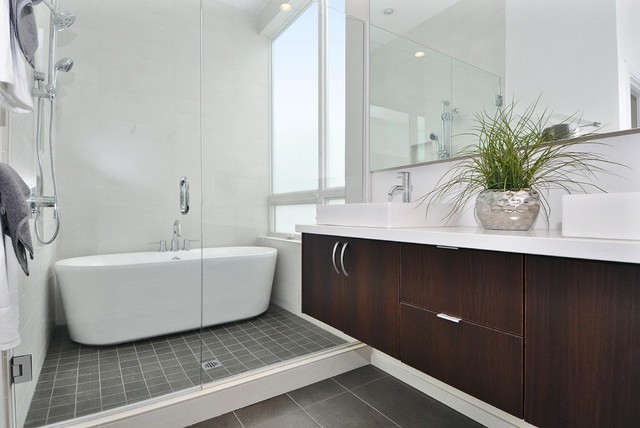
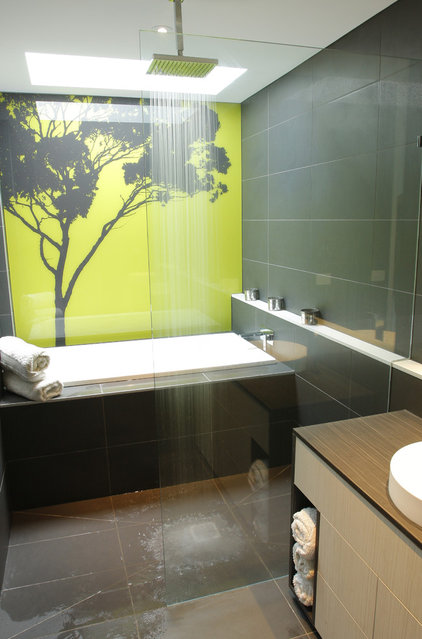
Putting your bathtub in the shower may be an unexpected idea, but it’s a solid one and a growing trend in bathroom design.
Sure, it looks great, but what does it mean from a practical standpoint? For one, kids (and grown-ups) can splash all they want in the tub without having to worry about water damage or a mess. Two, the right tub model can double as a great shower bench or spot to perch your leg on while shaving.
Curious if this will work in your new bathroom? Take a look at these examples and learn what questions to ask your contractor before implementing this design.

modern bathroom by Elemental Design, LLC

Add to ideabook
Waterproofing is vital in these installations. Your bathtub will have a 1½- to-2-inch drain line that will need to travel through your shower’s waterproofing materials.
Tubs in general are awkward and a pain to hook up, so there are a lot of factors to consider here. For example: Will your tub’s anti-tipping brackets poke through your shower membrane? This is a good question to ask your builder.
modern bathroom by Sean O'Brien Architecture

Add to ideabook
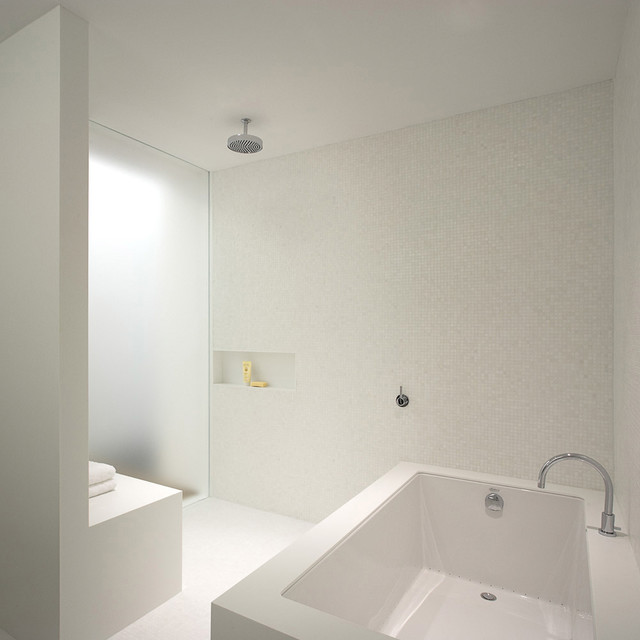
If this modern tub were a tub shower, it’d be pretty difficult to waterproof because it’s designed as an undermount tub. Clean-lined tubs like this usually don’t have edging that connects the tub with the wall’s waterproofing. Placing the tub inside the shower means the entire area is waterproofed, and it actually simplifies the room’s design.
Tip: A typical shower’s glass door and fixed panels can cost up to $2,000. I like how this shower-tub combination has a single wall panel and no door. A simple design change like this can dramatically reduce the cost of your new bathroom.
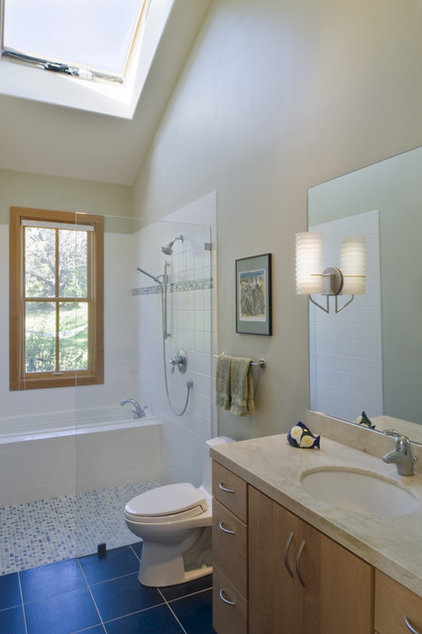
Some tubs are a challenge to get into for people with knee or hip issues. If this is the case for you but you still want a tub, a combination like the one shown here can help with accessibility. This barrier-free shower allows for a tub, but the shower itself can still be used for years and years to come.
Tip: If you plan to wash your kids in the tub, place the shower fixtures so they can be used in both the tub and the shower to make things easier.
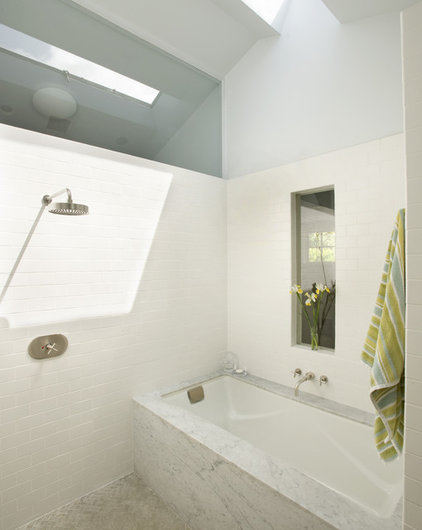
A built-in tub like this is actually much easier to install than a freestanding one. Waterproofing behind and under tubs with little wiggle room can be difficult, so I always suggest that clients install tubs like this, for practicality and cost savings.
Tip: Make sure your walls are waterproofed up to a height of 6 feet in your shower and tub area’s primary wet zone. Waterproof the walls at least 18 inches above the tub lip in a bathtub without a showerhead.
contemporary bathroom by Altereco Design

Add to ideabook
There’s plenty to love about this shower. For starters, the tiny ledge along the wall on the right is a great way to accommodate a smaller tub in a bigger space, while adding extra storage.
The floor outside the tub is actually graded back to the shower, so everything drains with ease. This is a true wet room, and it looks great.
http://www.houzz.com/ideabooks/3149263/

Seven Million to Struggle with Negative Equity for Four Years or More | South Salem Real Estate

Though three million homeowners were freed from the shackles of negative equity in the past year, it will take at least four more years for 7 million or more deeply indebted homeowners to reach positive equity, even as home values continue their current pace of recovery.

As home values continue to rise, the national negative equity rate continued to fall in the second quarter, dropping to 23.8 percent of all homeowners with a mortgage, according to the second quarter Zillow® Negative Equity Report. However, millions of homeowners remain so far underwater that it will take years for them to regain equity, even as home values continue their recovery.

Approximately 12.2 million homeowners with a mortgage were in negative equity, or underwater, at the end of the second quarter, owing more on their mortgages than their homes are worth. That is down from 13 million homeowners in the first quarter and 15.3 million at the same time last year. Roughly one-third of homes are owned without a mortgage. The negative equity rate among all homeowners, both with and without a mortgage, was 16.7 percent at the end of the second quarter.

Nationwide, more than half (57 percent) of homeowners in negative equity are underwater by 20 percent or more, and roughly one in seven (13.4 percent) owes more than twice what their home is worth. According to the most recent Zillow Home Value Forecast, home values are expected to rise 4.8 percent in the next year. Assuming appreciation at that rate going forward, it would take a homeowner underwater by 20 percent roughly four years to reach positive equity.

“Widespread rising home values during the past year have helped chip away at negative equity nationwide, helping many homeowners who were only modestly underwater to come up for air. For those homeowners who are deeply underwater, though, there is still a long row to hoe,” said Zillow Chief Economist Dr. Stan Humphries. “The frustratingly slow pace of negative equity declines in the face of such robust home value appreciation is a direct result of the fact that many people in the hardest-hit markets are underwater by an enormous amount. Because of this, negative equity will be a factor in these markets for years to come, constraining the supply of homes for sale and keeping people out of the market who might otherwise get involved.”

The “effective” negative equity rate, which includes those homeowners with a mortgage with 20 percent or less equity in their homes, fell to 41.9 percent, from 43.6 percent in the first quarter. Listing a home for sale and buying a new one generally requires equity of 20 percent or more to comfortably meet related expenses, including the down payment for a new home and associated closing costs, taxes and real estate agents’ fees. Homeowners without enough equity may remain tied to their homes, even if they are not underwater.


http://www.realestateeconomywatch.com/2013/08

Mortgage rates remain steady on uncertain jobs data | Waccabuc Real Estate

Mortgage rates remained unchanged this past week as mixed jobs data created some uncertainty about housing and the economy, Freddie Mac reported Thursday.

The average 30-year, fixed-rate mortgage came in at 4.57%, unchanged from highs reported a week earlier, and up from 3.55% last year.

While rising rates have been tied to a possible slowdown in housing activity, rates hit a plateau as the jobs situation created more questions for the market, stalling additional upward movement.

“Mortgage rates were little changed this week following a mixed employment report,” said Frank Nothaft, vice president and chief economist for Freddie Mac. “For example, the economy added 169,000 jobs in August, which was below the market consensus forecast, and revisions subtracted another 74,000 from the prior two months. Meanwhile, the unemployment rate fell to 7.3%, which was the lowest since December 2008.”

The 15-year, FRM came in at 3.59%, also unchanged from last week, but up from 2.85% a year earlier.

On the other hand, adjustable rates shifted, with the 5-year Treasury-indexed hybrid ARM averaging 3.22%, down from 3.28% a week earlier and up from 2.72% a year ago.

The one-year Treasury-indexed ARM also hit 2.67%, down from 2.71% a week earlier, and up from 2.61% a year ago.

Rates have been rising ever since the Fed started sending hints to the market in late spring that the possibility of tapering mortgage-backed securities and Treasury purchases could occur later this year.
HousingWire covered the dramatic tumble mortgage applications took this past week, falling 13.5% as rates remained elevated. The sharp drop prompted market fears that higher rates are beginning to sideline potential homebuyers as home affordability concerns resurface.

As of now, there are several factors that could impact consumer confidence and rates within the next few weeks.

For starters, the Federal Open Market Committee meets next week. A big question is when will the committee actually decide to scale back its asset purchases – at the next meeting or later in the year, Capital Economics noted in a Thursday report.

Julian Jessop, a chief global economist with Capital Economics, said, “Fed tapering is unlikely to be the major shock to the prospects for the rest of the world, or indeed for the US itself, that many have assumed.”

Jessop added, “In short, next week we expect the Fed to announce a reduction of perhaps $10 billion to $15 billion in the pace of asset purchases, from the current $85 billion per month. Surveys of other analysts and market participants suggest that this is the consensus view as well.”

Bankrate’s report also shows fixed rates barely shifting this past week. The 30-year, FRM edged down to 4.71% from 4.72%, while the 15-year, FRM shifted up slightly to 3.75% from 3.74%. Meanwhile, the 5/1 ARM stayed unchanged at 3.65%, according to Bankrate data.


http://www.housingwire.com/articles

Home prices hold steady in August | Mt Kisco Real Estate

The median price of homes for sale on realtor.com held steady at $199,900 in August from July, but were up 6.39 percent from August 2012, according to a monthly real estate trends report from realtor.com.

Inventory stood at 1.98 million in August, a 2.5 percent dip from a year ago and a 0.93 percent increase from July’s number, realtor.com data showed. Homes were on the market for a median of 92 days in August, down 8 percent from a year ago, but up 8.24 percent from July.

“Where we have seen significant volatility in many markets, including double-digit declines in inventory as well as increases in median price for both yearly and monthly views, we are now looking at a housing market that much more closely resembles ‘normal,’ ” said Steve Berkowitz, CEO of realtor.com operator Move Inc., in a statement.


Source: realtor.com


read more at: http://www.inman.com/wire/home-prices-hold-steady-in-august/#sthash.UWs9E1TZ.dpuf

Inside Tom Brady and Gisele Bündchen’s ‘French Chateau via the Pacific Coast Highway’ | Pound Ridge Real Estate

house-front.jpgPhoto by Roger Davies/Architectural Digest

When you’re really rich and beautiful and build a much-whispered-about 14,000-square-foot acid-washed limestone mansion from scratch, there’s no better place for a big reveal than the glossy pages of Architectural Digest. Despite an early slipup by the builder, who released photos of the project prematurely, the magazine continued apace and published New England Patriots quarterback Tom Brady and supermodel Gisele Bündchen’s  new “French chateau via the Pacific Coast Highway” in its October issue.

The story, which dropped online this morning after editor in chief Margaret Russell made a Today Show appearance, makes clear that it’s actually “normal” home. None of those “lavish pleasure dome replete with sultry sirens and gridiron gods cavorting around the pool” nor “sprawling palace staffed with a battalion of liveried footmen proffering protein shakes on silver trays,” writes Mayer Rus. Rather, there’s just the regular plebeian driveway that “leads over a pond to a motor court paved in reclaimed cobblestones and then to a stone bridge spanning a koi-stocked moat that’s picturesque but not pompous”; an unassuming pool “laid out with two straight sides and one long, sinuous edge that helps give the impression of a nautral lake, particularly in the early-morning and late-afternoon light”; and just your average “custom-made wrought iron monkey bars” in the gym. Bündchen sums it up: “I want to live in a place that feels like a real home, where you can put your feet up on the couch and just relax.”

It was important for the Bündchen, whom interior designer Joan Behnke describes as an “earth mother”—”she’s drawn to certain things because of the energy they give off”—that the home incorporate as many reclaimed materials as possible, from the decking and floorboards to the tiles, bricks, doors, and marble fireplace surrounds. Well we have great post to read about choosing best decking supplier. In addition, composting, gray-water technology, solar panels, and eco-friendly construction materials were all factored into the overall design, which was completed by architect Richard Landry. (Brady tells Rus that he’s “all about team dynamics and putting the right people together,” presumably while huddling.) The neutral interiors are filled with pieces from RH and Christian Liaigre, Loro Piana fabrics, Tai Ping carpets, custom pieces, and, of course, a black-and-white photo of Gillette Stadium hanging over the fireplace in the master bath. Check it out below—and head to Racked National for a look at Bundchen’s utterly insane closet.

http://curbed.com/archives/2013/09/04

Freddie Mac releases latest rates | Bedford Hills Homes

Freddie Mac (OTCQB: FMCC) today released the results of its Primary Mortgage Market Survey® (PMMS®), showing average fixed mortgage rates relatively unchanged from last week following a mixed employment report, and holding steady near their highs for the year.

News Facts

  • 30-year fixed-rate mortgage (FRM) averaged 4.57 percent with an average 0.8 point for the week ending September 12, 2013, unchanged from last week. A year ago at this time, the 30-year FRM averaged 3.55 percent.
  • 15-year FRM this week averaged 3.59 percent with an average 0.7 point, unchanged from last week. A year ago at this time, the 15-year FRM averaged 2.85 percent.
  • 5-year Treasury-indexed hybrid adjustable-rate mortgage (ARM) averaged 3.22 percent this week with an average 0.5 point, down from last week when it averaged 3.28 percent. A year ago, the 5-year ARM averaged 2.72 percent.
  • 1-year Treasury-indexed ARM averaged 2.67 percent this week with an average 0.4 point, down from last week when it averaged 2.71 percent. At this time last year, the 1-year ARM averaged 2.61 percent.

Average commitment rates should be reported along with average fees and points to reflect the total upfront cost of obtaining the mortgage. Visit the following links for the Regional and National Mortgage Rate Details and Definitions. Borrowers may still pay closing costs which are not included in the survey.

Quotes Attributed to Frank Nothaft, vice president and chief economist, Freddie Mac.

“Mortgage rates were little changed this week following a mixed employment report. For example, the economy added 169,000 jobs in August, which was below the market consensus forecast, and revisions subtracted another 74,000 from the prior two months. Meanwhile, the unemployment rate fell to 7.3 percent which was the lowest since December 2008.”

Freddie Mac was established by Congress in 1970 to provide liquidity, stability and affordability to the nation’s residential mortgage markets. Freddie Mac supports communities across the nation by providing mortgage capital to lenders. Today Freddie Mac is making home possible for one in four home borrowers and is one of the largest sources of financing for multifamily housing. For more information please visit www.FreddieMac.com and Twitter: @FreddieMac.

Marketing Plan that Delivers Ongoing Results | Mt Kisco Realtor

Are you happy with how you are using LinkedIn?

LinkedIn offers companies multiple marketing opportunities, but which ones are right for your business?

In this article I’ll show you five different ways to use LinkedIn to market your business.

How do you do start?

You’ll want to develop a comprehensive and consistent LinkedIn marketing plan for your business to achieve long-term, sustainable success.

It doesn’t matter if you’re a large corporate brand or a small business, you can build a comprehensive LinkedIn marketing strategy on a scale that suits your needs and objectives.

Social Media Examiner strategy on LinkedIn includes updating the business page regularly.

In order to have success with LinkedIn, you’ll need to make a long-term commitment to your plan. A strategy that delivers results requires ongoing management, monitoring, analysis, and adjustments.

Remember to assess your resources first and determine what you’re willing to commit with regard to people, time and dollars. An ongoing commitment to your strategy ensures you stay on track toward achieving your company goals.

Here are 5 LinkedIn marketing ideas your business can integrate into your comprehensive marketing program.

#1: Build a Robust Company Page on LinkedIn

To create a business presence on LinkedIn and gain access to additional features that enhance your visibility, you must build a LinkedIn company page.

Think of your LinkedIn company page as an extension of your business website within LinkedIn and use it to display compelling graphics, add products and services, even include job opportunities.

Invite existing employees, clients or customers, vendors and partners to follow your page, and showcase it to relevant LinkedIn members and encourage them to follow by using LinkedIn’s paid targeted advertising.

If it’s appropriate and/or allowable, ask key clients or customers to recommend your products and services on your LinkedIn company page. These recommendations show up on your page for everyone to see, and serve as powerful testimonials for your business.

Filling your LinkedIn company page with compelling and interesting status updates about your industry or business requires ongoing management, but it’s the most effective way to grow followers for your page and increase your company’s visibility. As you grow your following, remember to segment your members and target them with more relevant updates.

HubSpot, a marketing software company for medium-sized businesses, has amassed a company page following of over 40,000 people on LinkedIn as well as 272 product recommendations from members. Those are some powerful stats.

Each time HubSpot shares an update on its LinkedIn company page, it has the potential to engage over 40,000 people who further amplify the company’s visibility on LinkedIn!


http://www.socialmediaexaminer.com/linkedin-marketing-plan/