| Rank | Lender | Market Share |
| 1. | Wells Fargo | 22% |
| 2. | Chase | 11% |
| 3. | Quicken | 5%
|

| Rank | Lender | Market Share |
| 1. | Wells Fargo | 22% |
| 2. | Chase | 11% |
| 3. | Quicken | 5%
|
Here are some interesting charts by Deepak Shenoy on the India Housing Bubble.
India home prices have been going up at a compound annual growth rate (CAGR) of 26% since March of 2009.
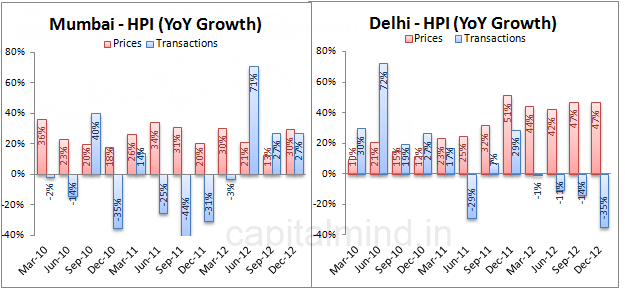
Mumbai and Delhi
Shenoy reports Mumbai is growing at a CAGR of 30%, and Dehli is up 47% from a year ago and 250% since March 2009.
Note the transaction volume in Delhi. Transaction volumes and prices are interesting in Bangalore and Chennai as well.
Bangalore and Chennai
Shenoy has details on five other cities as well. Inquiring minds may wish to take a look.
He writes “While India as a composite country is not at a bubble stage right now, it’s important to note that various bubbles are building up in individual cities. If any of these bubbles worsens, then it is likely that other cities will follow. There are no un-correlated prices in a crisis.“
I would suggest that India as a composite certainly is in a housing bubble. The overall HPI shows just that.
India Housing Bubble – Business Insider
As the sluggish economy drags on, county boards everywhere are looking for ways to replace lost income–re-assessments of residential real estate taxes is just one of those ways. Sometimes it’s fair, other times it avoids belt-tightening. If your property taxes have been raised and you feel it’s unfair, here is how to prepare to meet your assessor for a review to lower them:
1. Look for reporting mistakes. Examine the assessor’s entire property description. Note discrepancies and document them with blueprints, surveys, photos or other inspection reports.
2. Compare neighborhood assessments. Are other homes in your neighborhood assessed similar to yours? Check the web first; some counties post assessments online.
3. Compare current sales. Talk to a local real estate agent (if you need a referral, I’m glad to help) and get a report of comparables sold within the last 6 months. Sold homes count, listings don’t.
4. Take pictures. Document where your home needs repair compared to other homes in better shape in your neighborhood.
5. Get a new appraisal. If your home is unusual or hard to “comp” this is the one time it can work in your favor. If you recently refinanced and the value is lower, use that report instead.
6. Get your contract. If your taxes increased soon after you purchased, values probably haven’t changed that much. Document with your purchase agreement.
7. Are you exempt? There are many special exemptions: homestead, mortgage, senior citizens, veterans, disabled persons, and even energy-efficiency. Check with your county and check them all.
8. Prepare your case. In writing, briefly and professionally describe why you are entitled to the reduction, followed by documentation of your reasons. Make sure you have any required forms completed and know all deadlines for your appeal.
Home prices may have been on an upward spiral for many years, but the cost of owning a house in India remains near the most affordable level in over three decades, shows data compiled by mortgage giant HDFC Ltd.
The average price of a home, purchased with a housing loan, rose to over Rs 45 lakh in the 2012-13 fiscal – marking the fourth consecutive year of uptrend from about Rs 25 lakh in the year 2008-09, HDFC has said in a presentation.
However, factors like an even greater surge in the personal income levels, tax incentives and lower interest rates, have resulted into houses becoming more affordable to purchase, it said.
As per an ‘affordability’ ratio compiled for over three decades by HDFC, the average cost of owning a house stood at 4.7 times of the annual income of the home buyer in 2012-13.
The affordability ratio, which takes into account the annual income of the home buyer along with the price of the house, stood at as high as 22 in the year 1994-95, but has been mostly on a declining trend since then.
This means that a home buyer, on an average, needed an amount equivalent to nearly 22 times his or her annual income in 1994-95, but an amount less than five times of the annual earnings is required for purchasing a house now.
HDFC has released this dataset as part of an investor presentation on its latest fiscal financial results.
Explaining the improved affordability in the housing market, HDFC said it has been possible because of rising disposable income, tax incentives (on interest and principal repayments) and affordable interest rates available to the home loan customers.
The lender further said that the mortgage market was also witnessing a high demand growth because of increasing urbanisation and favourable demographics of the country, where 60 per cent of population is below 30 years of age and there is a rapid rise in new households.
Interestingly, the affordability ratio has remained in the range of 4.5-4.7 for the five consecutive years now, although the home prices have nearly doubled in this period.
Excluding a temporary dip during 2008-09, the home prices in the country have been rising for 11 years now, after hitting the lowest level in two decades at below Rs 15 lakh in the year 2001-02. However, the average annual income of a home loan customer has almost tripled during this period from less than Rs 4 lakh to close to Rs 12 lakh currently.
To be precise, the affordability ratio of 4.7 during the the last fiscal 2012-13 is the fourth lowest ever figure, after 4.3 in the year 2003-04, 4.5 in 2008-09 and 4.6 in 2011-12.
Home prices near most affordable levels in over 30 years: HDFC – Business Line.
| Today’s Real Estate Report – Maine |
| At Gay Realty Watch, we look for news to share with you about the gay real estate market – both lgbt real estate news and news specific to gay and lesbian real estate meccas. If you have a gay real estate story that you’d like to share with us, contact us at info@gayrealtynetwork.com. Today, in our ongoing series about local real estate markets, we’ll take a look at home sales and trends in the Maine real estate market. Overall, Maine home sales were up more than 8% in the first quarter of 2013 vs. 2012, the Bangor Daily News reports:
Maine’s home prices have not seen a big spike, but then the market didn’t suffer as much during the recession as other states:
Real estate business is up along Maine’s Midcoast as WCSH reports:
Up north, things aren’t going as well for The County. The St. John Valley Timesreports: The number of existing, single-family homes sold (units) and volume (MSP) during the months of January, February and March of 2012 and 2013 for Aroostook County are as follows:
|
As New Jersey continues to emerge from the recession, observers are noticing changes in the commercial retail real estate landscape: Bigger isn’t better, but variety is. And for the time being, it’s a tenant’s market.
In 2002, vacant storefronts represented about 2 percent of the shopping corridors in the central and northern parts of New Jersey. Buildings didn’t stay empty for long. Because space was at a premium, rents were high.
When big box stores such as Bradlees or Caldors went out of business, other enterprises like Kohl’s or Home Depot moved in.
But as the dark clouds of the recession roiled over New Jersey, large and small retailers became tentative. A survey of lease renewals by CoStar Group, a commercial real estate information company, showed 10-year lease renewals for retail outlets began plummeting in 2005, while one-year leases climbed dramatically.
Ryan McCullough, a vice president at CoStar, said it was as if stores had been placed on “a waiting list for foreclosure.” Parent companies wanted to take a wait-and-see approach before making long-term commitments. At the same time, landlords, looking to hold on to their tenants, lowered rents.
By the fourth quarter of 2006, the vacancy rate had risen to 7.6 percent and rents were $20.92 per square foot, according to CoStar. In the first quarter of this year, however, the vacancy rate is 6.6 percent while rents average $19.37. And lease lengths are showing signs of growing longer again.
“Think of it as a sign of retailer confidence,” said McCullough.
Marta Villa, vice president of CBRE, a commercial real estate firm, said, “One reason for the longer lease is the lower rents brought on by the recession. If (a retailer’s) lease is coming due in the next 24 months, they want to get in there and tie up that space.”
Villa said it is part of the new mantra in the commercial real estate market: “blend and extend.” In addition to extending leases, she said landlords are also willing to shake up the mix of outlets on a property.
Landlords have “become more receptive to filling space with nontraditional uses, like fitness centers, or day care or medical centers,” she said. “Gyms are one of the major retail sectors on the move.”
Fast food franchises are also growing rapidly in New Jersey, Villa said, as well as quick-serve restaurants like Smashburger or Chipotles.
Part of the uptick in activity is the lower rents
“A couple of years ago, we were fielding a lot of rent reduction requests,” said Matt Harding, president of Levin Management. “We reviewed them and we did work with tenants. But over the past 12 months, the number is slowing, absolutely.”
Retail real estate landscape is looking different after the recession | NJ.com.