Tag Archives: Chappaqua NY Homes

Chappaqua NY Homes

Cuba’s Real Estate Market on the Rise :: EDGE on the Net | Chappaqua Real Estate

Estrella Diaz sits next to a homemade sign advertising her home for sale, in Havana, Cuba.

Estrella Diaz sits next to a homemade sign advertising her home for sale, in Havana, Cuba.  (Source:AP Photo/Franklin Reyes)
In some ways, Yosuan Crespo’s real estate office resembles any you might find in New York, London or Tokyo. There are slick posters of hot properties hanging from the ceiling, a steady stream of hopeful buyers and sellers and a constant clack of computer keys.

But Crespo’s headquarters in central Havana’s trendy Vedado neighborhood is actually somebody else’s breezy front porch. The computer’s only connection to the Internet is a creaky dial-up link, and Crespo is careful to say he’s not operating as a broker, since the job is still technically illegal.

A baffling, sometimes bizarre real estate market has emerged in the year and a half since President Raul Castro legalized private home sales on this Communist-run island for the first time in five decades.

While trade in homes is now legal, the people who bring buyers together with sellers are not. The government has yet to make good on promises to legitimize brokers, most of whom still operate in the shadows.

It’s a story that has been typical of Castro’s economic reforms, which often have left little space for the sort of middlemen and other services that help markets work.

The Cuban leader also has legalized a used car market, but not the right to open a business that sells them. And while reforms have sparked an explosion of private restaurants and cafes across Cuba, the government has yet to give them access to wholesalers that could keep them better supplied.

Crespo gets around the broker ban by operating as a licensed computer programmer and photographer, helping clients list their properties on Web portals, producing the for-sale posters that hang in his office and offering digital photo services for sellers. He says he doesn’t charge commissions.

Crespo’s listed fees are just a few dollars, but he’s found himself in major demand. He estimates 30 to 40 customers a day wander into his porch-side business, called EspacioCuba. He says his service has 2,500 current listings and has helped sell about 250 properties since it opened in January.

“Right now we are very pleased,” said Crespo, a smartly dressed 28-year-old computer scientist with close-cropped hair, but he added that the market would benefit by the government made brokering legal.

The market also still lacks a workable mortgage system, an easy means of advertising potential sales and, most important, a middle class with resources to buy.

Yet sales are humming, with some 45,000 homes changing hands in the first eight months after Castro legalized the real estate market in November 2011, according to the most recent statistics from the government.


Cuba’s Real Estate Market on the Rise :: EDGE on the Net | Chappaqua Real Estate | Bedford NY Real Estate | Robert Paul Talks Life in Bedford NY.

What $700K Can Buy You Around The Cape & Islands | Chappaqua Homes

↑ Kicking off in Provincetown with The Boathouse, a 1BR, 1BA condo directly on Cape Cod Bay. Built in 1900, the year-round 487 sq. ft. freestanding cottage has waterviews on three sides, an exclusive use deck and parking for one. The property last changed hands in 2005 for $685,000 and returned to the market in May 2011 asking $735,000. The listing was removed in October 2011 and reappeared last month with a $729,300 price tag.


http://capecod.curbed.com/archives


Purchase loans tick up | Chappaqua NY Real Estate

Applications for purchase loans increased a seasonally adjusted 2 percent for the week ending May 3 from the previous week, and were up 12 percent on an annual basis, according to the Mortgage Bankers Association’s (MBA) Weekly Mortgage Applications Survey.

Meanwhile, applications for refinance loans climbed 8 percent from the previous week reaching the highest level since December 2012. The MBA attributed the gain to increases in both the conventional and government refinance indices. Source: MBA

www.inman.com

Banks Cool to FICOs Below 620 | Chappaqua NY Real Estate

Borrowers with FICO scores of 620 or lower will get a chilly reception from a growing number of banks unless they are willing to make substantial down payments.

Banks, most of them smaller banks, participating in the most recent Survey of Senior Loan Officers by the Federal Reserve indicated that they were less likely to approve loan applications with a FICO score of 620, depending on the size of the down payment.

Currently the median FICO score for all approved loans is 748. For approved conventional purchase loans, the median is 761 and for FHA purchase loans, 698.

Banks were more likely to approve an application for a conventional loan with a FICO score of 720 and a 20 percent down payment. However, about one-third of said they were less likely to approve loan such applications with FICO scores of 580 or 620.

Overall, only a few banks reported changes in either standards or demand for any type of residential real estate lending during the previous three months, though a significant number said that indicated that the demand for prime mortgages had picked up. A few domestic banks reported having eased their standards on prime residential mortgages, and respondents’ lending standards for nontraditional mortgages were little changed.

Roughly three-fourths of banks viewed the outlook for house prices or economic activity as important factors currently affecting their bank’s residential real estate lending. Three-fourths of banks also cited the risk of putback of delinquent mortgages by the GSEs as an important factor restraining their current ability or willingness to approve home-purchase loans. A large fraction of banks reported an increase in the importance of this factor over the past year.


http://www.realestateeconomywatch.com/2013/05

Drought Tolerant Perennials | Chappaqua Real Estate

In my neck of the woods precipitation comes one of two ways; either all at once or not at all. Spring sees ample showers, but as soon as the calendar turns to June the rain dries up. Unless there is an unusual weather pattern in play I can count on Arkansas’ summers to be hot and dry.

Rather than rely 100 percent on irrigation to carry the garden through, I choose drought tolerant plants that I know will survive extended periods without rain. By selecting the right plants for my dry climate I use less water and I don’t have to work as hard to keep the garden looking good during the dog days of summer.

To make things even easier I use a lot of drought tolerant perennials. Perennials will come back year after year without replanting and most are pretty low maintenance. Throw in drought tolerance and you’ve got something you can pretty much plant and forget.

Unlike annuals, many perennials bloom for a specific amount of time. Gardeners can create season-long interest by selecting spring, summer and fall flowering perennials and showy foliage plants.

Here’s a short list of drought tolerant perennials categorized by season.

Spring Flowering Drought Tolerant Perennials

Alyssum (Alyssum montanum)

Alyssum will form a dense mat of attractive foliage and spring blooms. Try River of Gold™ for its bright yellow flowers.

Zones 4 – 8; full sun; 6 to 8 inches tall with a 10-inch spread.

Proven Winners River of Gold Alyssum

Dead Nettle (Lamium maculatum)

Lamium is a low growing groundcover for either sun or shade. The variety Pink Chablis® has charming pale pink flower and frosty green and white variegated leaves.


Zones 4 – 8; full sun or shade; 8 – 12 inches tall with a 24-inch spread.

Proven Winners Pink Chablis Lamium

False Indigo (Baptisia hybrid)

Baptisia is a North American native plant that produces sweetpea-like blooms. Try one of the hybrids in theDecadence™ series for compact plant form and saturated color. Available cultivars include ‘Cherries Jubilee’ (maroon and yellow), ‘Blueberry Sundae’ (vibrant blue), ‘Dutch Chocolate’ (dark plum), and ‘Lemon Meringue’ (yellow).

Zones 4 – 9; full sun to partial shade; 30 – 26 inches tall.

Proven Winners Decadence Baptisia

Summer Flowering Drought Tolerant Perennials

Evening Primrose (Oenothera)

Oenothera has a loose, wildflower appearance that makes it right at home in cottage-style gardens. The cultivar Lemon Drop® produces fragrant, yellow blooms all summer. It is both drought tolerant and adaptable to poor soils. Because Lemon Drop® does not set seeds like some of its freewheeling cousins, it will stay put rather than pop up around the garden.

Zones 5 – 11, full sun; 8 – 12 inches tall.

Proven Winners Lemon Drop Oenothera

Perennial Sunflower (Heliopsis)

The bright yellow, daisy-like flowers of this North American native plant brighten the garden. The improved cultivar ‘Tuscan Sun’ boasts an extended blooming season and stays a manageable size.

Zones 3 – 9; full sun to partial shade; 12 – 20 inches tall.

Proven Winners Tuscan Sun Heliopsis

Butterfly Flower (Gaura lindheimeri)

This is one of my favorite “see through” plants. I like to position Gaura in the middle of a flower border so that the loose stems create a veil through which the background plants are seen. This creates a little mystery and added dimension. Stratosphere™ Pink Picotee and Stratosphere™ White will bloom May through September.

Zones 6 – 11; full sun; 12 – 24 inches tall.

Proven Winners Stratosphere Gaura

Fall Flowering Drought Tolerant Perennials

Sedum sp.

Sedums are a classic choice for low water gardens. There are both spreading and upright forms. The upright cultivar ‘Maestro’ puts on a spectacular autumn show with abundant bright purple bloom stalks and pink flowers.

Zones 3 – 9; full sun; 24 – 30 inches tall.

Proven Winners Maestro Sedum

Aster sp.

What would the fall garden be without asters? I’m particularly fond of the blue and purple varieties because the colors complement the red, orange and yellow of the season. ‘Sapphire Mist’ produces an abundance of large, lilac blooms on compact plants from late summer through fall.

Zones 4 – 8; full sun; 12 – 16 inches tall.

Proven Winners Sapphire Mist Aster

Bluebeard (Caryopteris sp.)

Caryopteris blooms are a splash of cool blue at the end of summer. Sunshine Blue® Caryopteris incana is one I grow. I love the color combination of the neon yellow foliage and periwinkle flowers.

Zones 5 – 11; full sun; 36 – 48 inches tall.

Proven Winners Sunshine Blue Caryopteris

Drought Tolerant Perennials Prized for their Foliage

Ornamental Grasses

Pair ornamental grasses with bold blooms or fleshy leaves to create an interesting texture combination. ‘Cheyenne Sky’ Red Switch Grass (Panicum) is part of my Proven Winners® Platinum Collection. It’s a chameleon that changes from blue-green to wine red over the course of the summer.

Zones 4 – 9; full sun; 30 – 36 inches tall.

Proven Winners Cheyenne Sky Switch Grass

Heuchera sp.

You’ll be amazed at the variety of color and pattern available with such an easy care plant. I’m a huge fan of the varieties in the Proven Winners® Dolce® Series, which range in color from chartreuse to almost black.


Zones 4 – 9; full sun to partial shade; 8 – 16 inches tall.

Proven Winners Dolce Heuchera

Wood Spurge (Euphorbia amygdaliodes)

This plant blooms in spring, but the foliage is its greatest asset. The cultivar ‘Helena’s Blush’ has variegated green and white leaves that develop bright pink highlights as the temperatures cool in autumn.

Zones 6 – 9; full sun; 16 – 20 inches tall and 20 inches wide.

Proven Winners Helena's Blush Euphorbia

Good to Know

Even drought tolerant plants need water just after planting, water your newly planted drought tolerant perennials weekly the first growing season.


http://www.pallensmith.com/articles

A Step-by-Step Guide to Building an Excel Graph [Quick Tip] | Chappaqua NY Realtor

Building graphs is part of most people’s jobs — they’re the best way to present information in a clear, easily digestible manner that can then serve to influence the decision-making process within an organization. But there are some people out there that get a little bit intimidated by the prospect of poking around in Excel. I, however, adore the thing (I work in Marketing Ops, so it’s pretty much a requirement).

So I thought I’d share some step-by-step instructions for anyone out there that cringes at the thought of sorting a spreadsheet full of data into a chart that actually, you know,means something. Here are the simple steps you need to build a graph in Excel.

Step 1: Get your data into Excel.

First, you need to input your data into Excel. This is the easy part! You may have exported the data from elsewhere, like a piece of marketing software or a survey tool. Or, you might be inputting it manually.

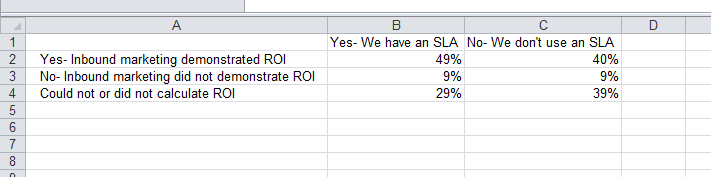
In the example below, in Column A, I have a list of the responses to the question “Did inbound marketing demonstrate ROI?”, and in Columns B,C, and D, I have the responses to the question “Does your company have a formal sales-marketing agreement?”. For example, Column C, Row 2 illustrates that 49% of people who have an SLA also say that inbound marketing demonstrated ROI.

excelgraphblogpostpicture1

Step 2: Choose a type of graph to create.

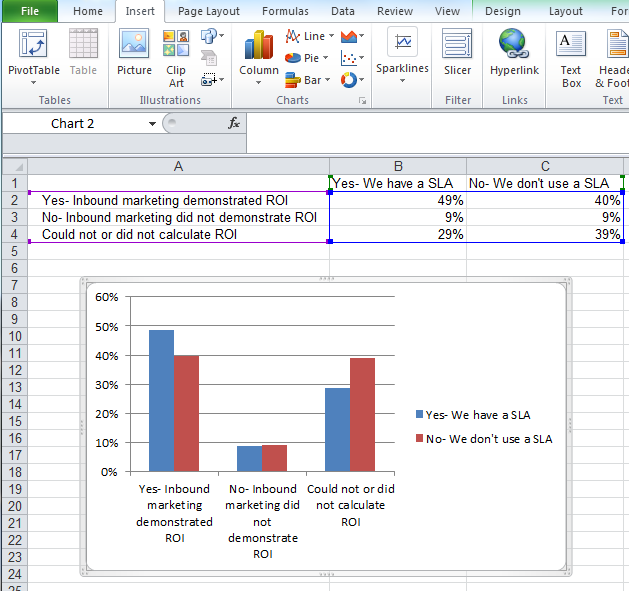
You have plenty of choices for charts and graphs to create. This data will look best in a bar graph, so let’s pursue making that one. To make a bar graph, highlight the data and include the titles of the X and Y axis. Go to the ‘Insert’ tab, click ‘Charts,’ click ‘Column,’ and choose the graph you wish (in this example I will be picking the first 2-D Column choice — just because I prefer it over the 3-D look).

finalgraphmay4blogstep2

Step 3: Switch axes, if necessary.

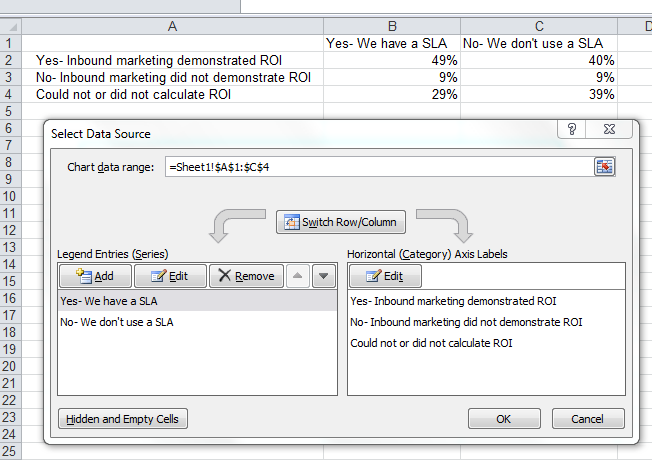
If you want to switch what appears on the X and Y axis, right click on the bar graph, click ‘Select Data,’ and click ‘Switch Row/Column.’

finalgraphmay4blogstep3

Step 4: Adjust your labels and legends, if desired.

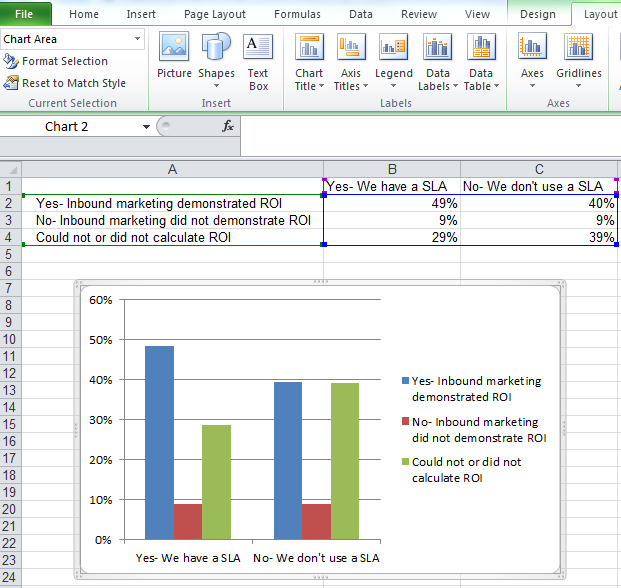
To change the layout of the labeling and legend, click on the bar graph, then click the ‘Layout’ tab. Here you can choose what layout you prefer for the chart title, axis titles, and legend.

In my example, I clicked on ‘Chart Title,’ and selected ‘Above Chart.’ To format the X axis title, I clicked on ‘Axis Titles’, clicked ‘Primary Horizontal Axis Title’, and clicked ‘Title Below Axis.’ To format the Y axis title, I clicked on ‘Axis Titles,’ clicked ‘Primary Vertical Axis Title,’ and chose ‘Rotated Title.’ To change the placement of the legend, click ‘Legend’ on the ‘Layout’ tab and choose your preferred location.

finalgraphmay4blogstep4

Step 5: Change the Y axis measurement options, if desired.

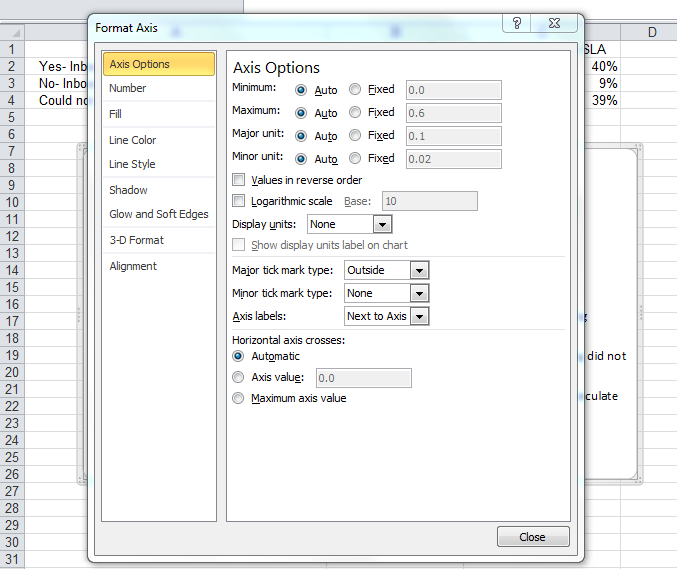
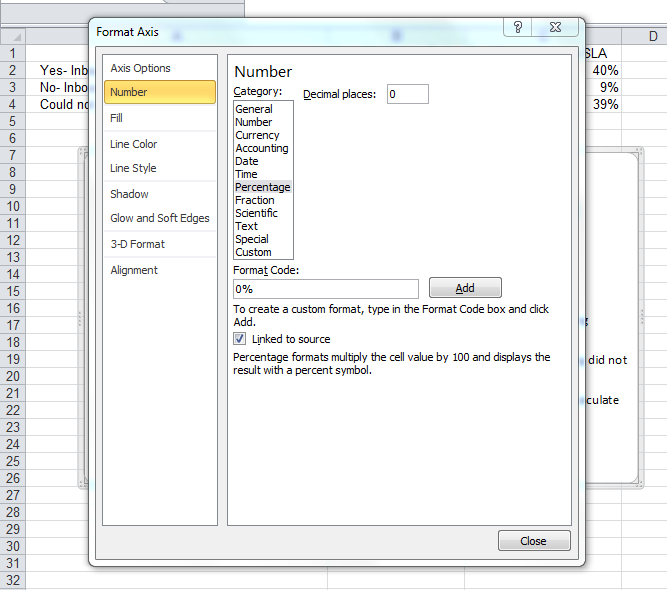
To change the type of measurement shown on the Y axis, right click on the Y axis percentages, and click ‘Format Axis.’ Here you can decide if you want to display units located on the Axis Options tab, or if you want to change whether the Y axis shows percentages to 2 decimal places or to 0 decimal places.

finalblogmay4step5p1

finalblogmay4step5p2

The resulting graph would be changed to look like this:

finalblogmay4step5p3

Step 6: Reorder data, if desired.

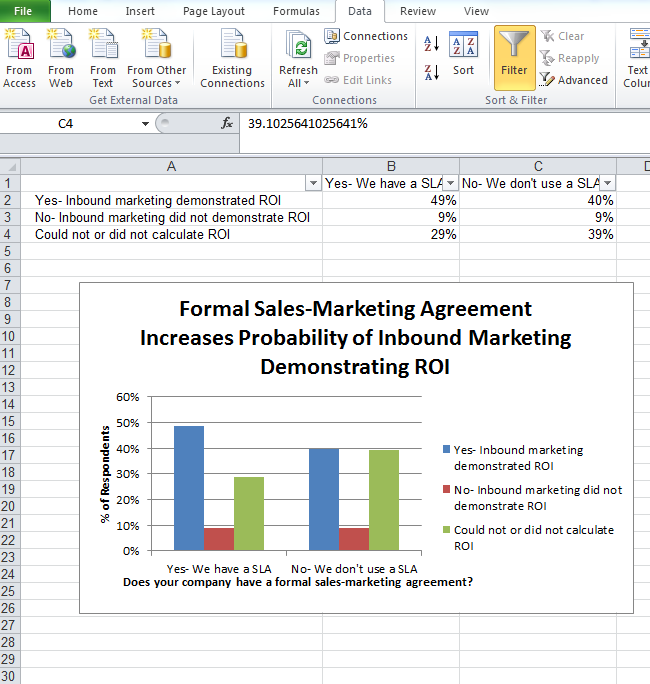
To sort the data so that the software choices appear in descending popularity order, click on the column that is most important to you (in this case I picked column B), click on the ‘Data’ tab, and click ‘Filter.’ Then go back to Column B and click the down arrow and click ‘Sort Largest to Smallest.’

finalblogmay4step7p1

If you click on the downward arrows located at B1 and C1, you can choose to sort based on smallest to largest or largest to smallest, depending on your preference. Here, I sorted largest to smallest on B1.

finalblogmay4step7p2-1

Pretty easy, right? What other Excel functions have you always wanted help with?


http://blog.hubspot.com/how-to-build-excel-graph

Retired Laker Mitch Richmond Lists Ultimate Guys’ Crib With Sports Bar, BBall Court | Chappaqua Homes

NextPrevious

Picture 1 of 30 |Toggle

Source: Wikipedia Commons

Source: Wikipedia Commons

You might expect to find a sports bar, built-in barbecue, basketball court and waterslide at a fraternity house or the Vegas Strip — not in your own backyard. But in a superstar athlete’s home, boys and their toys are taken to another level.

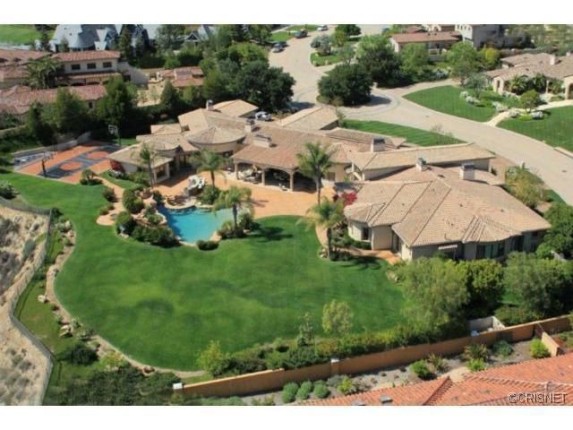
Former NBA Rookie of the Year Mitch Richmond has lived in this decked-out Calabasas crib with wife Juli and their three kids since 2004. The retired shooting guard is now selling the place for $9.495 million.

Located at 25374 Prado De La Felicidad, Calabasas, CA 91302, the sprawling Mediterranean mansion has 6 bedrooms and 9 bathrooms over 10,475 square feet. In addition to several backyard amenities, the home has a luxurious master suite, gourmet kitchen and a state-of-the-art gym with a steam room and sauna.

A sports bar with framed jerseys on the wall is a reminder of “The Rock’s” legacy as a six-time NBA All-Star and five-time All-NBA Team member. Although Richmond fell short in the 2013 vote for induction into the Basketball Hall of Fame, his career was nonetheless impressive, playing for the Golden State Warriors, Sacramento Kings, Washington Wizards and Los Angeles Lakers.

Richmond is currently back working with the Warriors as a scout. He’s also been a minority investor helping to persuade the NBA ownership relocation committee to keep the Kings in Sacramento.

Richmond bought the Calabasas property for $1.7 million in July 2004. A buyer can expect to pay around $33,301 a month, assuming 20 percent down on a 30-year fixed mortgage.


http://www.zillowblog.com/2013-05-03

Terminal City: ‘Grand’ old rail station once ruled NYC real estate market | Chappaqua Real Estate

Who hasn’t heard someone walk into a crowded room and ask, “What is this, Grand Central Station?” The reference is incorrect, as Sam Roberts notes in his book, “Grand Central,’’ a history of the “palace” that is marking its 100th anniversary.

The correct term is Grand Central Terminal: Rail traffic originates and ends there; it is not just a stop on the way. The present terminal is the second rail facility built more or less on that spot. The first, known as Grand Central Depot, opened in 1871.

That facility was inadequate from the get-go, and it was substantially altered by 1900. It was expanded from three stories to six, the tracks were modified to improve the movement of trains, and it became Grand Central Station. But, as Roberts explains, a tragic event in January 1902 inspired the development of what is now Grand Central Terminal and altered the history of what is now mid-town Manhattan.

A local train from White Plains, with a substitute engineer, slammed into a commuter train at 56th Street, killing 15 passengers. It appeared that the engineer had been speeding to make up lost time, but it was never determined why he did not stop his train in time to avoid the crash.

Railroad officials, who were not prosecuted in connection with the deaths, reacted immediately with a decision to raze the outdated station, electrify the rails and build the colossal and elegant structure that now stands at East 42nd Street and Park Avenue. The demolition alone was one of the biggest undertakings of its kind in New York City history:

“On 17 acres purchased by the railroad, 120 houses, three churches, two hospitals and an orphan asylum would have to be obliterated, as would stables, warehouses, and other ancillary structures.”

Together with the excavation of dirt and rock to a depth of 90 feet, building the new structure took 10 years and cost the equivalent of about $2 billion in 2013 terms. The result was a palace that, as one of the many photographs in this elegant book shows clearly, looked like a forlorn giant on an otherwise empty landscape


http://www.mycentraljersey.com/article

20 Things Savvy Facebookers Should Know (By Now) | Chappaqua Realtor

I’m sure you’ve heard of Facebook. It doesn’t matter if you are on it or not, active or not, or hate it or not; if you are on the Internet, you know what Facebook is. Safe to say that after nearly a decade, Facebook is still going strong and affecting the lives of millions every day. And if you have been on it for years, you would have known about some of the things Facebook users do that just makes no sense.

(Image Source: Fotolia)

But I guess this is just the new wave coming (or is it here already?). It’s quite common to see Facebookers post photos of their meals, self-portraits of them sleeping (don’t ask me why) or secret tips about how to stay healthy without exercising (hm…). If you find this silly, remember back to the time when we were sending chain mails because we don’t want to die in 7 days.

Here are 20 other things Facebookers should know by now (but still has to be said).

Recommended Reading: Facebook Etiquette: 10 Do’s and Don’ts

1. Facebook is free

… and it is going to stay that way. To be fair, you don’t have to pay with money to stay on Facebook. You may however need to pay with other things, like your data, or being subjected to ads, products and messages from advertisers.

2. Sick Babies and Charities

Do sick babies need your ‘Likes’ and ‘Shares’ to get Facebook to donate money to them? Nope. What they need is treatment for their illness, and for people to respect their privacy and not take advantage of their photos. Your clicks do help make money, for the pages that are sharing these messages.

‘Likes’ increase the fan base, ‘Shares’ give them exposure. Everything makes sense now, doesn’t it?


http://www.hongkiat.com/blog

Sure, you can have a pay rise – just get a company logo tattoo | Chappaqua Realtor

Sure, you can have a pay rise – just get a company logo tattoo – Americas – World – The Independent.


Some employees of a real estate company in New York are really pushing the meaning of ‘company loyalty’, by voluntarily being inked with the company’s logo.


It’s not entirely without an incentive though. According to CBS, the quick-thinking CEO of Rapid Realty, Anthony Lolli, offered a pay rise of 15 per cent to employees who get tattoos of the Rapid Realty logo.

Lolli told CBS that he got the idea from an employee who voluntarily got the logo tattooed on his body, and apparently the novel move has proved popular with staff. Around forty willing members of staff have gotten inked with the green and black logo or said they would take their boss up on the offer.

The tattoo costs $300 (around £192), and can be placed anywhere on the body. Lolli himself has yet to get inked, but says he plans to eventually.

Staff member Robert Trezza told CBS: “I think it’s a good opportunity to show commitment to a company that makes going to work fun every day,” while another added: “My wife was a little concerned, but I said, you know what, it was the best commitment I could think of.”