
Tag Archives: Bedford Corners NY Luxury Homes

Neighborhood preferences are changing | Bedford Corners Real Estate


Home buyers in 2014 are changing their priorities when selecting neighborhoods for their new homes. Instead of size and special amenities, buyers want conveniences within walking distance and shorter commuting time.

Home buyers are increasingly showing their desires for walkable neighborhoods that combine a mix of homes and stores. In fact, a survey shows that the least popular neighborhood is a suburban one with just houses in it.

Sixty percent of Americans surveyed say they favor neighborhoods with a mix of houses and stores and other businesses that are easy to walk to, rather than neighborhoods that require more driving between home, work and recreation,” according to the National Association of Realtors’ Community Preference Survey of 1,500 Americans.

“Although there is no one-size-fits-all approach, smart growth is typically characterized by mixed-use development, higher densities, and pedestrian-friendly streets that accommodate a wide diversity of transportation modes,” said the NAR president.

“Growth patterns, economic development, and quality-of-life issues are inextricably linked to the success of communities and residents.”

Home buyers say they’re willing to sacrifice the size of the home and lot in order to live in a neighborhood with walkable features and a shorter commute.

For example, 78 percent of respondents said that the neighborhood is more important to them than the size of the home. Fifty-seven percent said they’d give up a home with a larger yard if they could have a shorter commute. Fifty-five percent said they’d give up a home with a larger yard if it meant they could live within walking distance to schools, stores and restaurants.


http://siouxcityjournal.com/advertorial/siouxland_homes/neighborhood-preferences-are-changing/article_4cb285e8-d0d5-5d77-87ed-fd9454f9943b.html


Dream Spaces: 12 Beautiful White Kitchens | Bedford Corners Real Estate


Crisp, clean white kitchens with gleaming marble counters and backsplashes are everywhere you look these days. It’s easy to see why: White makes a space look bigger and airier, and enhances other design elements. Wood floors look richer against white, pendant lights stand out as sculptural elements, and stainless steel appliances sparkle.  Adding marble to the mix introduces a luxurious touch.
That said, there are drawbacks to this kind of simple elegance. A white kitchen demands upkeep; all that white isn’t going to stay clean without maintenance. And marble is definitely not for everyone. It’s soft and porous, so it scratches and stains easily, and acidic foods can cause surface etching. Marble aficionados learn to love the patina (or live with the patina) that time brings. If you can’t abide the inevitable signs of wear and tear, consider alternative materials, such as quartz.
But if you’re ready to take on the challenge, or just want to do a little daydreaming, check out the collection assembled here. You won’t be disappointed.
Tour dozens of white Kitchens of the Week

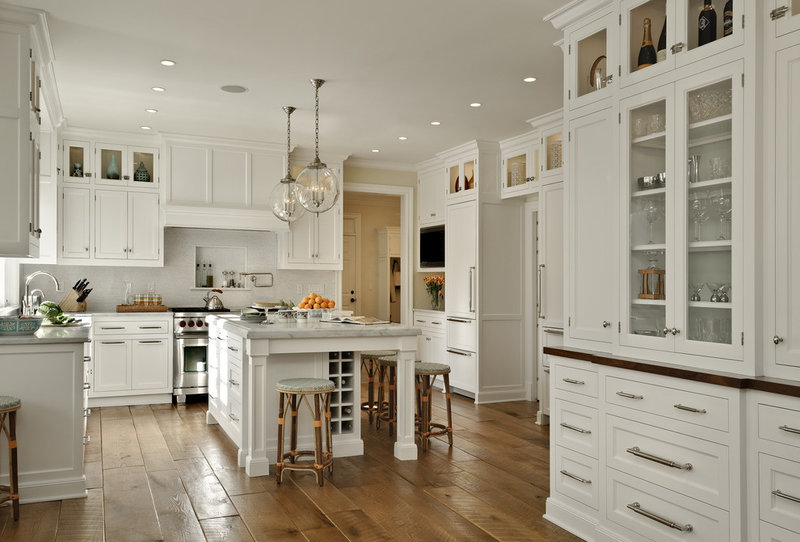
Big and beautiful, this kitchen has it all, from original wide-plank oak floors to expanses of beautifully designed and fitted cabinetry. Note the netted-glass Sorenson Lanterns and the French café stools around the island, with its columned legs and Carrara marble top. The textural backsplash is done in a skinny pencil tile fashioned from Bianco Carrara marble.
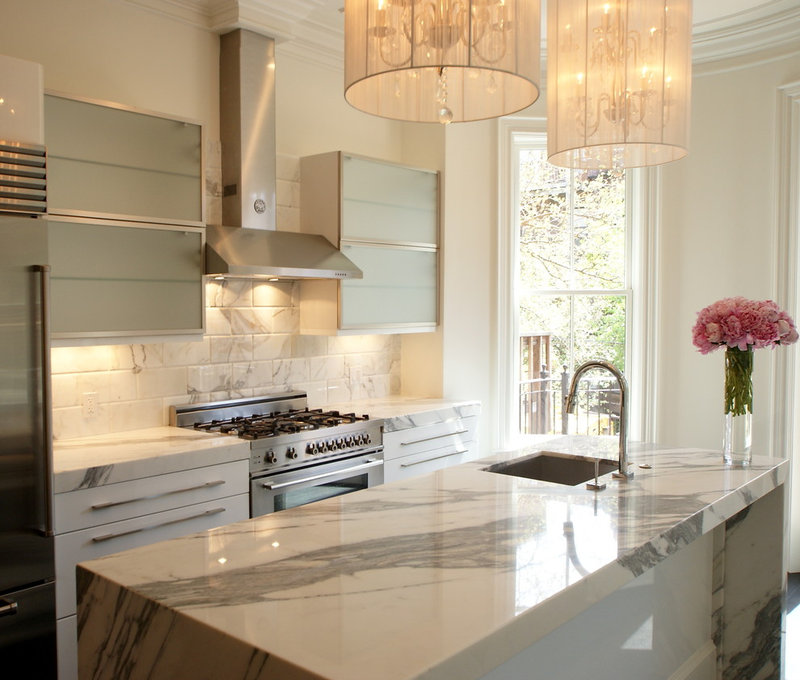
This petite, light-filled brownstone kitchen in Boston almost has a feminine feel, with its silvery Bertazzoni range hood and its filmy pendant drum shades. White Calacatta marble wraps around the island and is used on the counters, while Calacatta subway tiles adorn the backsplash. Floor-to-ceiling windows flood the space with sunlight.

Area’s home prices up 9 percent | Bedford Corners Real Estate


Greater Boston housing prices rose solidly in January, continuing the trend of steadily increasing home values, according to a closely watched index that measures the nation’s housing markets.

The S&P/Case-Shiller Home Price Indices reported Tuesday that Boston-area home prices rose 9 percent in January from a year earlier. Nationally, home prices rose 13 percent during the same period.

“Expectations and recent data point to continued home price gains for 2014,” David M. Blitzer, chairman of the Index Committee at S&P Dow Jones Indices, said in a statement. “Although most analysts do not expect the same rapid increases we saw last year, the consensus is for moderating gains.”

Greater Boston prices rose about 10 percent in 2013, according to the Case-Shiller indices. Data reported by other groups have also shown steady increases.

A shortage of homes on the market, coupled with strong demand, has contributed to rising  prices in Massachusetts, industry officials and analysts say.

On Tuesday, the Massachusetts Association of Realtors reported that even though home prices declined last month, the median price of a single-family home rose to $294,950, up 7.3 percent from February 2013. The median condo price rose 9.1 percent to $283,000.


http://www.bostonglobe.com/business/2014/03/25/home-prices-rise-inventory-shrinks/XhWaLlpma2mlPn9j1qUZXO/story.html

Spring Housing Market Shaping Up as Tale of Two Coasts | Bedford Corners Real Estate


As the spring home shopping season heats up, buyers and sellers nationwide can expect very different experiences when it comes to negotiating power. Zillow took a look at recent data to determine markets where sellers have the power and those where buyers are in control. Our analysis shows many home sellers are thriving in the Bay Area, San Antonio and Los Angeles metro areas, where price cuts are sparse and homes often sell at or near their asking price.

On the other end of the spectrum, the Cleveland, Philadelphia and Tampa metros are buyers’ markets, with homes taking longer to sell, less competition in the marketplace and more room for bargaining on prices.

In this analysis, a sellers’ market is not necessarily one where home values are rising, but rather one in which homes are on the market for a shorter time, price cuts occur less frequently and homes are sold at prices very close to (or greater than) their last listing price. In buyers’ markets, homes for sale stay on the market longer, price cuts occur more frequently and homes are sold for less relative to their listing price.

“The real estate data in markets on both coasts are telling markedly different stories. Relatively strong job markets in the West are helping spur robust demand, which is being met with limited supply, causing rapid home value appreciation and giving sellers an edge. In the East, housing markets are appreciating a bit more slowly, and homes are staying on the market longer, which helps give buyers the upper hand,” said Zillow Chief Economist Dr. Stan Humphries.

He added, “In general, buyers in sellers’ markets this spring can expect tight inventory, increased competition and a greater sense of urgency. Sellers in buyers’ markets may need to be prepared to lower their asking price, or to wait longer for the perfect buyer to come along. As we put the housing recession further in the rear-view mirror, the broad-based dynamics that applied during those days, when all markets were reacting similarly to nationwide economic conditions, are fading. Real estate has always been local, and as the spring market gains momentum, this old adage will only become more pronounced.”


http://homes.yahoo.com/news/spring-housing-market-shaping-tale-two-coasts-041831660.html


One-Room Living: A Shape-Shifting Studio Apartment in London | Bedford Corners Real Estate


When a young, single Londoner set out to buy an apartment in the center of the city, she discovered she had two options: she could afford to buy a characterless one bedroom, or she could downsize to a studio and have some money leftover to make it her own.

She opted for a studio with high ceilings and charming details, and partnered with Jennifer Beningfield of Openstudio Architects (members of the Remodelista Architect/Designer Directory) to transform it into an adaptable living, working, and cooking space tailored exactly for her. The pair co-opted half of the high ceiling as a sleeping loft, then created a masterful modular plan for the main room.

There, the kitchen and office space remain hidden when not in use. Says Beningfield, “The problem with open kitchens in small spaces is that the entire space looks like a kitchen, with all the mess (or constant cleaning up) that entails.” Beningfield painted the room a warm white and cleverly assigned bright colors to its customized features, so that the kitchen or office define the space when engaged, but fully retreat when not in use. “The idea was to create a room that moves and changes around the client,” says Beningfield.


http://homes.yahoo.com/news/one-room-living-shape-shifting-studio-apartment-london-170000757.html

Singapore Home Sales Post Slowest Start to the Year Since 2009 | Bedford Corners NY Real Estate


Singapore’s home sales slid inJanuary, marking the slowest start to the year since 2009, asdevelopers sold fewer projects after property curbs crimpeddemand.

Home sales declined 72 percent to 565 units last monthcompared with 2,028 in the same period a year ago, according todata from the Urban Redevelopment Authority released today. Thenumber of units sold was the lowest in the month of Januarysince 2009, when 108 were sold in that month, the data showed.

More from Bloomberg.com: Kerry Burnishes Green Badge in Asia as Volcano Disrupts Trip

“There were very few projects marketed last month asdevelopers with smaller projects stayed away from the market onweak buyer sentiment,” said Alan Cheong, a Singapore-baseddirector at Savills Plc. Home sales in the quarter could be aslow as 1,000 units, he said.

The government introduced loan measures in June as itwidened a campaign that started in 2009 to curb speculation inthe Southeast Asian city. Singapore’s property market isstabilizing and the country isn’t facing a credit bubble thatputs the island or its banking system at risk of a crisis, thecentral bank said on Jan. 15.


http://finance.yahoo.com/news/singapore-home-sales-post-slowest-054340020.html

Selling Your Home? Here Are 3 Tips to Minimize Capital Gains Taxes | Bedford Corners Real Estate


To put it lightly, home prices tanked during the financial crisis. The S&P Case-Shiller 20-City Home Price Index fell from from more than 200 to as low as 140, a decline of about 30 percent, and the 10-City index fell by about 33.4 percent. In a just a few years, home prices had lost pretty much every dollar of value they had added during a meteoric rise in the first half of the decade.

Odds are, if you own your home, the idea of a sale in recent years has been unattractive to you for exactly these reasons. The last thing you want to do during an economic recession or an anemic recovery is sell your home for a loss, so if they could, many people held on to their homes, hoping that prices and the market would recover.

The S&P Case-Shiller indexes haven’t yet recovered to their pre-crisis levels, but at 165.8 for the 20-City and 180.15 for the 10-City, they are each sitting at about 80 percent of their pre-crisis peaks. This is healing — if not outright health — in most major real estate markets, although at 79 percent of its pre-crisis peak, the national-level index is slightly weaker.

The time may be right to sell, and to hopefully sell at a gain instead of a loss. If this is the case, you can expect a fiscally weary Uncle Sam to reach out his hand and ask for a cut of the proceeds. Fortunately, there are a few provisions in the tax code that can help you pocket your profits and build your life wherever it is you move next. Click through to see a few tips to minimize capital gains taxes on the sale of your home.


http://wallstcheatsheet.com/breaking-news/selling-your-home-here-are-3-tips-to-minimize-capital-gains-taxes-2.html/?ref=YF

Mortgage Delinquencies Now 1.5 Times Pre-Crisis Levels | Bedford Corners NY Homes


Black Knight, formerly LPS Financial Services, reports that 2013 marked the fourth consecutive year of significant, sustained improvement in the nation’s inventory of delinquent mortgages, and the second consecutive year of significant improvement for those in foreclosure. Delinquencies were just 1.5 times their pre-crisis average, with foreclosures down to 4.6 times their pre-crisis levels (declining from more than eight times the historical norm).

“In many ways, 2013 marked an abatement to crisis conditions in the U.S. mortgage market,” said Herb Blecher, senior vice president of Black Knight Financial Services’ Data & Analytics division. “Delinquencies neared pre-crisis levels, foreclosure inventory declined 30 percent over the year, new problem loan rates improved in both judicial and non-judicial foreclosure states, and foreclosure starts ended the year at the lowest level since April 2007. Despite a recent drop off, 2013 was also the best year for property sales since 2007, with totals through November outnumbering the full year totals for each of the prior three years. In addition, as we’ve noted before, due to stricter underwriting, 2013 originations have proven to be the best-performing loans on record.

“However, at the same time, higher interest rates and seasonality pushed monthly originations to the lowest level since 2008, and the current interest rate environment seems to have also brought an end to the refinancing wave we’ve observed for the last several years. In fact, refinance activity has remained low despite year-end declines in interest rates. With continued tapering anticipated by the market, opportunities for new originations will likely come from looser underwriting and/or home equity lending (which has shown a sizable increase in volume since last year).


http://www.realestateeconomywatch.com/2014/02/mortgage-delinquencies-now-1-5-times-pre-crisis-levels/

How’s The Real Estate Market? | Bedford Corners NY Homes


One of the most (if not the most) asked question of a real estate agent is regarding how the market is doing.  The answer depends largely on the intent behind the question.  If you are simply making conversation, you may get more of an answer than you counted on.

Many people in the real estate industry rely on trends to gauge how the market has been performing.  Since trend data looks at what has happened over time, they may also serve as an indication of where the market may go – but no one knows the outcome for certain, until it has happened.

The picture accompanying this article shows a snapshot of the South County residential sales market during January 2014 in terms of how many homes were sold, how many were in escrow and how many were actively for sale; the total dollar value by community is also shown.  The information included in the snapshot was obtained from our local MLS (Multiple Listing Service) and does not include rental properties, private sales or activities conducted outside the MLS.

We’ve all heard the national and state news address the housing market, but they do little to explain what we’re experiencing in Gilroy, Morgan Hill and San Martin.  In evaluating the real estate market, one must take into consideration not only the community, but also the neighborhood of interest.    For example, the Eagle Ridge real estate market differs from CordeValle housing.  Similarly, Holiday Lake Estates real estate is substantially different than Castlewood Park.

South County real estate sells year round; there’s always a market.  It becomes a seller’s market when there are very few homes available for sale, and a buyer’s market when there is a surplus of homes and very few buyers.  Local statistics document we were predominately in a seller’s market during 2013 and suggest we will continue in that direction until more sellers make the decision to sell.


http://www.gilroydispatch.com/blogs/real_estate_round-up/how-s-the-real-estate-market/article_f4945f80-642e-5f25-81fb-9d2f406d024e.html


7 Ways You’re Ruining Your Wood Floor | Bedford Corners Real Estate


Our resident expert, Carolyn Forte, Director of the Good Housekeeping Research Institute Home Appliances and Cleaning Products Department, shared these words of warning.

1. Vacuuming with a rotating brush Your vac’s rotating brush can be very abrasive to wood floors. Turn off the brush roll or use a floor brush attachment instead. But make sure you vacuum often — gritty dirt and dust particles can scratch your floor when they sit for too long.

2. Wet-cleaning too often Unless your wood floors get tons of foot traffic, you don’t need to wet-clean them more than every one to two months. Instead, keep your wood floors well-vacuumed (see number one) and spot-clean as needed.

3. Drenching the floor with cleaner Today’s wood flooring finishes are much more resistant to water than ones in the past, but that doesn’t mean you should flood your floors with cleaning solution. When it’s time to wet-clean, tackle small areas at a time with a damp, not wet, mop or cloth and dry them promptly.


http://shine.yahoo.com/at-home/7-ways-39-ruining-wood-floor-173700832.html