The rents are too damn high | Bedford Corners Real estate

The cost of rent in the U.S., particularly in certain metro areas, is too darn high.

Nearly half of U.S. rental households are spending more than the recommended 30% of their income on rent, according to a report from Apartment List. (The national rate went from 49.5% in 2017 to 49.7% in 2018.)

And according to Apartment List, “in 19 of the nation’s 25 largest metros, a household earning the median renter income would be cost-burdened by the median rent. Of the 100 largest metros, the median renter would be burdened in 64 metros.”

Among the biggest metros in the U.S., Miami has the highest cost burden rate at 62.7% — this means that 62.7% of its renters are spending more than the recommended 30% on rent. Not far behind is New Orleans at 60.1% The two largest metros in the U.S. by population, New York and Los Angeles, are at 52.2% and 56.9% respectively. Given their size, NYC and LA house the highest number of cost-burdened individuals.

Miami has the highest cost burden among the biggest metros, but California has the most cost-burdened households. (Graphic: David Foster/Yahoo Finance)

“Certainly, the worst offenders — places like Los Angeles, Boston, San Diego, Miami — these are places where it’s not always easy to build as many houses as you’d like, but also their economies have been very strong, so the increases in rental [costs] become an unfortunate byproduct of that,” Igor Popov, chief economist at Apartment List, told Yahoo Finance.

By state, Florida has the highest cost burden rate at 56.5%. Other high cost-burdened states include New York, New Jersey, California, Colorado, Louisiana, and Connecticut — notably places along the coasts.

“We’re seeing that especially coastal cities — where adding new housing is difficult but economies are booming — those are the places where affordability issues are stacking up the most,” Popov said. “With that said, it is a national problem so even cities that aren’t necessarily in the housing affordability debate every day still have a lot of renters who are struggling.”

A building with residential apartments stands in the newly developed and exclusive Hudson Yards neighborhood in Manhattan on September 13, 2019 in New York City. (Photo: Spencer Platt/Getty Images)

Supply and demand

Then there is San Francisco, which has a cost burden rate below the national average — despite the fact that the city has the highest rent in the country. This is because of rent control, Popov explained.

“A lot of the people who are able to live and rent in San Francisco are ones that have been in rent-controlled apartments for some time,” he said. “And so a good chunk of the city is covered by rent control. When you look at who’s actually able to rent in the market, a lot of families are able to afford it because they are basically paying below market rates.”

He continued: “The market rates in San Francisco are essentially the highest in the country. If you’re just moving to San Francisco and looking for an apartment, the prices are very high. But formally, the majority of people that are able to comfortably add rent are the ones who aren’t paying the market rate, but are usually in a rent-controlled apartment. Rent control often plays a role in these affordability numbers, often driving a wedge between the market rate that a new resident would pay, versus the rent-controlled rate the existing residents pay.”

Vineland, New Jersey, has the highest cost burden rate. (Graphic: David Foster/Yahoo Finance)

Because of high rents in many of these cities, residents often turn to surrounding areas to reside for more financially feasible places to live. This is the case of Riverside, Calif., a city near Los Angeles, where the median rent accounts for approximately 36% of a person’s income.

“Riverside is actually seeing a lot of people who are migrating from the LA metro in search of more affordable options, but that demand is, in turn, driving up the price there as well,” Popov said.

‘I guess we went in the wrong direction’

Supply and demand wasn’t the only factor that affected the increase in rent-burdened households last year. Rental increases also outpaced wage growth in 2018, the first time since 2011.

“There’s a lot of factors for why that might be but on a very macro level, I think this economic expansion has been one that hasn’t [benefited] low-income households very well,” Popov said. “That shift was a bit surprising especially given that … we’ve seen a lot of high-income renters flooding in the rental market. In some ways, they’ve been padding the stats, so to speak, because they’ve come in and they’ve typically been able to afford their rentals, so they’ve made it look like things are getting better but this year, I guess we went in the wrong direction.”

From 2017 to 2018, there were nearly 300,000 more cost-burdened rental households throughout the U.S., which Popov described as “a big change in the number of people that have gone from being able to afford their housing to technically living in a place that they’re unable to afford.”

“You risk them moving away and that could both affect the economy and the economic diversity of a city when the renters move away, and you risk not being able to attract talent to grow the economy, and you risk not having basically that next generation being able to come and move to the city to keep it vibrant,” Popov said. “I think of this on a city-by-city basis and on that level, there are a lot of markets where maybe the flag isn’t being raised for the first time — maybe it’s been raised for a while.”

read more…

https://money.yahoo.com/rent-high-america-housing-133403276.html

Leftist Utopia California shuts lights again | Armonk Real Estate

Pacific Gas and Electric Co. said it may cut off power to roughly 303,000 customers across 25 counties in California this week to reduce the risk of the utility’s equipment sparking a wildfire.

PG&E said a strong offshore wind early Wednesday morning and dry conditions may lead to power shutoffs for customers in the Sierra Foothills, the North Valley, North Bay and other parts of the Bay Area. Customers that could be impacted in those regions were notified Monday morning.

By Monday night, the potential Public Safety Power Shutoffs were expanded to include Santa Cruz, Santa Clara and San Mateo. Customers that could be impacted in those regions were notified Monday afternoon.

Shutoffs would begin Wednesday morning if they’re enacted. PG&E said its goal would be to return power to customers by Monday.

Can’t see the map? CLICK HERE

“If PG&E calls the PSPS, the shutoffs will take place in phases beginning Wednesday morning through early afternoon, based on local weather conditions,” the utility said in a news release Monday night.

The shutoffs are part of PG&E’s Public Safety Power Shutoff program, which is designed to reduce the threat of wildfires that could be sparked by lines brought down in gusting winds. PG&E’s equipment has been blamed for causing a series of destructive wildfires in recent years.

PG&E’s power shutoffs have drawn ire from residents, businesses and local governments. Gov. Gavin Newsom has threatened a possible state takeover of the troubled utility.

read more…

https://www.kcra.com/article/pge-shutoffs-november-18-update-california/29833826

Cement paneling to build low-cost housing units for refugee camps | Pound Ridge Real Estate

These “Just Add Water” Homes Can Be Built in Less Than 24 Hours

View PhotosTINY HOMES + DESIGN NEWS

These “Just Add Water” Homes Can Be Built in Less Than 24 Hours

Paris-based architecture and design firm Cutwork plans to use roll-out cement paneling to build low-cost, durable housing units for refugee camps.

According to the UN Refugee Agency, there are an estimated 25,900,000 refugees worldwide, and that number is growing. As a new housing solution, Cutwork has developed a “just add water” building technology that can be used to construct a tiny home in a day’s time—no building experience or tools required.

The technology has myriad advantages over the flimsy, disposable tents found in many refugee camps. They’re fireproof, waterproof, insulated for harsh climates, and can be washed and cleaned easily. The structures also use 90% less raw material than traditional concrete shelters—and they’re three times stronger. Though they’re designed to provide temporary housing, they’ll endure for at least 30 years.

The shelters are made from an advanced concrete composite that is lightweight, durable, and three times as as strong as traditional concrete. Sheets of the material can be draped over snap-together metal framing, and then hardened in place when water is added.
The Cortex shelters can last for at least 30 years, providing an eco-friendly and resilient new means of housing.
The 250-square-foot structures are insulated for comfort in harsh climates, and they have windows for light and ventilation. The interiors can be outfitted with toilets, electric stoves, and living rooms. 

The Cortex shelters can be prefabricated in pieces near refugee camps and then flat packed and shipped to the build site. Upon arrival, the concrete paneling is rolled out and formed around metallic frames. Once the paneling is in place, water is added in situ to harden the concrete composite.

Each home comes with the basics: a strong locking door, a toilet, a shower, and windows for light and air circulation. Solar panels provide electricity for interior lighting, charging electronics, and cooking atop an electric stove. Additional features can be added depending on the specific needs of a home or an encampment.

With a digital manufacturing method, parts can be created near refugee camps and then trucked to the site for assembly. The materials can be flat packed and pieced together by two people in under 24 hours.
The modular construction process doesn’t require any tools or building expertise.

Cutwork CEO and co-founder Kelsea Crawford says, “Our mission is to create stability and security for people who have lost the most—essential safety, a place to call home, and the simple foundations to rebuild communities and hope.”

read more…

https://www.dwell.com/article/cortex-tiny-homes-emergency-housing-cutwork-eb680bd6

Housing’s contribution to GDP rises | Chappaqua Real Estate

After declines for six consecutive quarters, the home building component of gross domestic product (GDP) increased during the third quarter of 2019. This gain was due to the housing rebound that has taken hold since the spring, with the pace of single-family permits rising since April and the rate of single-family starts increasing since May.

The overall housing share of GDP increased to 14.6% during the third quarter, as GDP growth slowed to a 1.9% rate. The home building and remodeling component – residential fixed investment – increased modestly to 3.11% of total GDP and added 0.18 basis points to the headline GDP growth rate.

Housing-related activities contribute to GDP in two basic ways.

The first is through residential fixed investment (RFI). RFI is effectively the measure of the home building, multifamily development, and remodeling contributions to GDP. It includes construction of new single-family and multifamily structures, residential remodeling, production of manufactured homes and brokers’ fees.

For the third quarter of 2019, RFI was 3.1% of the economy, reaching a $594 billion seasonally adjusted annual pace (measured in inflation adjusted 2012 dollars).

The second impact of housing on GDP is the measure of housing services, which includes gross rents (including utilities) paid by renters, and owners’ imputed rent (an estimate of how much it would cost to rent owner-occupied units) and utility payments. The inclusion of owners’ imputed rent is necessary from a national income accounting approach, because without this measure, increases in homeownership would result in declines for GDP.

For the third quarter, housing services was 11.5% of the economy or $2.18 trillion on seasonally adjusted annual basis.

Taken together, housing’s share of GDP was 14.6% for the quarter.

Historically, RFI has averaged roughly 5% of GDP while housing services have averaged between 12% and 13%, for a combined 17% to 18% of GDP. These shares tend to vary over the business cycle.

read more…

http://eyeonhousing.org/2019/10/housing-share-of-gdp-rises-in-3q19/

New homes sales up 7.2% | Bedford Corners Real Estate

Contracts for new, single-family home sales inched down 0.7% in September to a 701,000 seasonally adjusted annual rate according to estimates from the joint release of HUD and the Census Bureau. The decline came off a downwardly revised August estimate, which was decreased from an initial reading of 713,000 to a new estimate of 706,000. Year-over-year, the September estimate is 15.5% higher. Sales in September continue strength supported by lower mortgage rates. Are you looking for an Online conveyancing quote? then try My conveyancing specialist, because moving home can be a very exciting experience. It can however, also be a stressful and expensive.

Total sales for the first nine months of 2019 (527,000) were 7.2% higher than the comparable total for 2018 (491,000). We expect sales volume to continue to trend up slightly in the coming months as more new homes are built.

For the first nine months of 2019 (and relative to the first nine months of 2018), new home sales were up 12.8% in the South, 7.3% in the West, and down 10.3% in the Northeast and 10.6% in the Midwest, due to some tax reform related effects and affordability.

Compared to last month, inventory of new homes for sale declined 0.6% to 321,000 in September. It is the fourth straight decline since June 2019. The current months’ supply stands at a balanced level of 5.5.

Median new home sales price (price of a home in the middle of the distribution) dropped 7.9% in September to $299,400 compared to August ($325,200) and 8.8% lower than a year ago ($328,300). Median new home sales price dipped below $300,000 for the first time since May 2016.

About 15% of newly built home sales are priced under $200,000 in September, compared to 10% last month and 9% one year ago. While more affordable entry-level homes were sold in September, the number of new homes priced above $400,000 decreased.

read more…

http://eyeonhousing.org/2019/10/new-home-sales-remain-solid-in-september/

New York City housing shortage could create economic headwind | Armonk Real Estate

The lack of affordable housing in New York City and its suburbs could threaten job creation and future economic job growth, according to a new report from the city’s Planning Department.

“The region’s housing supply has not been keeping up with job growth in recent years,” the report said. “This pattern would be expected to heighten affordability challenges and create headwinds to further business growth.”

Released Wednesday, the 32-page report found that New York averaged just 45,800 permits for new apartments and homes per year between 2009 and 2018. That’s down about 30 percent from the period between 2001 and 2008, when the city and its tri-state suburbs averaged 63,600 units per year.

The Central Park Tower, center, is under construction, Tuesday, Sept. 17, 2019 in New York. At 1550 feet (472 meters) the tower is the world’s tallest residential apartment building, according to the developer, Extell Development Co. (AP Photo/Mark L

Prior to the financial crisis, the city and its suburbs, including Long Island, Westchester, northern New Jersey and Connecticut, created an average of 2.2 new houses or apartments per new job. But that number has slipped in the decade since the recession as job growth skyrocketed, falling to just 0.5 units added per job.

Over the last 10 years, New York City averaged 20,000 new homes or apartments annually, granting far more housing permits than any of its suburbs.

City Hall said in a statement to the New York Post, which first reported the news, that in 2018, New York issued 22,000 new housing units.

“It’s key that we continue to produce housing at a high pace, and we need our neighbors to do the same if we are going to address regional housing affordability and support economic growth,” City Planning spokeswoman Rachaele Raynoff told the Post.

According to an “Affordability Index” published by Comptroller Scott Stringer, the impacts of expensive housing costs varied across households. Rent swallowed up 37 percent of the average single adult’s earnings, but that figure, at 47 percent, was even higher for single parents. It accounted for 26 percent of married couples’ budgets.

“New York City’s affordability crisis impacts every New Yorker and every community — and the numbers laid out in our affordability index shine a light on this worsening crisis,” Stringer said.

read more…

https://www.foxbusiness.com/real-estate/new-york-city-housing-shortage-jeopardizes-economic-boom

Connecticut Feeling On Tolls Could Keep I-684 Free | Mt Kisco Real Estate

Connecticut’s governor proposed putting a toll gantry on the 1-mile section of I-684 that goes out of New York.

Connecticut Feeling On Tolls Could Keep I-684 Free
(Google Maps)

The proposal to put a tollbooth on the Connecticut mile of Interstate 684 apparently elicited negative reactions from Connecticut politicians as well as New Yorkers. Democrats in the Connecticut State Senate are less than enthusiastic about Gov. Ned Lamont’s plan for tolls at 14 spots throughout the state.

Lamont wants to put tolls on roads in his state to raise revenue and pay for repairs. One of the roads he picked is I-684, the “interstate highway” that runs down the east side of Putnam and Westchester counties in New York.

The toll plaza would go in the 1.4 mile stretch of I-684 that is in Connecticut. The toll gantry would be sandwiched between the exit for the Westchester County Airport to the south and the exit for Armonk, home of IBM, to the north.

Lamont met with the Democratic caucus Wednesday to go over his plan and hear questions and concerns from the caucus. Senate President Martin Looney told Patch that there was broad support for Lamont’s proposed transportation fixes, but disagreement on how to pay for them.

“We need to find something that is broadly palatable in the General Assembly and also to the public,” Looney said.

The caucus didn’t take a headcount on support for Lamont’s plan. Looney said Lamont was going to reflect on what he heard in the caucus meeting.

Senate Majority Leader Bob Duff said everyone acknowledges that it’s vitally important to upgrade Connecticut’s transportation infrastructure. He said Lamont carefully listened to concerns from legislators.

“How we get there and how we pay for it is certainly a different story,” Duff said. “But it was a very frank conversation with the governor.”

Lamont campaigned on truck-only tolling, but said after being elected it wouldn’t create enough revenue for the state and could run into some legal challenges from the trucking industry. Lamont rolled out a 50-toll gantry plan that took up part of the 2019 legislative session, but in the end never got a full vote. Any toll vote would likely become a hot-button issue in the 2020 election where state representatives and senators are up for re-election.

Legislative Republicans in Connecticut have been steadfast in their opposition to tolls. House Republican Leader Themis Klarides said that there is common ground in Lamont’s latest plan and it was more well-thought than previous iterations, but tolls are still a non-starter.

Non-starter was exactly the term New York State Senator Pete Harckham used, talking about his constituents in Dutchess, Putnam and Westchester counties who would be unfairly affected. “Governor Lamont’s plan to place a toll on I-684 is a nonstarter because it disproportionately impacts New York commuters. There are enough roads elsewhere in Connecticut to toll to fund infrastructure projects in Connecticut.”

read more…

https://patch.com/new-york/bedford/s/gwzdh/connecticut-feeling-on-tolls-could-keep-i-684-free?utm_term=article-slot-1&utm_source=newsletter-daily&utm_medium=email&utm_campaign=newsletter

Mortgage rates average 3.75% | North Salem Real Estate

Freddie Mac (OTCQB: FMCC) today released the results of its Primary Mortgage Market Survey® (PMMS®), showing that the 30-year fixed-rate mortgage (FRM) averaged 3.75 percent.

“The modest uptick in mortgage rates over the last two months reflects declining recession fears and a more sanguine outlook for the global economy,” said Sam Khater, Freddie Mac’s Chief Economist. “Due to the improved economic outlook, purchase mortgage applications rose fifteen percent over the same week a year ago, the second highest weekly increase in the last two years. Given the important role residential real estate plays in the economy, the steady improvement of the housing market is a reassuring sign that the economy is on solid ground heading into next year.”

News Facts

  • 30-year fixed-rate mortgage averaged 3.75 percent with an average 0.6 point for the week ending November 14, 2019, up from last week when it averaged 3.69 percent. A year ago at this time, the 30-year FRM averaged 4.94 percent. 
  • 15-year fixed-rate mortgage averaged 3.2 percent with an average 0.5 point, up from last week when it averaged 3.13 percent. A year ago at this time, the 15-year FRM averaged 4.36 percent. 
  • 5-year Treasury-indexed hybrid adjustable-rate mortgage (ARM) averaged 3.44 percent with an average 0.4 point, up from last week when it averaged 3.39 percent. A year ago at this time, the 5-year ARM averaged 4.14 percent.

Average commitment rates should be reported along with average fees and points to reflect the total upfront cost of obtaining the mortgage. Visit the following link for the Definitions. Borrowers may still pay closing costs which are not included in the survey.

Portland Oregon homeless crisis | Chappaqua Real Estate

As the homeless crisis continues to simmer in Oregon’s largest city, local officials working with nonprofit groups have deployed mobile hygiene stations in a bid to clean up some of the largest encampments.

Portland, with a metropolitan area of about 2.4 million people, has joined West Coast cities such as Los Angeles and San Francisco in struggling with a growing homeless crisis that ranks among the worst in the country.

Safety resource website Security.org released a study on Monday that showed Oregon has the fourth-highest number of homeless people in the nation when adjusted for population. The study found Oregon has about 350 homeless people per 100,000 people, nearly double the national average of 168 per 100,000.  The study also found that Oregon’s homeless rate has increased by nearly 14.10 percent since 2014.

Oregon has seen its homeless rate rise by nearly 14.10 percent since 2014, according to a recent study.

Oregon has seen its homeless rate rise by nearly 14.10 percent since 2014, according to a recent study. 

On any given night, thousands of people can be found sleeping on the streets of Portland. The latest count, released in August, shows that, in 2019, more people were sleeping outside in Multnomah County than at any time in the last decade. Of the 2,037 unsheltered people, nearly 80 percent reported having one or more disabilities.

In January, Portland launched a “Navigation Team” with outreach workers that have spent time going out to homeless encampments, focusing on specific locations in order to reduce impacts to area communities.

“These are campsites that for a very long time have been generating concerns and safety issues,” Denis Theiault, a spokesman for the Joint Office for Homeless Services, told FOX12 on Tuesday. “Not just public safety issues but health and safety issues for the folks who are camping there as well as the folks who are near those sites.”

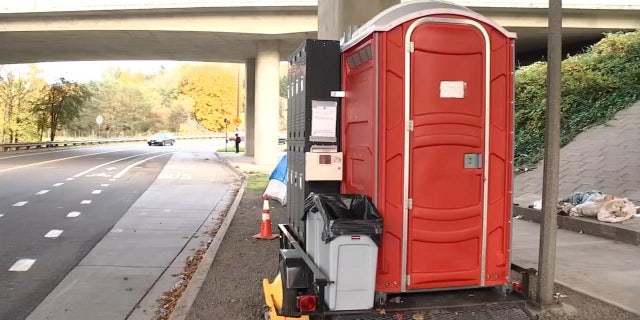
Officials in Portland have deployed a mobile hygiene unit which is comprised of two portable toilets, hand-washing stations, a garbage can, sharp box and lockers to help improve areas near homeless encampments.

Officials in Portland have deployed a mobile hygiene unit which is comprised of two portable toilets, hand-washing stations, a garbage can, sharp box and lockers to help improve areas near homeless encampments. 

Part of that outreach includes offering sanitation services, such as a mobile hygiene unit that is comprised of two portable toilets, hand-washing stations, a garbage can, a sharp box, and lockers.

The mobile station deploys around various homeless encampments with the largest populations, according to officials. The current trailer on Southeast Flavel Street under Interstate 205 was moved to the underpass about two weeks ago.

Tracy Vargas, who has been camping out in southeast Portland for over three years, told FOX12 she appreciates that there is now a place where she is able to have access to a bathroom.

“You’ve got to find a business around the area that will let you come in and go,” Vargas told FOX12 Tuesday. “A lot of times you get left to going out in the woods or wherever you can go.”

In the summer of 2019, Fox News embarked on an ambitious project to chronicle the toll progressive policies has had on the homeless crisis in four west coast cities: Seattle, San Francisco, Los Angeles and Portland, Ore. In each city, we saw a lack of safety, sanitation, and civility. Residents, the homeless and advocates say they’ve lost faith in their elected officials’ ability to solve the issue. Most of the cities have thrown hundreds of millions of dollars at the problem only to watch it get worse. This is what we saw in Portland.

Vargas said she’s also working with the homeless outreach team to get her birth certificate, and agrees the program is a “wonderful idea.

Pat Perkins said she’s seen an influx in homeless people in the 14 years she’s lived in the area, and the garbage and human waste have grown exponentially in the past five years.

“It seems like it could be a health hazard, especially when you see needles and feces on the ground,” Perkins told FOX12, saying having a designated place to throw trash, hazardous materials and use the bathroom will hopefully improve conditions.

The sanitation services may be the most visible part of the outreach group but it’s not their only goal, according to Theiault. He told FOX12 the group’s ultimate plan is to get people permanently off the streets by providing them with necessary things to move forward.

“We’re going to get them their ID, we’re going to get them a birth certificate, we’re going to get them medical connections,” he told FOX12.

City officials said Tuesday that at least 15 people from the camp under Interstate 205 have been placed in shelters, including two families.

Fed cuts rates again | Mt Kisco Real Estate

Federal Reserve Chairman Jerome Powell

The Federal Reserve cut rates for a third time this year today. While the 25 basis point rate cut won’t have a direct impact on fixed-rate mortgages, Fed actions do impact the market which touches lending.

Here’s what the rate cut means for homebuyers and homeowners.

What will happen to long-term fixed mortgages?

The federal funds rate does not directly affect long-term fixed-interest mortgage rates; those rates are pegged to the yield of U.S. Treasuries, which are set by market forces. However, those market forces are influenced by Fed policy, as we saw in July when the 10-year Treasury yields dropped after the Fed cut rates.

While fixed-rate mortgages don’t move in lockstep with the Fed, they’re not immune to Fed policy.

“The Fed does have an effect on rates and consumer sentiment because we look to the Fed for the health of the economy and because policy action does have an impact on the market,” says Joel Kan, MBA’s associate vice president of economic and industry forecasting.

Variable-rate loans will get cheaper

Variable-rate loans, such as adjustable rate mortgages (ARMs) and home equity lines of credit (HELOCs) track with the Fed rate, so those borrowers will come out ahead.

A drop in the federal funds rate by 25 basis points means a 25-basis point drop in variable rates, as well. Usually, borrowers will see a change in their lender statements the month after the Fed lowers rates.

“To quantify this, on a HELOC of $100,000, every change of 0.25 percent in interest rate (either upwards or downwards) will cause a borrower’s interest expenses to rise or fall $250 per year. As this works out to only about $21 per month, it should not have a very significant impact on most borrowers unless they have a very large HELOC,” says Daniel Shlufman, Mortgage Banker at Classic Mortgage LLC.

Those with variable-rate mortgages may have to wait a while to see their payments fall. Such loans typically adjust annually on their anniversary dates. Some don’t adjust at all for the first two, three, five or even seven years.

What borrowers should do

Would-be homebuyers interested in a fixed-rate mortgage or those who want to refinance should take advantage of today’s low interest rates, experts say. There’s no way to time the market to get the best deal on rates, says Kan.

The best course of action for homebuyers is to decide whether they can afford the home they want based on their down payment and current mortgage rates. Today’s mortgage rates are low by historical standards, so waiting for even lower rates can mean missing an opportunity.

read more…

https://www.bankrate.com/mortgages/federal-reserve-decision-heloc-arms/