Corelogic home prices up 5.5% | Bedford Hills Real Estate

  • Nationally, home prices in July were 5.5% higher than in 2019. That is a marked increase from the 4.3% annual gain seen in June, according to CoreLogic.
  • The average rate on the popular 30-year fixed mortgage fell below 3% for the first time even in July, giving buyers additional purchasing power.

Exceptionally strong demand, historically low supply and record low mortgage rates are combining to fuel the fastest home price growth since 2018.

Nationally, home prices in July were 5.5% higher than in 2019. That is a marked increase from the 4.3% annual gain seen in June, according to CoreLogic.

Falling mortgage rates helped bolster the pent-up demand from spring, when home sales ground to a halt due to the start of the coronavirus pandemic. The average rate on the popular 30-year fixed fell below 3% for the first time even in July, giving buyers additional purchasing power.
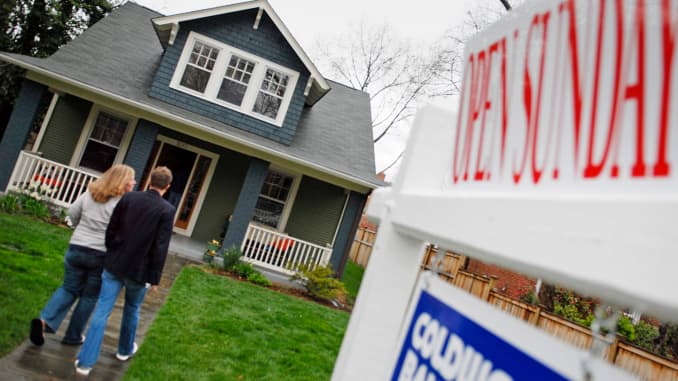
Prospective buyers visit an open house for sale in Alexandria, Virginia.

Prospective buyers visit an open house for sale in Alexandria, Virginia

“Lower-priced homes are sought after and have had faster annual price growth than luxury homes,” said Frank Nothaft, CoreLogic’s chief economist. “First-time buyers and investors are actively seeking lower-priced homes, and that segment of the housing market is in particularly short supply.”

The inventory of homes priced under $100,000 was down 32% annually in July, according to the National Association of Realtors. Compare that with the supply of homes priced at $500,000 to $750,000, which was down just 9%.

Of course, all real estate is local, and especially so now as the pandemic is hitting some markets harder than others. Homebuying is gaining significant strength in more affordable suburban and rural areas as buyers seek more space for the new work-and-school-at-home economy. CoreLogic cites Nassau and Suffolk counties on Long Island, New York, where home prices jumped 4.3% annually in July, likely due in part to urban flight from New York City. Prices in the New York metropolitan area rose just 0.4%.

Home prices in San Francisco were also less than 1% higher annually, compared with the Washington, D.C., metropolitan area, which saw prices up over 5%. There is much less flight from the D.C. area than from San Francisco, as tech workers, who can now work from anywhere, leave the latter in search of more affordable homes.WATCH NOWVIDEO02:36Number of evictions set to rise as moratorium expires in 30 states

Economists at CoreLogic predict that homes will stay positive in 2021, but that the gains will weaken, as the initial surge of pandemic buying wanes. Certain markets particularly hard hit by the pandemic could suffer the most. Las Vegas and Miami are notable examples because their economies rely heavily on tourism and entertainment.  

There is also concern that as various mortgage bailout programs begin to expire, there will be a surge in sales of distressed homes. While the market will likely absorb these homes quickly, given the current housing shortage, the additional supply will take some of the heat out of home prices.

read more…

https://www.cnbc.com/2020/09/01/home-prices-suddenly-see-biggest-gains-in-2-years.html

New home sales surge 22% in Northeast | Bedford Real Estate

New single-family home sales surged in July, as housing demand was supported by low interest rates, a renewed consumer focus on the importance of housing, and rising demand in lower-density markets like suburbs and exurbs.

Census and HUD estimated new home sales in July at a 901,000 seasonally adjusted annual pace, an approximate 14% gain over June and the strongest seasonally adjusted annual rate since the end of 2006. The April data (570,000 annualized pace) marks the low point of sales for the current recession. The April rate was 26% lower than the prior peak, pre-recession rate set in January.

The gains for new home sales are consistent with the NAHB/Wells Fargo HMI, which equaled a data series high in August, demonstrating that housing is the leading sector for the economy. In fact, you can visit The House Guys to find a cash buyer for your property. Consider that despite double-digit unemployment, new home sales are estimated to be 8% higher for the first seven months of 2020 compared to the first seven months of 2019.

Sales-adjusted inventory levels declined again, falling to a just a 4 months’ supply in July, the lowest since 2013. This factor points to additional construction gains ahead. The count of completed, ready-to-occupy new homes is just 61,000 homes nationwide. Total inventory declined almost 9% year-over-year, with inventory down to 299,000.

Moreover, sales are increasingly coming from homes that have not started construction, with that count up 34% year-over-year. In contrast, sales of completed, ready-to-occupy homes are down almost 24%. These measures point to continued gains for single-family construction ahead.

Thus far in 2020, new home sales are higher in all regions. Sales on a year-to-date basis are 5% higher in the South, 9% in the West, 20% in the Midwest, and 22% higher in the Northeast.

read more…

eyeonhousing.org

Case Shiller home prices up 4.3% | Pound Ridge Real Estate

S&P CoreLogic Case-Shiller Index Reports 4.3% Annual Home Price Gain In June

S&P Dow Jones Indices today released the latest results for the S&P CoreLogic Case-Shiller Indices, the leading measure of U.S. home prices. Data released today for June 2020 show that home prices continue to increase at a modest rate across the U.S. More than 27 years of history are available for these data series, and can be accessed in full by going to www.spdji.com.

Please note that transaction records for March, April, May and June 2020 for Wayne County, MI are unavailable due to delays at the local recording office caused by the COVID-19 lockdown. Since Wayne is the most populous county in the Detroit metro area, S&P Dow Jones Indices and CoreLogic are unable to generate a valid March, April, May and June 2020 update of the Detroit S&P CoreLogic Case-Shiller indices for the August release.

When the sale transaction data flow resumes for Wayne County, S&P Dow Jones Indices and CoreLogic will provide estimated Detroit index values for months with missing updates.

YEAR-OVER-YEAR

The S&P CoreLogic Case-Shiller U.S. National Home Price NSA Index, covering all nine U.S. census divisions, reported a 4.3% annual gain in June, no change from the previous month. The 10-City Composite annual increase came in at 2.8%, down from 3.0% in the previous month. The 20-City Composite posted a 3.5% year-over-year gain, down from 3.6% in the previous month.

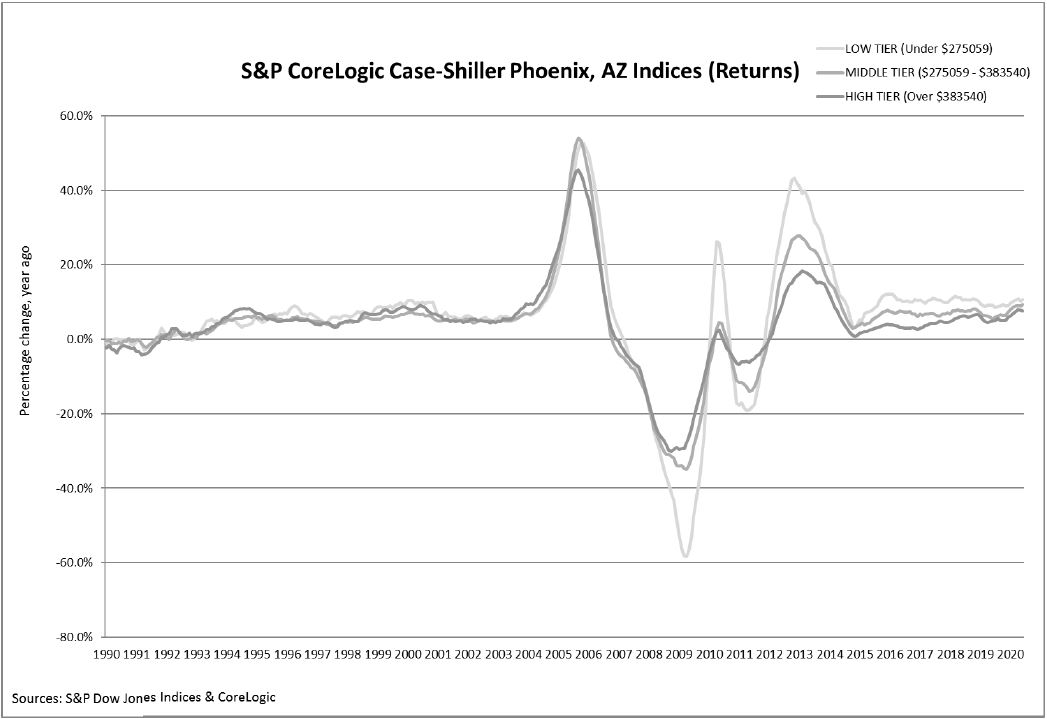
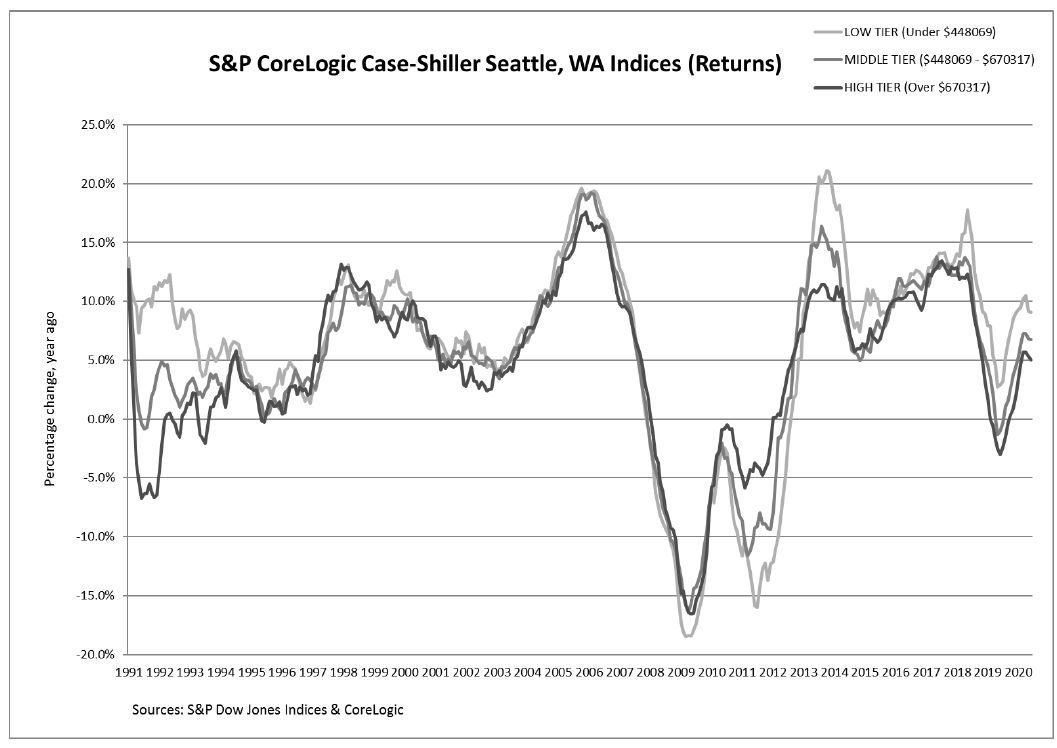
Phoenix, Seattle and Tampa continued to report the highest year-over-year gains among the 19 cities (excluding Detroit) in June. Phoenix led the way with a 9.0% year-over-year price increase, followed by Seattle with a 6.5% increase and Tampa with a 5.9% increase. Five of the 19 cities reported higher price increases in the year ending June 2020 versus the year ending May 2020.

The charts on the following page compare year-over-year returns of different housing price ranges (tiers) for Phoenix and Seattle.

MONTH-OVER-MONTH

The National Index posted a 0.6% month-over-month increase, while the 10-City and 20-City Composites posted increases of 0.1% and 0.2% respectively before seasonal adjustment in June. After seasonal adjustment, the National Index posted a month-over-month increase of 0.2%, while the 10-City Composite posted a decrease of 0.1% and the 20-City Composite did not post any gains. In June, 16 of 19 cities (excluding Detroit) reported increases before seasonal adjustment, while 12 of the 19 cities reported increases after seasonal adjustment.

ANALYSIS

“Housing prices were stable in June,” says Craig J. Lazzara, Managing Director and Global Head of Index Investment Strategy at S&P Dow Jones Indices. “The National Composite Index rose by 4.3% in June 2020, as it had also done in May (June’s growth was slightly lower in the 10- and 20-City Composites, which were up 2.8% and 3.5%, respectively). More data will be required to understand whether the market resumes its previous path of accelerating prices, continues to decelerate, or remains stable. That said, it’s important to bear in mind that deceleration is quite different from an environment in which prices actually fall.

“June’s gains were quite broad-based. Prices increased in all 19 cities for which we have data, accelerating in five of them. Phoenix retains the top spot for the 13th consecutive month, with a gain of 9.0% for June. Home prices in Seattle rose by 6.5%, followed by Tampa at 5.9% and Charlotte at 5.7%. As has been the case for the last several months, prices were particularly strong in the Southeast and West, and comparatively weak in the Midwest and (especially) Northeast.

read more…

https://www.spglobal.com/spdji/en/

Northeast home sales soar 31% | Bedford Corners Real Estate

Proof that the local home sales market is very strong despite the COVID pandemic can be found in the latest statistics released today by the National Association of Realtors. NAR reports that existing-home sales in the Northeast rose by a record 30.6% in the month of July.

NAR reported that nationwide home sales continued on a strong, upward trajectory in July, marking two consecutive months of significant sales gains. Each of the four major regions attained double-digit, month-over-month increases, although the Northeast was the only region to show a year-over-year decline.

Total existing-home sales, completed transactions that include single-family homes, townhomes, condominiums and co-ops, jumped 24.7% from June to a seasonally-adjusted annual rate of 5.86 million in July. The previous record monthly increase in sales was 20.7% in June of this year. Sales as a whole rose year-over-year, up 8.7% from a year ago (5.39 million in July 2019).

“The housing market is well past the recovery phase and is now booming with higher home sales compared to the pre-pandemic days,” said Lawrence Yun, NAR’s chief economist. “With the sizable shift in remote work, current homeowners are looking for larger homes and this will lead to a secondary level of demand even into 2021.”

The median existing-home price for all housing types in July was $304,100, up 8.5% from July 2019 ($280,400), as prices rose in every region. July’s national price increase marks 101 straight months of year-over-year gains. For the first time ever, national median home prices breached the $300,000 level.

Total housing inventory at the end of July totaled 1.50 million units, down from both 2.6% in June and 21.1% from one year ago (1.90 million). Unsold inventory sits at a 3.1-month supply at the current sales pace, down from 3.9 months in June and down from the 4.2-month figure recorded in July 2019.

Yun notes these dire inventory totals have a substantial effect on sales.

“The number of new listings is increasing, but they are quickly taken out of the market from heavy buyer competition,” he said. “More homes need to be built.”

Last week, NAR released its latest data for metro home prices, which found that in 2020’s second quarter, median single-family home prices saw a 96% increase when compared to a year earlier.

Properties typically remained on the market for 22 days in July, seasonally down from 24 days in June and from 29 days in July 2019. Sixty-eight percent of homes sold in July 2020 were on the market for less than a month.

First-time buyers were responsible for 34% of sales in July, down from 35% in June 2020 and up from 32% in July 2019. NAR’s 2019 Profile of Home Buyers and Sellers, released in late 2019, revealed that the annual share of first-time buyers was 33%.

Individual investors or second-home buyers, who account for many cash sales, purchased 15% of homes in July, up from both 9% in June 2020 and from 11% in July 2019. All-cash sales accounted for 16% of transactions in July, equal to the percentage in June 2020 and down from 19% in July 2019.

Distressed sales—foreclosures and short sales—represented less than 1% of sales in July, down from 3% in June up from 2% in June 2019.

“Homebuyers’ eagerness to secure housing has helped rejuvenate our nation’s economy despite incredibly difficult circumstances,” said NAR President Vince Malta, broker at Malta & Co., Inc., in San Francisco. “Admittedly, we have a way to go toward full recovery, but I have faith in our communities, the real estate industry and in NAR’s 1.4 million members, and I know collectively we will continue to mount an impressive recovery.”

Realtor.com’s Market Hotness Index, measuring time-on-the-market data and listing views per property, revealed that the hottest metro areas in July were Topeka, KA; Rochester, NY; Burlington, NC; Columbus, OH and Reading, PA.

According to Freddie Mac, the average commitment rate for a 30-year, conventional, fixed-rate mortgage decreased to 3.02% in July, down from 3.16% in June. The average commitment rate across all of 2019 was 3.94%.

Single-family and Condo/Co-op Sales

Single-family home sales sat at a seasonally-adjusted annual rate of 5.28 million in July, up 23.9% from 4.26 million in June, and up 9.8% from one year ago. The median existing single-family home price was $307,800 in July, up 8.5% from July 2019.

Existing condominium and co-op sales were recorded at a seasonally adjusted annual rate of 580,000 units in July, up 31.8% from June and equal to a year ago. The median existing condo price was $270,100 in July, an increase of 6.4% from a year ago.

“Luxury homes in the suburbs are attracting buyers after having lagged the broader market for the past couple of years,” Yun said. “Single-family homes are continuing to outperform condominium units, suggesting a preference shift for a larger home, including an extra room for a home office.”

Regional Breakdown

For the second consecutive month, sales for July increased in every region and median home prices grew in each of the four major regions from one year ago.

July 2020 existing-home sales in the Northeast rocketed 30.6%, recording an annual rate of 640,000, a 5.9% decrease from a year ago. The median price in the Northeast was $317,800, up 4.0% from July 2019.

Existing-home sales jumped 27.5% in the Midwest to an annual rate of 1,390,000 in July, up 10.3% from a year ago. The median price in the Midwest was $244,500, an 8.0% increase from July 2019.

Existing-home sales in the South shot up 19.4% to an annual rate of 2.59 million in July, up 12.6% from the same time one year ago. The median price in the South was $268,500, a 9.9% increase from a year ago.

Existing-home sales in the West ascended 30.5% to an annual rate of 1,240,000 in July, a 7.8% increase from a year ago. The median price in the West was $453,800, up 11.3% from July 2019.

read more…

http://www.realestateindepth.com/news/northeast-home-sales-soared-by-a-record-31-in-july/

Home construction jumps 22% | Chappaqua Real Estate

Home Construction
Workers toil on a multifamily dwelling Tuesday, Aug. 4, 2020, in Winter Park, Colo. The Commerce Department reported Tuesday, Aug. 18, construction of new U.S. homes surged 22.6% last month as homebuilders continued to bounce back from the coronavirus pandemic. (AP Photo/David Zalubowski)

WASHINGTON (AP) — Construction of new U.S. homes surged 22.6% last month as homebuilders bounced back from a lull induced by the coronavirus pandemic.

The Commerce Department reported Tuesday that new homes were started an annual pace of nearly 1.5 million in July, highest since February and well above what economists were expecting. Housing starts have now risen three straight months after plunging in March and April as the virus outbreak paralyzed the American economy. Last month’s pace of construction was 23.4% above July 2019’s.

“U.S. housing starts blew the roof off of expectations in July … …. these are the kind of gains seen after storms/hurricanes,” Jennifer Lee, senior economist at BMO Capital Markets, wrote in a research note. Strong demand and limited supply drove builders to break ground.

The big gains came from the construction of apartments and condominiums, which soared 56.7%. But single-family home construction ticked up, too, by 8.2%.

Construction rose all over — 35.3% in the Northeast, 33.2% in the South, 5.8% in both the Midwest and the West.

Applications for building permits, a good indication of future activity, jumped 18.8% from June to an annual rate of 1.5 million, highest since January and up 9.4% from July 2019.

The National Association of Home Builders reported Monday that builders’ confidence this month matched the record high first reached in December 1998. “Strong demand and a record level of homebuilder confidence will support housing starts in the second half of 2020,” economists Nancy Vanden Houten and Gregory Daco of Oxford Economics wrote.

But they warned that Congress’ failure to approve another rescue package could take a toll on the economy. “The still-widespread coronavirus and an economy struggling to recover without fiscal support may limit the upside” for the housing industry, they wrote.

read more…

https://finance.yahoo.com/news/us-home-construction-surges-22-124508782.html

Mortgage rates average 2.91% | Katonah Real Estate

Mortgage Rates Fall

Freddie Mac (OTCQB: FMCC) today released the results of its Primary Mortgage Market Survey® (PMMS®), showing that the 30-year fixed-rate mortgage (FRM) averaged 2.91 percent.

“This year has been anything but normal and as the uncertainty lingers, mortgage rates remain near record lows,” said Sam Khater, Freddie Mac’s Chief Economist. “These rates continue to incentivize potential buyers and the home buying season, which shifted from spring to summer, will likely continue into the fall.”

30-year fixed-rate mortgage averaged 2.91 percent with an average 0.8 point for the week ending August 27, 2020, down from last week when it averaged 2.99 percent. A year ago at this time, the 30-year FRM averaged 3.58 percent.  

15-year fixed-rate mortgage averaged 2.46 percent with an average 0.7 point, down from last week when it averaged 2.54 percent. A year ago at this time, the 15-year FRM averaged 3.06 percent.  

5-year Treasury-indexed hybrid adjustable-rate mortgage (ARM) averaged 2.91 percent with an average 0.2 point, unchanged from last week.  A year ago at this time, the 5-year ARM averaged 3.31 percent.

The PMMS® is focused on conventional, conforming, fully-amortizing home purchase loans for borrowers who put 20 percent down and have excellent credit. Average commitment rates should be reported along with average fees and points to reflect the total upfront cost of obtaining the mortgage. Visit the following link for the Definitions. Borrowers may still pay closing costs which are not included in the survey.

Builder confidence at record high | Armonk Real Estate

  • Builder confidence in the newly built, single family home market jumped six points to 78 in August on the National Association of Home Builders/Wells Fargo Housing Market Index.
  • Anything above 50 is considered positive sentiment.
  • The cost of lumber is soaring not only because of increased demand but because mills shut down in April and May and did not expect to see the kind of strong demand they’re seeing now.

Potential buyers continue to flood into model homes across the nation, and that has builders feeling better about their business than they have in over 20 years. But rising lumber prices could sap the market’s momentum this fall.

Builder confidence in the newly built, single-family home market jumped six points to 78 in August on the National Association of Home Builders/Wells Fargo Housing Market Index. Anything above 50 is considered positive sentiment.

The index is now at the highest level in the 35-year history of the monthly series and matches the record set in December 1998. Builder sentiment plunged to 30 in April, when the coronavirus pandemic shut down the U.S. economy, but it recovered quickly as consumers suddenly sought more space in less urban areas.

“The demand for new single family homes continues to be strong, as low interest rates and a focus on the importance of housing has stoked buyer traffic to all-time highs as measured on the HMI,” said NAHB Chairman Chuck Fowke. “However, the V-shaped recovery for housing has produced a staggering increase for lumber prices, which have more than doubled since mid-April. Such cost increases could dampen momentum in the housing market this fall, despite historically low interest rates.”

The cost of lumber is soaring not only because of increased demand but because mills shut down in April and May and did not expect to see the kind of strong demand they’re seeing now. There have also been issues with transportation and labor.

Of the index’s three components, current sales conditions rose six points to 84. Sales expectations in the next six months increased three points to 78, and buyer traffic jumped eight points to 65, its highest level in the history of the survey.

Builders are clearly benefiting from the severe shortage of existing homes for sale. There were too few homes to meet demand even before the pandemic struck, and now fewer homeowners are willing to list their homes for sale.

Mortgage rates dropped to a record low to start August but pushed higher last week, as Treasury yields rose and mortgage giants Fannie Mae and Freddie Mac increased fees to lenders. Unless rates really break much higher, which is unlikely, the latest increase is unlikely to throw much cold water on the very strong demand for housing.

“Housing has clearly been a bright spot during the pandemic and the sharp rebound in builder confidence over the summer has led NAHB to upgrade its forecast for single-family starts, which are now projected to show only a slight decline for 2020,” said NAHB chief economist Robert Dietz. “Single-family construction is benefiting from low interest rates and a noticeable suburban shift in housing demand to suburbs, exurbs and rural markets as renters and buyers seek out more affordable, lower density markets.”

Regionally, on a three-month moving, builder sentiment in the Northeast jumped 20 points to 65, in the Midwest it rose 13 points to 63. In the South sentiment increased 12 points to 71 and in the West it rose 15 points to 78.

read more…

www.cnbc.com

NYC rental apartment vacancies hit record high | North Salem Real Estate

  • The number of apartments for rent, or listing inventory, more than doubled over last year and set a record for the 14 years since data started being collected, according to a report from Douglas Elliman and Miller Samuel.
  • While hundreds of thousands of residents left the city in March and April in the beginning of the coronavirus pandemic, brokers and landlords hoped many would start returning in July and August.
  • July’s weakness, and what brokers say is already a slow August, suggests that Manhattan’s real estate and economic troubles could extend well into the fall or beyond.

NYC apartment vacancies hit a new all-time high as renters leave the city amid the pandemic

The number of empty apartments for rent in Manhattan soared to their highest level in recent history, topping 13,000, as residents fled the city and landlords struggled to find new tenants.

The number of apartments for rent, or listing inventory, more than doubled over last year and set a record for the 14 years since data started being collected, according to a report from Douglas Elliman and Miller Samuel. As the number of apartments listed for rent hit 13,117, the number of new leases signed fell by 23%.

July also saw the largest fall in rental rates in nearly a decade, dropping 10%. Landlords are now offering an average of 1.7 months of free rent to try to lure tenants, according to the report, which is also a recent high. The top moments in business and politics – wrapped with exclusive color and context – right in your ears

While hundreds of thousands of residents left the city in March and April in the beginning of the coronavirus pandemic, brokers and landlords hoped many would start returning in July and August, as the city’s lockdown eased and brokers could start showing apartments again. July and August are usually the busiest rental months of the year, as families get ready for school. But July’s weakness, and what brokers say is already a slow August, suggests that Manhattan’s real estate and economic troubles could extend well into the fall or beyond.

“The outbound migration is higher than the inbound migration right now,” said Jonathan Miller, CEO of Miller Samuel, the appraisal and research company. 

Manhattan apartment rentals are still far from cheap. The average rental price for a two-bedroom apartment is $4,620. Yet the so-called effective median rent — what people pay with concessions — fell 10% over last year, according to Miller. Aside from offering free rent, brokers are offering to pay broker fees, adding gift cards to Home Depot and other retailers, and offering initial cleaning services, brokers say.

All segments of the market, from the high end to the low end, saw declines. And all areas of Manhattan had a sharp drop in new leases. But the Upper East Side was hit hardest, with a 39% fall in new leases.

The surge in empty apartments in the nation’s largest rental market is likely to have ripple effects throughout the economy. Housing experts estimate that about half of Manhattan’s apartment rentals are owned by small business owners, rather than large publicly traded companies or the big, well-funded real estate families. As the small landlords lose income, they may be unable to pay property taxes, which is New York City’s largest source of revenue. A drop in property taxes could result in cuts to services, which could make New York less attractive to new residents.

“This could be a difficult couple of years for landlords,” Miller said.

read more…

https://www.cnbc.com/2020/08/13/empty-apartments-in-manhattan-reach-record-high-topping-13000.html

Homeowners will face new refinancing fee starting in September | Mt Kisco Real Estate

Borrowers who rushed in droves to capitalize on low mortgage rates are in for a new surprise.

Fannie Mae and Freddie Mac, the government-sponsored enterprises that back millions of mortgages, are adding a new 0.5% fee on all mortgage refinance transactions starting Sept. 1. The news comes as the rate on the 30-year-fixed mortgage is just off its all-time low at 2.96%, according to Freddie Mac.

Normally a rate this low would be a boon for homeowners looking to refinance their current mortgage and lower their monthly payment, but the extra would cost the average consumer $1,400, according to the Mortgage Bankers Association, and would eat away at some of the savings during a very uncertain economic time.

“It’s a money grab,” said Greg McBride, chief financial analyst at Bankrate.com, a personal finance website. “It’s capitalizing on refinancing volume with the idea of putting more money into the coffers of Freddie Mac and Fannie Mae.”

Huntington, N.Y.: Photo of home for sale in Huntington, New York on August 5, 2020. (Photo by Thomas A. Ferrara/Newsday RM via Getty Images)

17.8 million candidates are eligible for refinancing

The new fee could affect the 17.8 million homeowners who are eligible for refinancing, according to numbers provided exclusively to Yahoo Money from BlackKnight, a mortgage and analytics data consulting firm.

On average, these Americans could save $291 a month, for a total of $5.2 billion in cumulative savings. These homeowners have at least 20% equity in their homes, a credit score of 720 or higher, and who can shave off at least 0.75 percentage points off their current mortgage rate.

Lenders have the option to pay the fee themselves rather than passing it on to the borrower, but it’s unclear if banks will do this.

You’ve got a Federal Reserve creating money that is used to buy Fannie Mae and Freddie Mac mortgage-backed securities [to] drive down mortgage rates and allow the consumer to put savings in their pockets, but then the Federal Housing Finance Authority wants to get in the pockets of these consumers and dilute a lot of the benefit of what the Federal Reserve is doing in the first place,” McBride said.

“It is really going to put a dent in the refinancing boom,” he added, “especially for borrowers who with a rate of 3.7% could refinance to 2.7%, but now will expect 3%.

read more…

https://money.yahoo.com/homeowners-will-face-new-refinancing-fee-starting-in-september-200212661.html

NYC apartment sales drop 57% | South Salem Real Estate

a garden in front of a house: Photo of home for sale in Huntington, New York on August 5, 2020. New York City suburbs are seeing a huge increase in real estate demand amid the pandemic. Thomas A. Ferrara/Newsday RM via Getty ImagesNewsday RM via Getty Images Photo of home for sale in Huntington, New York on August 5, 2020. New York City suburbs are seeing a huge increase in real estate demand amid the pandemic.

  • New York City apartment sales plunged in July, according to a report from the real-estate firm Douglas Elliman.
  • But in neighboring suburbs, home sales are surging as wealthy New Yorkers seek greener pastures. 
  • For Connecticut — which has struggled to rebound even from the last recession — the migration could be a boon for its struggling finances. 

Only one Manhattan condo sold for more than $10 million in July, according to a new report, as many wealthy New Yorkers continue to flee the city for greener pastures.

Overall apartment sales fell 57% in July compared to the same month in 2019 as for-sale listing soar, real estate firm Douglas Elliman said in its monthly report, a highly-watched data source for the nation’s largest housing market.

As the US largely fails to stop the spread of the coronavirus, short-term escapes appear to be turning in to long-term moves, potentially fueling a rebirth for struggling suburbs. In Westchester County, directly north of the five boroughs, overall single-family sales were up 112% over last year, with those over $2 million more than quadrupling.

And in Connecticut, the areas closest to New York City saw a similar uptick in-step with Westchester. The state was hit hard by the housing crisis more than a decade ago, and has struggled to recover in the years since. Connecticut is one of just two states in the country where gross domestic product has yet to recover from the previous recession and its employment numbers have lagged neighboring states, according to data from the Bureau of Economic Analysis and the Federal Reserve Bank of St. Louis.

“We are going to market ourselves more to those individuals as opposed to marketing ourselves to the company,” a state economic-development official told The Wall Street Journal, assuming that the days of commuting to an office in Manhattan’s core or corporate parks are on the skids for now. People working from home in Connecticut could be a much-needed boost to the state’s income tax base — and its lawn-laden towns and countryside feel all the more attractive in the middle of a pandemic.

But while the shift in high-end housing is shaping up to be a boon for some towns and brokers, investors are circling distressed assets at depressed prices as unemployment remains above 10% and out-of-work Americans struggle to pay rent.

“Real-estate investors — when you take the emotion out of it — many of them have been waiting for this for a decade,” David Schechtman, a broker with Meridian Capital Group, told The Wall Street Journal in April. The economy has seen little improvement in the months since.

read more…

https://www.msn.com/en-us/money/realestate/