Category Archives: Pound Ridge

Some housing markets cooling | Pound Ridge Real Estate

The red-hot growth in home prices across the U.S. West is starting to slow in some cities as sticker shock and low inventory put off weary buyers.

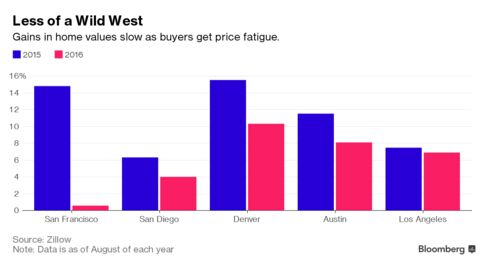
Denver, Los Angeles and Austin, Texas, have seen gains in real estate values moderate after years of double-digit increases, according to Zillow. A slowdown in the tech epicenter of San Francisco is becoming even more pronounced, with the median home value in August rising less than 1 percent from a year earlier.
The five-year surge in real estate demand across the West is starting to take its toll in some areas as buyers become more reluctant to purchase a home that would eat up a large chunk of their monthly earnings. With job growth still robust, house hunters are pushing outward from core cities to get more for their money.

“Homebuyers are starting to see a bit of price fatigue and are starting to step back and think twice about making that purchase,” said Svenja Gudell, chief economist at Seattle-based Zillow. “Prices have grown so much over the last few years as part of the recovery that many markets are well beyond their initial 2006 or 2007 peak, so homes are now more expensive than they’ve ever been.”

Western cities have led the nation’s recovery from last decade’s recession with record-setting economic growth and a boom in jobs, particularly in the technology industry, leading to a surge in housing demand. In the past five years, home values have soared 71 percent in Denver, 66 percent in San Francisco and 54 percent in Austin, Zillow data show. Nationwide, the gain was 22 percent.

Buyer Pushback

The prices have gotten too heated for many buyers in Denver, which has seen a slowdown since the beginning of the year, said Wade Perry, a managing broker at Coldwell Banker Devonshire in the area.

“Buyers are starting to push back and say, ‘I’m not going to pay that much for that house,’” Perry said.

The median home value in Denver rose 10 percent in August from a year earlier to $353,300, according to Zillow. While that’s still one of the top increases in the country, it’s down from an almost 16 percent surge in the same period of 2015.

In Austin, which, like Denver, has benefited in part from a spreading tech industry and an influx of well-paid workers, the median climbed 8.1 percent, compared with 12 percent growth a year earlier. Los Angeles’s growth slowed to 6.9 percent from 7.5 percent, while in San Diego it decelerated to 4 percent from 6.3 percent.

For San Francisco, where the median home value has soared to $1.1 million, the increase was just 0.6 percent after a 15 percent jump in August 2015. The city’s price gains have made it the most overvalued housing market in the U.S., UBS Group AG said in a report this week.

Still Hot

Still, there’s no let-up in some other Western tech-heavy markets, such as Portland, Oregon, where home values soared 20 percent in August, compared with 13 percent a year earlier. In Seattle, the 15 percent gain outpaced the roughly 14 percent increase the year before.

Nationwide, the median home value climbed 5.1 percent in August — up from 4.6 percent a year earlier.

A slowdown in home-price appreciation would be a healthy change, said Patrick Carlisle, chief marketing analyst at Paragon Real Estate Group in San Francisco.

“The cooling of a desperately overheated housing market to something closer to normal is not bad news,” he said. “The huge increases in housing prices have created enormous social stresses in the area, as well as leading some of our local high-tech companies and would-be startups to look at locating elsewhere.”

The overheated markets are pushing some buyers to shift their house hunt to the suburbs, fueling faster appreciation in outlying areas than in the neighboring boom cities, Zillow data show. In the Denver suburb of Arvada, for instance, the median home value in August soared 13 percent from a year earlier. It jumped almost 14 percent in Englewood, a short light-rail ride from downtown.

Moving Outward

Ben and Nicole Irwin began looking for homes in the area last year and soon discovered the Denver properties they liked cost $500,000 to $600,000. The couple ended up paying $390,000 for a three-bedroom house in Arvada, where they were attracted to good public schools, a charming old town and the city’s proximity to the Red Rocks Amphitheatre, a popular outdoor concert venue.

“To get the size house we wanted, it would have been out of our price range,” said Ben Irwin, a 37-year-old communications manager for the city of Boulder. “We found that we could get those kinds of houses for $150,000 to $200,000 less” outside of Denver.

In Austin, where home prices are higher but sales are down, surrounding towns “have seen incredible appreciation” as buyers seek out affordability in the city’s outskirts, said Dave Murray, a broker at DMTX Realty.


read more…


http://www.bloomberg.com/news/articles/2016-09-28/runaway-home-prices-ebb-in-u-s-west-as-weary-buyers-push-back

Case-Shiller: Rising house prices just below record highs | Pound Ridge Real Estate

Home prices are continuing to rise; now mere basis points below the all-time highs for prices, set in 2006.

According to the latest data released Tuesday by S&P Dow Jones Indices and CoreLogic, the S&P CoreLogic Case-Shiller U.S. National Home Price NSA Index, which covers all nine U.S. census divisions, reported a 5.3% annual gain in August, up from 5% in July.

Per the report, the S&P CoreLogic Case-Shiller U.S. National Home Price NSA Index is currently at 184.42, which is within 0.1% of its record high of 184.62, set in July 2006.

The increase in August represents the 52nd consecutive month of positive gains.

According to the Case-Shiller report, the 10-City Composite posted a 4.3% annual increase, up from 4.1% in July, while the 20-City Composite posted a 5.1% annual increase, up from 5.0% in July.

The report states that Portland, Seattle and Denver turned in the highest year-over-year gains among the 20 cities for the seventh consecutive month, with year-over-year increases of 11.7%, 11.4% and 8.8%, respectively.

“Supported by continued moderate economic growth, home prices extended recent gains,” said David Blitzer, managing director and chairman of the Index Committee at S&P Dow Jones Indices.

“All 20 cities saw prices higher than a year earlier with 10 enjoying larger annual gains than last month,” Blitzer continued. “The seasonally adjusted month-over-month data showed that home prices in 14 cities were higher in August than in July.”

Blitzer also noted that other housing data including sales of existing single-family homes, measures of housing affordability, and permits for new construction also point to a “reasonably healthy housing market.”

Additionally, the Case-Shiller report showed that before seasonal adjustment, the National Index posted a month-over-month gain of 0.5% in August.

The report also showed that both the 10-City Composite and the 20-City Composite posted a 0.4% increase in August.

After seasonal adjustment, the National Index recorded a 0.6% month-over-month increase, and both the 10-City Composite and the 20-City Composite reported 0.2% month-over-month increases.


read more…


Case-Shiller: Rising house prices just below record highs

Apartment and Condominium Market Dips Slightly | Pound Ridge Real Estate

The National Association of Home Builders’ (NAHB) Multifamily Production Index (MPI) dropped three points to 50 in the second quarter of 2016 (Exhibit 1). This is the 18th consecutive reading of 50 or above, which means that more builders and developers report that current conditions in the apartment and condominium market are improving than report conditions are getting worse.

Exhibit 1: NAHB Multifamily Production Index (MPI) and Multifamily Starts (in thousands)

Figure1

The MPI is comprised of three key sub-components: construction of low-rent units, market-rate rental units and “for-sale” units, or condominiums. Low-rent units decreased two points to 52 in the second quarter, while market-rate rental units dropped five points to a level of 53, and for-sale units fell three points to 45.

The NAHB Multifamily Vacancy Index (MVI), which measures respondent perceptions of vacancies in the multifamily housing market, increased three points to 42, with higher numbers indicating more vacancies (Exhibit 2). However, the MVI is still below the breakeven point of 50, which means that more respondents perceived a reduction in vacancy rates than perceived an increase.

Exhibit 2: NAHB Multifamily Vacancy Index (MVI) and 5+ Rental Vacancy Rate

Figure2

After peaking at 70 in the second quarter of 2009, the MVI improved consistently through 2010 and has been fairly stable since 2011. Historically, the MVI has shown to be a leading indicator of Census multifamily vacancy rates, which is displayed in Exhibit 2 as well.


read more…


http://eyeonhousing.org/2016/08/apartment-and-condominium-market-dips-slightly-in-the-second-quarter/

Six Essential Questions to Ask a New Client | Pound Ridge Real Estate

Imagine you are considering working with a potential client who seems apprehensive and possibly needy. Imagine you get the project. What might you wish you had considered and/or asked the potential client or yourself before deciding to work with them?

Here are some suggestions:

Why are these folks good clients for your company?
Over time, all companies have at least a gut level feel for what is a good fit regarding clients. Use that filter all the time. Ignoring it can put you, your people, and the company through thankless grief.

Why do these folks think we are the right contractor to work with?
Ask this question early on. The worst case is they expect something from your company that you simply can’t deliver. Better to find that out as soon as possible.

Have they been through a remodeling project in the past? If so, how did it go?
If they have never experienced the challenges involved in being a remodeling client, you are likely to be viewed negatively if you work for them. There are simply so many things that can go wrong during all phases of the planning and the actual remodeling.
If they have been through a remodeling project and it did not go well, question them thoroughly about why they think that happened. If all they do is blame the contractor then get clear about what they think the contractor did wrong. If you think the potential client was the real problem, not the contractor, then don’t work for them!

What are the client’s expectations about the process, in general? Do those expectations align with your company’s idea of what reasonable expectations are?
If so, great. But if not, what are the specific gaps? Are the gaps large or small? It’s better find out sooner than later. There is the distinct likelihood that they don’t align with yours. Talk it through. If there is not a meeting of the minds, refer another remodeler who might be a better fit.

Can the client listen to what your company says? Will they allow your company to be in control?
If they won’t listen now, they likely won’t listen when it all hits the fan. If you can’t be in control you will rue the day you decided to work with them.


read more…


http://www.remodeling.hw.net/business/operations/six-essential-questions-to-ask-with-a-new-client_o

U.S. housing starts trending up | Pound Ridge Real Estate

Housing Starts in the United States is expected to be 1150.00 Thousand by the end of this quarter, according to Trading Economics global macro models and analysts expectations. Looking forward, we estimate Housing Starts in the United States to stand at 1230.00 in 12 months time. In the long-term, the United States Housing Starts is projected to trend around 1280.00 Thousand in 2020, according to our econometric models.

United States Housing Starts
ForecastActualQ3/16Q4/16Q1/17Q2/172020Unit
Housing Starts118911501170121012301280Thousand
United States Housing Starts Forecasts are projected using an autoregressive integrated moving average (ARIMA) model calibrated using our analysts expectations. We model the past behaviour of United States Housing Starts using vast amounts of historical data and we adjust the coefficients of the econometric model by taking into account our analysts assessments and future expectations. The forecast for – United States Housing Starts – was last predicted on Tuesday, July 19, 2016.
United States HousingLastQ3/16Q4/16Q1/17Q2/172020
Building Permits115311301141115211781315
Housing Starts118911501170121012301280
New Home Sales551475517510510590
Pending Home Sales-0.20.880.720.911.041.26
Existing Home Sales553054725453543954175182
Construction Spending-0.80.40.30.30.2-0.9
Housing Index0.20.410.40.390.380.31
Nahb Housing Market Index595960605953
Mortgage Rate3.65.13.683.733.776.5
Mortgage Applications7.20.480.530.530.530.53
Home Ownership Rate63.563.5363.5363.5363.5363.53
Case Shiller Home Price Index187192192192193211

read more…


http://www.tradingeconomics.com/united-states/housing-starts/forecast

Mistakes most people make when buying homes | Pound Ridge Real Estate

You can check in for a flight from your phone, deposit a check on your phone and pay for Starbucks from your phone, so why would should shopping for a mortgage be any different?

Although, it is a little behind the curve on the memo.

And while these changes are mostly focused on the technology aspect of buying a home, the mortgage product side is changing just as much.

In a recent interview with HousingWire, Mat Ishbia, CEO of United Wholesale Mortgage,explained why 3% down mortgages are going to be the new normal.

What’s more, in order to help educate new borrowers on mortgages today, David Gunn, mortgage sales effectiveness director for Fifth Third Mortgage, shared five of the biggest mistakes consumers make when buying homes, along with tips to avoid them:

1.Passing up help.

There are more than 200 federal, state and local programs to assist consumers to make their down payments or pay their mortgage closing costs. Some programs are only for first-time homebuyers, others could be for veterans. 

Tip: Make sure to research programs in your region. “It’s hard to research and navigate programs alone,” Gunn said. “They vary from city to city, and might only be available during certain times of the year.”

2. Believing you make too much money to qualify.

Some buyers think assistance programs are only for low-income households. Some programs assist first-time homebuyers no matter their income levels depending on where they purchase a home.

Tip: Look at programs options. For example, Gunn notes that they have a program that helps pay closing costs on homes purchased in designated low-income areas with loans financed through Fifth Third Mortgage, no matter the consumer’s income. 

3. Thinking you don’t have enough money for a down payment.

The Freddie Mac Home Possible Advantage Mortgage allows homebuyers to put down 3%. This will allow the majority of borrowers to enter this program with no cash out of pocket for the down payment.

Tip: Work with your mortgage loan originator to see which programs can help you qualify. “People tell us they can’t afford a house because of the down payment,” Gunn said. “It’s the most common barrier to buying a home. But we find that a buyer needs less money than she thinks to get into a home with a monthly payment that meets her budget.”

4. Clinging to outdated ideas on closing timelines.

Closing times are lengthening. And that can be a good thing. The Know Before You Owe rule enacted by the Consumer Financial Protection Bureau went into effect, and has extended the timeline on most home closings. The rule created documents that detail how much a buyer will pay for closing costs, how much each monthly payment will be, and how payments or rates could potentially adjust. Any change to these terms must be given to borrowers with 3 days to review, which is different from the past when changes could be made to the loan before and during closing without a wait.

Tip: “Be patient,” Gunn said. “And know that all of the changes are made to help you better understand the mortgage terms and help you find the best loan for you.”

5. Relying on a one-size- fits-all loan.

Many homebuyers likely had a 30-year-loan on their last house. But it’s not the default loan anymore. For each purchase, loan originators look at the buyer’s financial situation and goals, and might suggest a loan with a shorter term.

Tip: Work through the financials on several options with your loan originator to see what puts you in the best financial position to meet your family’s goals. “It might be better to get a lower term loan now to build equity, and then move into something bigger in a few years,” Gunn said. “We want what is right for you.”


read more…


Avoid these 5 major mistakes most people make when buying homes

Mortgage rates drop to 3.54% | Pound Ridge Real Estate

Freddie Mac (OTCQB: FMCC) today released the results of its Primary Mortgage Market Survey® (PMMS®), showing average fixed mortgage rates declining for the second consecutive week.

News Facts

  • 30-year fixed-rate mortgage (FRM) averaged 3.54 percent with an average 0.5 point for the week ending June 16, 2016, down from last week when it averaged 3.60 percent. A year ago at this time, the 30-year FRM averaged 4.00 percent.
  • 15-year FRM this week averaged 2.81 percent with an average 0.5 point, down from last week when it averaged 2.87 percent. A year ago at this time, the 15-year FRM averaged 3.23 percent.
  • 5-year Treasury-indexed hybrid adjustable-rate mortgage (ARM) averaged 2.74 percent this week with an average 0.5 point, down from last week when it averaged 2.82 percent. A year ago, the 5-year ARM averaged 3.00.

Average commitment rates should be reported along with average fees and points to reflect the total upfront cost of obtaining the mortgage. Visit the following link for the Definitions. Borrowers may still pay closing costs which are not included in the survey.

Quote
Attributed to Sean Becketti, chief economist, Freddie Mac.

“The 10-year Treasury yield continued its free fall this week as global risks and expectations for the Fed’s June meeting drove investors to the safety of government bonds. The 30-year mortgage rate responded by falling 6 basis points for the second straight week to 3.54 percent — yet another low for 2016. Wednesday’s Fed decision to once again stand pat on rates, as well as growing anticipation of the U.K.’s upcoming European Union referendum will make it difficult for Treasury yields and — more importantly — mortgage rates to substantially rise in the upcoming weeks.”

Builder’s Choice Custom Home Design Award-winning projects | Pound Ridge Real Estate

Jeff Goldberg

In honor of Earth Day, Custom Home and BUILDER take a look back at five Builder’s Choice Custom Home Design Award-winning projects that are as environmentally-conscious as they are commendable. These projects, designed with the planet in mind, are dynamic and innovative—some powered by the resources they produce.

The Builder’s Choice Custom Home Design Awards (BCCHDAs) honor excellence and innovation in residential design and construction across 13 categories including project of the year, modular, multi-family, and architectural interiors. With this year’s extended deadline fast approaching—May 2 for early submissions, and May 6 for late submissions—we encourage you to submit your own best work here.

Excerpts from the awards coverage highlighting the projects’ sustainable features are included below. Follow the link in each project’s title to view more photos and information.
Tucson Mountain Retreat, Tucson, Ariz., designed by DUST
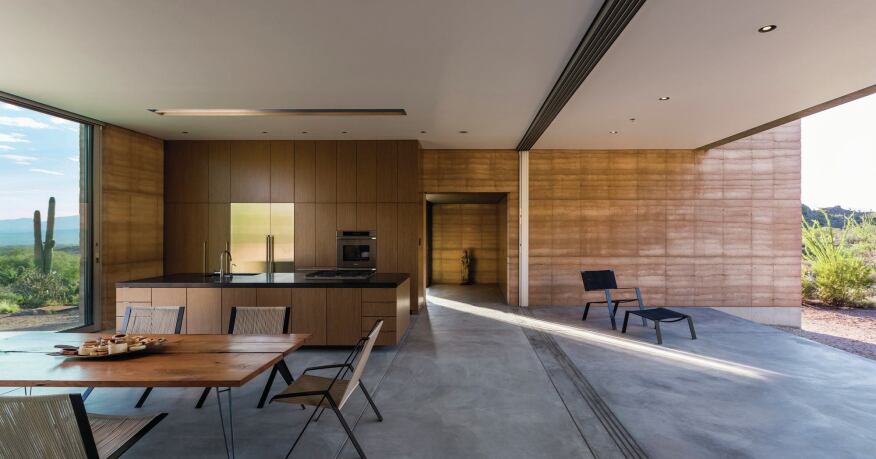
The layout is keenly attuned to the Sonoran Desert site. The long side faces south to allow the sun to passively heat the concrete floors, and the building’s deep overhangs and thermal mass keep it cool in the summer. A large kitchen/dining/living space is flanked by an acoustically designed music room/recording studio on one side and two bedrooms on the other. Each volume is fitted with glass walls that dematerialize to take in views and breezes.

Jeff Goldberg

RainShine House , Decatur, Ga., designed by Robert M. Cain, Architect
As an exercise in green design, this LEED Platinum–certified house puts a check in every column: passive solar, active solar, rainwater collection, natural daylighting and ventilation, energy-efficient electrical and mechanical systems, resource-conserving materials, a tight building envelope, low-VOC finishes, and no-irrigation landscaping. What got the attention of our judges, though, was that its environmental ethos also yields a thoroughly pleasing aesthetic experience.

Paul Hultberg Photography

Sustainable Steel Home , San Diego, designed by Macy Architecture/
Jensen & Macy Architects
The home’s footprint allows for plenty of natural ventilation, and it also connects the interiors with the outside in true mid-century spirit. The house maximizes its infill location by providing city and water views to the main rooms, which all occupy the second floor. Photovoltaics produce on-site power, and rainwater harvesting meets the site’s irrigation needs. Lots of glass, both transparent and translucent, helps with daylighting and passive solar.

Scot Conti

GREENville House, Greenville, N.C., designed by Tonic Design
The owners of this new LEED Silver-rated residence did their sustainability homework in advance. “They knew about solar and geothermal from the beginning,” says project designer Katherine Hogan. That head start allowed Hogan and principal designer Vincent Petrarca to weave green features into the fabric of the building, rather than tack them on as options after the fact.

Todd Lanning

Green Lantern , San Antonio, Texas, designed by John Grable Architects
In one of San Antonio’s, oldest neighborhoods, architect and developer John Grable, FAIA, salvaged 45 percent of a 1948 house because of his client’s commitment to conservation and green building. At the same time, a contemporary home was the aim.

Dror Baldinger, AIA

read more…


http://www.ecobuildingpulse.com/projects/five-award-winning-sustainable-homes-from-the-builders-choice-custom-home-design-awards_s?utm_source=newsletter&utm_content=Article&utm_medium=email&utm_campaign=EBP_042616%20(1)&he=bd1fdc24fd8e2adb3989dffba484790dcdb46483

Falling Expectations for 2016 Depress Housing Confidence | Pound Ridge Real Estate

Americans’ overall confidence in the U.S. housing market has declined from a year ago, according to the January 2016 Zillow Housing Confidence Index, driven lower by diminished expectations of the market’s future.

The overall U.S. Housing Confidence Index fell to 66.9 in January from 67.4 a year ago according to the Zillow Housing Confidence Index, sponsored by Zillow and calculated by Pulsenomics LLC.

However, expectations for the year ahead fell even more, from 69.9 in 2015 to 67.5 this year, a decline of 3.4%.  Homeowners near term expectations fell 3.5 percent, from 74.1 to 71.8 but renters lost even more confidence.  Among renters, expectations for 2016 compared to 2015 fell from 63.9 to 60.8, or 4.8 percent.

The results come at a time when rising rents and stagnant incomes are making it tough for many Americans to buy homes. Millennials are renting longer than past generations as they put off major life decisions. Those aged 18-34 said they expected home values to grow by 5 percent per year, on average, over the next ten years, compared to just 3.7 percent for all Americans.

The survey found that overall aspirations for homeownership are at their highest level in two years, driven in large part by faith among younger Americans and Americans-of-color in the general value of homeownership. Among people 18-34 years old, 65 percent said homeownership and the American Dream go hand-in-hand, more than any other generation. Of Hispanic respondents surveyed, 70 percent agreed that owning their own home is necessary to live the American Dream, followed by 64 percent of Asian respondents and 63 percent of black respondents. Less than 60 percent of white respondents agreed.

The semi-annual Zillow Housing Confidence Index, sponsored by Zillow and calculated by Pulsenomics LLC, is calculated for the U.S. as a whole and 20 large metro markets nationwide. It is based on a national survey of 10,000 American renters and homeowners. The ZHCI is composed of three sub-indexes: one that summarizes homeowner and renter assessments of current market conditions (HMCI); another that measures their expectations regarding future home values and affordability (HEI); and a third that gauges their aspirations and attitudes regarding homeownership (HAI).


read more…


http://www.realestateeconomywatch.com/2016/03/9641/

Housing Affordability Edges Up | Pound Ridge Real Estate

Modest home price and interest rate decreases resulted in a slight increase in nationwide housing affordability in the fourth quarter of 2015, according to the National Association of Home Builders/Wells Fargo Housing Opportunity Index (HOI).

In all, 63.3 percent of new and existing homes sold between the beginning of October and end of December were affordable to families earning the U.S. median income of $65,800. This up from the 62.2 percent of homes sold that were affordable to median-income earners in the third quarter.

HOI PPT Q415

The national median home price fell from $231,000 in the third quarter to $226,000 in the fourth quarter. Meanwhile, average mortgage rates edged lower from 4.18 percent to 4.09 percent in the same period.

Youngstown-Warren-Boardman, Ohio-Pa. was rated the nation’s most affordable major housing market, switching places with Syracuse, N.Y., which fell to the second slot on the list. In Youngstown-Warren-Boardman, 90.1 percent of all new and existing homes sold in last year’s fourth quarter were affordable to families earning the area’s median income of $53,700.

Meanwhile, Binghamton, N.Y. claimed the title of most affordable small housing market in the fourth quarter of 2015. There, 94.6 percent of homes sold during the fourth quarter were affordable to families earning the area’s median income of $66,400.

For the 13th consecutive quarter, San Francisco-San Mateo-Redwood City, Calif. was the nation’s least affordable major housing market. There, just 10.4 percent of homes sold in the fourth quarter were affordable to families earning the area’s median income of $103,400.


read more…


http://eyeonhousing.org/2016/02/affordability-edges-up-in-fourth-quarter/