Category Archives: Lewisboro

Katonah Weekly Real Estate Report | #RobReportBlog

Katonah   NY Weekly Real Estate Report9/10/2013
Homes for sale45
Median Ask Price$999,000.00
Low Price$450,000.00
High Price$18,995,000.00
Average Size4143
Average Price/foot$447.00
Average DOM132
Average Ask Price$2,451,618.00

Fixed mortgage rates retreat from a 2-year high | South Salem Real Estate

Fixed mortgage rates eased up from a two-year high this past week as lenders offered a 30-year mortgage at an average rate of 4.51%, up from 4.58% a week earlier, the Los Angeles Times reported.

The newspaper gave a rundown of all the changes this past week:

“The 15-year fixed-rate mortgage averaged 3.54%, down from 3.6%, according to Freddie Mac. Starting interest rates for popular types of variable-rate loans were up slightly, the McLean, Va., housing finance giant said.”

Freddie’s chief economist, Frank Nothaft, said the market is being driven by speculation about when the Federal Reserve will cut back on its stimulus program, which involves buying $85 billion a month in Treasury and mortgage bonds.

                    Source: The Los Angeles Times

Housing communities suffer from influx of renters | Cross River Real Estate

There are a growing number of people renting houses instead of buying since they cannot obtain a mortgage under today’s tougher standards. But due to the influx of renters, housing communities are facing the adverse effects of renter’s disconnect, according to CNBC:

“When there are fewer homeowners, there is less ‘self-help,’ like park and neighborhood cleanup, neighborhood watch,” said William M. Rohe, a professor at the University of North Carolina at Chapel Hill who has just completed a review of current research on homeownership’s effects.

Even conscientious landlords and tenants invest less in their property than owner-occupants, he said. “Who’s going to paint the outside of a rental house? You’d almost have to be crazy.”

                    Source: CNBC

CoreLogic: Prices to Rise 12.3 Percent in August | Katonah Real Estate

The housing recovery will keep rolling right along   through August as price increases continue to score in the double digit range   and rise for the 18th straight month, according to CoreLogic’s   pending sales index.


Home prices   nationwide, including distressed sales, increased 12.4 percent on a year-over-year   basis in July 2013 compared to July 2012. Prices are rising   even faster than they did in the first half of the year, when they averaged   10 percent from January through June.     On a month-over-month basis, including distressed sales, home prices   increased by 1.8 percent in July 2013 compared to June 2013,

Excluding distressed   sales, home prices increased on a year-over-year basis by 11.4 percent in   July 2013 compared to July 2012. On a month-over-month basis, excluding   distressed sales, home prices increased 1.7 percent in July 2013 compared to   June 2013. Distressed sales include short sales and real estate owned (REO)   transactions.

The CoreLogic Pending   HPI indicates that August 2013 home prices, including distressed sales, are   expected to rise by 12.3 percent on a year-over-year basis from August 2012   and rise by 0.4 percent on a month-over-month basis from July 2013. Excluding   distressed sales, August 2013 home prices are poised to rise 12.2 percent   year over year from August 2012 and by 1.2 percent month over month from July   2013. The CoreLogic Pending HPI is a proprietary and exclusive metric that   provides the most current indication of trends in home prices. It is based on   Multiple Listing Service (MLS) data that measure price changes for the most   recent month.

“Home prices   continued to surge in July,” said Dr. Mark Fleming, chief economist for   CoreLogic. “Looking ahead to the second half of the year, price growth   is expected to slow as seasonal demand wanes and higher mortgage rates have a   marginal impact on home purchase demand.”

“Home prices   continue to climb across the nation in July with markets hit hardest during   the downturn leading the way,” said Anand Nallathambi, president and CEO   of CoreLogic. “Nationally, home prices are now within 18 percent of   their peak levels reached in April of 2006.”

Highlights   as of July 2013:

  • Including        distressed sales, the five states with the highest home price        appreciation were: Nevada (+27 percent), California (+23.2 percent),        Arizona (+17 percent), Wyoming (+16.4 percent) and Oregon (+15 percent).
  • Including        distressed sales, this month only one state posted home price        depreciation: Delaware (-1.3 percent).
  • Excluding        distressed sales, the five states with the highest home price        appreciation were: Nevada (+24.2 percent), California (+20.2 percent),        Arizona (+14.9 percent), Utah (+13.5 percent) and Florida (+13.5        percent).
  • Excluding        distressed sales, no states posted home price depreciation in July.
  • Including        distressed transactions, the peak-to-current change in the national HPI        (from April 2006 to July 2013) was -17.6 percent. Excluding distressed        transactions, the peak-to-current change in the HPI for the same period        was -12.9 percent.
  • The        five states with the largest peak-to-current declines, including        distressed transactions, were Nevada (-43 percent), Florida (-37.4        percent), Arizona (-32.5 percent), Rhode Island (-29.7 percent) and        Michigan (-27.7 percent).
  • Of        the top 100 Core Based Statistical Areas (CBSAs) measured by population,        99 were showing year-over-year increases in July, equaling the measure        in June 2013.

*June data was   revised. Revisions with public records data are standard, and to ensure   accuracy, CoreLogic incorporates the newly released public data to provide   updated results.

July HPI for the   Country’s Largest CBSAs by Population (Ranked by Single-Family Including   Distressed):

CBSA

July 2013     12-Month HPI

Change by     CBSA

Single-Family     Including Distressed

Single-Family     Excluding Distressed

Los     Angeles-Long Beach-Glendale, CA

22.6%

20.1%

Riverside-San     Bernardino-Ontario, CA

22.5%

21.1%

Phoenix-Mesa-Glendale,     AZ

18.1%

15.7%

Atlanta-Sandy     Springs-Marietta, GA

15.6%

13.7%

Houston-Sugar     Land-Baytown, TX

11.1%

11.9%

Dallas-Plano-Irving,     TX

10.0%

10.7%

Washington-Arlington-Alexandria,     DC-VA-MD-WV

9.1%

9.0%

Chicago-Joliet-Naperville,     IL

8.6%

10.7%

New     York-White Plains-Wayne, NY-NJ

7.8%

8.2%

Philadelphia,     PA

4.3%

4.8%

Source:   CoreLogic.


http://www.realestateeconomywatch.com/2013/09/corelogic-prices-to-rise-123-percent-in-august/

The Architect Of Coconut Grove’s Iconic, Imperiled Chart House Restaurant Is Joe Lancor | Katonah Real Estate

Screen%20Shot%202013-09-06%20at%2012.44.44%20PM.png[Photo via Lancor Architects]

A Curbed reader has discovered the architect of Coconut Grove’s imperiled organic modern Chart House Restaurant to be Joe Lancor of Honolulu, Hawaii. The restaurant is listed on his website. Over the years, Mr. Lancor has designed dozens of Chart Houses for the chain, each one of them unique. ·


Lancor Architects [lancorarchitects] ·


Should Coconut Grove’s Organic Mod Chart House Be Saved? [Curbed Miami]

90 Stories Above Manhattan, This Pad Has a 30′ Waterfall | Waccabuc Real Estate

ODAapt.jpg
[All renderings by ODA.]

This apartment, located somewhere 90 stories above Manhattan, is apparently “one of the largest private apartment residences in the United States,” according to the blurb from ODA-Architecture, which handled the apartment’s interiors. We’re not sure exactly when the renovation took place, but we stumbled on it yesterday courtesy of one helpful Curbed tipster, and it’s the kind of apartment that’s worth our attention regardless of timing. The property is 18,000 square feet, with six bedrooms and 12 bathrooms. Then there are the quirkier features, which include a theater and music room, private spa and gym, teahouse, 2,000 bottle wine room, sculpture garden, and 30′ waterfall with reflecting pool. Each of those amenities deserves to be followed by an (!) or two. And the archibabble reveals a little bit more:

With a perimeter of 16′ foot floor- to-ceiling windows, the essence of the apartment is the sculpture garden at its entrance. The garden features a spectacular 30′ water wall and reflecting pool overlooking the famed United Nations headquarters along the East River. This superlative dwelling also features a 75′ expanse of living and dining area along with a Italian kitchen, library, game room, day spa, home theater and professional grade listening room with recording studio.

ODAapt2.jpg

ODAapt3.jpg

The ODA listing for the project does not, of course, disclose the apartment’s owner. Our tipster wonders if the apartment in question is the three-unitpenthouse duplex at Trump World Tower, which sold back in 2007 for $33.654 million. The square footage doesn’t quite add up, though—anyone have any insight?
· Private Residence [ODA]
· Trump World Tower coverage [Curbed]


90 Stories Above Manhattan, This Pad Has a 30′ Waterfall – Renovations – Curbed NY.

Home Security Systems and Alarm Systems | Cross River Homes

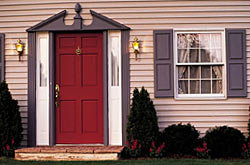
Doors

Home security systems are only as strong as their weakest link, and if you set up equipment that’s too complicated for household members to use, they are likely to ignore the equipment or work around it. Remember that the people in your home are part of any security arrangements you make, so you have to be realistic about how much hassle they are willing to accept in the name of security.

1. Be sure your home appears occupied.

Most thieves are opportunistic. They come into a neighborhood and look for houses that seem undefended and unoccupied. An important part of home security is making your home look occupied at all times.

One big clue that you are out of town is if your mail or newspapers are piling up. Never allow newspapers to accumulate in the front yard.

Interior lights are also important in making a home look occupied. Not only should some lights be on, but the array of lights should change just as it would if the home were occupied. The easiest way to do this is with timers.

Another very simple way to make a house appear occupied is to leave on a TV or radio with the volume turned up loud enough to be heard by someone approaching the doors or windows.

Leaving a car in the garage or driveway can also be a deterrent. If you are going on a trip and not leaving a car at home, you might want to make arrangements with the next door neighbor to park one of their cars in your driveway while you are away.

2. Create perimeter defenses.

Another important home security measure involves making it difficult to get near the home. This is most commonly accomplished by a high wall or fence.

In many parts of the world, this is the primary home security tactic, but it does suffer from some shortcomings. Generally, it is easier to sneak undetected over or under a wall or fence than it is to force entry into a home.

Yet perimeter defenses often give occupants of the home a false sense of security that may lead them to get sloppy about locking doors and windows. For this reason, perimeter defenses are most effective when they are either very difficult to penetrate or are augmented by cameras and/or motion detectors.

3. Be sure all entrances are well lit.

For most homes, perimeter defenses like walls and fences are of little use. Most people assume that the next line of defense is doors and windows, but there is something that comes first. It’s based on the simple fact that thieves want to do their work where no one can see them. This means you want to make sure the outside of your home is well lit – especially at any potential points of entry. An effective solution is motion detector lights. These inexpensive devices can be set up to turn on whenever something moves near it.

4. Install deadbolts and peepholes on doors.

Most home security measures are concentrated on doors. With doors, the two main issues are structural integrity and locks.

Recommended for exterior doors, deadbolt locks are substantial locks that lock the door into the frame. Deadbolts come in keyed versions, which always require a key, and levered versions that only require a key to open from the outside. If no glass is nearby, the lever version is best as it is more likely to get used.

There are many facets to your ensuring your personal home security. Click this link if you want to use our free service to have any of our prescreened home security contractors install home security measures.

Sliding glass doors present a special challenge. Most are vulnerable to breakage. The simplest security enhancement is to place a metal bar or broom handle in the inside floor track. Some sliding doors can simply be lifted out of their tracks. There are screws at the top and bottom of the inside of the door that control how it sits in the track. Adjust these so that the door cannot be lifted so high that the bottom comes free from the track.

Every front door should be equipped with a peephole. This is a very inexpensive, easy to install device that allows you to check out a visitor before you open the door. For the same reason, an intercom can allow you to communicate with a caller before deciding whether to open the door or deactivate an alarm.

5. Secure your home’s windows.

While your home may only have two or three doors, it may have a dozen or more windows. Burglars know that if you systematically check all the windows in a house, there is a good chance that at least one will remain unlocked.

Most standard window locks are very simple to jimmy or force. Heavier locks will improve your home security quite a bit. Another simple, inexpensive tactic that is effective for double hung windows (those with two sliding panels that go up and down or side to side) is window pins. There are specially made pins, or large nails can easily be used.

6. Remember your home’s other points of access.

Exterior doors and windows are not the only access points to most homes. Many thefts take place through garages. Besides having valuable items stolen from the garage, the door that goes from the garage to the house is often unsecured or not substantial enough to stop a burglar.

Check also to see if skylights, crawl spaces, attic vents, and other openings may provide burglars with unrestricted access to your home.

7. Consider installing an alarm system.

Alarm systems offer little in the way of physical obstacles to thieves. Instead they offer an important psychological one.

In a neighborhood with an efficient police force, the alarm substantially increases the odds that the thief will get caught. Even in areas where police response times are slow, the noise and attention of an alarm may well dissuade the burglar from finishing his mission.

The cost of alarm systems varies widely. A burglar easily can disable some of the simpler, less expensive detection devices. The more complex and unfamiliar the array of devices, the more likely the burglar is to trigger the alarm or give up trying to disable it.

Response times to alarms are driven by several factors. First is the effectiveness of the monitoring service you’re using. When considering a monitoring service, get the names of people who have had the opportunity to observe response times in the past.

The second factor is the protocol you request that the monitoring service use. Who do you have them call in what order? In some cases, you might do better to alert a helpful neighbor than to alert an unresponsive police force.

The third factor is the 911 services in your area. Most work well and a few don’t. While you have no direct control over the 911 services, you may be able to draw attention to the problem and seek a solution through the political process.

8. Keep a record of your valuables.

Most area police departments encourage homeowners to etch their social security number on the metal surfaces of valuables that are prone to theft. When police come across marked stolen merchandise, they can easily find the true owner and return it. Photographs of especially valuable items like artwork and antiques can help police recover goods.

Read more: http://www.homeadvisor.com/article.show.8-Steps-to-Better-Home-Security.10577.html&m=homesense&entry_point_id=26787158#ixzz2eKGOwoCN


Home Security Systems | Alarm Systems.

Living Off the Grid and Thriving! | Katonah NY Homes

Michelle and Cam are living off the grid entirely at Sunflower Farm, their homestead in Eastern Ontario.

PHOTO: CAM MATHER


More than a decade ago, my wife, Michelle, and I moved from a busy suburban street to 150 acres in the Ontario bush, where our nearest neighbors are three miles away. Ditto for the nearest utility pole. We’d transitioned to living off the grid with little knowledge about renewable energy — or electricity, for that matter — and had to quickly put into practice our home-schooling mantra of “lifelong learning.”

To say that the learning curve was steep is an understatement. Back then, there were no good books on the subject of renewable energy for homes, and the information you could find was pieced together by pioneers who were learning as they went along. Consulting with any local electrician was a waste of time, so we learned by the seat of our pants. Luckily, we developed a network of helpful and skilled friends along the way. We came to realize that the more things we learned to do ourselves, the more independent we would become, which is the theme of the book I’ve just written, Thriving During Challenging Times: The Energy, Food and Financial Independence Handbook.

As we begin to experience the converging challenges of resource depletion, climate change, and the ongoing financial crisis, we need to make ourselves more resilient to shocks to the system.

If you do decide to go off the grid, generating your own electricity from the sun and wind provides an incredible sense of well-being — not only from a sense of independence, but also from the realization that you aren’t using any electricity that comes from coal. Powering your home with renewable energy is a huge step toward reducing your carbon footprint. We started with a fairly small solar-electric system that the previous owners of our home had installed, and we’ve steadily added more panels. As we learned more about peak oil, we were determined to reduce our use of nonrenewable fossil fuels for both cooking and powering our gasoline generator; there are times when there isn’t enough sunlight or wind to charge our off-grid batteries, so we use a fossil fuel-powered generator as a backup.

Wonderful Wind, Super Solar

When we moved in, there was an old wind turbine on a 60-foot tower on our property, but several years ago we decided to replace it with a new Bergey 1-kilowatt turbine on a 100-foot tower. We are surrounded by forests (not optimal for wind generation), so putting up a 100-foot tower set the turbine about 30 feet above the trees to capture some of the stronger winds. We decided to film the installation process and sell a video of it via our publishing company, Aztext. I’m a visual learner, and if I could have watched a video of the process of putting all the pieces of our off-the-grid system together, it would have made our efforts go more smoothly.

The new turbine required us to upgrade our battery bank from a 12-volt to a 24-volt system, so we also upgraded our inverter and added more solar panels. In the previous year, we ran our backup generator about 15 times. In the year after we put up the turbine and added solar panels, we ran the generator just twice. This means that, on many days, we now have extra electricity to use for cooking, offsetting our propane use.

Most people who move off grid just move onto propane, substituting propane for all their major heat loads, such as cooking and heating water. We already heat with wood cut sustainably from our property, so using the electric stove helps reduce our propane use as well.

The biggest drop in our propane consumption came when we installed our solar hot water system. It uses solar energy to heat water we use for washing and bathing, and should offset about 60 percent of water heating costs. For most people, this should be the first solar panel they put on their roof, because the payback is much faster than that of photovoltaics. There’s nothing nicer on a cold winter evening than soaking in a bath with water that was heated all day by the sun. After the system is paid for, there are no additional costs, and there are no carbon dioxide emissions created by the energy that heats the water. It’s an incredible, guilt-free luxury.

Many utilities now offer incentives to integrate renewable energy technologies, and with faster paybacks on your investment, you can take the savings from these systems and pay down debt. This was one of our keys to being able to move where we did. We scrimped, saved, and paid off our old mortgage before we left the city. Financial independence allows you to capitalize on the opportunities that will present themselves in the future.

Read more: http://www.motherearthnews.com/print.aspx?id={47AF2418-0348-4C83-A164-280F2EF9170C}#ixzz2eKFnTFTK


Living Off the Grid and Thriving! – Homesteading and Livestock – MOTHER EARTH NEWS.

Rising Rates and Falling Standards Raise Default Risk | South Salem Real Estate

Mortgages currently being originated stand a 14 percent higher risk of default due solely to current economic conditions, especially rising mortgage interest rates and falling underwriting standards.

Under current economic conditions, investors and lenders should expect defaults on loans currently being originated to be 14% higher than the average of similar loans originated in the 1990s, due solely to the local and national economic environment.

Investors and lenders should expect defaults to rise on new loans according to the latest UFA Mortgage Report by University Financial Associates of Ann Arbor, Michigan. The UFA Default Risk Index for the third quarter of 2013 rose to 114 from last quarter’s revised 96 in our baseline scenario.

“Most of the increased risk this quarter can be attributed to the hefty increase in mortgage rates – 100bps in just three months! Borrowers initiating mortgages at these higher rates will have higher payment ratios and will be more likely to default if the household is stressed,” said Dennis Capozza, Professor of Business Administration in the Ross School of Business at the University of Michigan and a founding principal of UFA.

“At the same time, borrowers at the lower rates of earlier vintages become less likely to default. This is because their existing mortgage at the earlier favorable rate becomes a more valuable contract, since the market value of the mortgage liability falls when valued at current higher rates,” Capozza said.

Capozza also cited changes in underwriting standards as factors contributing to higher rates of risk in new mortgages. Last week Jonathan Corr, president and CEO of Ellie Mae, said credit standards continued to ease in July. “The average FICO score fell to 737, from 742 in June 2013, and it is now at the lowest level since we began our tracking in August 2011. Similarly we saw slight increases in both loan-to-value and debt-to-income ratios last month-signs that lenders are willing to accept slightly more risk to maintain volume,” he said.

The UFA Default Risk Index measures the risk of default on newly originated prime and nonprime mortgages. UFA’s analysis is based on a “constant-quality” loan, that is, a loan with the same borrower, loan and collateral characteristics. The Index reflects only the changes in current and expected future economic conditions, which are much less favorable currently than in prior years.


Rising Rates and Falling Standards Raise Default Risk | RealEstateEconomyWatch.com.

Move facilitating sharing of listings between California MLSs | Katonah Real Estate

Agents with two California multiple listing services — MetroList Services Inc. and i-Tech MLS — will see confidential information about shared listings from the source MLS using a reciprocal deep-linking service powered by realtor.com operator Move Inc.’s “Find” search tool.

Agents at those MLSs — and any others in California that agree to sign on to the service — will see an additional layer of detail about shared listings that includes offers of cooperation and compensation, agent contact information, and showing details, Move said.

MetroList Services is based in Sacramento, and serves more than 17,000 real estate professionals in seven counties — Sacramento, Placer, El Dorado, San Joaquin, Stanislaus, Merced and Yolo. I-Tech MLS is a joint venture of the Glendale Association of Realtors and the Pasadena-Foothills Association of Realtors.

Any MLS in California can participate by contracting with Move for the Find search tool, becoming a party to the reciprocal deep-linking agreement, and implementing the technology on their MLS system, Move said.

“This innovative agreement is a model for MLSs seeking collaborative solutions that meet the business and technical needs of their customers, which are now inseparable,” said Move CEO Steve Berkowitz in a statement. “The agreement and integration is a landmark step towards maximizing the tremendous potential of the Find application by allowing licensed agents to work together across MLSs to access complete listing information in real time to serve their clients.”

MetroList Services President and CEO Tom Beede called reciprocal deep linking “the most cost-effective way to provide real estate agents with access to confidential information on for-sale properties, because it’s free.”

– See more at: http://www.inman.com/2013/09/04/move-facilitating-sharing-of-listings-between-california-mlss/#sthash.VHAWjPB9.dpuf


Move facilitating sharing of listings between California MLSs | Inman News.