Category Archives: Katonah

Appreciating Values Make it Easier to Move | Katonah Real Estate

One in three Americans would consider moving to another state in the next one to two years for financial as well as lifestyle considerations, according to a new survey by ERA Real Estate

“While U.S. unemployment has declined and real estate values have been on the rise, many Americans who met with financial challenges during the last five years may be looking to make a change by moving to a new job market,” said Charlie Young, president and CEO of ERA Real Estate.  “That not only makes good financial sense, but would likely increase their quality of life.”

For those consumers who would consider relocation, the primary financial drivers are better job opportunities and a lower cost of living, while curiosity about new places and better weather were equally important in the lifestyle consideration set.

For those who were not interested in a major move, 72% of respondents reported it was because they were happy living in their current local market.

With U.S. Census data pointing to increased “migration” – the number of people who moved out of state or region in 2012 increased 6 percent over 2011 – and ERA brokers citing an increased interest in self-directed relocation, ERA Real Estate partnered with HGTV to dig deeper into the American appetite for relocation.

“As the overall economy and job market improves, people are more likely to consider a major life change that is on their terms, not because they have to,” said Dr. Leslie Reiser, a behavioral expert who worked with ERA Real Estate to understand consumer psychology, attitudes and behavior surrounding relocation.

Moving to a market with better job prospects, a lower cost of living and better weather appears to be favorable to prospective house-hunters, even if it means leaving family and friends behind.

In addition to the consumer survey with HGTV.com, ERA Real Estate also conducted a national survey of its real estate brokers, who cited an improving economy and real estate market as the main reasons that their clients find relocating out of their local market today more attractive than it was 2 to 3 years ago. Other findings include:

  • About two-thirds (63%) of ERA brokers reported that homebuyers and sellers are more open to the idea of moving to a new area, outside of their current local market


http://www.realestateeconomywatch.com/2013/10/rising-values-make-it-easier-to-move/


US Default Seen Pushing Housing to the Brink | Katonah NY Real Estate

Housing largely dodged a bullet on the government shut down that went into effect October 1, the pending default, however, is an entirely different matter. As the October 17 default deadline nears, knuckle in the housing industry are turning white.

All the progress that the housing recovery has achieved since the crashed could be erased overnight if the US defaults on its debts, according to the president of the National Association of Realtors. But Gary Thomas is not the only housing leader raising alarms and the debt default clock ticks down.

In testimony before the Senate Committee on Banking, Housing and Urban Affairs, NAR president Gary Thomas said that unless the debt ceiling is raised in “a timely manner,” the country would face a recession that would wipe out the recent progress made in home prices, home sales and new residential construction.

Robert Dietz, Vice President for Tax and Market Analysis for the National Association of Homebuilders, says the primary effect of a default or downgrade would be increased uncertainty. “Home buyers are making purchase of a capital asset that they will own, on average, for ten years. Given other sources of uncertainty, particularly from the labor market, the largest impact from a failure to reach a deal that increases the debt ceiling would be to further increase concern and anxiety of families attempting to make long-term economic decisions.

“What the housing market needs now is more, not less, certainty, with respect to housing policy and access to capital via the mortgage markets. This will help stabilize housing prices, thereby helping households repair balance sheets and set the stage for more robust economic growth.”

Writing in Friday’s New York Times, economist Paul Krugman argues that a default would create a shock to the economy on a scale of the Great Recession or the Housing Crash of 2007. The default would put the burden of paying interest on Treasury bonds. Currently the cash-flow deficit is a bit more than 4 percent of GDP, which would have to be closed immediately and the government would then fall even further behind on its bills, he says.

“So, when did we last see a spending shock this big? As it happens, we’re looking at something just about the size of the post-bubble housing bust, which was also about 4 percent of GDP:

NAR’s Lawrence Yun describes a similar scenario. “Should the government decide to pay bills other than interest obligations, we can expect interest rates on Treasury bonds to rise as investors look for more return to compensate for the increased risk of their not getting paid. And if that happens, mortgage rates will rise, because mortgage rates follow Treasury rates.”

Yun says home sales can be expected to drop by 350,000 to 450,000 units for each 100 basis-point rise in mortgage rates.


Wayne Newtown’s Hideously Overpriced Ranch Asks $70M | Katonah Real Estate

29 images

Arabian horses and lemurs may have once frolicked on the 36-acre grounds of Casa de Shenandoah, Wayne Newton’s Las Vegas estate, but the real zoo these days is its price tag: it’s just been listed for a crazy—nay, insane, nay, utterly inconceivable—$70M. As Redfin Blog points out, there are eight separate homes on the property, a “car museum” (that must mean “garage,” in brokerbabble), 37 stables, an “equestrian pool,” a tennis court, and, best of all, a “jumbo jet and terminal” meant to be used—as if there were any doubt by those marbleized interiors—”for entertaining.” Yet it’s unclear from the photos where, exactly, the “excess of 15-20 Million in improvements” went.

Mr. Las Vegas and his wife, Kathleen, lived at Casa de Shenandoah for nearly 45 years, but in recent years the place has been riddled with lawsuits and squabbles. In 2010, a developer purchased the estate for $19.5M in an agreement that would help the Newtons out of bankruptcy, so long as they agreed to vacate and build a smaller place for themselves right on the property so that the main house could be turned into a Wayne Newton-themed theme park, complete with a museum, gift shop, and dinner theater. Newton didn’t actually seem against the idea; in fact, he retained a 20 percent stake in the development company and seemed to see the financial potential in the museum idea. An excerpt from 2010 AP coverage:

“In Newton’s vision, visitors to Casa de Shenandoah would tour select parts of his 10,000-square-foot home amid the plush white carpets, gold-trimmed doors, impressionist paintings by Pierre-Auguste Renoir and 17th-century antiques collected from European castles. 

They might glance at the singer’s favorite space, a cramped office just to the right of his lavish living room, where the ominous red paint splashed on the walls is barely visible behind the shelves and stacks of mementoes collected during his 50-plus years in show business.”


Things didn’t go as planned, though, and last year the entertainer was sued for allegedly dragging his feet on moving out, not handing over the agreed-upon memorabilia, and, uh, “deliberately thwarted construction efforts, including sexually harassing construction workers,” according to the International Business Times. The Las Vegas Sun has a brilliant breakdown of the suit, as well as Newton’s countersuit; as a sneak preview, it involves people accusing each other of shooting Rhodesian ridgebacks.

Back to the estate at hand: this summer, Newton settled for an undisclosed sum and finally left; the animals, according to Redfin, have been sold to wildlife centers; and the developer dropped its plans to proceed with “Graceland West,” as the theme park has been called. Last Dec., a judge greenlit Casa de Shanandoah to go to auction—at which point a relatively decent crop of listing photos surfaced online—but the auction never actually happened. Now, of course, the home where Ellen Griswold has her date with Newton, playing himself, in the 1997 flick Vegas Vacation is seeking someone to shell out $70M. Let’s just hope some of those “impressionist paintings by Pierre-Auguste Renoir” are factored in.


http://curbed.com/archives/2013/09/10/wayne-newtowns-hideously-overpriced-ranch-asks-70m.php

A Look at the (Future) Tallest Vertical Garden on Earth | Katonah Real Estate

one-central-park-sydney-image-sept-2010.jpgRendering via Patrick Blanc

Any building posed to have the tallest vertical garden on Earth isn’t just any ol’ boring monolith, no siree! And if Jean Nouvel, the Pritzker Prize-winning French architect who’s simply obsessed with light, shadow, and ambitious, glassy structures, has anything to do with it, well, then the results promise to be fairly bonkers. Such is the case for One Central Park, a largely residential mixed-use project currently underway in Sydney and scheduled to be finished next year. According to Dezeen, half the façade will be covered in 350 plant species in a massive vertical garden-type thing designed and installed by French botanist and artist Patrick Blanc.

But that’s not all! The 624-unit building is actually two towers of different heights—the taller one rises more than 380 feet in the air, beating out a crazy vertical garden planned for Milan by about 20 feet—conjoined at the center, and

“The tallest tower features a large cantilever that contains 38 luxury penthouse apartments. On the underneath, there is a heliostat of motorised mirrors that direct sunlight down onto the surrounding gardens. After nightfall the cantilever is used as a canvas for a LED light installation by artist Yann Kersalé.”


Here now, a sketch, a rendering, and a 45-second video of Blanc talking about the project:

one-central-park-sydney-sketch.jpgSketch via Patrick Blanc

dezeen_tallest_living_wall_sydney_jean-nouvel_patrick_blanc_sq_3.jpgRendering via Dezeen


http://curbed.com/archives/2013/09/09/a-look-at-the-future-tallest-vertical-garden-on-earth.php

Land Banks Help Clear Paths For Neighborhood Renewals | Katonah NY Real Estate

What do Pennsylvania, New York, Missouri, Georgia, and Nebraska have in common? Your first thought might be practically nothing. But all of these states have passed comprehensive legislation in the past two years that authorized the formation of land banks for the purpose of reclaiming real estate whose market value in its present blighted or tax-delinquent condition is all but worthless.

For adventurous builders and developers, especially those whose business models include infill aspirations, land banks hold out the promise of inexpensive, albeit risky, redevelopment options. And if this phenomenon expands, as some experts predict it will, land banks could become a more important component in helping metros resuscitate left-for-dead neighborhoods and achieve their larger goals of attracting more residents and businesses.

“It’s an exciting time for land banks,” says Wade Kapzukiewicz, treasurer of Lucas County, Ohio, and chairman of the county’s three-year-old land bank, one of 16 in the Buckeye State.

Between 100 and 150 authorized land banks are in operation across the United States. Typically, the banks are set up to serve counties or metros like Chicago, whose Cook County Land Bank Authority is scheduled to open this fall. And if all things fall into place as planned, Philadelphia could have its first land bank by mid 2014, says Rick Sauer, executive director of the Philadelphia Association of Community Development Corporations.

Philadelphia has more than 40,000 residential and commercial properties that either haven’t paid taxes in years, are vacant, or abandoned. Various public agencies own about one quarter of these properties. The game plan over time, says Sauer, is to move a sizable portion of the land and buildings into the land bank, and repurpose as many properties as local real estate conditions will allow to get them back on the tax roles via redevelopment that could include everything from open space to market-rate and affordable housing.

Why Land Banks? Land banks “are a new tool based on a new reality,” says Dr. Frank Alexander, Sam Nunn Professor of Law at Emory University in Atlanta, and cofounder and general counsel for the Center for Community Progress, which advocates the creation of vibrant communities primarily through the reuse of problem properties in America’s cities and towns. Historically these properties have been located in dilapidated neighborhoods within a city’s urban core. But, says Alexander, the last housing recession spread this plague to the suburbs, where he’s seen whole subdivisions succumb to foreclosure.

A Quicker Fix. Land banks have become a solution for cash-strapped cities that want to rehabilitate rundown neighborhoods, but don’t have the money or manpower to chase down owners of abandoned properties or to tear down buildings.

Land banks have the legal authority to take ownership of properties within days or weeks, settle (often by voiding) title and lien obstacles, demolish what can’t be salvaged, and assemble and resell land and buildings through commercial brokers. By authorizing a land bank in the spring of 2012, Syracuse, N.Y., last November was able to initiate foreclosures on 3,900 properties that were at least two years behind in their taxes. Having someplace where the city could transfer ownership of those properties was a prerequisite for completing the foreclosure process.


http://www.builderonline.com/land-acquisition/land-banks-help-clear-paths-for-neighborhood-renewals.aspx?utm_source=newsletter&utm_content=jump&utm_medium=email&utm_campaign=EBP_100813&day=2013-10-08


Westchester County ‘Fortress of Solitude’ Asks $1.575M | Katonah Real Estate

23 images

Location: Harrison, N.Y. Price: $1,575,000 The Skinny: In 1998, a cosmetics executive paid $625K for a 1960s house on more than an acre of land in Harrison, N.Y., a small, verdant town some 25 miles north of Manhattan. Coming as close to a teardown as possible without actually tearing it down, she spent seven years renovating the place so it would fit the only type of home she had had ever known—a high-rise apartment—giving the quiet suburban property the “feel of a high-end Manhattan loft in the middle of Central Park,” the owners explain by email. The spiky, geometric exterior (actually “the original home’s cedar siding covered with a malleable material that could be molded to create sharp angles,” according to a 2011 Wall Street Journal piece) and confident use of glass were also inspired by Superman’s Fortress of Solitude from the comic series she read as a kid. Inside the 4,247-square-foot contemporary are three bedrooms (including a bi-level master suite with a home office), Volga blue granite floors, remote-controlled skylights, and a Snaidero kitchen with a wood-burning pizza oven. Outside, there’s an 1,800-square-foot deck (with ramps for accessibility), a sculptural waterfall, and “plenty of space for a swimming pool and tennis court,” according to the brokerbabble. Though it’s been on and off the market for a few years, the Fortress of Solitude is currently awaiting for a superhero to pay $1.575M.


http://curbed.com/archives/2013/10/16/westchester-county-fortress-of-solitude-asks-1575m.php

Raw Materials Revealed: Brick, Block and Stone Help Homes Last | Katonah NY Homes

he basic building materials that fall under the heading of masonry have been used since people started building protective structures. Some of those first buildings are still standing, a testament to the longevity of brick, block and stone. In this time of increased attention to green building, it’s important to remember that one of the greenest things you can do is build something that will last.
Below you’ll learn more about these building essentials and how they can improve the look and durability of your home.

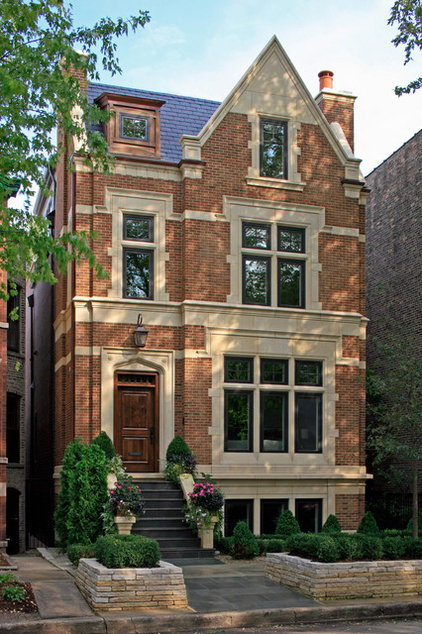
traditional exterior by Burns and Beyerl Architects

Save to Ideabook
Email Photo
Everyone plays with blocks as a child, but not everyone is cut out to become a mason. It takes great skill to construct walls from brick, block and stone.
The materials are heavy and difficult to cut and shape. Though each piece is laid by hand and walls go up slowly (especially compared to a wall framed with wood), the wall must be perfectly plumb at the end, because there is no way to shim, trim or shift a masonry wall the way you can do with a frame wall covered in siding.
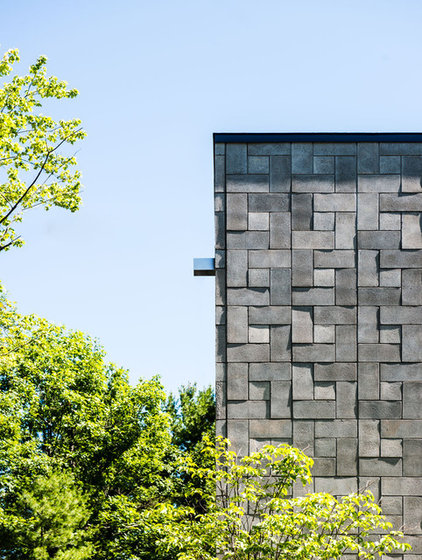
modern exterior by Kariouk Associates

Save to Ideabook
Email Photo
Concrete Masonry Unit
CMU is the most common building block masons use these days. CMU stands for concrete masonry unit, and is usually referred to as CMU on architectural plans.
Laypeople tend to refer to CMU as cinder block, concrete block or just block. Regardless of what you call it, this material is frequently used thanks to its large sizes (8 by 8 by 16 inches is common), which help a structural wall go up quickly.
Browse designs built with CMUs
farmhouse family room by Paul Rice Architecture

Save to Ideabook
Email Photo
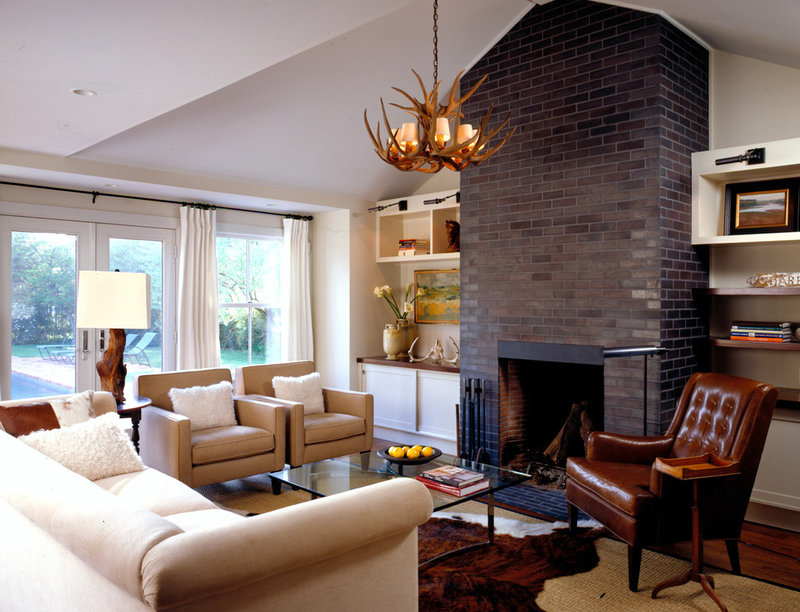
Brick
There are many variations, but in general, a brick is made of clay rather than the concrete in a CMU. Bricks are also generally smaller (about 3 by 8 by 2 inches) and red, though as you can see in this photo, bricks come in all the earthen colors, including black. Though brick looks impenetrable, a brick wall should have gaps in the mortar at the bottom to let moisture out. I also recommend avoiding paint on exterior brick to allow the bricks to breathe.

A Revolutionary Renovation in Connecticut | Katonah NY Real Estate

year before the Continental Congress adopted the Declaration of Independence, a man named Joseph Wheadon built a modest, one-room house in New Milford, Connecticut. Wheadon cut the lumber by hand and scavenged foundation stones from the surrounding property. After his premature death, a Greek Revival wing was built, followed by other less-distinctive additions.
More than 235 years after Wheadon first wielded his ax, a Greenwich woman discovered the property while searching for a weekend retreat. By this time, the house was dated and neglected, with systems that had outlived their usefulness. “It was my duty to the community to maintain and uphold the architectural history of the house,” says the homeowner, a former student of historic preservation, now earning a doctorate in environmental policy. “However, on the backside of the house, I wanted to bring nature in and to connect the house to its surroundings.”
Houzz at a Glance Who lives here:The home is a getaway for a local family of five Location: New Milford, Connecticut Size:  2,700 square feet; 4 bedrooms, 4 bathrooms That’s interesting: The old foundation stones were used to build a labyrinth behind the house.

farmhouse exterior by Blansfield Builders, Inc.

Save to Ideabook
Email Photo
Working with Mark Goodwin of Beinfield Architecture, and Jim Blansfield of Blansfield Builders, the owner remodeled and expanded the house, opening the interior spaces to each other and the view.
The new column-lined entryway across from the garage pays homage to the 19th-century Greek Revival facade in front. The wing to the right was newly built, and the whole house was covered in standing-seam metal roofing, which is both easy to maintain and environmentally responsible — a consideration that drove much of the project.
farmhouse living room by Blansfield Builders, Inc.

Save to Ideabook
Email Photo
“You venture into a different world when you venture inside,” observes Goodwin, who heeded the owner’s request to reduce every element to its simplest components.
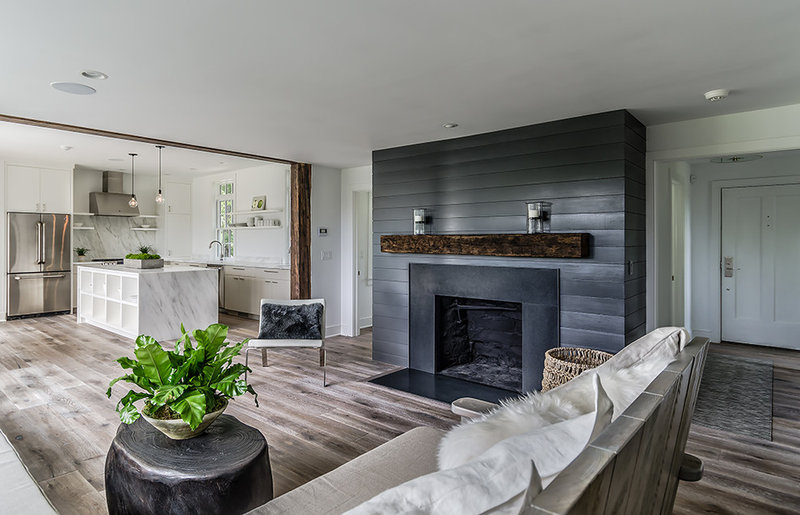
The living-dining area is dominated by an original fireplace, now covered in reclaimed wood that’s been treated to a charcoal gray finish. “We tried to reuse as much of the wood as we could,” says Goodwin, who left some of the hand-hewn beams exposed and used one to create a sublimely understated mantel.
contemporary living room Circa 1700 in NY

Save to Ideabook
Email Photo
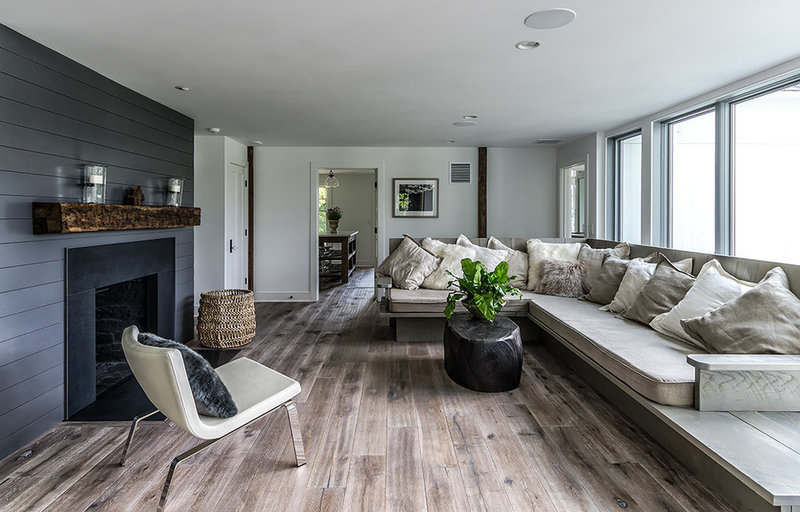
While the home feels like a radical departure from its Revolutionary past, the owner doesn’t see the two as incompatible. “If you look at the interiors, they’re contemporary in terms of being minimal,” she says. “But actually, those are the same materials that would have been used by the original builders. Instead of making it a relic of the past, we revived it and gave it a whole new identity.”
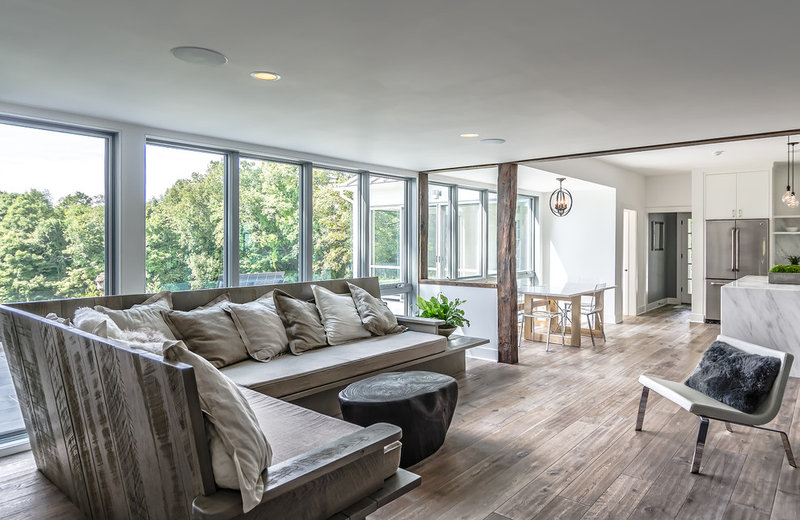
The living room sectional was custom crafted from Northern white pine, while the Andrianna Shamaris coffee table was fashioned from a tree stump. The engineered-wood floors (Castle Combe’s Worcester pattern) are made from oak, textured and treated to look like ancient reclaimed wood.
farmhouse living room by Blansfield Builders, Inc.

Save to Ideabook
Email Photo
The neutral decor defers to the view. The garden room is visible through the doorway at rear.

contemporary  Circa 1700 in NY

Save to Ideabook
Email Photo
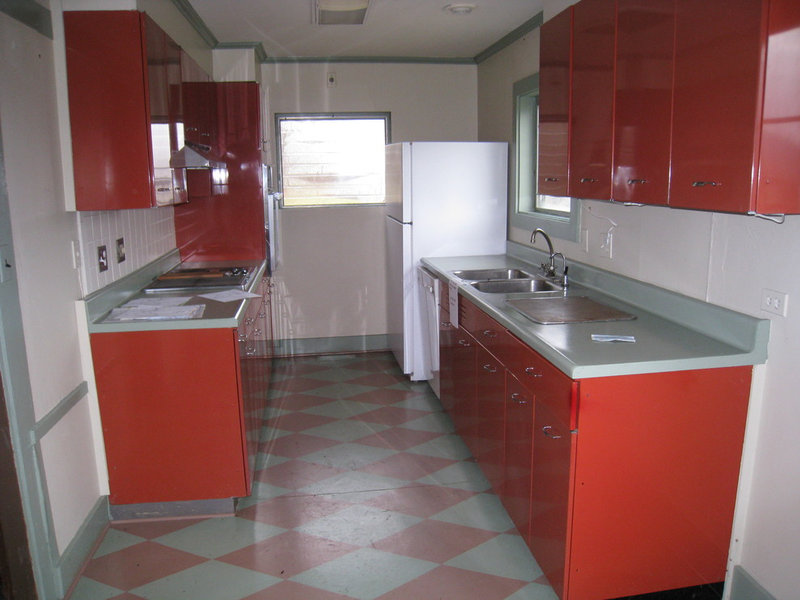
When the owner bought the house, the kitchen had barely been updated since the 1950s and still sported its vintage metal cabinets.

Identify hot buying behavior | Katonah NY Real Estate

There’s nothing worse than working day and night chasing leads that never seem to amount to anything. Working manually through the process only exasperates the frustration, especially when it seems like leads are slipping right through your fingers. Below are thoughts to help you identify hot buyers and reach out effectively.

However, the tips assume you have already handled the following three items: (1) You have an automated marketing tool in place; (2) You are already capturing the name and email of browsers; and (3) You have property search and detail pages to monitor online behavior. For more information on why these assumptions are important, take a moment to read the previous Digital Mind Shift articles: part one | part two | part three.

Monitor hot behavior Think of your property search and detail pages as a stocked pond. Drive as much traffic to your pond as possible because that’s the best place to catch fish. This is where you can discover the hot buying behavior of browsers. Look for a combination of the following behaviors to determine how and when to reach out. Saved or preferred properties: Give your users the opportunity to favorite or save properties that most interest them. In doing so, you provide a value-added online benefit and know precisely the type of properties the user wants. Length of time browsing on site: Pay attention to browsers who are spending considerable lengths of time searching for properties.

This is a key indicator they are serious about finding the right home to buy. Expense level of properties: Buyers who are interested in more expensive properties should raise an eyebrow and warrant your attention. Just sayin’.Frequency of returns to the site: Buyers who are visiting your site frequently and searching for properties are demonstrating clear signs of hot buying behavior.

Frequency of returns to a particular property: When a browser keeps checking out the same property repeatedly over the course of a few weeks, you might want to take notice. Communicate like a human, not a machine It’s important you don’t scare customers away or annoy them with messages that look and feel like spam. Yes, you should set up automated campaigns to reach the maximum amount of people, but you can do it with a personalized and human approach. Here’s how: Let the customer know you’re paying attention by putting the property address she has shown interest in directly in the note.

This can be done automatically with most marketing tools. Give the impression the email is from a real person by always signing off with a name and contact information. Also, be sure to craft the messages like you would in any normal email correspondence. Be positive, personable and try to generate a dialogue.

Show yourself as helpful and friendly by offering to answer any questions about the property. Every customer who responds to an email should immediately be contacted by a real person (even though they think the note came from a real person to begin with). Start building your campaigns around hot buying behavior and personalized messaging techniques. Happy fishing!


– See more at: http://www.inman.com/next/identify-hot-buying-behavior/#sthash.Ucbg1gup.dpuf

September foreclosure activity falls 27% | Katonah NY Homes

Foreclosure filings in the U.S. dropped 27% year-over-year in September, RealtyTrac reported in its latest foreclosure update.

The report shows 131,232 U.S. homes facing either a default notice, auction sale or bank repossession in September, down 27% from last year and 2% from the previous update.

In fact, the month of September marked 36 months of annual declines in foreclosure activity, with third-quarter foreclosure activity falling to its lowest quarterly level since 2Q 2007, RealtyTrac noted.

As a whole, the data and research firm recorded 376,931 properties with foreclosure filings in the third quarter, down 7% from the previous quarter and a 29% drop from last year.

“The September and third-quarter foreclosure numbers show a housing market that is haltingly returning to health,” said Daren Blomquist, vice president of RealtyTrac. “In a healthy housing market foreclosures are rare but streamlined while still protecting the rights of the homeowner.”

“While foreclosures are clearly becoming fewer and farther between in most markets, the increasing time it takes to foreclose is holding back a more robust and sustainable recovery,” Blomquist added.


http://www.housingwire.com/articles/27345-september-foreclosure-activity-falls-27