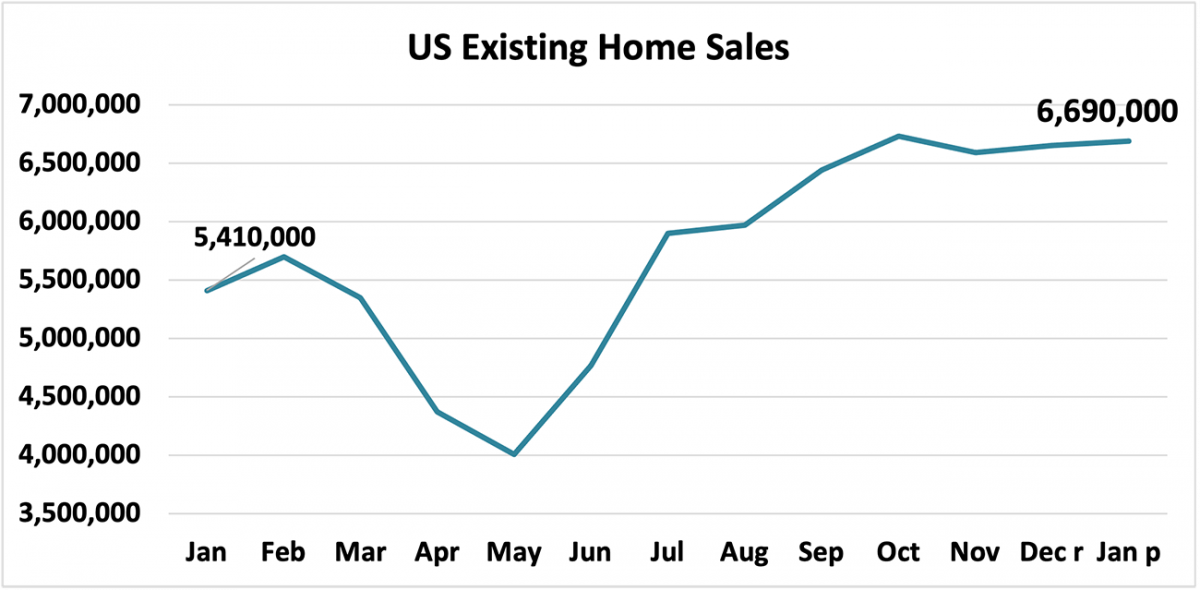
NAR released a summary of existing-home sales data showing that housing market activity this January rose modestly 0.6% from December 2020. January’s existing home sales reached a 6.69 million seasonally adjusted annual rate. January’s sales of existing homes rose 23.7% from January 2020.
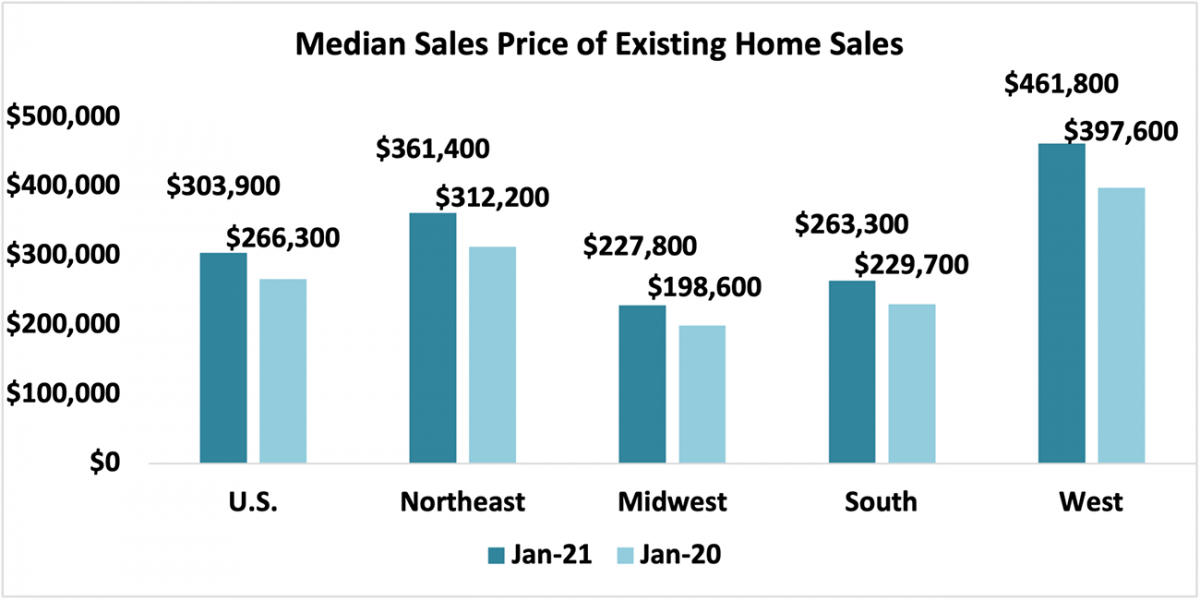
The national median existing-home price for all housing types rose to $309,900 in January, up 14.1% percent from a year ago. Home prices have continued to escalate, and this marks the 107th consecutive month of year-over-year gains.
Regionally, all four regions showed double digit price growth from a year ago. The West had the largest gain of 16.1% followed by the Northeast with an increase of 15.8%. The Midwest showed an increase of 14.7% and the South had the smallest price gain of 14.6% from January 2020.
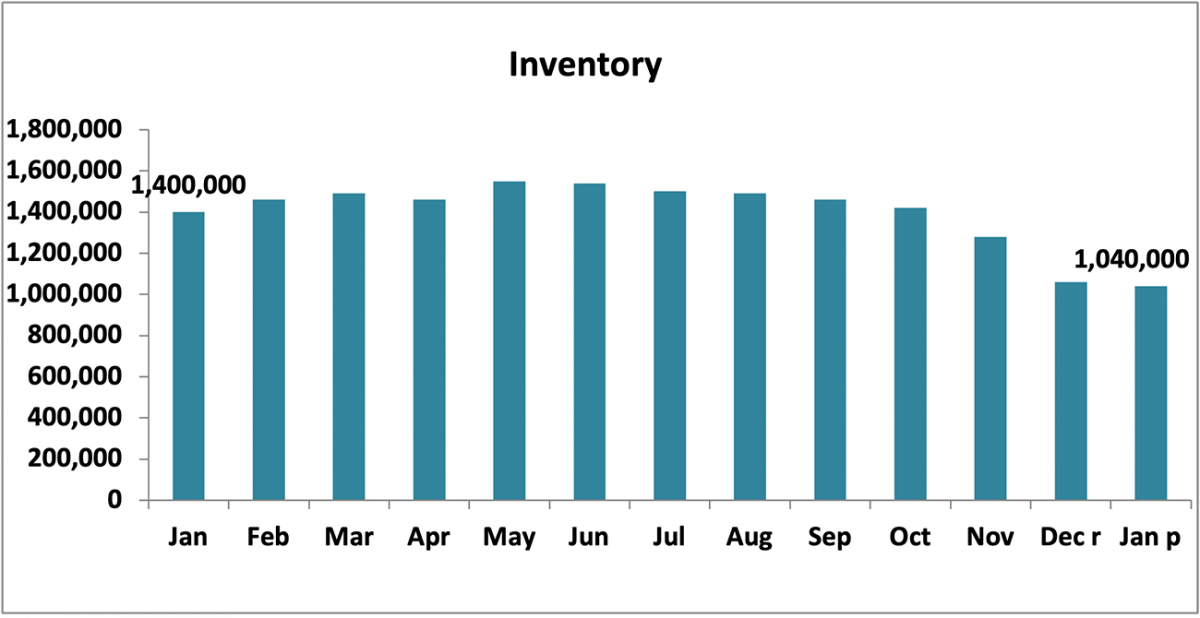
January’s inventory figures dropped 1.9% from last month standing at 1.04 million homes for sale. Compared with January of 2020, inventory levels dropped 25.7%. This would mark 20 straight months of year over year declines. It will take 1.9 months to move the current level of inventory at the current sales pace.
It takes approximately 21 days for a home to go from listing to a contract in the current housing market. A year ago, it took 43 days.
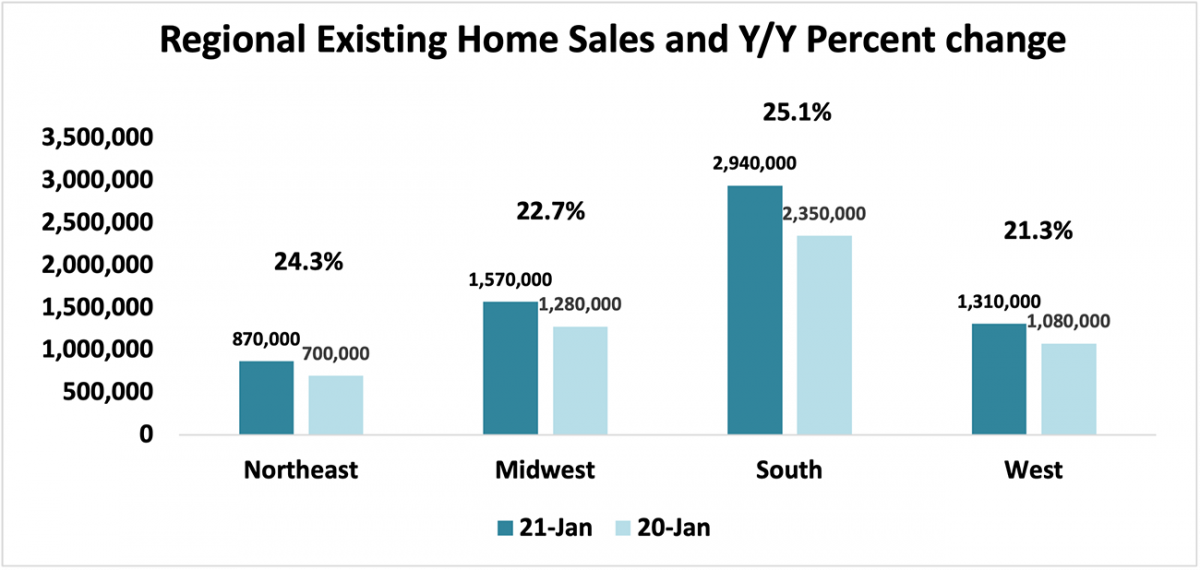
From December 2020, two of the four regions had increases in sales. The South had the largest gain of 3.2% followed by the Midwest with an increase of 1.9%. The Northeast had a decline of 2.2% followed by the West with the biggest dip of 4.4%.
From a year ago, all four regions showed double digit increases in sales. The South region had the largest gain of 25.1%. The Northeast had an increase in sales of 24.3% followed by the Midwest with a rise of 22.7%. The West had the smallest gain of 21.3%.
The South led all regions in percentage of national sales, accounting for 43.9% of the total, while the Northeast had the smallest share at 13.0%.
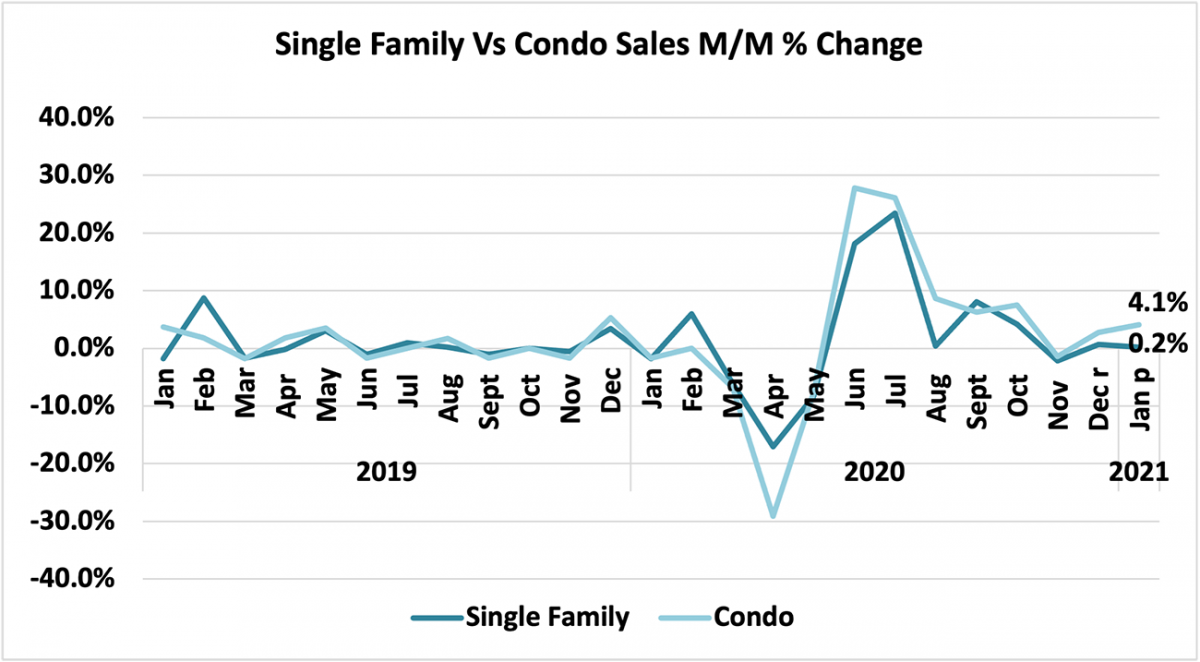
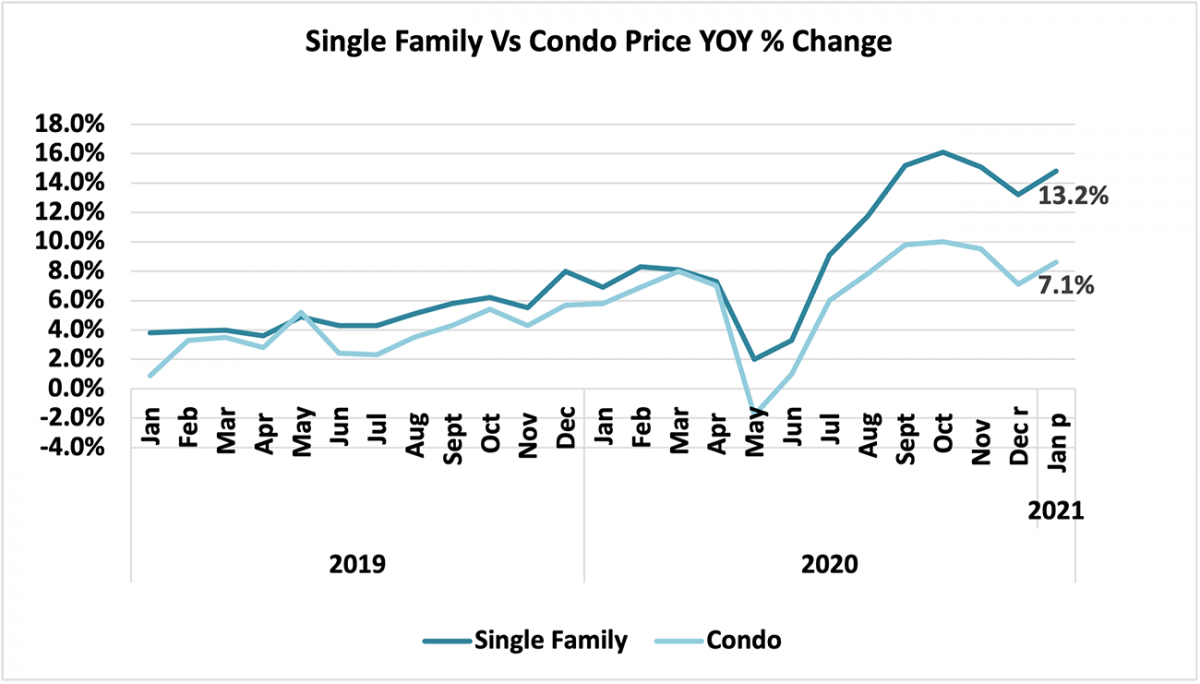
In January, single-family sales were up 0.2% and condominiums sales were up 4.1% compared to last month. Single-family home sales were up 23.0% while condominium sales were up 28.8% compared to a year ago. The median sales price of single-family homes rose 14.8% at $308,300 from January 2020, while the median sales price of condominiums rose 8.6% at $269,600.
January marked the fifth straight month that the National Association of Realtors® (NAR) has reported a decline in its Pending Home Sales Index (PHSI). The index, based on newly signed contracts for the purchase of existing homes, was down 2.8 percent from its December level.
The index in January was at 122.8 compared to 125.5 in December and has lost 10 points since August. Still, pending sales were up 13 percent compared to a year earlier. This January’s PHSI was, in fact, the highest for any January on record.
Analysts had expected the index to be flat but individual estimates by those polled by Econoday all overshot the actual results. They covered a range from a 1.5 percent downturn to 0.5 percent growth. The consensus was for zero change.
“Pending home sales fell in January because there are simply not enough homes to match the demand on the market,” said Lawrence Yun, NAR’s chief economist. “That said, there has been an increase in permits and requests to build new homes.” Yun said that increase in single-family permits has been consistent for eight months and is a good sign that the supply and demand imbalance in the residential real estate market could be easing as soon as mid-2021.
“There will also be a natural seasonal upswing in inventory in spring and summer after few new listings during the winter months,” he said. “These trends, along with an anticipated ramp-up in home construction will provide for much-needed supply.”
Following a week where January’s existing-home sales increased, Yun noted that pending contracts are a great early indicator for upcoming closed sales but stressed that the timing of the relationship between existing-home sales and pending home sales may not be in lockstep.
“The two measurements aren’t always perfectly correlated due to varying amounts of time required to close a contract,” Yun said. “This is because a number of fallouts can occur due to a variety of factors, including a buyer not obtaining mortgage financing, a problem with a home inspection, or an appraisal issue.”
He noted that the economy is showing promising signs of improvement, and many millions of Americans are now receiving a COVID-19 vaccination. Still, he cautioned that the better economic outlook, rising inflation prospects and higher budget deficits will soon drive increases in interest rates. “I don’t foresee mortgage rates jumping to an alarming level,” he said, “but we should prepare for a rise of at least a decimal point or two.”
Pending home sales transactions in the South inched up 0.1 percent to an index of 151.3 in January and were 17.1 percent higher year-over-year. The index in the West was at 104.6, a 7.8 percent drop from December but up 11.5 percent from a year prior.
The PHSI is based on a large national sample, typically representing about 20 percent of transactions for existing-home sales. In developing the model for the index, it was demonstrated that the level of monthly sales-contract activity parallels the level of closed existing-home sales in the following two months. Existing home sales numbers for February will be released on March 22.
An index of 100 is equal to the average level of contract activity during 2001, which was the first year to be examined. By coincidence, the volume of existing-home sales in 2001 fell within the range of 5.0 to 5.5 million, which is considered normal for the current U.S. population.
S&P Dow Jones Indices (S&P DJI) today releases the latest results for the S&P CoreLogic Case-Shiller Indices, the leading measure of U.S. home prices. Data released today for December 2020 show that home prices continue to increase across the U.S. More than 27 years of history are available for the data series, and can be accessed in full by going to https://www.spglobal.com/spdji/.
Please note that transaction records for October 2020 and November 2020 for Wayne County, MI, are now available. Due to delays at the local recording office caused by the COVID-19 pandemic, S&P DJI and CoreLogic were previously unable to generate valid October 2020 and November 2020 updates for the Detroit S&P CoreLogic Case-Shiller Indices.
However, there are still an insufficient number of records from Wayne County for December 2020. Since Wayne County is the most populous county in the Detroit metro area, S&P DJI and CoreLogic are unable to generate a valid Detroit index value for December 2020. When the sale transactions data fully resumes, and sufficient data is collected, the Detroit index values for the month(s) with missing updates will be calculated.
YEAR-OVER-YEAR
The S&P CoreLogic Case-Shiller U.S. National Home Price NSA Index, covering all nine U.S. census divisions, reported a 10.4% annual gain in December, up from 9.5% in the previous month. The 10-City Composite annual increase came in at 9.8%, up from 8.9% in the previous month. The 20-City Composite posted a 10.1% year-over-year gain, up from 9.2% in the previous month.
Phoenix, Seattle, and San Diego continued to report the highest year-over-year gains among the 19 cities (excluding Detroit) in December. Phoenix led the way with a 14.4% year-over-year price increase, followed by Seattle with a 13.6% increase and San Diego with a 13.0% increase. Eighteen of the 19 cities reported higher price increases in the year ending December 2020 versus the year ending November 2020.
MONTH-OVER-MONTH
Before seasonal adjustment, the U.S. National Index posted a 0.9% month-over-month increase, while the 10-City and 20-City Composites both posted increases of 0.9% and 0.8% respectively in December. After seasonal adjustment, the U.S. National Index posted a month-over-month increase of 1.3%, while the 10-City and 20-City Composites both posted increases of 1.2% and 1.3% respectively. In December, 18 cities (excluding Detroit) reported increases before seasonal adjustment, while all 19 cities reported increases after seasonal adjustment.
ANALYSIS
“Home prices finished 2020 with double-digit gains, as the National Composite Index rose by 10.4% compared to year-ago levels,” says Craig J. Lazzara, Managing Director and Global Head of Index Investment Strategy at S&P DJI. “The trend of accelerating prices that began in June 2020 has now reached its seventh month and is also reflected in the 10- and 20-City Composites (up 9.8% and 10.1%, respectively). The market’s strength continues to be broadly-based: 18 of the 19 cities for which we have December data rose, and 18 cities gained more in the 12 months ended in December than they had gained in the 12 months ended in November.
“As COVID-related restrictions began to grip the economy in early 2020, their effect on housing prices was unclear. Price growth decelerated in May and June, and then began a steady climb upward, and December’s report continues that acceleration in an emphatic manner. 2020’s 10.4% gain marks the best performance of housing prices in a calendar year since 2013. From the perspective of more than 30 years of S&P CoreLogic Case-Shiller data, December’s year-over-year change ranks within the top decile of all reports.
“These data are consistent with the view that COVID has encouraged potential buyers to move from urban apartments to suburban homes. This may indicate a secular shift in housing demand, or may simply represent an acceleration of moves that would have taken place over the next several years anyway. Future data will be required to address that question.
“Phoenix’s 14.4% increase led all cities for the 19th consecutive month, with Seattle (+13.6%) and San Diego (+13.0%) close behind. Prices were strongest in the West (+10.8%) and Southwest (+10.5%), but gains were impressive in every region.”
SUPPORTING DATA
Table 1 below shows the housing boom/bust peaks and troughs for the three composites along with the current levels and percentage changes from the peaks and troughs.
2006 Peak
2012 Trough
Current
Index
Level
Date
Level
Date
From Peak (%)
Level
From Trough (%)
From Peak (%)
National
184.61
Jul-06
134.00
Feb-12
-27.4%
234.40
74.9%
27.0%
20-City
206.52
Jul-06
134.07
Mar-12
-35.1%
240.75
79.6%
16.6%
10-City
226.29
Jun-06
146.45
Mar-12
-35.3%
254.18
73.6%
12.3%
Table 2 below summarizes the results for December 2020. The S&P CoreLogic Case-Shiller Indices are revised for the prior 24 months, based on the receipt of additional source data.
December 2020
December/November
November/October
1-Year
Metropolitan Area
Level
Change (%)
Change (%)
Change (%)
Atlanta
168.58
0.8%
1.2%
8.9%
Boston
250.33
0.8%
1.4%
11.4%
Charlotte
184.40
0.7%
1.1%
10.2%
Chicago
154.45
0.3%
0.4%
7.7%
Cleveland
141.25
0.9%
0.1%
11.5%
Dallas
209.09
0.9%
0.8%
8.4%
Denver
243.49
0.9%
1.0%
9.2%
Detroit
—
—
0.7%
—
Las Vegas
210.65
1.1%
0.7%
7.9%
Los Angeles
317.64
0.7%
0.9%
9.9%
Miami
269.81
1.2%
1.3%
9.2%
Minneapolis
196.81
0.4%
0.6%
10.2%
New York
223.32
1.2%
1.9%
9.9%
Phoenix
228.24
1.1%
1.3%
14.4%
Portland
264.51
0.5%
0.7%
9.9%
San Diego
297.52
0.6%
0.9%
13.0%
San Francisco
289.88
0.0%
0.9%
8.7%
Seattle
288.75
0.9%
0.9%
13.6%
Tampa
248.92
1.2%
1.4%
10.7%
Washington
259.00
1.2%
1.1%
10.3%
Composite-10
254.18
0.9%
1.2%
9.8%
Composite-20
240.75
0.8%
1.1%
10.1%
U.S. National
234.40
0.9%
1.1%
10.4%
Sources: S&P Dow Jones Indices and CoreLogic
Data through December 2020
Table 3 below shows a summary of the monthly changes using the seasonally adjusted (SA) and non-seasonally adjusted (NSA) data. Since its launch in early 2006, the S&P CoreLogic Case-Shiller Indices have published, and the markets have followed and reported on, the non-seasonally adjusted data set used in the headline indices. For analytical purposes, S&P Dow Jones Indices publishes a seasonally adjusted data set covered in the headline indices, as well as for the 17 of 20 markets with tiered price indices and the five condo markets that are tracked.
S&P Dow Jones Indices is the largest global resource for essential index-based concepts, data and research, and home to iconic financial market indicators, such as the S&P 500® and the Dow Jones Industrial Average®. More assets are invested in products based on our indices than products based on indices from any other provider in the world. Since Charles Dow invented the first index in 1884, S&P DJI has been innovating and developing indices across the spectrum of asset classes helping to define the way investors measure and trade the markets.
S&P Dow Jones Indices is a division of S&P Global (NYSE: SPGI), which provides essential intelligence for individuals, companies, and governments to make decisions with confidence. For more information, visit https://www.spglobal.com/spdji/.
“It’s a tale of two economies. The services economy remains in the doldrums, but the production side of the economy remains strong,” said Sam Khater, Freddie Mac’s Chief Economist. “New COVID-19 cases are receding, which is encouraging and that has led to a rise in Treasury rates. But, the run-up in Treasury rates has not impacted mortgage rates yet, which have held firm.”
Khater continued, “The residential real estate market remains solid given healthy purchase demand while implied real-time home price growth is high, due to the inventory shortage that is plaguing the housing market.”
News Facts
30-year fixed-rate mortgage averaged 2.73 percent with an average 0.7 point for the week ending February 11, 2021, unchanged from last week. A year ago at this time, the 30-year FRM averaged 3.47 percent.
15-year fixed-rate mortgage averaged 2.19 percent with an average 0.6 point, down from last week when it averaged 2.21 percent. A year ago at this time, the 15-year FRM averaged 2.97 percent.
5-year Treasury-indexed hybrid adjustable-rate mortgage (ARM) averaged 2.79 percent with an average 0.2 point, up slightly from last week when it averaged 2.78 percent. A year ago at this time, the 5-year ARM averaged 3.28 percent.
U.S. Reps. Mondaire Jones (D-NY), Tom Suozzi (D-NY) and U.S. Senate Majority Leader Charles Schumer on Thursday introduced the SALT Deductibility Act that would remove the $10,000 cap on state and local tax deductions imposed in 2017 under the federal tax reform law.
The SALT Cap was highly criticized by New York politicians, as well as the New York State real estate industry, including the Hudson Gateway Association of Realtors.
“When it comes to SALT, if you think Westchester and Rockland families needed and deserved this money before the coronavirus took hold, the stakes are even higher now because the cap is costing this community tens-of-thousands of dollars they could be using amid the crisis… Double taxing hardworking homeowners is plainly unfair. We need to bring our federal dollars back home to cushion the blow of this virus—and this harmful SALT cap—has dealt so many homeowners and families locally,” said U.S. Senate Majority Leader Charles Schumer.
The SALT Deductibility Act would remove the cap on the SALT deduction instituted in 2017 as part of then President Donald Trump’s Tax Cuts and Jobs Act and would allow New Yorkers to fully deduct their state and local taxes from their federal taxes.
“Donald Trump cut taxes for billionaires and big corporations and paid for it on the backs of hardworking families in Westchester and Rockland counties, where we pay the highest property taxes in the entire nation,” said Rep. Jones at a press conference announcing the introduction of the SALT bill. “That must change. Restoring the SALT deduction is a necessary first step to creating an equitable tax system – one where we put money back in the pockets of working people.”
Congressman Jones’ said the passage of the bill will bring needed relief to his constituents in Westchester and Rockland residents who pay the highest property taxes of any Congressional District in the entire nation, with Westchester ranked first and Rockland ranked second.
Others who praised the bill’s introduction were U.S, Senator Kirsten Gillibrand (D-NY), who said, “The reinstating of the SALT Deduction will ensure that New York families have more money in their pockets, get much-needed tax relief and will once again be treated fairly.”
New York State Senate Majority Leader Andrea Stewart-Cousins noted that over the last three years, “Trump’s unfair attack on Blue States has cost New Yorkers over $30 billion, while wealthy corporations saw tax breaks.”
“I want to thank US Congressman Mondaire Jones for his work, in conjunction with US Senator Chuck Schumer, to restore the State and Local Tax or ‘SALT’ deduction,” said Westchester County Executive George Latimer. “This federal tax law is not only double taxation, but it also unfairly targets communities like Westchester County–and every homeowner in this county is a victim. In Westchester, where the average home is valued at $691,392.00, our homes are our greatest asset and this cap is a hit to our wallet. We cannot stand for this—and we will not. We won’t stop fighting until we overturn the SALT deduction cap.”
In other legislative news, Spectrum News reported that two state lawmakers had introduced a bill to tax capital gains in New York as a means to increase taxes on the state’s wealthiest residents. The bill backed by Sen. Gustavo Rivera and Assemblyman Ron Kim that would tax investment income could raise an estimated $7 billion in revenue for the state.