Monthly Archives: November 2013

Investors Have Doubled Purchases Over 2012 | North Salem Real Estate

Though most observers forecast rising home prices would drive investors out of the market for single family rentals, that fact is that to date investors have purchased more homes than they did in all of 2012 or 2011.

Investors have purchased more than 370,000 properties so far in 2013, already more than in either of the previous two full years according to a new investor insight report released today by RealtyTrac.

The report also found that:

  • Investors have purchased more than $1 trillion in US real estate since 2011. Fifty-four percent were all-cash;
  • Fifty-seven percent of investor purchases re-sold, only 1 percent re-sold by 1,000+ purchasers. Investors with 1,000+ purchases bought 36 percent of properties as foreclosures
  • Out of the more than 950,000 purchases totaling more than $1 trillion made by investors since 2011, 54 percent were all-cash purchases. When the data is filtered for just entities that purchased at least 1,000 properties, the all-cash percentage skyrockets to 93 percent.
  • Investors have purchased more than 370,000 properties so far in 2013, already more than in either of the previous two full years.
  • The majority (54 percent) of properties purchased by investors were underwater but not in foreclosure. Meanwhile 24 percent of properties purchased by investors were in foreclosure or bank-owned, and 23 percent were a regular, equity purchases.
  • Among entities that purchased at least 1,000 properties during the three-year period, 36 percent were in some stage of foreclosure (22 percent auction alone), while 37 percent were underwater and 27 percent were regular equity sales.
  • Among all investor purchases during the time period, 57 percent have subsequently been re-sold, but only 25 percent of properties have been re-sold by entities purchasing at least 100 properties, and only 1 percent of properties have been re-sold by entities purchasing at least 1,000 properties.

RealtyTrac’s report, Real Estate Investor Purchase and Finance Patterns: 2011 to 2013, looks at a number of investor habits relating to real estate purchases since 2011, including the volume of properties purchased, breakdown of cash versus financed purchases, property situation (distressed, non-distressed, underwater etc.), investor purchases by property value, and number of investor-purchased properties that have since resold.

“The new investor insight report is the first of its kind and offers customers an exclusive look into investor decision making that has never been done on this scale before,” said Daren Blomquist, vice president at RealtyTrac. “We examined in-depth a variety of factors from cash sales to lender financing that impact real estate investing and offers key insight that no one else in the market can deliver.”

This report features purchasing activity of real estate investors across the U.S., identifying key variables by state and quarter within the last three years. The report identifies an investor as any person or entity that purchased three or more properties within a 12-month timeframe and provides key insights into the transactions made by investors over this time period, which was marked by the U.S. housing market moving from full distress mode to full recovery mode including.

Key metrics covered by the Investor Insight report:

  • Transaction by Financing Type identifies by investor name how many properties were purchased with 100 percent cash, 100 percent finance, mixed cash & finance, or unknown along with the amount identified for each category.


http://www.realestateeconomywatch.com/2013/10/investors-have-doubled-purchases-over-2012-or-2011/

Supporting a Wide-Span Floor With Structural Steel | Waccabuc Real Estate

When my client described how he wanted to convert his home’s existing two-car garage into a spacious new living room, I knew it would be a great project for my design/build firm. Measuring 34 feet deep by 28 feet wide, the garage space was a blank slate — little more than an unheated box with a concrete slab for a floor. The garage had a full-height attic that he was planning to convert into a master suite, and the first floor had plenty of space for a nice living room and his many collectibles. The only problem was that the wide-open floor plan he wanted wouldn’t be possible until we figured out a way to support the second floor’s main girder, which was propped up by a steel I-beam running down the center of the garage (see Figure 1).

To transform this garage (top) into living space with an open floor plan, the author replaced the existing steel I-beam and supporting column with a framework of custom-fabricated decorative steel (bottom).

When we started the design process — specifically, figuring out how to create a unique space and support the second floor without posts or columns — I immediately thought of local steel fabricator and sculptor John Rubino, whose decorative steel beams are on display in various residential and commercial structures in northern Vermont. Although these structural elements function much like ordinary structural red iron, the stylized beams look anything but ordinary.

With the client’s go-ahead, John and I worked out a plan: We would support the top half of the building without intermediate posts and simultaneously create a living space using exposed steel framing that would become an integral part of the overall design. While John spent about a month fabricating the steel in his Morrisville, Vt., shop (see “Fabricating a Custom steel Beam“), my crew and I readied the building for its new structural elements.

The steel design was relatively simple — two upside-down U-shaped frames connected to another beam running perpendicular to them at the center. Designed with a graceful sweeping curve, the connecting beam would replace the garage’s existing center I- beam and eliminate the need for supporting columns; it would also add a sculptural element to the space.

Getting to Work

Before delivery of the steel, we built a pair of 2×4 walls that would temporarily support the second floor while we removed the existing steel I-beam and posts. Even though we had to frame new openings for a 6-foot patio door and several windows, we purposely left the existing garage-door openings in place to make it easier to bring the steel inside.

About a month after finalizing the plan, John backed his delivery truck into the garage and we lifted the beams off with a chain hoist (Figure 2). John had welded on lifting points near the center span of each beam, to help keep the components nice and level as they went up. This was good thinking, because this steel was meant to be exposed and had been spray-painted and finished with a water-based clear finish called Safecoat Acrylacq (AFM, 619/239-0321, www.afmsafecoat.com). This coating is pretty tough, but we still had to handle the steel with care so as not to scratch it. The lifting points made the process a lot easier and safer.


http://www.jlconline.com/framing/supporting-a-wide-span-floor-with-structural-steel.aspx

Billionaire Activist Wants $48M for Award-Winning Penthouse | Mt Kisco Real Estate

[Photos via BHS.]
22 images

Back in 2002, billionaire activist Jon Stryker snapped up two adjacent apartments atop the Beaux-Arts Prasada on Central Park West for $12.8 million, setting what was then an Upper West Side record for the the most expensive single-occupancy apartment purchase. Well, times, they have a-changed, and prices, they have a-soared. And Stryker just listed the combined, renovated triplex penthouse—clocking in at 5,600 square feet with five bedrooms and six baths, plus two levels of outdoor space, exposures in every direction, and Central Park views—for a whopping $48 million (h/t The Real Estalker.)

Though he’s trained as an architect himself in his native Michigan, where he is the heir to the fortune of a medical-equipment firm that bears his surname, Stryker currently devotes his time to philanthropy as one of the largest donors to gay and lesbian charities and conservation groups. Since he’s busy getting a species of monkey named after him and fighting for social justice and all, Stryker tapped notable design firm Shelton, Mindel & Associates to carry out the makeover. The units apparently came with, erm, “nymph sconces and endless stained-glass windows.” Eleven years later, the sprawling apartment still retains some classic touches, like detailed millwork and coffered ceilings, but the vibe is decidedly updated. Earning an award for its interiors from the American Institute of Architects, a 2010 jury deemed it “beguilingly timeless” and “masterfully done.” Agree or disagree?

If the photos don’t speak for themselves, there’s this from listing agent Brown Harris Stevens:

Featured in Architectural Digest, this unique mansion in the sky is in mint condition and features soaring ceilings, pristine hardwood flooring and expertly crafted millwork throughout. There are 4-5 bedrooms, 6 baths, 45 windows and 2 fireplaces. A stately foyer leads to a 19-foot gallery opening onto a dramatic corner entertaining expanse, with a fireplace a double-height coffered ceiling, a mezzanine balcony and a series of eight 7 windows capturing breathtaking direct Park views. …  Upstairs, there is a magnificent altelier, with 3 walls of floor-to-ceiling windows, limestone flooring. and French doors leading onto an extraordinary private decked terrace of approximately 3,000 sf with attractive plantings. A staircase from the terrace leads to a second, tower rooftop terrace of approximately 480 square feet, offering 360 degree views.

Stryker has plenty of other real estate holdings in Michigan, Palm Beach, and upstate New York, so perhaps he was ready to sell while the market is going gangbusters in order to harness some more millions for his charity work. · Listing: 50 Central Park West [Brown Harris Stevens] · Floor Plan Porn: Jon Stryker [The Real Estalker] · Historic Central Park Triplex [Shelton, Mindel & Associates] · 2010 INSTITUTE HONOR AWARDS FOR INTERIOR ARCHITECTURE RECIPIENT: Historic Central Park West Residence [AIA] · West Side Record [NYO]

Chappaqua NY Sales up 75% | Median price flat | #RobReportBlog

Chappaqua   NY Real Estate ReportRobReportBlog
20136 months ending 11/52012
121Sales69up 75%
$899,999.00median sold price$900,000.00flat
$405,000.00low sold price$465,000.00
$4,000,000.00high sold price$2,550,000.00
3477average size3673
$301.00ave. price per foot$288.00
148ave days on market174
$1,044,310.00average sold price$1,045,921.00
0.9736ave. sold to ask0.9591

South Salem NY Weekly Real Estate Report | #RobReportBlog


South   Salem NY Weekly Real Estate Report11/5/2013
Homes for sale75
Median Ask Price$699,000.00
Low Price$205,000.00
High Price$12,200,000.00
Average Size3029
Average Price/foot$338.00
Average DOM178
Average Ask Price$1,078,984.00


Home prices were up 12% in September year over year but growth is slowing | Cross River Real Estate

Home prices were up 12% in September year over year but growth is slowing, market researcher CoreLogic says.

From August, home prices were up just 0.2%, marking the smallest month to month gain since January.

Price gains will slow further, to 0.1% from September to October, CoreLogic says.

Slower appreciation of home prices was expected by many economists given very rapid gains earlier this year, which fueled fears of housing bubbles forming in some markets, along with higher interest rates since late spring.

Year over year, the states with the highest home price appreciation in September were Nevada, up 25.3%; California, 22.5%; Arizona, 14.6%; Georgia, 14.4% and Michigan, 13.9%, CoreLogic says.

September marked the unofficial five-year anniversary of the start of the housing crisis. Given the strong home price gains for more than a year, average home prices in nearly half the states are now within “striking distance” of their pre-downturn peaks, says Anand Nallathambi, CoreLogic CEO.

Still, it may take longer to make up the rest of the ground.

Asking prices, whose trends lead sale prices by several months, were up 0.6% in October from September, on a seasonally adjusted basis, shows data from market researcher Trulia. That’s the second-slowest monthly gain in seven months.

Despite smaller monthly gains, prices are still rising because the inventory of homes for sale is still tight in many markets. Also, buying still looks cheap relative to renting in many markets, Trulia says.


http://www.usatoday.com/story/money/business/2013/11/05/corelogic-september-home-prices/3435687/


August Values Rose in Fewer Local Markets | South Salem NY Homes

Prices increased on a month-over-month basis in 253 of the top 300 markets, fewer than 293 in July, according to Homes.com’s Local Market Index for August.

The downtrend in the number of markets that gain monthly is likely due to both seasonal trends and the state of recovery for these markets. Of the 47 markets that saw declines last month, 40 percent have fully recovered their decline in home prices from the housing bubble, while another 28 percent were found to be unaffected by the boom-bust scenario, illustrating that the weakness is a result of leveling off in home prices.

As a complement to Local Market Index, Homes.com publishes an exclusive Rebound Report, highlighting how the housing recovery process is unfolding across the country. It measures each market’s peak-to-trough decline in index value, which had been attributed to the bursting of the U.S. housing bubble.

Rising home values in the third quarter saw four more top 100 markets reach full recovery. More than a quarter of the top 100 real estate markets have now fully recovered the value they lost in the housing crash. Nearly half of the remaining markets have recovered 50 percent of their lost value, increasing by four markets from the previous month.

Twenty-two midsized markets showed little to no effect from value lost in the 2007 housing bubble and experienced more stable changes in index values. Half of those 22 bubble-proof markets are from Texas, and more than 70 percent are from energy producing states where typical housing boom-bust scenarios did not occur. The remainder of midsized markets showed 51 markets, or 29 percent, with a 100 percent recovery and 94 markets with a 50 percent or more recovery.

“We found the effects of the housing boom-bust lingering in some areas because of the instability they suffered and the long, steep price slope needed for rebound.  While these particular markets are improving somewhat, higher rates of negative equity increase risk of foreclosure and can lock move-up buyers-who are also sellers-out of the marketplace, thus slowing overall recovery in certain local areas. Yet other markets that did not experience the bursting bubble to the same degree are in a better position to take full advantage of the recovery.  Their prices are appreciating faster, and they are rebounding earlier,” said Brock MacLean, executive vice president of Homes.com.  “The important thing to realize is that all markets are in some form of recovery, and different factors contribute to recovery scenarios across the country.  With data from the top 300 markets, the Homes.com Local Market Index and Rebound Report analyze trends in local communities where millions of Americans live-key trends missed by other real estate reports.”


http://www.realestateeconomywatch.com/2013/10/6784/


August Prices Rise to 12.8 Percent Over 2012 | Katonah NY Real Estate

S&P Dow Jones Indices released for its S&P/Case-Shiller1 Home Price Indices showing that the 10-City and 20-City Composites increased 12.8% year-over-year. Compared to July 2013, the annual growth rates accelerated for both Composites and 14 cities.

On a monthly basis, the 10-City and 20-City Composites gained 1.3% in August. Las Vegas led the cities with an increase of 2.9%, its highest since August 2004. Detroit and Los Angeles followed with gains of 2.0%.

In August 2013, the 10- and 20-City Composites posted annual increases of 12.8%.

“The 10-City and 20-City Composites posted a 12.8% annual growth rate,” says David M. Blitzer, Chairman of the Index Committee at S&P Dow Jones Indices. “Both Composites showed their highest annual increases since February 2006. All 20 cities reported positive year-over-year returns. Thirteen cities posted double-digit annual gains. Las Vegas and California continue to impress with year-over-year increases of over 20%. Denver and Phoenix posted 20 consecutive annual increases; Miami and Minneapolis 19. Despite showing 26 consecutive annual gains, Detroit remains the only city below its January 2000 index level.

“The monthly percentage changes for the 20-City composite show the peak rate of gain in home prices was last April. Since then home prices continued to rise, but at a slower pace each month. This month 16 cities reported smaller gains in August compared to July. Recent increases in mortgage rates and fewer mortgage applications are two factors in these shifts.

“Denver and Dallas again set new highs. All the other cities remain below their peaks. Boston and Charlotte are the two MSAs closest to their peaks with only 8-9% left to go. Las Vegas is still down 47.1% from its peak level.”

As of August 2013, average home prices across the United States are back to their mid-2004 levels. Measured from their June/July 2006 peaks, the peak-to-current decline for both Composites is approximately 20-21%. The recovery from the March 2012 lows is 22.1% and 22.7% for the 10-City and 20-City Composites.

All twenty cities posted monthly gains in August, although most cities showed deceleration compared to July. Las Vegas was at the top of the range at +2.9% and Seattle was at the bottom with a return of +0.5%. Month-over-month, San Francisco has been losing momentum as prices increased 4.9% in April 2013 and 0.9% in August 2013.


http://www.realestateeconomywatch.com/2013/10/august-prices-rise-to-128-percent-over-2012/


New plays on bay windows are boldly branching out in modern architecture | Bedford Hills NY Homes

When modern and contemporary architecture “abandon” traditional architectural elements in favor of new forms, one of the elements left behind is the bay window. Yet if we think of these elements as reinterpretations of traditions in architecture rather than abandonments (columns, for example, are turned into skinny pilotis without details like capitals), then the idea of the bay window is alive and well, if less used than it should be.
Here you’ll find six examples that show the benefits of modern answers to bay windows — increased area, light and seating capacity — and the various means of expressing the idea in modern houses and in modern renovations of old houses.

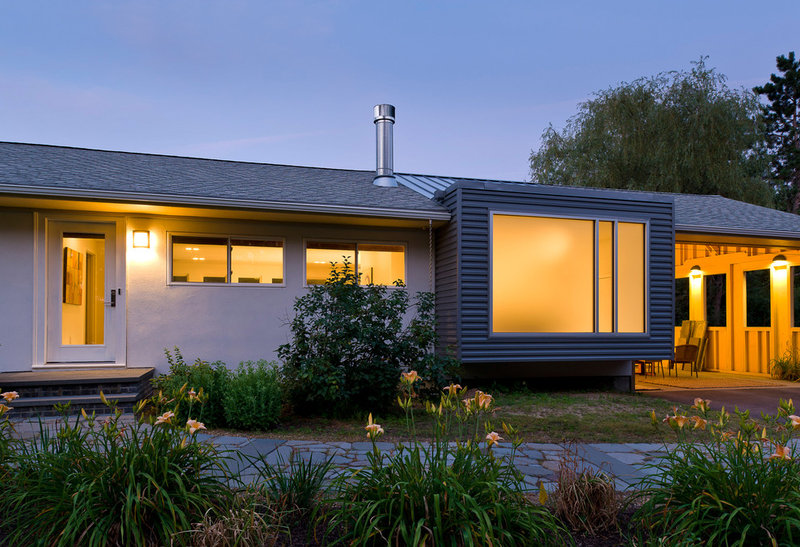
This addition to a ranch house looks like the end of a square tube that runs from front to back, with large windows on each side. The front picture window is partially frosted to maintain privacy.
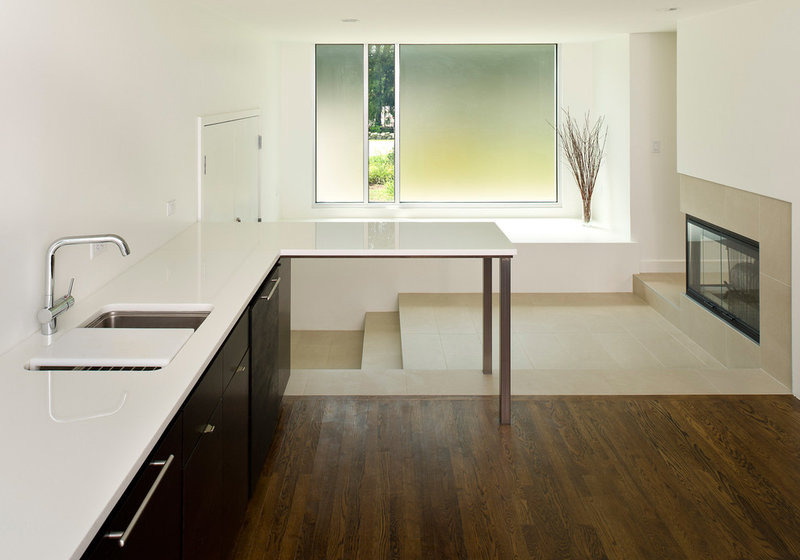
Here we are looking toward the front window from the kitchen before it was furnished. Only one thin strip of glass is clear; the adjacent pieces are translucent. Adding cushions to the bay would make it a great window seat; one could peek outside through the vertical strip or just enjoy the light coming in through the painting-like panes of color.
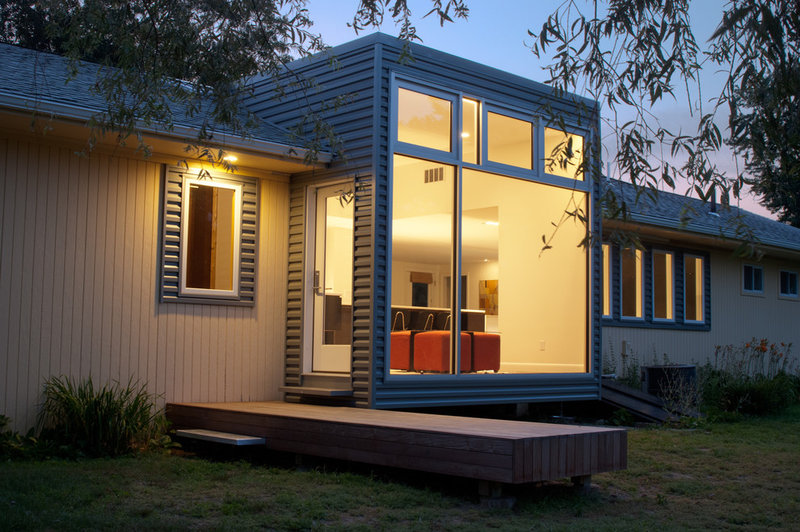
Like the front window, the back window projects from the house, cantilevered a foot or two above the ground. But unlike on the the front, all the glass here is clear, and the area inside is an extension of the floor, giving more space for seating near the kitchen.
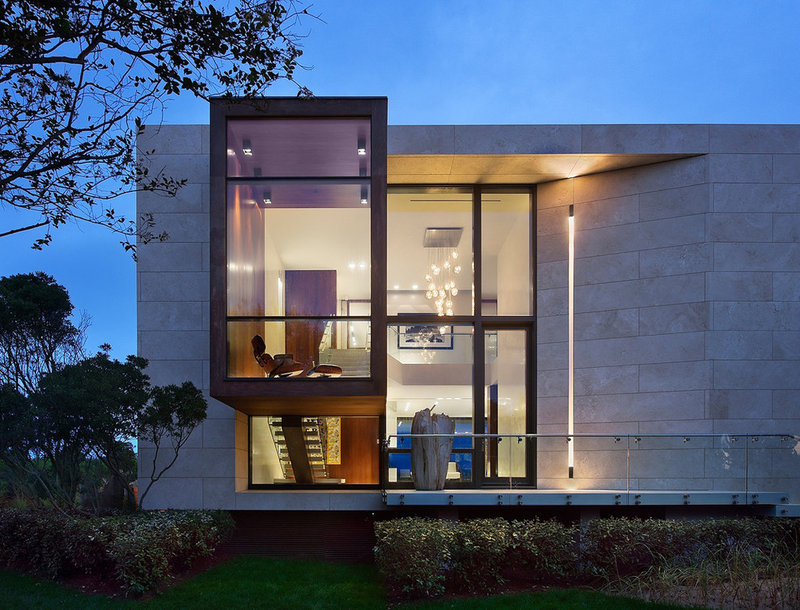
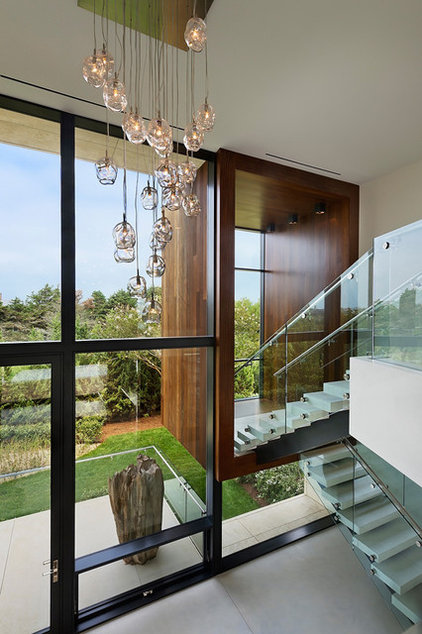
This house on New York’s Long Island has a fair amount of ins and outs on its exterior. I’m drawn to the tall portion facing right.
A view from the side reveals a tall bay window adjacent to a section of curtain wall set back from the stone facade. A stair can be seen below the large bay window.
It turns out the bay window is actually an extension of the stair landing. The Eames Lounge Chair in the previous photo indicates that this space is ideal for sitting, relaxing and enjoying the view.
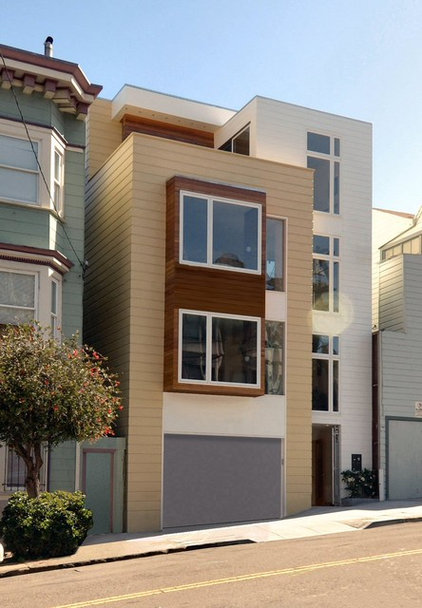
On a more modest scale is this two-unit condo in San Francisco, with modern bay windows above the garage.
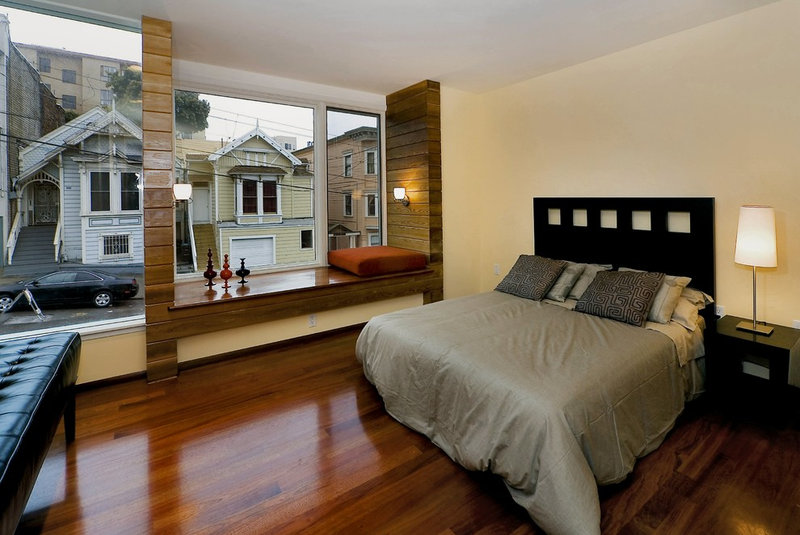
What looks fairly subtle on the outside is impressive on the inside, owing to the relative size of the window (almost the full width of the bedroom) and the way the architect articulated the window seat. The only thing I would change for myself would be the height of the sconces, which appear to be head height, making it hard for someone to lean against the walls while occupying the window seat.

Case-Shiller: Prices Slowing to 5.4% Appreciation | Bedford NY Real Estate

Home prices increased by 10.1 percent in the second quarter of 2013 compared to a year ago and prices nationwide are now 16 percent above the trough, reached in the fourth quarter of 2011, but still remain 24 percent below the peak, reached in the first quarter of 2006.

Based on CoreLogic Case-Shiller data forecast through June 30, 2014, home price appreciation will slow to an average of 5.4 percent across all U.S. markets. CoreLogic Case-Shiller projects that price appreciation will decelerate through the second half of 2013 and into the beginning of 2014.

Purchases by first-time and trade-up buyers are increasing, though tight mortgage lending conditions and slow job-market gains are constraining demand for owner-occupied housing. Demand from investors is weakening as well, as fewer distressed properties are listed for sale and rising home prices cut into potential rental profits. At the same time, the overall supply of homes for sale is still rising in many metro areas as current homeowners take advantage of favorable seller’s markets.

The downtrend in the number of markets that gain monthly is likely due to both seasonal trends and the state of recovery for these markets. Of the 47 markets that saw declines last month, 40 percent have fully recovered their decline in home prices from the housing bubble, while another 28 percent were found to be unaffected by the boom-bust scenario, illustrating that the weakness is a result of leveling off in home prices.

Three weeks ago Homes.com released its Local Market Index for August wich found that prices increased on a month-over-month basis in 253 of the nation’s top 300 markets, compared to 293 in July.

In the Homes.com report, of the metro areas that felt the greatest impact from the housing bubble, Sacramento (+26 percent), Las Vegas (+25 percent) and Phoenix (+20 percent) saw the largest increase in home prices during the second quarter of 2013 versus the same period last year. Coastal California markets also exhibited strong price appreciation, including Oakland (+24 percent), San Jose (+22 percent) and Los Angeles (+20 percent), as buyers continue to jump in before increasing prices and mortgage rates substantially reduce affordability.


http://www.realestateeconomywatch.com/2013/10/case-shiller-prices-slowing-to-54-appreciation/