Daily Archives: November 5, 2013

Chappaqua NY Sales up 75% | Median price flat | #RobReportBlog

Chappaqua   NY Real Estate ReportRobReportBlog
20136 months ending 11/52012
121Sales69up 75%
$899,999.00median sold price$900,000.00flat
$405,000.00low sold price$465,000.00
$4,000,000.00high sold price$2,550,000.00
3477average size3673
$301.00ave. price per foot$288.00
148ave days on market174
$1,044,310.00average sold price$1,045,921.00
0.9736ave. sold to ask0.9591

South Salem NY Weekly Real Estate Report | #RobReportBlog


South   Salem NY Weekly Real Estate Report11/5/2013
Homes for sale75
Median Ask Price$699,000.00
Low Price$205,000.00
High Price$12,200,000.00
Average Size3029
Average Price/foot$338.00
Average DOM178
Average Ask Price$1,078,984.00


Home prices were up 12% in September year over year but growth is slowing | Cross River Real Estate

Home prices were up 12% in September year over year but growth is slowing, market researcher CoreLogic says.

From August, home prices were up just 0.2%, marking the smallest month to month gain since January.

Price gains will slow further, to 0.1% from September to October, CoreLogic says.

Slower appreciation of home prices was expected by many economists given very rapid gains earlier this year, which fueled fears of housing bubbles forming in some markets, along with higher interest rates since late spring.

Year over year, the states with the highest home price appreciation in September were Nevada, up 25.3%; California, 22.5%; Arizona, 14.6%; Georgia, 14.4% and Michigan, 13.9%, CoreLogic says.

September marked the unofficial five-year anniversary of the start of the housing crisis. Given the strong home price gains for more than a year, average home prices in nearly half the states are now within “striking distance” of their pre-downturn peaks, says Anand Nallathambi, CoreLogic CEO.

Still, it may take longer to make up the rest of the ground.

Asking prices, whose trends lead sale prices by several months, were up 0.6% in October from September, on a seasonally adjusted basis, shows data from market researcher Trulia. That’s the second-slowest monthly gain in seven months.

Despite smaller monthly gains, prices are still rising because the inventory of homes for sale is still tight in many markets. Also, buying still looks cheap relative to renting in many markets, Trulia says.


http://www.usatoday.com/story/money/business/2013/11/05/corelogic-september-home-prices/3435687/


August Values Rose in Fewer Local Markets | South Salem NY Homes

Prices increased on a month-over-month basis in 253 of the top 300 markets, fewer than 293 in July, according to Homes.com’s Local Market Index for August.

The downtrend in the number of markets that gain monthly is likely due to both seasonal trends and the state of recovery for these markets. Of the 47 markets that saw declines last month, 40 percent have fully recovered their decline in home prices from the housing bubble, while another 28 percent were found to be unaffected by the boom-bust scenario, illustrating that the weakness is a result of leveling off in home prices.

As a complement to Local Market Index, Homes.com publishes an exclusive Rebound Report, highlighting how the housing recovery process is unfolding across the country. It measures each market’s peak-to-trough decline in index value, which had been attributed to the bursting of the U.S. housing bubble.

Rising home values in the third quarter saw four more top 100 markets reach full recovery. More than a quarter of the top 100 real estate markets have now fully recovered the value they lost in the housing crash. Nearly half of the remaining markets have recovered 50 percent of their lost value, increasing by four markets from the previous month.

Twenty-two midsized markets showed little to no effect from value lost in the 2007 housing bubble and experienced more stable changes in index values. Half of those 22 bubble-proof markets are from Texas, and more than 70 percent are from energy producing states where typical housing boom-bust scenarios did not occur. The remainder of midsized markets showed 51 markets, or 29 percent, with a 100 percent recovery and 94 markets with a 50 percent or more recovery.

“We found the effects of the housing boom-bust lingering in some areas because of the instability they suffered and the long, steep price slope needed for rebound.  While these particular markets are improving somewhat, higher rates of negative equity increase risk of foreclosure and can lock move-up buyers-who are also sellers-out of the marketplace, thus slowing overall recovery in certain local areas. Yet other markets that did not experience the bursting bubble to the same degree are in a better position to take full advantage of the recovery.  Their prices are appreciating faster, and they are rebounding earlier,” said Brock MacLean, executive vice president of Homes.com.  “The important thing to realize is that all markets are in some form of recovery, and different factors contribute to recovery scenarios across the country.  With data from the top 300 markets, the Homes.com Local Market Index and Rebound Report analyze trends in local communities where millions of Americans live-key trends missed by other real estate reports.”


http://www.realestateeconomywatch.com/2013/10/6784/


August Prices Rise to 12.8 Percent Over 2012 | Katonah NY Real Estate

S&P Dow Jones Indices released for its S&P/Case-Shiller1 Home Price Indices showing that the 10-City and 20-City Composites increased 12.8% year-over-year. Compared to July 2013, the annual growth rates accelerated for both Composites and 14 cities.

On a monthly basis, the 10-City and 20-City Composites gained 1.3% in August. Las Vegas led the cities with an increase of 2.9%, its highest since August 2004. Detroit and Los Angeles followed with gains of 2.0%.

In August 2013, the 10- and 20-City Composites posted annual increases of 12.8%.

“The 10-City and 20-City Composites posted a 12.8% annual growth rate,” says David M. Blitzer, Chairman of the Index Committee at S&P Dow Jones Indices. “Both Composites showed their highest annual increases since February 2006. All 20 cities reported positive year-over-year returns. Thirteen cities posted double-digit annual gains. Las Vegas and California continue to impress with year-over-year increases of over 20%. Denver and Phoenix posted 20 consecutive annual increases; Miami and Minneapolis 19. Despite showing 26 consecutive annual gains, Detroit remains the only city below its January 2000 index level.

“The monthly percentage changes for the 20-City composite show the peak rate of gain in home prices was last April. Since then home prices continued to rise, but at a slower pace each month. This month 16 cities reported smaller gains in August compared to July. Recent increases in mortgage rates and fewer mortgage applications are two factors in these shifts.

“Denver and Dallas again set new highs. All the other cities remain below their peaks. Boston and Charlotte are the two MSAs closest to their peaks with only 8-9% left to go. Las Vegas is still down 47.1% from its peak level.”

As of August 2013, average home prices across the United States are back to their mid-2004 levels. Measured from their June/July 2006 peaks, the peak-to-current decline for both Composites is approximately 20-21%. The recovery from the March 2012 lows is 22.1% and 22.7% for the 10-City and 20-City Composites.

All twenty cities posted monthly gains in August, although most cities showed deceleration compared to July. Las Vegas was at the top of the range at +2.9% and Seattle was at the bottom with a return of +0.5%. Month-over-month, San Francisco has been losing momentum as prices increased 4.9% in April 2013 and 0.9% in August 2013.


http://www.realestateeconomywatch.com/2013/10/august-prices-rise-to-128-percent-over-2012/


New plays on bay windows are boldly branching out in modern architecture | Bedford Hills NY Homes

When modern and contemporary architecture “abandon” traditional architectural elements in favor of new forms, one of the elements left behind is the bay window. Yet if we think of these elements as reinterpretations of traditions in architecture rather than abandonments (columns, for example, are turned into skinny pilotis without details like capitals), then the idea of the bay window is alive and well, if less used than it should be.
Here you’ll find six examples that show the benefits of modern answers to bay windows — increased area, light and seating capacity — and the various means of expressing the idea in modern houses and in modern renovations of old houses.

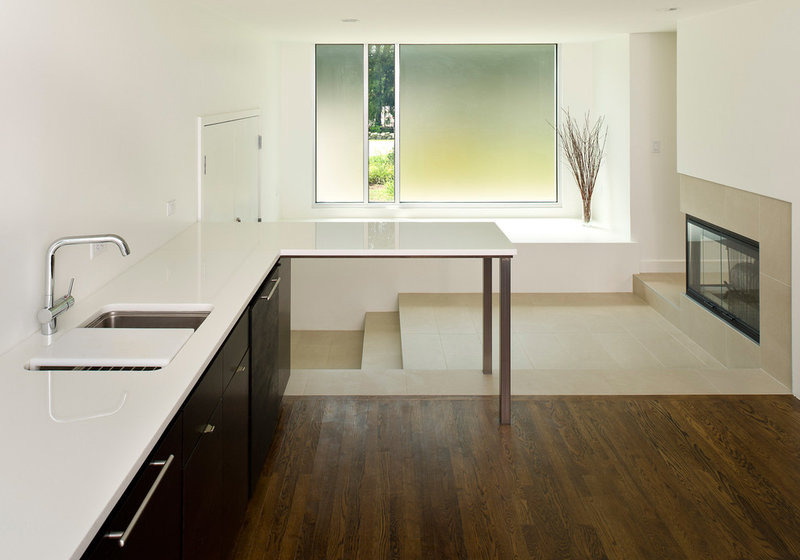
This addition to a ranch house looks like the end of a square tube that runs from front to back, with large windows on each side. The front picture window is partially frosted to maintain privacy.
Here we are looking toward the front window from the kitchen before it was furnished. Only one thin strip of glass is clear; the adjacent pieces are translucent. Adding cushions to the bay would make it a great window seat; one could peek outside through the vertical strip or just enjoy the light coming in through the painting-like panes of color.
Like the front window, the back window projects from the house, cantilevered a foot or two above the ground. But unlike on the the front, all the glass here is clear, and the area inside is an extension of the floor, giving more space for seating near the kitchen.
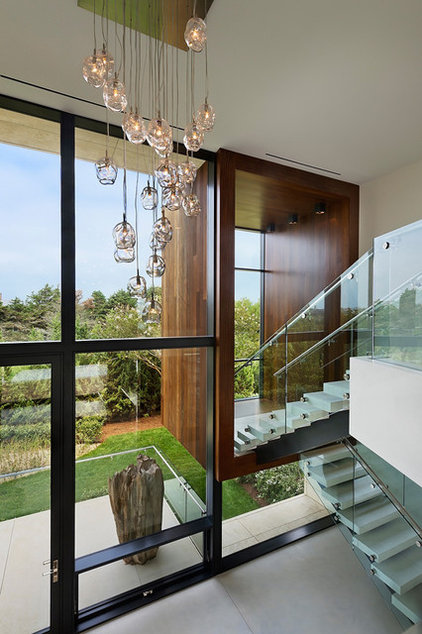
This house on New York’s Long Island has a fair amount of ins and outs on its exterior. I’m drawn to the tall portion facing right.
A view from the side reveals a tall bay window adjacent to a section of curtain wall set back from the stone facade. A stair can be seen below the large bay window.
It turns out the bay window is actually an extension of the stair landing. The Eames Lounge Chair in the previous photo indicates that this space is ideal for sitting, relaxing and enjoying the view.
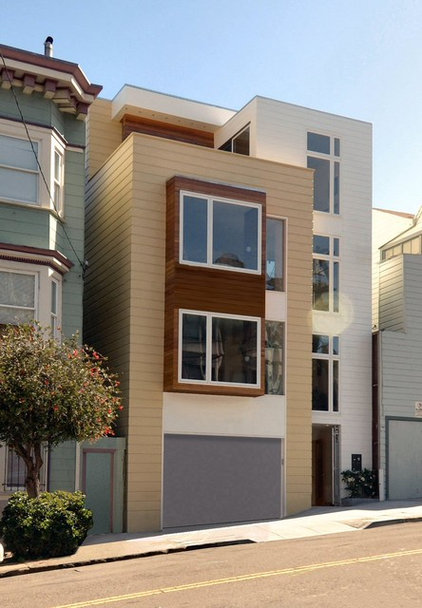
On a more modest scale is this two-unit condo in San Francisco, with modern bay windows above the garage.
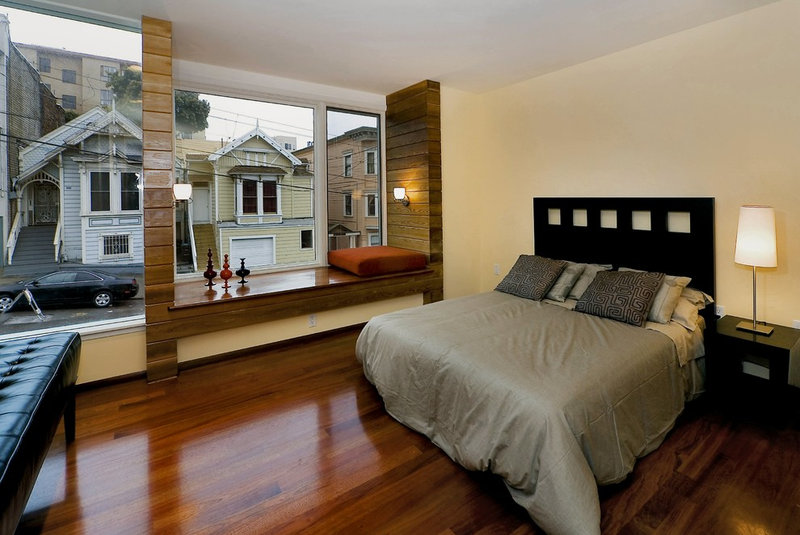
What looks fairly subtle on the outside is impressive on the inside, owing to the relative size of the window (almost the full width of the bedroom) and the way the architect articulated the window seat. The only thing I would change for myself would be the height of the sconces, which appear to be head height, making it hard for someone to lean against the walls while occupying the window seat.

Case-Shiller: Prices Slowing to 5.4% Appreciation | Bedford NY Real Estate

Home prices increased by 10.1 percent in the second quarter of 2013 compared to a year ago and prices nationwide are now 16 percent above the trough, reached in the fourth quarter of 2011, but still remain 24 percent below the peak, reached in the first quarter of 2006.

Based on CoreLogic Case-Shiller data forecast through June 30, 2014, home price appreciation will slow to an average of 5.4 percent across all U.S. markets. CoreLogic Case-Shiller projects that price appreciation will decelerate through the second half of 2013 and into the beginning of 2014.

Purchases by first-time and trade-up buyers are increasing, though tight mortgage lending conditions and slow job-market gains are constraining demand for owner-occupied housing. Demand from investors is weakening as well, as fewer distressed properties are listed for sale and rising home prices cut into potential rental profits. At the same time, the overall supply of homes for sale is still rising in many metro areas as current homeowners take advantage of favorable seller’s markets.

The downtrend in the number of markets that gain monthly is likely due to both seasonal trends and the state of recovery for these markets. Of the 47 markets that saw declines last month, 40 percent have fully recovered their decline in home prices from the housing bubble, while another 28 percent were found to be unaffected by the boom-bust scenario, illustrating that the weakness is a result of leveling off in home prices.

Three weeks ago Homes.com released its Local Market Index for August wich found that prices increased on a month-over-month basis in 253 of the nation’s top 300 markets, compared to 293 in July.

In the Homes.com report, of the metro areas that felt the greatest impact from the housing bubble, Sacramento (+26 percent), Las Vegas (+25 percent) and Phoenix (+20 percent) saw the largest increase in home prices during the second quarter of 2013 versus the same period last year. Coastal California markets also exhibited strong price appreciation, including Oakland (+24 percent), San Jose (+22 percent) and Los Angeles (+20 percent), as buyers continue to jump in before increasing prices and mortgage rates substantially reduce affordability.


http://www.realestateeconomywatch.com/2013/10/case-shiller-prices-slowing-to-54-appreciation/


Roman Abramovich to Buy Lavish (Almost) Manse For $75M | Pound Ridge Real Estate

11 images

Perhaps feeling insecure after Sheikh Khalifa bin Zayed al-Nayan stole the title as owner of the world’s largest yacht, billionaire Roman Abramovich has bought—well, he’s in contract to buy, according to the Post—this ridiculously opulent Manhattan mansion. The purchase would add a NYC home to an already robust portfolio (which includes, but is by no means limited to, nine-figure estates in St. Barths, Snowmass, Colo., and the English countryside), and provide Abramovich 22 rooms, eight bedrooms, 15 bathrooms, a grand ballroom, a reception rotunda, a library, a rooftop terrace, and some of the most lavish, gussied-up interiors in the city.

When the mansion hit the market last year, it was asking $72M for three units, all owned by the Monaco-based family of the late real estate developer Howard Ronson. That price was meant for uncombined—and frankly somewhat architecturally incompatible—units, but not the entirety of the building, as there were, at the time, still two of five holdout owners. If Abramovich was’t able to quietly convince them to vacate—and, really, who would want to be in the bad graces of a corrupt Russian billionaire?—perhaps his publicly profligate ways, surely a media magnet, will finally convince those guys to bid, uh, do svidaniya.

Curbed NY points out that if the deal goes through for $75M, it will become the most expensive co-op ever sold in New York. Oh, and that $3M over ask? Yep, that’s just about 0.03 percent of Abramovich’s net worth.


http://curbed.com/archives/2013/10/04/roman-abramovich-to-buy-lavish-almost-manse-for-75m.php

Tight Lending Standards Slow the Economy | Chappaqua Real Estate

Changes in lending standards by banks, undertaken to reduce their risk and preserve capital, have huge, macroeconomic effects on the economy.  Not are not only restricting credit, they simultaneously reduce the demand for credit by businesses homeowners, even creating credit shocks that impact GDP. However, banks loosen standards to create a competitive advantage in the marketplace according to a new study by economists at the Federal Reserve.

Tightening credit creates shocks to the credit supply and leads to a substantial decline in output and the capacity of businesses and households to borrow from banks, as well as to a widening of credit spreads and an easing of monetary policy.

Shifts in the supply of bank loans to businesses and households corresponds to changes in lending standards that-using an econometric model-have been adjusted for the bank-specific and macroeconomic factors that, in addition to affecting banks’ credit policies, can also have a simultaneous effect on the demand for credit.

The economists, William F. Bassett, Mary Beth Chosak, John C. Driscoll, and Egon Zakrajsek, used the Fed’s quarter Senior Loan Officer Survey as a way to measure and track banks’ lending standards and credit policies from the bottom up, using bank-level responses on changes in lending standards for businesses.

“This analysis shows that credit supply disturbances have economically large and statistically significant effects on output and core lending capacity of U.S. commercial banks. Specifically, an adverse credit supply shock of one standard deviation is associated with a decline in the level of real GDP of about 0.75 percent two years after the shock, while the capacity of businesses and households to borrow from the banking sector falls more than 4 percent over the same period, the economists found. Such disruptions in the credit-intermediation process also lead to a substantial rise,” they found.

Economic factors influencing banks’ business credit policies include a projected increase in the unemployment rate as does a deterioration in the current labor market conditions. Expected changes in longer-term interest rates again exert a significant influence-in both economic and statistical terms-on the probability that banks will modify their current lending standards: An expected increase of 100 basis points in the 10-year Treasury yield over the next four quarters is estimated to lower the probability of tightening in the current quarter about 6.5 percentage points and boost the likelihood of easing by nearly the same amount.

The capacity of businesses and households to borrow from the banking sector begins to decline within two quarters after the initial credit disruption, and the resulting reduction in this broad measure of credit inter-mediation is very persistent and protracted, they said.


http://www.realestateeconomywatch.com/2013/11/tight-standards-can-rock-the-economy/

 

Happy Inspector takes pen-and-paper home inspections and makes them digital | Bedford Corners Homes

Happy Inspector takes traditional pen-and-paper based inspections and makes them digital, bringing more transparency and an easier, faster and professional process to inspections of residential real estate, commercial buildings, cruise ships, ski resorts, not to mention food and safety or fire safety inspections.

The company is one of 13 in the inaugural class of the Inman Incubator program, a yearlong mentorship, advisory and promotional program to help new companies in the real estate industry succeed.


– See more at:


http://www.inman.com/2013/11/05/happy-inspector-takes-pen-and-paper-home-inspections-and-makes-them-digital/#sthash.xrh206qL.dpuf