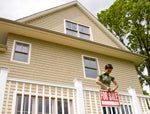
“Down” and “depressed” – according to the news, that’s the real estate market these days. And thanks to continuing tight credit and sluggish job growth, the United States isn’t likely to see anything like a booming real estate market for many years. But although reports about today’s real estate market sound grim, here’s something you probably haven’t heard: there’s no such thing as a “bad” real estate market. Let’s take a look at some of the patterns the real estate market can fall into, who is hurt by them and who stands to benefit.
IN PICTURES: 6 Tips On Selling A Home In A Down Market
Homeowners Vs. Investors
The difference between investors and the average home buyer is that investors don’t have to buy a property – because they don’t need to live in it. This gives them a lot more ability to profit in different types of markets, because they are able to buy when real estate prices are down, and sell when they are up. Home buyers don’t have this much flexibility, but what they can take from real estate investors is how they look at the market. Like any good investor, a real estate investor looks at the market strategically, and decides whether to buy or sell based on the potential to benefit. The bottom line is, what the media is saying about the market doesn’t enter into the equation. (For more insight, see 5 Things Every Real Estate Pro Knows.)Buyer’s Market
When the news is reporting grim figures about real estate and housing prices it’s hard to be enthusiastic about jumping into the real estate market. But investors could have said the same thing about investing in the stock market in 2009, when the S&P 500 dropped to its lowest point in more than 10 years; however, those who chose solid companies during the low point saw major gains when the market rebounded through 2010.A real estate buyer’s market occurs when there is more property for sale (supply), than there are buyers (demand), forcing prices down. While this type of market is bad news for homeowners who want to sell their homes, it’s great for those entering the real estate market. In this case, new homebuyers have the opportunity to buy properties at a low point. The lack of competition in the market will also allow them to take their time choosing a property, and provide them with some bargaining leverage.
Because in some cases home prices may not rebound for a long time, buyers need to choose their homes carefully and look for areas where homes are truly undervalued – and not just cheap. Buyers should also weigh the fact that they’ll have to pay to live somewhere – whether they buy or rent – so even a property that maintains its value may provide significant savings over time. (For more tips on how to find an undervalued property, check out The 5 Factors Of A “Good” Location.)
Homeowners may also fret about this type of market, but unless they are looking to sell, they shouldn’t. Sure, this affects their net worth on paper, but it’s just like holding a stock in a down market: the price only matters if you plan to sell.
Sellers’ Market
A seller’s market is just the opposite of a buyer’s market: low supply and high demand for available properties drive prices up. This is the type of real estate market the United States experienced before the market crashed in 2009, when bad loans and rising interest rates conspired to make runaway prices unsustainable. For those who managed to cash in on big gains in real estate prices by selling their homes at the peak, this was a great market. For those who were buying those homes, it was a disaster.But just like a buyer’s market can best be taken advantage of by those who are entering the market, the seller’s market is best for those who are leaving it – or at least downsizing. After all, even if the value of your home increases by 100% over the time that you own it, this won’t be money in your pocket if you have to buy another house in the same area, as their prices will have all increased at a similar rate. For empty-nesters who are looking to downsize (or perhaps even rent) or for those who are making a move to a less-expensive area, the peak of a seller’s market is the ideal time to sell. (For related reading, see Downsize Your Home To Downsize Expenses.)
Balanced Market
In a balanced, or neutral, real estate market buyers and sellers are equalized. This tends to happen when interest rates are affordable, but not too low and real estate sales remain stable over an extended period. This type of market doesn’t offer an extreme benefit to either buyers or sellers; sellers’ profit will depend on when they entered the market, while buyers can eke out a more profitable arrangement by choosing a home that may be undervalued (such as a fixer-upper). But many buyers are also just satisfied to purchase a nice home at what they consider a “fair” price.Whether you’re a buyer or a seller in this type of market, don’t expect miracles: in a balanced market an accurately priced house will sell for very close to the price it is listed for. (Learn some tips on how to make more on a home sale in How Real Estate Agents Sell Their Homes For More.)
What Type of Market Is This?
The problem for many people comes in determining just what state the real estate market is in at any given time. Here are a few indicators that will help you figure it out.Buyer’s Market
–A lot of houses are on the market and staying there for an extended period of time compared to previous months or years.
-“For Sale” signs are staying up longer.
-Sale prices are declining.Seller’s Market
-Few houses are on the market, and those that are put up for sale sell very quickly compared to previous months or years.
-“For Sale” are up for a short time before a “Sold” sign is attached.
-Sale prices are rising.Balanced Market
–The number of houses on the market is consistent with previous months or years (it is consistent over time).
-Turnover is stable. (Some sources say this means home sell within 30-45 days, but this may depend on where you live).
-Sale prices have flattened are consistent over timeThe Bottom Line
Your home is not exactly an investment – you need somewhere to live, so you can’t base the decision to buy or sell entirely on economics. That said, by being aware of what kind stage of its cycle the real estate market is in can sometimes help you find the best times to enter and exit the real estate market. The most important thing for people to remember is to look at the market objectively and strategically, because a “bad” market could just be the best thing for you.
Daily Archives: March 11, 2011
A Success Coach Shares 7 Mistakes the Newly Self-Employed Make#utm_source=feed&utm_medium=feed&utm_campaign=feed
Rising prices threaten growth | Inman News
Rising prices threaten growth
Commentary: Inflation fears build support for spending cuts
By Lou Barnes, Friday, February 18, 2011.
Flickr photo by Jen Maloney.
Long-term Treasury rates, the bellwether for everything — recovery, inflation, recession, fear, joy — have stopped rising in the last two weeks, and even improved a bit and helped mortgages.
Interpreting markets is hard these days. The deafening financial-market chant — "recovery, inflation, recovery, commodities, recovery, sustained recovery" — makes it hard to concentrate. Maybe we could set the whole thing to music and hire the Super Bowl babe to sing the wrong words.
Many think that Middle East unrest has held rates down, but thus far it’s small-potatoes unrest. A more likely cause: Inbound data do not support acceleration of the U.S. economy. Retail sales numbers came in at half of forecast, industrial production is flat, and mortgage applications have fallen to near-record lows.
Global food and commodity prices are rising, igniting inflation fear among those who have worried about inflation ever since it broke in 1981, never to return. These price rises are cost increases that are likely to slow the U.S. economy, as there is no wage growth with which to pay them, or to pull into broad-gauge inflation.
more…
To continue reading sign in to yourPremium Member account.
Premium Members have full access to all news archives.
Buy Now Purchase 1-year Premium Membership – $149.95
Copyright 2011 Lou BarnesAll rights reserved. This article may not be used or reproduced in any manner whatsoever, in part or in whole, without written permission of Inman News. Use of this article without permission is a violation of federal copyright law.
Nonrefundable pet deposits under fire | Inman News
Nonrefundable pet deposits under fire
Rent it Right
By Janet Portman, Thursday, March 10, 2011.
Flickr image courtesy of wsilver.
Q: Our landlord charged us a $200 nonrefundable pet deposit, plus a refundable deposit, when we moved in two years ago with our dog. Now that we’re moving out, he’s deducting for damage (scratched floors) that he claims was done by us humans, but in fact it was the dog’s nails that caused the scratches. Isn’t the pet deposit supposed to cover that? –Jim and Susan C.
A: Your question illustrates the mischief that can result from the phrase "nonrefundable deposit." It doesn’t take someone with a Ph.D. in English to realize that this phrase is a contradiction in terms: A deposit is by nature returnable, so calling a deposit "nonrefundable" makes no sense.
A better description of the amount would be "pet fee," which goes a bit toward removing the confusion. But without a clear explanation in the lease as to how this fee will be used, misunderstandings can still crop up.
In fact, the likelihood of confusion and disagreements has prompted a few states (California, Hawaii and Montana) to prohibit nonrefundable fees altogether.
Properly speaking, a fee is a one-time expense for a specific service or item. It might also refer to an amount of money meant to compensate the landlord for any negative consequences that result from allowing an animal in the rental.
The fee could be used to cover added screening time and costs that a careful landlord will incur when considering an applicant with a pet (savvy landlords screen the pet, too). Or it could be considered compensation for the diminished applicant pool that results when pets are on the premises (some tenants will not consider living in a building with pets, fearful of noise, disruption, allergies or pet waste).
Most commonly, however, it’s imposed on the assumption that the pet will cause damage, and the landlord does not want to argue about it when the tenancy ends.
When the latter reason is the basis for the pet fee, it behooves the landlord to say so and to make clear that damage clearly caused by the pet will be applied first to the nonrefundable pet deposit/fee before tapping into the refundable deposit.
The lease should also state that the pet fee will not be used to cover human errors, which (if you ask the dogs) are often far more serious.
Some states require explanations, though they need not be so specific: In Arizona, Nevada, Washington and Wyoming the purpose of any nonrefundable fee must be stated in the lease.
Even with a clear clause, there may be instances when it’s hard to determine whether the damage was due to the pet’s activities or the tenants’ carelessness.
Most of the time, however, it’s clear; one would think that apartment-wide scratches on hardwood floors couldn’t reasonably be attributed to the human occupants. That’s the argument you’ll want to make if you end up in small claims court, arguing for the return of the deducted parts of your deposit.
Many landlords who have had hassles over "nonrefundable pet deposits" have come to the conclusion that it’s easier to simply charge one refundable deposit to cover damage regardless of how it happened.
True, they give up the fetching prospect of being able to pocket an entire pet fee when the pet has proved to be a fastidious occupant, but they also avoid arguments about who caused the ripped curtains or carpet stain of unknown origin.
If their state does not set limits on the amount of the deposit — and many do not, such as Colorado, Florida, Georgia, Idaho, Illinois, Indiana, Kentucky, Louisiana, Minnesota, Mississippi, Montana, New York (nonregulated units only), Ohio, Oregon, South Carolina, Tennessee, Texas, Utah, Vermont, Washington, West Virginia, and Wyoming — they simply increase the deposit to cover the damage they think could be caused by the pet’s residency.
Q: The legislature in Maine is considering a bill that would make a landlord responsible for damages caused to a third party by a tenant’s pet — period. That sounds crazy to me, and it will result in the disappearance of pet-friendly rentals. Only homeowners will end up being able to have a dog. Surely this isn’t legal! –Patti M.
A: After reading your question, I thought that surely you had misunderstood the bill. But no, you’ve nailed it. The proposed law is two sentences long: "A tenant and that tenant’s landlord are jointly and severally liable for damages caused to a third party by that tenant’s pet. For purposes of this section, "pet" means any domesticated animal normally maintained in or near the household of its owner" (see HP0062, LD 74).
Boy, they are playing hardball in Maine.
If it becomes law, this bill will mean two things: first, that landlords will be "strictly liable" for the consequences of the acts of their tenants’ pets. This means that they will be legally responsible even if they were not in any way at fault. Conceivably, this would apply even when the tenant keeps a pet in violation of a no-pets clause, and the landlord has not had an opportunity to even find out.
Not very fair, you say, and in fact, strict liability is rare precisely because it isn’t fair. It’s imposed in situations where great harm is at stake, consumers are not in a position to evaluate and avoid a dangerous situation or product, and compensating injured victims is even more important than fairness.
A good example of strict liability is the federal Comprehensive Environmental Response, Compensation and Liability Act (CERCLA) of 1980, which makes landlords responsible for the cost of cleaning up pollution on their land, even if tenants caused that pollution and the landlords didn’t know about it or had gone further and forbidden the polluting activities.
Landlords can turn around and seek "contribution" from the truly responsible parties, but meanwhile the government has gotten its money.
Similarly, manufacturers of consumer goods are frequently held strictly liable for the injuries these goods cause, even if they didn’t carelessly produce them. The rationale is that only the company that makes the goods, not an everyday consumer, is in a position to evaluate the safety of the products it makes.
Although it may seem unfair to slap the manufacturer with responsibility for a defect it could not foresee, it’s less palatable to leave consumers in the lurch.
Secondly, this bill would make a landlord responsible for the entire settlement or award, regardless of fault. The landlord could always turn around and sue the person who is rightly responsible — the tenant — but that’s after the landlord has written a possibly sizable check to the injured party.
It’s not hard to imagine the effect of this bill, should it become law. While an innocent landlord can theoretically sue the tenant for damages it has paid to an injured victim, in practice this will often be a hollow remedy.
Many tenants do not have resources, and in any event, making a landlord sue for contribution is onerous. Understanding this, many landlords will simply refuse to rent to tenants with pets.
Additionally, insurance premiums for landlords’ liability policies are likely to soar because of the landlord’s added responsibility for an entirely new, large pool of risk.
It’s important to understand that people who are injured by tenants’ pets already have a legal remedy against the landlord if the victim can show that the landlord knew, or should have known, of the presence of a dangerous animal on the premises, and failed to take reasonable steps to deal with it.
If the landlord has received complaints about a tenant’s pet or has observed aggressive behavior but has failed to demand that the tenant get rid of the pet or leave, it’s reasonable to lay some of the responsibility on the landlord for ensuing harm.
Several years ago in San Francisco, a dreadful case in which a tenant was attacked and killed by another tenant’s vicious dogs resulted in not only a criminal prosecution against the dogs’ owners, but also a claim by the victim’s survivor against the apartment building’s insurance company.
That claim was proper, and it settled — the resident manager had the opportunity to observe the animals prior to the incident.
Tort law reformers have zeroed in on joint and several liability, arguing that allowing an injured person to collect from the deepest pocket at the defense table is unfair and promotes baseless lawsuits.
This proposed law expands joint and several liability in a context where it is both unnecessary and likely to cause consequences that no one wants: more pets surrendered to animal shelters and fewer pets adopted back out again, resulting not only in higher euthanasia rates but higher costs for the local governments that operate these shelters.
Janet Portman is an attorney and managing editor at Nolo. She specializes in landlord/tenant law and is co-author of "Every Landlord’s Legal Guide" and "Every Tenant’s Legal Guide." She can be reached at janet@inman.com.
Contact Janet Portman: Letter to the Editor
Copyright 2011 Janet PortmanAll rights reserved. This article may not be used or reproduced in any manner whatsoever, in part or in whole, without written permission of Inman News. Use of this article without permission is a violation of federal copyright law.
North America’s newest real estate renaissance | Inman News
North America's newest real estate renaissance
Natural resources fuel housing, population boom in North Dakota, Saskatchewan
By Steve Bergsman, Friday, March 11, 2011.
Six years ago, my wife and I took a car ride through the center of Saskatchewan, Canada, spending a few days in the capital city of Regina and the small, isolated town of Moose Jaw. We preferred Moose Jaw.
At least Moose Jaw had some quirky things going for it, such as an underground town trail. Regina seemed beat-up and despondent. I guess I arrived two years too early, because around 2007 the province of Saskatchewan caught economic fire, uplifting its two biggest cities: Saskatoon and Regina.
When the U.S. and Eastern Canada began slipping into recession and residential real estate values collapsed like deflated balloons, home prices skyrocketed in Saskatoon and Regina and investors partied like it was 1999 in a Miami Beach condo. They are still partying today, but more moderately.
"In Regina, three-bedroom houses that sold for about $110,000 in 2006 saw prices climb to $270,000 before leveling off," reported Rod Spence of Century 21 Conexus Realty Ltd. in Regina.
"Things were even better in Saskatoon, where the $160,000 average home price in 2007 vaulted to $300,000 by the spring of 2010." —Norm Fisher, Royal LePage Saskatoon Real Estate
Things were even better in Saskatoon, where the $160,000 average home price in 2007 vaulted to $300,000 by the spring of 2010, said Norm Fisher with Royal LePage Saskatoon Real Estate. Prices have leveled off there, too, with average homes prices now fluctuating between $275,000 and $300,000.
The person who clued me into the Saskatchewan renaissance was Bill Madder, executive vice president for the Association of Saskatchewan Realtors. "Saskatchewan used to be known for cheap houses and not many people," he said.
For the past decade, I’d been visiting Canada at least twice every year and that was my impression as well. Next to Newfoundland, Saskatchewan was the most disparaged province in the country. Ask about Saskatchewan and the first thing someone would do is repeat the painful canard that the province is so flat you can watch your dog run away — for days.
Realtors and homebuyers suffered. "The way it used to be in Regina was you would buy a house for $150,000 and five years later it was worth $150,000," Spence joked, but the comment had a strong grain of truth to it.
What changed for Saskatchewan were two things: one temporal and the other of more sustenance.
As in the U.S., home prices were quickly escalating in most major Canadian cities since the mid-1990s so investors looking around for cheaper playing fields discovered Saskatchewan, which had completely missed the residential run-up. Investment dollars poured in.
"In 2007, we had 4,000 transactions — that was a 33 percent increase over the year before," Spence said about Regina. (In 2010, 3,500 homes were sold through November.) In Saskatoon, during that wacky 2007, home prices jumped 20 percent. (Prices are still rising but at a much more moderate rate, said Madder, probably at a 4 percent to 5 percent pace in 2011.)
As prices escalated, pure investment interest in residential housing waned, which is OK because sustainable investment capital has taken its place.
Although mostly known for its agriculture, Saskatchewan has blossomed because demand for its natural resources skyrocketed, attracting billions of dollars in investment and immigration from other provinces. Saskatchewan boasts 51 percent of the world’s deposits of potash, which is used in fertilizers.
Less known is the fact that Saskatchewan is Canada’s second-largest producer of oil behind Alberta. However, much of Alberta’s oil comes from tar sands; in Saskatchewan you can get the product the old way, by pumping it out of the ground.
With the development of natural resources came jobs and people to fill those jobs. "We have been running about 60,000 new immigrants a year across the province over the last couple of years," said Fisher. Most of those folk settle in or near Saskatoon or Regina.
Saskatoon’s population has grown 10 percent since the start of 2007 and today is around 225,000 people, slightly more than Regina, which has a population of about 210,000. The latter city boasts one of the lowest vacancy rates in the country, under 1 percent for rental housing.
Both cities are playing catch-up. According to the Canada Mortgage and Housing Corp., during the first 11 months of 2010, 650 single-family houses were built in Regina, up from 569 units the year before. In Saskatoon, 1,522 detached single-family units were built over the same time period, up from 1,004 units in 2009.
Apparently, Saskatchewan’s good fortune has spilled south of the border into North Dakota. The Wall Street Journal, with a headline screaming, "Resource-Rich States Surge," reported, "The states that weathered the recession best were the energy-rich states of North Dakota and Alaska."
I gave a call to Dan Deutsch of www.fargohomes.com to see what was happening in North Dakota’s largest city.
"Our economy is good; unemployment is close to 3 percent; the state budget is in the black; we have few foreclosures; and homes on the market close in three months," he said.
The median home price in Fargo stands at $160,000, about where it was last year, and very close to peak, said Deutsch. While appreciation isn’t great, the good news for Fargo homeowners is the last time the market saw a significant downturn in residential values was back in the 1970s.
From 1990-2000, the city of Fargo grew just over 20 percent, to about 91,000 people. In the past decade, Fargo grew another 10 percent to about 100,000. (The metro area counts about 200,000 people.)
According to Deutsch, business has been good, as he closed an average two home sales a month in 2010. "Loans are easy to get here," he said. "The banks aren’t afraid to lend money."
For a long time, North Dakota, like Saskatchewan, had not been on anyone’s radar as place to find work and live, but the northern Midwest states and provinces are finally having their day in the economic sunshine.
Steve Bergsman is a freelance writer in Arizona and author of several books. His latest book, "After the Fall: Opportunities and Strategies for Real Estate Investing in the Coming Decade," has been ranked as a top-selling real estate investment book for the Amazon Kindle e-reader.
Contact Steve Bergsman: Letter to the Editor
Copyright 2011 Inman NewsAll rights reserved. This article may not be used or reproduced in any manner whatsoever, in part or in whole, without written permission of Inman News. Use of this article without permission is a violation of federal copyright law.
Don’t wait to deduct real estate equipment cost | Inman News
Don't wait to deduct real estate equipment cost
Real Estate Tax Talk
By Stephen Fishman, Friday, March 11, 2011.
Did you buy any of the following for your real estate business last year:
- computer equipment,
- telephones and cell phones,
- office furniture,
- fax machines,
- pagers,
- cameras,
- recorders,
- briefcases,
- map books,
- lockboxes and keys, or
- real estate books?
If so, you’re probably aware that you are entitled to deduct the cost as a business expense. Ordinarily, business property such as computers and office furniture that has a useful life over one year must be depreciated a little at a time over several years. How long depends on the type of property involved — it can vary from three to 39 years.
For example, if you purchased a $1,000 computer for your real estate business in 2010 (and used it only for business), using depreciation you’d have to deduct the cost over six years. Using the straight-line method of depreciation, you’d get the following annual deductions:
Year Depreciation deduction 2010 $100 2011 $200 2012 $200 2013 $200 2014 $200 2015 $100 What if you don’t want to wait for years to get your full deduction? You could be in luck. There is a tax law provision that may permit you to deduct the entire cost in one year — that is, deduct the entire $1,000 cost of the computer on your 2010 tax return.
If you learn only one section number in the tax code, it should be Section 179. This humble law is one of the greatest tax boons ever for small-business owners, including real estate professionals.
Section 179 doesn’t increase the total amount you can deduct, but it allows you to get your entire deduction in one year, rather than taking it a little at a time over the term of an asset’s useful life.
Under Section 179 you can deduct the cost of tangible personal long-term property that you buy for your real estate business. Examples include: computers, business equipment and office furniture. Although it’s not really tangible property, computer software can also be deducted under Section 179.
The property can be used or new, but you must have purchased it from someone unrelated to you. In addition, you must use it over half the time for business.
Section 179 is designed to help small businesses, so there is an annual limit on the deduction. In 2007, the Section 179 limit was $128,000.
In an effort to help the economy, this was increased to a whopping $250,000 for 2008. Due to the continuing bad economy, the $250,000 limit was extended through the end of 2009. The limit has been increased to $500,000 for 2010 and 2011. The limit is currently so large it presents no problems for most real estate pros.
In 2012, the Section 179 limit is scheduled to go down to a measly $25,000.
There is also a limit on the total amount of Section 179 property you can purchase each year. You must reduce your Section 179 deduction by one dollar for every dollar your annual purchases exceed the applicable limit.
For 2010 and 2011 the limit is an enormous $2 million. In 2012 and later the limit will be much lower.
There is one major restriction on using Section 179 that can limit its use by some real estate professionals: You can’t use it to deduct more in one year than your net taxable business income for the year.
In determining this amount, you subtract your business deductions from your business income. However, don’t subtract your Section 179 deduction, the deduction for 50 percent of self-employment tax, or any net operating losses you are carrying back or forward.
If you’re a married sole proprietor (or owner of a one-person LLC taxed as a sole proprietorship) and file a joint tax return, you can include your spouse’s salary and business income in your total business income.
If you have a net loss for the year, you get no Section 179 deduction for that year. If your net taxable income is less than the cost of the property you wish to deduct under Section 179, your deduction for the year is limited to the amount of your income. Any amount you cannot deduct in the current year is carried forward to the next year to be deducted then (or any other year in the future).
If your business income was too low in 2010 to take full advantage of Section 179, consider using bonus depreciation, which is not subject to an income limitation.
Bonus depreciation is a temporary law that permits you to deduct half the cost of new business property you placed in service during 2010 (for 2011, the percentage has been increased to an amazing 100 percent).
Stephen Fishman is a tax expert, attorney and author who has published 18 books, including "Working for Yourself: Law & Taxes for Contractors, Freelancers and Consultants," "Deduct It," "Working as an Independent Contractor," and "Working with Independent Contractors." He welcomes your questions for this weekly column.
Contact Inman News: Letter to the Editor
Copyright 2011 Inman NewsAll rights reserved. This article may not be used or reproduced in any manner whatsoever, in part or in whole, without written permission of Inman News. Use of this article without permission is a violation of federal copyright law.


Tweet This