Tag Archives: Waccabuc NY Homes

The 1916 Proposal To Expand Manhattan By 50 Square Miles | Waccabuc NY Real Estate

Screen-Shot-2013-11-03-at-9.27.06-PM.jpg

In the early 20th century, land reclamation was such a popular idea that at least once a decade, some engineer proposed filling in a New York waterway to make the city bigger and better. There was the 1934 plan to turn the Hudson River into land, which came 10 years after a plan to drain the East River. But both of those bonkers plans were preceded by an even more ambitious scheme, put forth by a Dr. T. Kennard Thomson in a 1916 issue of Popular Science. Not only did he want to fill in the East River, but the plan also called for creating a “New Manhattan” to the south that would subsume Governors and Liberty Islands. He also wanted to build new islands and tack new land onto Staten Island and New Jersey for a total of 50 square miles with 100 miles of new waterfront property.

Thompson was no crackpot engineer with fanciful ideas. He designed and built pneumatic caissons (water-tight supports) for dozens of bridges across the country, consulted on more than 20 New York skyscrapers by 1916, and helped create the New York barge canal system. Even still, he admits in the first paragraph of the Popular Science article that his new landmass idea “seems somewhat stupendous,” but he was convinced that creating new land and more shipping areas would ease congestion both on land and in the harbor.

Screen-Shot-2013-11-03-at-9.27.25-PM.jpg

Through his proposal, City Hall would become the literal center of the city, with a radius of surrounding land stretching for 25 miles. “…Within that circle, there would be ample room for a population of twenty-five millions,” wrote Thompson. The whole thing would take “a few years,” and supposedly hundreds of engineers supported his proposal.

The cost would be “a great deal more than the sum involved in the construction of the Panama Canal,” but Thompson believe that “the great returns would quickly pay off the debt incurred, and then would commence to swell the city’s money bags until New York would be the richest city in the world.” The Panama Canal cost the U.S. about $375 million, and Thompson’s endeavor would require “an annual expenditure” of $50 to $100 million. By today’s numbers, that’s a hefty amount more than $1 billion every year.

kennard-thompson-1.jpg

The plan would be carried out in phases, the first of which would be to extend Manhattan from the Battery to within one mile of Staten Island. Then the boroughs would be connected with new subway tunnels, which Thompson said would increase the value of Staten Island from $50 million to $500 million. Next, a large island would be built off the shore of Sandy Hook, which would protect a “new harbor” created by the addition of two new pieces of land jutting off Staten Island. The point? To create 40 miles of new docks, shipyards, dry docks, and coaling stations that could accommodate the biggest ships in the world.

After that, the East River would be wiped out. “Naval authorities agree that the East River is no place for the Brooklyn Navy Yard,” wrote Thompson. The Navy Yard would move to new land in Newark Bay, and a new East River would be cut through Brooklyn and Queens, connecting the Flushing and Jamaica Bays. A new Harlem River would be created as well, slicing through upper Manhattan from Hell Gate to the Hudson River.  The old East River would be filled in, upon which new highways and “business blocks” like Grand Central’s Terminal City would be built. And of course, more subways would run beneath the new acreage.

t.kennard-thompson-2.jpg

Obviously, his plan never came to be. By 1930, Thompson must have realized his ambitious ideas would never become a reality, and he drastically scaled back the plan to include only the “New Manhattan.” Instead of filling in the East River, he proposed fusing the new island to New Jersey and creating a Four Mile Boulevard with three tiers, one each for car, trains, and planes. But given that New York’s harbor looks much the same as it did when Thompson dreamt up his scheme, we all know how this story ends. · A Really Greater New York [Popular Science via Google Books] · 1916 Plan for NYC Proposed Fusing Brooklyn and Manhattan, Building New Islands [io9] · 486 – “A Really Greater New York” [Strange Maps on Big Think] · Curbed’s Could Have Been archives [Curbed]

Mortgage rates drop for second straight week | Waccabuc Real Estate

Amid data that has lowered expectations for the performance of the housing market in the fourth quarter of this year, mortgage rates dropped for the second straight week.

Rates on 30-year fixed-rate mortgages averaged 4.1 percent with an average point of 0.7 percent for the week ending Oct. 31, down from 4.13 percent last week but up from 3.39 percent a year ago, according to Freddie Mac’s latest Primary Mortgage Market Survey.

Rates on 15-year fixed-rate mortgages and five-year Treasury-indexed hybrid adjustable-rate mortgage (ARM) loans also decreased, while rates on one-year Treasury-indexed ARMs increased.

“Fixed mortgage rates eased further leading up to the Federal Reserve’s (Fed) Oct. 30th monetary policy announcement,” said Frank Nothaft, vice president and chief economist at Freddie Mac. “The Fed saw improvement in economic activity and labor market conditions since it began its asset purchase program, but noted the recovery in the housing market slowed somewhat in recent months and unemployment remains elevated.”

“As a result, there was no policy change which should help sustain low mortgage rates in the near future.”

Source: Freddie Mac

– See more at: http://www.inman.com/wire/mortgage-rates-drop-for-2nd-straight-week/#sthash.Yi9iOhYW.dpuf

Dreaming in Color: 8 Eye-Opening Yellow Bedrooms | Waccabuc Real Estate

I tend to associate the color yellow with the sweet corn my hometown, just outside the reach of suburban Chicago, is famous for. It’s also the color of one of the first flowers of spring in that part of the country, daffodils, which my mother planted in beds around the house to herald the end of our long, cold winters. To me yellow represents the color of sunshine, sustenance and rejuvenation. It reminds me of happy, idyllic days and makes me feel optimistic for the future. If you have similar positive associations with yellow, try using it in your bedroom to help you get revved up each morning for the day ahead.
Below you’ll find several sunny yellow bedrooms as well as tips for working the happy hue into your sleeping space.

If you have tall ceilings in your bedroom and lots of natural light, you can go super bold and intense with yellow. This particular shade of yellow packs a wallop, so I’d recommend limiting it to an accent wall. A room that gets this much natural light can handle a bold yellow on an entire wall, but be aware that if your bedroom has low ceilings and little natural light streaming in, then a yellow as bright and bold as this one could leave you feeling anxious.
Get a similar look with Babouche from Farrow & Ball.
Those seeking a mellower yellow should look at softer sandy and golden hues, such as this green-tinged gold. There’s quite a bit of brown and white in it, so it reads as a neutral hue — a pumped-up beige, if you will. This is a good color choice if you plan to paint all or most of your walls yellow, as it offers a nice wash of color without going overboard.
Add oodles of warmth to your bedroom with a generous dose of wood tones and a yellow hue such as this one that veers more toward warmer orange than cooler green. This is an ideal palette for getting a cozy bedroom vibe in even the coldest of climates.
If you’re a fan of wall coverings, choose one that really makes a statement. An interesting print on a bold yellow background is a great choice for an accent wall. Wall coverings can also provide protection from dents and dings, and many are scrubbable and therefore easy to clean, making them a smart choice in a kids’ room.

Mortgage originations expected to fall 32% in 2014 | Waccabuc Real Estate

Mortgage originations are estimated to reach a total value of $1.2 trillion in 2014, a 32% drop from 2013 levels, the Mortgage Bankers Association said Tuesday.

The trade group elaborated on some of the trends expected next year:

“We expect mortgage rates will increase above 5 percent in 2014 and then increase further to 5.3% by the end of 2015. As a result, mortgage refinancing will continue to drop, and borrowers seeking to tap the equity in their homes will be more likely to rely on home equity seconds rather than cash-out refinances.”

“We will potentially see a small increase in refinances toward the end of 2015 as the Home Affordable Refinance Program 2.0 (HARP) expires but HARP activity during 2014 will still be low.”


http://www.housingwire.com/articles/27690-mba-mortgage-originations-to-drop-32-in-2014

Luxury housing market lifts Hamptons | Waccabuc Real Estate

Hamptons home prices ticked up in the third quarter over last year, according to two reports released Thursday, paced by a robust rise in the price of luxury homes.

However, the median sale price in the luxury market—defined in the Hamptons as anything above $2.8 million—hit $4.45 million this quarter, a 14% jump from a median of $3.9 million a year earlier, according to brokerage firm Douglas Elliman. That compares to a miniscule rise of less than 0.5% for the overall market, according to Jonathan Miller, CEO of Miller Samuel, the firm that prepared the report.

But even as prices rose at the top end, so did shoppers’ urge to jump into the market, which drove the number of sales up to 52 in the quarter, a jump of 27%. In turn, the potent combination of rising sales as well as prices, prompted more sellers to put their homes on the market, driving inventory up 123% over the same quarter last year. Miller said that supply had been extremely low over the past few years, and the jump signified more of a return to normal.

But looking forward, the larger number of properties on the market should begin to temper the same rise in prices that kicked off the growth in the first place.

“The market is sort of self-correcting,” Mr. Miller noted. “The supply, in response to the rise in price, is keeping prices from rising too quickly and that is a good sign for market stability.”

The hottest neighborhood for Douglas Elliman was Wainscott. There two homes sold for an average of about $12 million, followed by East Hampton, where the brokerage closed deals on eight properties for an average of $10.5 million, according to the report.

In the broader market median prices were depressed in the quarter by the large number of homes that were sold on the lower end of the cost spectrum, contributing to the highest quarterly sales numbers in eight years.

Mr. Miller partially attributes the rush on the more affordable homes to a spike in interest rates in May, and fears they will climb even higher.”You had a surge of people come who were on the fence and entered the market to finally buy,” he said.

The Corcoran Group reported similar gains in its 3Q report. In the luxury market, the firm charted a 29% increase in average median sales prices, and broker Ernie Cervi said few factors lead him to believe the area will cool off any time soon. At the end of the third quarter last year, the median price tag was about $4.5 million, while this quarter it hit $5.8 million.


http://www.crainsnewyork.com/article/20131024/REAL_ESTATE/131029946

Native Plants Inspire and Educate at NYC’s Botanical Garden | Waccabuc NY Real Estate

If you’re planning a trip to New York City, make sure to see the Native Plant Garden, which opened earlier this year at the New York Botanical Garden. There’s something for everyone here.  Shade gardeners will find plenty to look at in the dappled layers beneath a canopy of river birch, dogwood and sugar maple. Farther along the path, beneath an open sky, plants that love sun sprawl in wispy cascades that catch the wind or offer up their blooms in rigid, colorful spikes. And there are places for sitting and listening. In the middle of one of the biggest cities in the world, the sound of bees and birds is very sweet.

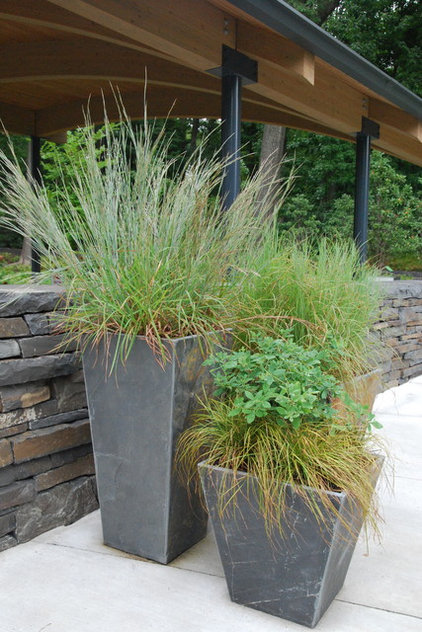
Flared pots showcase native plants outside the entrance pavilion — you won’t find geraniums or begonias here. Instead, ornamental grasses welcome you to this state-of-the-art landscape with plants indigenous to eastern North America.
More than 100,000 plants cover this 3½-acre USDA zone 7a location, inspiring anyone looking for ways to develop a sustainable landscape or combine plants in new ways. On a recent visit, I found a new baptisia that I’d like to try — the short purple cultivar ‘Purple Smoke’ (Baptisia australis ‘Purple Smoke’), because I love anything with purple spikes.
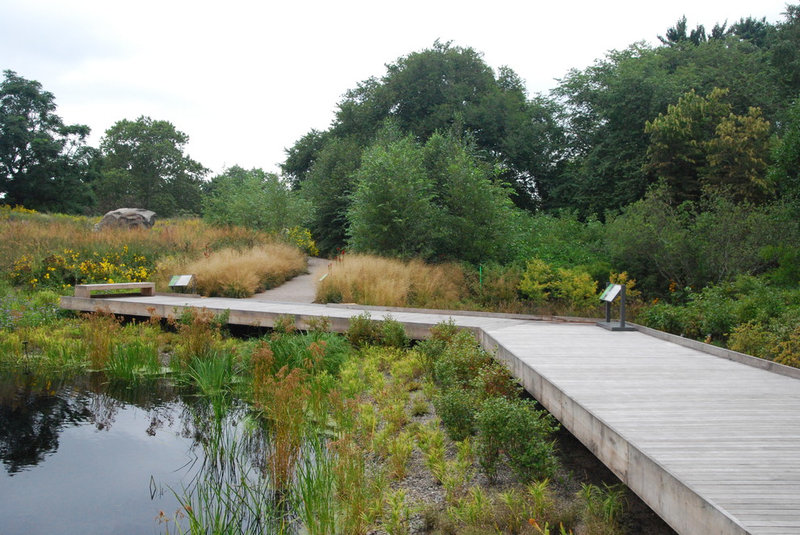
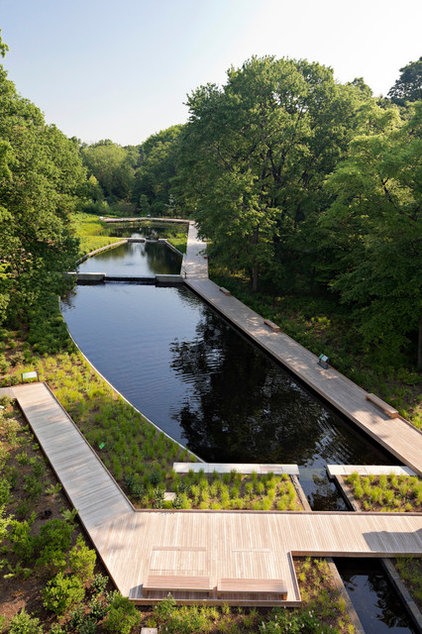
Winding paths take you through a woodland and connect to other distinct areas. There’s a glade, wetland, wet meadow, dry meadow, native border and promenade walk that runs along an angular 230-foot-long water feature that cuts through the center of the landscape.
“The whole site is a tribute to the rich, diverse flora of the Northeast,” says principal designer Sheila Brady of Oehme, van Sweden. “We pivoted the design around the geology, all the beautiful rock outcroppings, the wet meadow and the mature forest nearby.”
One of the project goals was to integrate a sustainable water feature. “We capture all the surface runoff in a system that utilizes biofiltration and minimizes potable water usage,” Brady says. Storm water is filtered through plants like sweetflag (Acorus sp) and stored in cisterns belowground.
In the specially designed wetland, a pump recirculates rainwater, moving it through layers of gravel, sand and plant roots that filter and clean the water through this natural biofiltration system.
Slender blue flag iris (Iris prismatica ‘Exeter’), one of only three iris species native to New York, can be found along the boardwalk. If you’ve got wet soil, a pond or stream, you’ll be interested to know that this tough perennial naturally occurs in these types of areas and has a lovely spring bloom.
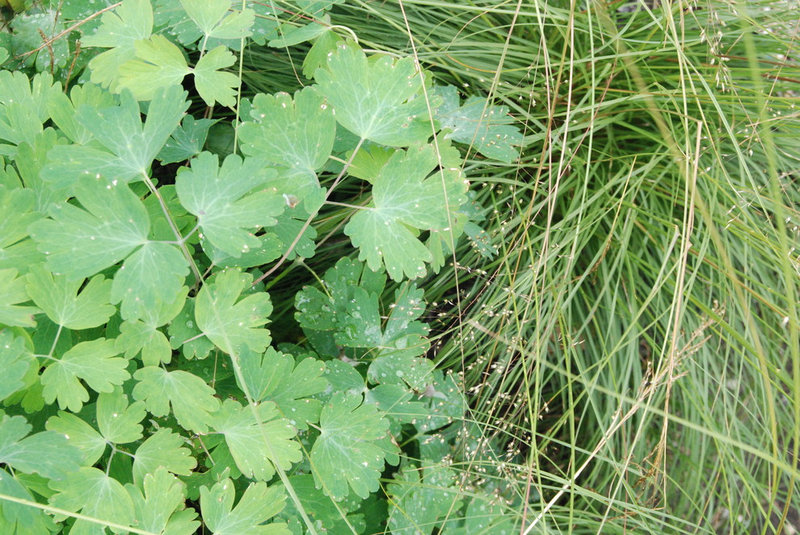
In the dappled light of the woodland, clumps of wild columbine (Aquelegia canadensis) mingle with prairie dropseed (Sporobolus heterolepis), a delicate grass with wand-like seed heads.  Aquilegia canadensis ‘Little Lanterns’, called Canadian columbine, is mixed into the displays and is more intensely colored than the species.
Red Northern lady fern (Athyrium ‘Lady in Red’) forms a ground cover, along with eastern teaberry (Gaultheria procumbens) and Appalachian sedge (Carex appalachica).
Prairie dropseed cascades along the edges of walkways and adds a tactile element.
“What really intrigued me was how, even with a simplified plant palette, a very strong sense of place for each habitat area was communicated,” says garden photographer Karen Bussolini.
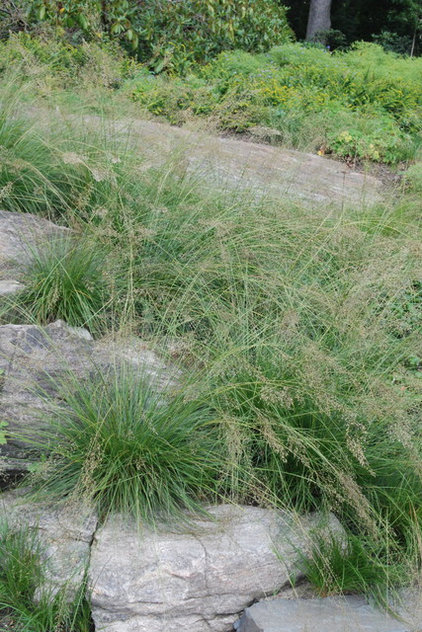
Grasses abound on rocky slopes, where they soften the hard contours of boulders.
For Bussolini, who also works as an ecofriendly garden coach in northwestern Connecticut, the plantings are inspirational. “The garden is full of really great plants, any one of which would be an asset in any garden, but here grown in community,” she says. “The patterns of intermingling plants were endlessly fascinating, and I left inspired to try quite a few of them.”

Price Hikes Help High-End Flippers | Waccabuc Real Estate

Recovering prices helped short-term flippers earn an average gross profit of $54,927 on single family home flips in the third quarter, up 12 percent from a year ago.

RealtyTractoday reported that in the third quarter there were 32,993 single family home flips – where a home is purchased and subsequently sold again within six months – in the third quarter of 2013, down 35 percent from the second quarter and down 13 percent from the third quarter of 2012.

The higher gross profit was driven in part by an increase in high-end flips on homes that were sold by flippers for $750,000 or more. A total of 968 high-end homes nationwide were flipped in the third quarter, down 13 percent from the previous quarter but up 34 percent from a year ago. More than three-fourths of all high-end flips were in five markets: the New York metro area and four coastal California markets – Los Angeles, San Francisco, San Jose and San Diego.  Flips on homes priced between $1 million and $2 million increased 42 percent year over year, while flips on homes priced between $2 million and $5 million increased 350 percent year over year.

“Increasing home prices over the past 18 months combined with decreasing foreclosures have created a market less favorable to the high quantity of middle- to low-end bread-and-butter flips that we saw late last year and early this year,” said Daren Blomquist, vice president at RealtyTrac. “But the sharp rise in high-end flipping indicates there is still good money to be made for flippers willing and able to take on the additional risk of buying and rehabbing more expensive homes. With that higher risk also comes the potential for higher reward. The average gross profit on each high-end flip equals more than four times the average gross profit on each flipped home in the lower price ranges.


http://www.realestateeconomywatch.com/2013/10/price-hikes-help-high-end-flippers/


Fastest Markets are in Low Gear | Waccabuc Real Estate

Home-selling speeds fell for the fourth month in a row. In August, 27.9 percent of homes went under contract in less than two weeks, down from 29 percent in July and 33.7 percent in April, according to the National Association of Home Builders.

The competitive landscape in the housing market has changed drastically since spring, due to elevated home prices and mortgage rates. Many buyers have slowes or paused their buying plans over the past four months according to Redfin’s latest Bidding War Report/

San Jose remains the fastest-moving market in August, with 43.6% of listings under contract within two weeks despite slowing slightly from 46.1% in July. Across 23 markets, San Jose has been the fastest every single month since December 2011.

The slowest-moving market was again Philadelphia, which saw 7.0% of homes under contract within two weeks, down from 7.3% in July.

San Diego slowed the most from July to August. In San Diego, the rate of homes going under contract within two weeks slowed from 36.1% to 31.6%.

Las Vegas sped up the most from July to August. In Las Vegas, 24.7% of homes went under contract within two weeks in August compared with 18.3% in July.

Compared to a year earlier, Atlanta sped up the most. The rate of homes going under contract in 14 days moved from 1.2% to 22.7% between August 2012 and August 2013.

Sacramento slowed the most in the year, dropping from 40% to 34.1%.

Despite the slowing trend throughout summer, market speed could see a slight increase in September as some buyers react to reduced mortgage rates. After surpassing 4.7 percent in mid-August, 30-year fixed mortgage rates eased to about 4.3 percent in September in reaction to the Federal Reserve’s decision on September 18 to keep its stimulus program unchanged for now. Although the rates have dropped only slightly, Redfin agents in Seattle, Washington, D.C. and Los Angeles in recent days have reported a boost in urgency among buyers to find a home.


http://www.realestateeconomywatch.com/2013/09/fastest-markets-are-in-low-gear/

This Mobile Micro ‘Blob’ Has All the Comforts of Home | Waccabuc Real Estate

defbefb.pngPhoto via Architizer

When Belgian architectural firm dmvA—no strangers to oddball projects—came up against harsh local building regulations while building a home-office extension, they did what anyone would do: they built a giant white bean. Naturally. The Blob vB3, as it’s been unceremoniously named, is mobile and, at just 215 square feet, micro—double trendiness points there—but packs a lot of punch for such a small space, as micro homes manage to do. Inside is a bathroom, kitchen, bed, plenty of storage, and even a fold-out wing that acts as a make-shift porch.

The structure, which took 18 months to complete, has a sturdy timber frame covered with polyester that’s been sanded down to give it its, well, egg-like exterior. Though it has no windows, the sides flare out to let sunlight in. The firm suggests it be used as a home office, garden house, or guest bedroom, but for now, it’s on display at the Verbeke Art Foundation in Belgium. Do have a look at more photos over on Design Boom.

fbef.pngPhoto via Architizer

Cob Building Basics: DIY House of Earth and Straw| Waccabuc NY Real Estate

In early 1999, a young woman from Florida happened across an article online  about the recent revival of an ancient British method for sculpting dirt houses.  Intrigued, she used her savings to travel to Vermont for a five-day workshop,  where she learned how to mix clay, sand and straw by foot, and then knead lumps  of the stuff into solid walls nearly as durable as concrete.

After returning to Florida, she and some friends used the techniques she had  learned to build a small pottery shed in her parents’ backyard. Some people  predicted Florida’s humid air and torrential rains would melt her “mud hut” back  into the ground. Following Hurricane Lili in 2002, however, the sturdy little  building, which had cost just a few hundred dollars and a summer’s labor to  build, proved to be one of the few buildings left standing in her neighborhood.  Christina Ott had discovered cob building.

Cob-Building Origins

Cob building gets its name from the Old English term for “lump,” which refers  to the lumps of clay-rich soil that were mixed with straw and then stomped into  place to create monolithic earthen walls. Before coal and oil made  transportation cheap, houses were built from whatever materials were close at  hand. In places where timber was scarce, the building material most available  was often the soil underfoot.

Building with earth has a long and successful history. Cob construction is  particularly easy to learn, requires no fancy equipment, uses local materials,  and can be done in small batches as time allows — making it extremely accessible  to a wide range of people. (See DIY Cob-Building Technique, later in  this article.) After her initial success with cob, Ott traveled to Oregon to  apprentice with the Cob Cottage Company. When her family relocated to the  mountains east of Nashville, Tenn., Ott used her new skills to build a small cob  house for just under $8,000. By age 23, she was mortgage-free and teaching  cob-building workshops all over the United States as the “Barefoot Builder.”

In the U.K., tens of thousands of cob buildings are still lived in, some of  them more than 500 years old. When the British immigrated to the United States,  Australia and New Zealand in the 1700s and 1800s, they brought the technique  with them. In Africa, the Arabian Peninsula, parts of Asia and what is now the  southwestern United States, cob was developed independently by indigenous  people. In Yemen, cob buildings stand that are nine stories tall and more than  700 years old.

However, with the industrial age came factories and cheap transportation in  the West, making brick, milled wood, cement and steel readily available. Mass  production led to mass marketing and the promotion of these new materials as  signs of progress. The perception of cob as “poor people’s housing” led to its  near demise. By 1985, there hadn’t been a new cob building constructed in the  U.K. for more than 60 years, or in the United States for at least 120 years.

Modern Cob Buildings

Today, building your own house is the exception to the norm, and it is almost  unheard of to build with local materials. Instead, houses are built by  specialists using expensive tools and expensive, highly refined materials  extracted and transported long distances, often at great ecological cost.  Industrial materials have many benefits — performance, predictability, speed and  ease of installation — but they have in common that they must create a profit  for the companies that manufacture them. The average number of members in U.S.  households has dropped by more than half in the past 50 years. Yet, over the  same time period, average home sizes have more than doubled. We are more  comfortably housed than at any point in history, but practically enslaved by the  payments (the word “mortgage” is French for “death contract”). Fortunately, we  have other choices.

In the county where Ott lives, low-income housing is often a crumbling  trailer home that is difficult to heat and cool and expensive to maintain. As  she sits next to the woodstove in her cozy cob house, she explains that a quick  fire in the morning warms the cob walls and will often keep the house warm for a  day or more. She uses less than a cord of wood per year. Meanwhile, the same  neighbors who laughed about her “dirt house” are stripping their own land of  trees and burning trash just to keep from freezing. Some go through as many as  15 cords of wood per year. For less than what many people spend on a down  payment, Ott has a house, and it performs well even by modern standards.

Cob’s thermal performance varies by climate region. While cob is a relatively  poor insulator, it also has the ability to absorb large quantities of heat.  These properties are valuable in regions such as the Southwest, but would be a  disadvantage in the chilly Northeast, for example, where heat gains will quickly  be lost. This weakness of cob can be solved by building interior walls of cob  for mass heat storage while using better-insulating materials for exterior  walls.

Anecdotal evidence and recent testing show cob walls are highly resistant to  earthquakes. Unlike cement or adobe, which tend to shake apart in an earthquake,  lumps of cob are woven together in the building process to form one large mass  reinforced by straw fiber. Also, unlike cement, cob is easily repaired with the  same material it was built from, and if torn down, there is no waste to be  disposed of — only earth that can be returned to the ground or soaked in water  and reused to build another room or house.

Oregon Cob-Building Method

Outside Coquille, Ore., stands a constantly evolving collection of test  buildings affectionately known as “Cobville.” Sculpted cob garden walls weave  around and between the tiny cottages, giving each its own sense of space. Here,  apprentices and workshop attendees learn and experiment with ingredients,  methods and finishes. This is the headquarters of the Cob Cottage Company, which  is largely responsible for the re-emergence of cob building in the United  States. Founded by Ianto Evans, his wife, Linda Smiley, and Michael G. Smith,  Cob Cottage Company started with the radical idea that, with a little direction,  almost anyone can learn how to build a cob house.

Evans, a spry Welshman now in his 70s, has reimagined the cob of his  birthplace in a more efficient form. The traditional British cob method, which  was generally to stomp lumps of whatever clay soil was handy into place, relied  on thick walls for strength. “Oregon cob,” by contrast, effectively does more  with less. Builders make thinner but significantly stronger walls by tightly  controlling the clay-and-sand mix and using lots of straw for reinforcement. “We  have created in Oregon cob an almost-free building material most people can  manufacture for themselves. It has fluidity of form, and it’s healthy,  non-polluting and local. The buildings it inspires are sculptural, snug and  permanent,” Evans says. Because you can provide much of the construction labor  yourself, cob is very affordable.

But Evans speaks of cob and “natural building” (a term he helped popularize)  less in terms of cob-construction methods and more in terms of the social  movement it has become. “Building your own house for less than $10,000 is  revolutionary, and, yes, you can do it,” he says. “Millions of people in other  countries and our own ancestors have proven that.” Evans has seen firsthand the  way people are empowered by building their own houses from earth.

Cob-Building Community

Thirty years after its founding, Cob Cottage Company has much progress to  report. Evans, Smiley and Smith’s book, The Hand-Sculpted House, has sold more than 30,000 copies  worldwide. Their CobWeb newsletter documents 18 years of experiments  and advances (and failures) in cob technology, and it is available at the Cob Cottage  Company. Multiple nonprofits, such as the Natural Building Network,  continue to promote cob building and work with code officials to streamline the  approval process. Every year, natural builders host regional colloquia to swap  techniques and foster camaraderie. Some travel hundreds of miles and sleep in  tents to help each other with projects.

Cob Cottage Company alumni are building and teaching all over the world.  Despite the downturn in the global economy — or maybe because of it — cob  workshops are more popular than ever. On her first building project, Ott’s most  steadfast supporter was an unemployed single mother who went on to build her own  cob house after her first home was destroyed by a hurricane. Together, they  built a building while chatting and watching kids run around the yard. A  construction site is not a playground, but without the noise and danger of heavy  machinery and without nails littering the ground, a cob-building site is a great  deal more family-friendly. Most natural builders go to great lengths to keep  that atmosphere on their job sites. Many times I’ve been grateful for that as I  watched my young daughters hard at work atop the growing cob wall of a friend’s  new bedroom.

If you are serious about building with cob, Evans strongly recommends that  you seek hands-on experience, either at a workshop or by volunteering on a  project. To find a workshop near you, visit the event calendars on the websites  listed in the resources box to the left.

See Golden Retrofit & Foundation Repair for more and read this post: http://www.motherearthnews.com/print.aspx?id={17BBBF82-CFC3-4892-96B0-6BBD76943B00}#ixzz2gmIi9IFc