Philly Fed's Plosser warns of rapid rate rise – MarketWatch.
Philly Fed’s Plosser warns of rapid rate rise | Waccabuc Real Estate
Leave a reply

Low inventory, bidding wars and record-setting prices were recurring themes for New York’s residential real estate market in 2013.
In 2014, rising mortgage rates, a new mayor and administration and a surge in new construction could be the factors that spark major changes in real estate. DNAinfo asked the experts for their forecasts.
1. Rising mortgage rates will likely dampen price growth by mid 2014
Concern over rising mortgage rates pushed some prospective buyers to seal the deal in 2013. In Manhattan’s third quarter, for instance, the number of sales spiked 30 percent compared with the year before — the most transactions since the recession began — according to a report released by Douglas Elliman, the city’s largest residential brokerage.
But with rates expected to rise, resulting in higher monthly costs, buying may no longer be an option for some, which may make for a less frenzied market.
“2014 is going to be the year of ‘slow and steady,'” said Dottie Herman, president and CEO of Douglas Elliman, “With interest rates inching up, that should help level things off to a more sustainable level of housing price growth.”
Frances Katzen, one of Elliman’s top brokers, agreed: “I also believe 2014 will reflect an adjustment in purchase power due to mortgage rate hikes, and I do expect the mid-year to mellow down with respect to heated prices.”
2. Inventory will expand … just a bit
In terms of new construction, Manhattan will see more condos and Brooklyn will see more rentals, real estate expert Jonathan Miller said.
“I do see inventory edging higher, but not sharply,” Miller said. “That will keep prices making modest gains.”
He added: “I don’t see 2014 as a bad market, but I view it as a little disappointment relative to the euphoria in 2013.”
3. Manhattan will see a wave of ultra-luxury condos opening
A slew of new buildings are slated to open, according to Jeff Schleider, founder of Miron Properties. He noted that nearly every developer his firm represents has a few projects in progress that will hit the market in 2014.
Because land costs have soared in Manhattan, with some areas commanding more than $700 a foot, these projects are primarily luxury: priced at more than $2,500 a square foot and above in order to be profitable — which means they won’t ease the housing shortage, brokers said.
4. But the prices of these high-end projects may not be sustainable
“It will be interesting to see if the market demand for this product will be strong enough to absorb this volume of units,” Schleider said.
Many brokers aren’t convinced these prices can be sustained beyond the first wave of these buildings.
“The new construction is so over-luxurious,” Elliman’s Katzen said. “It comes down to the quality of what you’re looking for — a lot of them are like hotel rooms. [But] I think there are a few of us who appreciate more classical homes.”
Kirk Henckels, director of Stribling Private Brokerage’s division that focuses on luxury sales above $5 million, said, “Smart developers are reassessing. Some prices will go up and some will go down.”
http://www.dnainfo.com/new-york/20140102/east-harlem/14-predictions-for-nycs-housing-market-2014
The Miami Marine Stadium, designed by Hilario Candela, stands as one of Miami’s most crowning architectural achievements. The stadium undeniably captures the essence of the Miami Modern, or MiMo, architectural style—a term coined by Randall Robinson and Teri D’Amico that describes the adaptation of the International Style of modernism to South Florida’s environment and culture from the end of WWII until the late 1960s. Recently an effort to save the stadium from demolition and restore it has received much attention and support, all in the interest of the enormous architectural and social impact the stadium has had on Miami through its history.
 Pancoast, Ferendino, Skeels, and Burnham’s as built plans of Miami Marine Stadium. 1963. [Courtesy of Hilario Candela]
In 1962 the City of Miami hired the Chicago firm of Ralph H. Burke to master plan a new park on Virginia Key, along the Rickenbacker Causeway. The proposal called for a monumental racecourse for speedboats, similar to Rome’s Circus Maximus but with water. It would include a grandstand on the south side and be open to Biscayne Bay on the northwest end. The project’s total estimated cost: $10 million.
The inclusion of a grandstand and other amenities for a large audience came at a time when boat racing and water skiing were exploding in popularity throughout the country. Amateurs and professionals alike embraced a sport that had once only been accessible to the wealthy who owned yachts or belonged to private clubs. Yet no city in America had an adequate boat racing course. In Miami, the annual Orange Bowl Regatta in December attracted hundreds of spectators and boat entries to the event. However, due to the lack of unprotected and limited space the event also gained public criticism.
The new stadium was to be the world’s first specifically designed for powerboat racing. Though other marine stadiums existed, such as the Long Beach Marine Stadium in California or the Jones Beach Marine Theatre in New York, each was built for either rowing/boat races or musical concerts, respectively. Miami’s new stadium would capitalize on tourism and local revenue with a diverse list of events to be hosted on site including major regattas, shows, and concerts.
To carry out the project the City of Miami hired the Miami-based architectural firm of Pancoast, Feredino, Skeels and Burnham, as well as Dignum Engineers. Dignum’s lead engineer Jack Meyer and Hilario Candela, a young Cuban-born architect from Pancoast, Feredino set out to construct an ambitious concrete wonder.
 Construction photos of Miami Marine Stadium. 1963. Photo by Pancoast, Ferendino, Skeels, and Burnham. [Courtesy of Hilario Candela]
The then 27-year old Hilario Candela had a resume of experiences prior to this project that he usefully drew on for the stadium. Candela trained at the Georgia Institute of Technology and his mentors, a group of men that were leading the pathway with concrete structure experimentation, included Italian architect Pier Luigi Nervi, Spanish structural engineer Eduardo Torroja, and Spanish-Mexican architect Félix Candela. After graduation Candela returned to Havana, Cuba where he interned under Max Borges, Jr., designer of the famed Arcos de Cristal at the Tropicana Night Club, and Sáenz, Cancio, Martín, Álvarez and Gutiérrez-the largest firm in Havana at the time. It was here that Candela was introduced to thin-shell concrete construction and expressive rooflines. Coming to Miami to join Pancoast, Feredino, Skeels and Burnham, Candela’s first project was to construct a series of buildings for the first campus of Miami Dade College—something he continued for 30 years.
http://miami.curbed.com/archives/2013/12/09/marine-stadium-marvin-aguilar.php
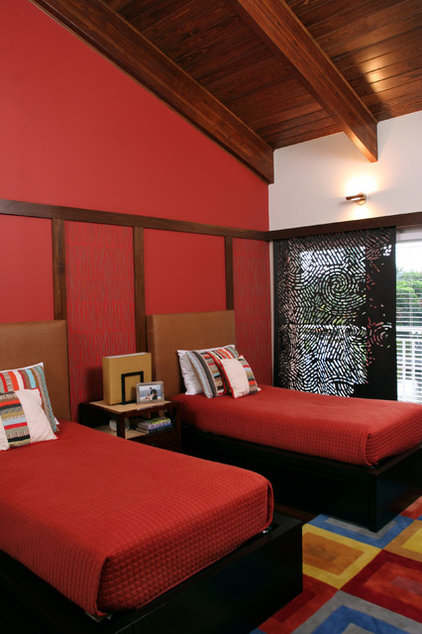
I’m not a morning person, so I’ll take any help I can get for waking up early and feeling motivated to start my day. Bold red is an attention-getting hue, so it’s a great color for those who need assistance getting revved up and energized. Keep in mind, though, that red has been shown to raise blood pressure slightly as well as increase stress and anxiety levels, so it’s not a good color for those who need their bedroom to be a mellow sanctuary. Of course, deeper and darker reds that veer toward burgundy are less “hot” and therefore more soothing, so look for those if you prefer a more calming effect in your bedroom.
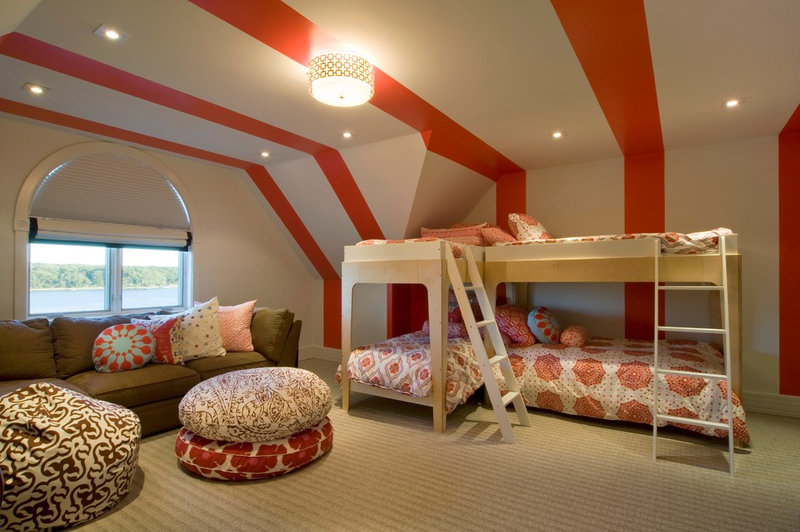
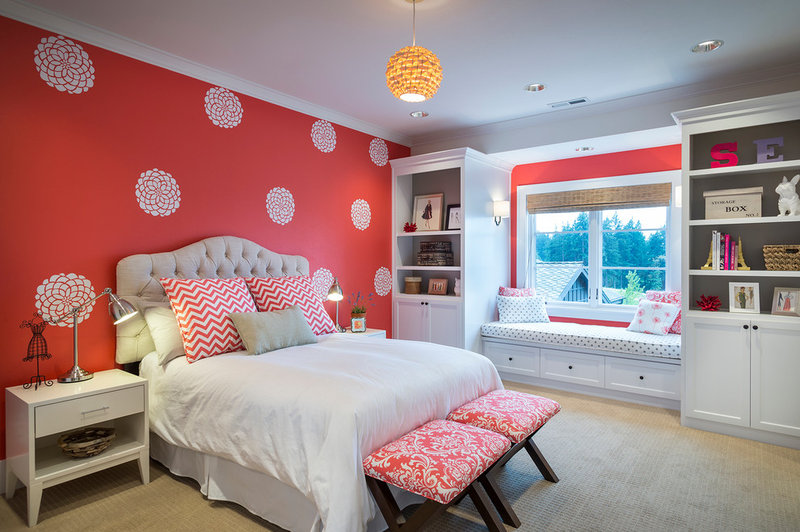
For those of you ready to go red, check out these eight bold red bedrooms from around Houzz, along with a few tips for working with the hue in your own bedroom.
Home prices in New Jersey remained stagnant between September and October, reflecting a nationwide cooling down-period for the real estate market, according to a monthly Home Price Index report from CoreLogic, a real estate analytic firm.
The average price of a single-family home in New Jersey fell by 0.33 percent month-to-month. In the Newark region, one of the statistical areas studied by CoreLogic, prices slipped by 0.74 percent. Atlantic City and the Jersey City-New York-White Plains area saw gains of 0.19 percent and 1.21 percent respectively. Camden and Trenton saw declines of 0.66 percent and 0.27 percent.
Nationally, prices increased 0.2 percent.
Mark Fleming, chief economist for CoreLogic, said in a statement that the “monthly growth rate is expected to moderate even further in November and December.”
CoreLogic president and chief executive officer Anand Nallathambi said “the housing market appears to be catching its breath.”
http://www.nj.com/business/index.ssf/2013/12/new_jersey_home_prices_dip_in.html
Concerns are rising that the nation’s year-long revival in residential housing might be facing an uncertain future. The latest publication to tackle the issue was none other than the venerable Economist, which had this to say:
What effect will this slowdown will have on builders? Previous busts have taught them to control the inventory of new properties coming to the market. If they react abruptly to falling sales by building less, the housing market may be “on the verge of a significant correction”, argues Ian Shepherdson of Pantheon Macroeconomics. Although residential construction is only 3% of GDP, in each of the past five quarters it has contributed around a quarter of America’s economic growth.
It’s time to move on. The feeling is becoming more and more significant with each passing day and it just keeps spreading.
It’s just not it any more… we want something new, exciting, which can take us places we’ve never been. We want to be surprised again. We want a new, better social network.
Facebook may say its user base is growing, but original members from the last decade appear to be leaving in droves. As more niche networking services and platforms enter the space, people are finding that not any one company is serving all of their networking needs. Our tastes and channels are becoming fragmented, and users are pushing back on accepted norms in the social media space.
This is inevitable. It’s a natural life cycle for any product; unless it somehow becomes a living organism with its own reproductive system and evolution, one will eventually wither and die. Facebook cannot evade this process – it regenerates with nuances, but is not reinventing itself.
For inventions, it usually looks like this:
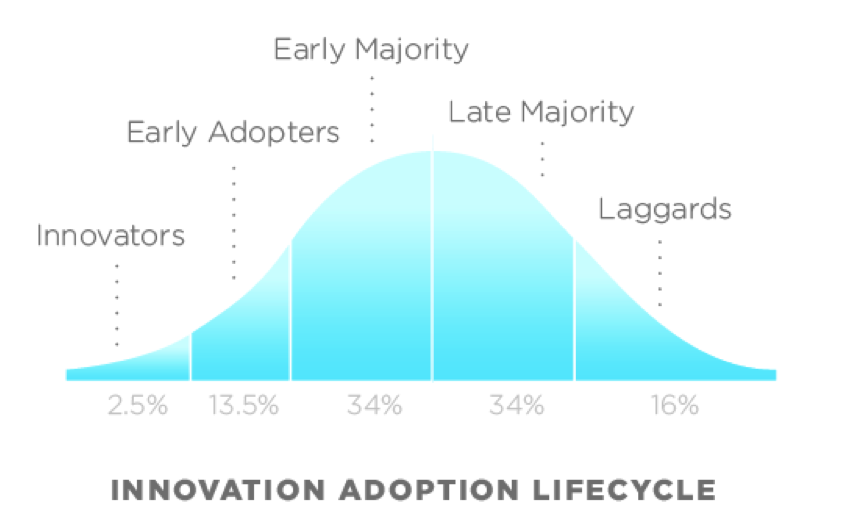
Early adopters as shown in the Rogers’ bell curve
This curve is missing something important – the two-way migration that happens over time. When the late majority joins in, the innovators and early adopters are already feeling uncomfortable.
Facebook today doesn’t resemble a thriving, living metropolis – it’s more of a friendly neighborhood bar. For that reason, FB will face its cruel destiny of simply fading away. Living in the same city as your parents is forgiven and acceptable; there is enough diversity and distance between everyone. But finding yourself sitting in the same bar as your mom and dad – that’s horrifying. When your father posts pictures of sunsets and breakfast on his wall you know it’s over.
The conclusion is undeniable; a new social network is needed. These are the things that will make it awesome and sustainable…
Trulia, the national real-estate data-crunching outfit, has been maintaining a “bubble watch” since May, 2013, tracking local markets where home prices are rising fast enough that the dollar signs threaten to outrun the “market fundamentals.” This week, Trulia’s bubble watch list puts four Texas metropolitan areas in its top ten, including the coastal markets of Houston and San Antonio.
Trulia chief economist, Jed Kolko, reports on the organization’s data in Forbes: “At the metro level, home prices are above their fundamental value in 17 of the 100 largest metros. Most of these overvalued metros are only slightly so: Of the 17 overvalued metros, just two–Orange County and Los Angeles–look at least 10% overvalued. (Austin rounds up to 10% but is actually slightly below.) Several California metros also stand out for having both overvalued prices AND sharp price increases, including Orange County, Los Angeles, Oakland, and Riverside-San Bernardino.” (For the full story, see “Trulia: Home Prices Are Simmering, Not Bubbling.”)
The Houston market, according to the Trulia report, is presently overvalued by 6% after rising 13.9% in the past year. San Antonio, the report says, is overvalued by 4% after rising by 11.1%.
Those numbers don’t qualify those cities for bubble status, even by Trulia’s reckoning—somewhat arbitrarily, Trulia reserves the “bubble” label for areas where it considers the prices to be more than 10% above what Trulia believes justified by underlying demand and production. But even so, Texans are taking exception to the inclusion of three Texas cities on the top ten list. Market watcher Steve Cook notes the controversy on his Real Estate Economy Watch blog (for Cook’s full post, see “Smile when you say ‘bubble,’ mister“).
“Dr. James Gaines, an economist with the Real Estate Center at Texas A&M University, responded that concerns about a price bubble in Texas’ housing markets are overblown,” writes Cook. “He said some of the recent increases are just making up for several years in the recession when Texas home prices were declining or flat.”
http://www.jlconline.com/home-prices/a-bubble-in-rising-texas-markets-.aspx


Say what you will about rentals—that they’re hard to decorate, expensive, orders of magnitude too small—there’s at least a smörgåsbord of options in any given locale. If variety is the spice of life, then the rental market is the most well-stocked and poorly organized spice drawer the world has ever known, wherein wasabi snuggles up next to vanilla bean. And, indeed, what field more convenient to have a jumble of balls-to-the-wall offerings than that of temporary homes? Take, as proof, these two listings in London. One (at left) asks £40,000 ($64,440) a week and comes with gold ceilings, two gazillion (an exact figure) pounds of drapery, and a ballroom with three massive crystal chandeliers and two equally monstrous flanking fireplaces. Oh, and let’s not forget the two elevators, 14 bedrooms, 10 bathrooms, and 11 reception rooms. In the same city: a penthouse apartment—also on the rental market, though at 12 percent of the cost—done up in clean lines and a much more pared-down (to say the least) aesthetic. Below, eight more odd couples:


Grandiose house: Location: Paris Price: $54,100 a month Highlights: Architecture by Charles Garnier—the mastermind behind the Opera de Paris—plus a suite of yummy salons and reception areas, winter garden, steam room, and indoor pool.
Pared-down house: Location: Paris Price: $5,990 a week Highlights: Interiors like “a rocket ship of luxury,” with lots of angular upholstery and a rooftop patio.