Tag Archives: Armonk Homes

Armonk NY Homes

More than half of Long Island’s 20- to 34-year-olds live with parents | Armonk Homes

A severe shortage of rental housing on New York’s Long Island due to zoning restrictions is at least partially to blame for the high share of all 20- to 34- year-olds on the island still living with their parents: 55 percent, according to a new report.

Source: New York Times

– See more at: http://www.inman.com/wire/more-than-half-of-long-islands-20-34-year-olds-live-with-parents/#sthash.v6NKK9tr.dpuf

Must-Know Modern Homes: Mies van der Rohe’s Villa Tugendhat | Armonk Homes

wenty years before Ludwig Mies van der Rohe realized his famous Farnsworth House, and seven years before emigrating to the United States, he designed Villa Tugendhat in 1930 for the wealthy couple Fritz and Grete Tugendhat.
As a wedding present, Grete (born Grete Weiss Löw-Beer) received about a half acre of her family’s land, a portion on a slope immediately adjacent to Černopolní Street in Brno, now in the Czech Republic. On the property Mies developed a split-level house with three floors: The entrance, bedrooms, nanny quarters, a terrace and play area, and a garage with chauffeur quarters are on the upper level; the living spaces, kitchen, winter garden and another terrace are on the middle level; and the utilities are on the lowest level.
The house can be seen as a domestic version of Mies’ Barcelona Pavilion from just one year before, with its flowing, open plan and structural columns distinct from walls. It is also a precursor to Mies’ later “universal space,” found primarily in the office towers he designed in the United States in the 1950s. But the design is sensitive to the particulars of place and the family who occupied it for only a short time — the Tugendhats, Jewish in origin, fled in 1938, first to Switzerland then to South America.
Perhaps due to Mies’ open plan, the building was able to serve later as a school and hospital (housing a child psychology department) before the municipality took ownership and restored the villa in the 1980s. In 2001 the house was named a Unesco World Heritage site, and 10 years later it underwent more restoration work, opening to the public in March 2012. The photos in this tour follow the latest restoration.
Villa Tugendhat at a Glance Year built: 1930 Architect: Ludwig Mies van der Rohe Location: Brno, Czech Republic Size: 2,600 square feet Visiting info: Guided tours with advance tickets available

modern exterior Villa Tugendhat

Add to ideabook
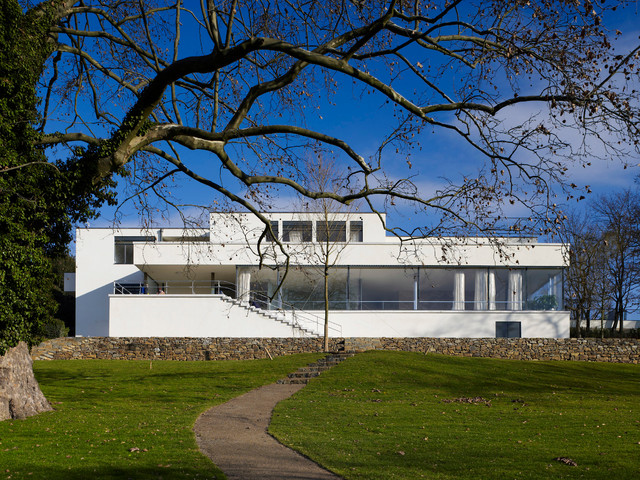
The west side is where we find all three levels, but the massing does not make it appear so. The horizontal glass of the middle floor dominates, while the top floor is set back, almost out of sight, and the lowest floor is short and predominantly solid.
modern exterior Villa Tugendhat

Add to ideabook
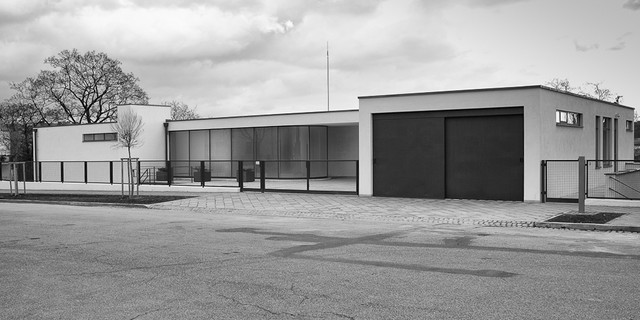
From the street side on the east, the house appears as one horizontal level. With its planar surfaces, glass expanses and garage front and center, the house must have made a stir in 1930. Even now it presents a very un-house-like face to the street.
Between the garage on the right and the glass expanse in the middle is a gap that frames the landscape beyond and draws one toward the entrance.
modern entry Villa Tugendhat

Add to ideabook
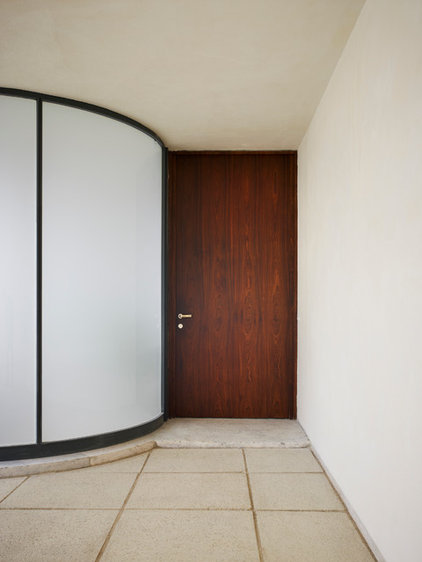
The milk-white glass curves to subtly hide the front door from the street but also to encourage movement toward it once someone is beyond the gate. The cover is generous, but the step up to the door is subtle. Nevertheless the latter is important, particularly in the change from one stone to another.
modern entry Villa Tugendhat

Add to ideabook
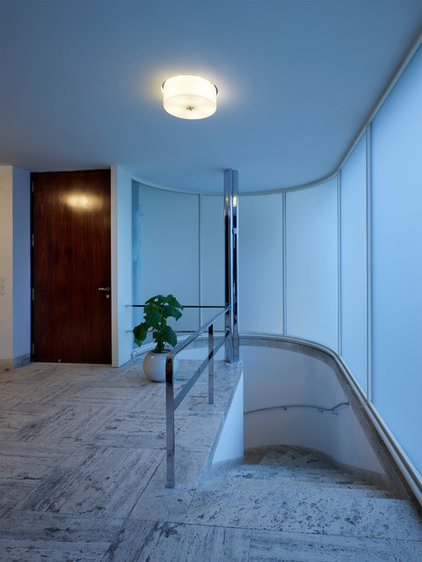
Inside, on the travertine flooring (a favorite of Mies’), the reason for the curved glass becomes apparent. The bedrooms are located to the left and behind us in this photo, while the stairs provide access to the main living space downstairs.
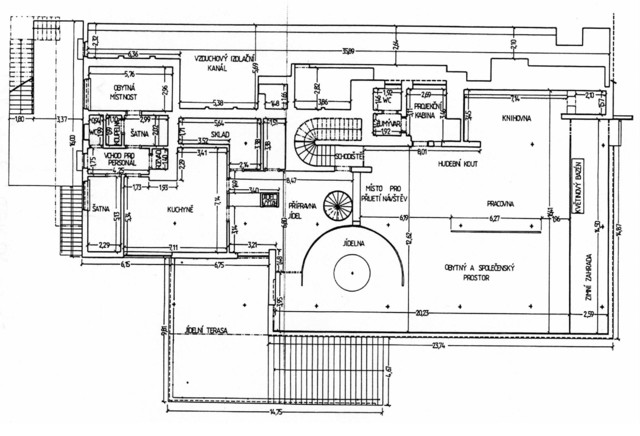
modern floor plan Villa Tugendhat

Add to ideabook
Here is a plan of the main level, where we find the living area, kitchen, winter garden and terrace. The stair from above is located in the middle. The spiral below it on the drawing provides access to the lower (utility) level.
After the 180-degree turn from above, one enters a large, open space with the primary view to the right (bottom on the drawing). But two walls — one straight and one curved — break up this space, as does a grid of small columns. What looks open is actually made up of smaller areas defined in unconventional ways.

Archbishop Stepinac Goes All-Digital With Textbooks | Armonk Real Estate

Archbishop Stepinac High School introduced a new concept to its academic program on Tuesday as it rolls out a complete digital textbook library for its students.

This program will eliminate the need for the traditionally heavy and expensive books that students use for their academic courses.
In partnership with Pearson, a provider of educational materials, technologies, assessments and related services, Stepinac implemented the new digital library for its 675 students on their first day of the new school year. Stepinac has worked with Pearson for the past two years to offer select digital books to its students, but this is the first time all of its textbooks will be online.

“In keeping with Stepinac’s commitment to remain at the forefront of educational technology, we have moved to this digital library,” said the Rev. Thomas Collins, president of Stepinac. “We are thankful to Pearson, the world’s leading learning company, for working with us on this national pilot program that will set the trend for schools across the United States for years to come. The digital library will help keep our tuition affordable as well as prepare our students for their college careers.”

After a student is charged a one-time annual fee of $150, he can visit the 40-textbook digital library through a website or application for various Androids and iPads to gain access to its College Prep Digital Library and the Honors/AP Digital Library. Typically, students purchase seven hard copy textbooks for the school year, costing $500 to $600 on average.


http://whiteplains.dailyvoice.com/schools/archbishop-stepinac-goes-all-digital-textbooks


52nd Armonk Art Show To Include 50 New Artists | Armonk Real Estate

The  Armonk Art Show, consistently ranked among the top “fine art and design shows” in the New York area by Sunshine Artist Magazine, returns for its 52nd season on Sept. 28-29.

The show, which benefits the North Castle Public Library, runs from 10 a.m. to 5 p.m., at Community Park, 205 Business Park Drive.

More than 185 juried artists will be featured in the show, including 50 new artists. They will display a broad spectrum of media, including oils/acrylics, water colors, mixed media, printmaking/drawing/pastels, sculpture, photography/digital art, wearable art and fine crafts.

There is free parking, and a food court. The library will show a free-art-themed film on Sept. 27, and the Fishtank Ensemble will perform on Sept. 28, at Whippoorwill Hall.

A road race, Jamie’s 5k Race for the Library, will also be run in conjunction with the show. It begins at 9:45 a.m. on Sept. 22.

For complete information, or to register for the 5k race/walk, visit the event’s website.


http://armonk.dailyvoice.com/events/52nd-armonk-art-show-include-50-new-artists

Armonk Early Election Results | Armonk Real Estate

Democratic Vote for Town Supervisor
► Michael J. Schiliro
Anthony Futia

Republican Vote for Town Board

► John J. Cronin
► Barbara W. DiGiacinto
Diane DiDonato-Roth

Independence Vote for Town Supervisor
► Michael J. Schiliro
Independence Vote for Town Board
► Barbara W. DiGiacinto
Jose L. Berra — Too Close to Call
Write-In –Too Close to Call
Independence Vote for Town Justice
► Linda Trummer-Napolitano
Douglas J. Martino
Conservative Vote for Town Supervisor
► Michael J. Schiliro
Conservative Vote for Town Board
► Barbara W. DiGiacinto
► Barry S. Reiter

Rise in interest rates could be overdone, or just starting | Armonk Real Estate


The first week of each month always brings the most news, the most important news and the newest news. The net result of this week’s load: a brief pause in the next leg up in long-term rates.

For 40 years, one of the most reliable economic indicators has been the monthly survey of manufacturing purchasing managers, renamed “ISM” (don’t ask). For August that value jumped to 55.7 (50 is breakeven, 60 a runaway) in an uptrend beginning early this year of the kind historically telling the Fed that it’s time to pull back.

The companion ISM for the five-times-larger service sector has a history less than half as long, thus a suspect indicator but rocketed to 58.6 in August.

After those two releases, the 10-year T-note on Thursday touched 3 percent, and mainstream low-fee mortgages reached 5 percent.

Today’s job data bought us some time, the 10-year down to 2.9 percent, mortgages in the high 4′s.

The headline 169,000-job gain was enough to maintain Fed-fear, but not the 74,000 jobs revised out of June-July, not the 2.2 percent year-over-year increase in wages (nominal; negative after inflation), and not the jobs themselves, heavy on the low-end.

– See more at: http://www.inman.com/2013/09/06/rise-in-interest-rates-could-be-overdone-or-just-starting/#sthash.tpBPTOi2.dpuf


Rise in interest rates could be overdone, or just starting | Inman News.

Dedicated to the memory to Our Town Councilwoman | Armonk Homes

Becky Kittredge
Dedicated to the memory of our beloved Town Councilwoman
Click image on right to play a memorable tribute to a beautiful public servant.

On Friday, August 30th, at the steps of Town Hall, citizens gathered to honor the memory of Becky Kittredge and, more importantly, to  celebrate her life and contributions to our town of North Castle.
It’s unfortunate that three of our Town Board members (Howard Arden, John Cronin, and Diane Roth) refused to broadcast, on NCTV, this beautiful and memorable tribute of one who has given 32 years  of service as a Town Board member.
Additionally, during her tenure, she was appointed as deputy supervisor to long-time Town Supervisor Jack Lombardi and her responsibilities included Town Board liaison to the Police Department, Highway Department and the Beautification Committee.
In this video, I have embedded pictures and footage that I  recorded to emphasize Becky’s spirit as a government official, as a volunteer, as a citizen, as a family member, and as a genuine, caring, thoughtful person.  As you view this video, particularly the last 5 minutes, ask why three members of our Town Board felt it was inappropriate and voted against its broadcast.
Feel free to express your comments by clicking on the below e-mail links . . .
Howard Arden John Cronin Diane Roth
Respectfully,
Sam Morell

Mapping 15 Manhattan Buildings Originally Built for Artists | Armonk Real Estate

artistsmap_9_13.jpg

To do their work, artists need light and space—two things that can be hard to come by in Manhattan. In the early twentieth century, artists and their backers put up a number of buildings meant to meet those needs, with double-height studios, allowing for ample light, and low rents. Some of those buildings took advantage of the relatively new idea of co-op apartments and had artists buy shares in order to fund the buildings’ construction and maintenance. Artists’ cooperatives had occasional downsides—one resident of 130 West 57th Street filed a disorderly conduct complaint against a downstairs neighbor in 1921 over the “absolute riot” of ragtime music coming from her apartment. (The noisy neighbor in question decided to flee to Italy in search of “personal liberty” even once she was found not guilty.) But they were also home to the production of much notable work. We’ve rounded up 15 notable artists’ buildings for the map below. Most are still standing, though the prices for their apartments are no longer so artist-friendly.

Tenth Street Studio Building
51 West 10th Street, New York, NY 10011
Starchitect Richard Meier, before he achieved starchitect-dom, created the West Village’s Westbeth housing complex, meant for early-career artists who could hold onto their inexpensive rentals for about five years while growing their careers. The complex is now a landmark, and its residents have ended up having similar staying power. In fact, local politicians recently accused the complex of “stockpiling” apartments rather than allowing those on the waiting list to move in.
55 Bethune St, New York, NY 10014
Tenth Street Studio Building
Many of the buildings on this list date to the first decade of the twentieth century, but those structures were preceded by the Tenth Street Studio Building, which dates to 1857. Artists including Winslow Homer and Frederic Church had studio spaces there, and the building included a central gallery. (Some of the units were just studio spaces; others had bedrooms as well.) The building was demolished in 1956, and non-artist-oriented apartments now stand on the spot. (Photo courtesy the Museum of the City of New York.)
51 West 10th Street, New York, NY 10011
Gainsborough Studios
To address their needs for light and space, a group of painters and sculptors formed the Gainsborough Corporation in the early 1900s to build a building full of cooperative studios for artists. They purchased 222 Central Park South, then a millionaire’s mansion, in 1907, and replaced the mansion with the Gainsborough Studios. The 34 apartments at the front of the building have double-height living rooms. At the moment there’s one 2BR in the building for sale.
222 Central Park South, New York, NY 10019
Studio Building
The 1907 Studio Building, designed by Herbert Harde and R. Thomas Short, also had double-height studios intended for artists. But regular folk (i.e., lawyers and doctors) also lived there from the beginning. The building received some rave archicritical reviews: a “Brobdingnagian cathedral,” one magazine called it; the terra cotta decoration “appears to have been squeezed out of a pastry tube,” said an architectural historian. The building has one incredible penthouse on the market now.
44 West 77th Street, New York, NY 10024
Hotel Des Artistes
George Mort Pollard designed this building, which was built in 1917. As at other artists’ residents, a number of the apartments include double-height spaces, but not only visual artists lived at the Hotel Des Artistes. Noel Coward and Fannie Hurst, for example, were among the writers in residence. There is one $2 million 1BR on the market in the building now.
1 W 67th St, New York, NY 10023
Studio Building
This building—which shares the name the Studio Building with one of the Upper West Siders on this list—was architect Charles Platt’s first major city design. (He had previously been known as a country house architect.) Painter Gerald Murphy (a friend of F. Scott Fitzgerald) and baritone Lawrence Tibbett were among the early residents. There’s one two-bedroom on the market now in the landmarked building.
131 East 66th Street, New York, NY 10065
140 West 57th Street
Pollard & Steinam—who designed several other artist-oriented buildings on West 67th Street—were the architects of this structure, which was built in 1907-1908. The front of the building contained seven double-height apartments, and as the Landmarks Preservation Commission designation report for the building puts it, “the tall, projecting bay windows set in geometrically-ornamented cast iron frames bring in the north light so prized by artists.” 130 West 57th Street was designed by the same architects and was almost identical. (It was also the site of a disorderly conduct complaint over the “absolute riot” of ragtime.)
140 West 57th Street, New York, NY 10019
80 West 40th Street
Painter (and naturalist) Abraham Archibald Anderson tried living in Connecticut so that he would have the space and light in which to work, but he wanted to be in the city—so he decided to buy four lots at 40th Street and Sixth Avenue and build a studio building there. Anderson and his wife occupied the top floor once the building was finished. Other artists took space, and eventually, Liz Claiborne had her first studio there. In the 1980s, the building received a restoration.
80 West 40th Street, New York, NY 10018
The Rembrandt
Carnegie Hall Tower now stands where the Rembrandt Studio building went up in 1881. Christopher Gray speculated in one Streetscapes column that the Rembrandt—along with the Sherwood Studio building at 57th Street and Sixth Avenue, since demolished—may have been one of the buildings that persuaded Andrew Carnegie that a concert hall would be the right fit for the neighborhood. (Photo via Museum of the City of New York.)
152 W 57th St, New York, NY 10019
Carnegie Hall Studios
Carnegie Hall kicked out its last artists several years ago in order to convert their live/work spaces above the famed concert hall into additional office and classroom space. One of the last residents, photographer/filmmaker Josef Astor, made the documentary Lost Bohemia about the end of the building’s artist housing era.
881 7th Ave, New York, NY 10019
(212) 247-7800
read more…

North Castle Funeral Service for Becky Kittredge | Armonk Homes

Newsletter
Funeral Service for Rebecca (Becky) Kittredge
The funeral service took place on Friday, Aug. 30 at Town Hall and can be viewed on line through All About Armonk.
There have been dozens of inquiries requesting information about when the video of the funeral will be aired on NCTV.  Unfortunately, a 3-2 majority of the Town Board: Supervisor Arden, and Board members John Cronin and Diane DiDonato Roth, have voted NOT to allow the service to be aired on our cable TV channel.
Your comments regarding this decision may be forwarded to the Town Clerk’s Office.
Town Board Work Session – Sept. 4  (Agenda)
2:00-5:00 p.m. at Hegenhan Recreation Center.
Agenda with supporting documents and video: View
Primary Election – Sept. 10 –  (Sample Ballots)
Registered Voters in Democratic, Republican, Independence and Conservative Parties may vote.
Note: The last day to postmark an Absentee Ballot application is today – Sept. 3.   Read more…
Town Clerk  273-3321

When Will Solar Get Cheap Enough for Everyone to Use? | Armonk Real Estate

The prices of solar cells are falling rapidly, and will keep doing so for the next few years. The big questions revolve around the rate of the price declines. And the panels themselves aren’t the only place where cost reductions will be found. America has very high “soft costs”—installation, permitting, marketing etc. Whittling down these expenses will help, too. Check out https://wiredsolar.net/how-much-do-home-solar-panels-cost/ to know the home solar panel cost.

Check out, HOW SOLAR PANELS WORK FOR YOUR HOME: A BEGINNER’S GUIDE

Solar is taking off at a breakneck pace (admittedly from a tiny base). Stephen Lacey at Greentech Media provides the striking figures illustrating the exponential growth of solar photovoltaics (PV) in the past few years:

It took nearly four decades to install 50 gigawatts of PV capacity worldwide. But in the last 2 ½ years, the industry jumped from 50 gigawatts of PV capacity to just over 100 gigawatts. At the same time, global module prices have fallen 62 percent since January 2011. Even more amazingly, the solar industry is on track to install another 100 gigawatts worldwide by 2015—nearly doubling solar capacity in the next 2 1/2 years.

Even though prices of modules—the solar panel itself—have plummeted in the last few years, a report from the Department of Energy’s Lawrence Berkeley National Laboratory reveals that other costs haven’t been so easy to bring down:

Non-module costs—such as inverters, mounting hardware, and the various non-hardware or “soft” costs—have also fallen over the long-term but have remained relatively flat in recent years. As a result, they now represent a sizable fraction of the total installed price of PV systems.

When Will Solar Get Cheap Enough for Everyone to Use? | Mother Jones.