Mortgage rates average 3.85% | South Salem Real Estate

Freddie Mac (OTCQBFMCC) today released the results of its Primary Mortgage Market Survey® (PMMS®), showing the average 30-year fixed mortgage rate ticking up to its highest mark in six weeks.

News Facts

  • 30-year fixed-rate mortgage (FRM) averaged 3.85 percent with an average 0.5 point for the week ending October 5, 2017, up from last week when it averaged 3.83 percent. A year ago at this time, the 30-year FRM averaged 3.42 percent.
  • 15-year FRM this week averaged 3.15 percent with an average 0.5 point, up from last week when it averaged 3.13 percent. A year ago at this time, the 15-year FRM averaged 2.72 percent.
  • 5-year Treasury-indexed hybrid adjustable-rate mortgage (ARM) averaged 3.18 percent this week with an average 0.4 point, down from last week when it averaged 3.20 percent. A year ago at this time, the 5-year ARM averaged 2.80 percent.

Average commitment rates should be reported along with average fees and points to reflect the total upfront cost of obtaining the mortgage. Visit the following link for the Definitions. Borrowers may still pay closing costs which are not included in the survey.

Quote
Attributed to Sean Becketti, chief economist, Freddie Mac.
“After holding steady last week, rates ticked up this week. The 10-year Treasury yield rose 8 basis points, while the 30-year mortgage rate increased 2 basis points to 3.85 percent.”

New single family home sales drop | Bedford Corners Real Estate

Sales of new single-family houses in the United States shrank 3.4 percent to a seasonally adjusted annual rate of 560 thousand in August of 2017 from an upwardly revised 580 thousand in July. It is a new low so far this year, well below market expectations of 588 thousand. Sales fell the most in the South, partly due to Hurricanes Harvey and Irma. New Home Sales in the United States averaged 650.80 Thousand from 1963 until 2017, reaching an all time high of 1389 Thousand in July of 2005 and a record low of 270 Thousand in February of 2011.

United States New Home Sales


US New Home Sales Fall for 2nd Month

Sales of new single-family houses in the United States shrank 3.4 percent to a seasonally adjusted annual rate of 560 thousand in August of 2017 from an upwardly revised 580 thousand in July. It is a new low so far this year, well below market expectations of 588 thousand. Sales fell the most in the South, partly due to Hurricanes Harvey and Irma.

Sales fell in the Northeast (-2.6 percent to 38 thousand), the West (-2.7 percent to 146 thousand) and the South (-4.7 percent to 307 thousand) and were unchanged at 69 thousand in the Midwest. The counties in Texas and Florida accounted for about 14 percent of US single-family housing units authorized by permits in 2016, and about 27 percent of single-family housing units authorized in the South region. In August, information on the sales status was collected for only 65 percent of cases in Texas and Florida counties, compared to a normal 95 percent rate.
The median sales price of new houses sold was $300,200, above $298,900 a year earlier. The average sales price was $368,100, also higher than $355,100 in August of 2016.
The stock of new houses for sale went up to 284 thousand from 274 thousand in July, hitting the highest level since May of 2009. This represents a supply of 6.1 months at the current sales rate.
Year-on-year, new home sales shrank 1.2 percent.
Figures for July were revised up to 580 thousand from an initial estimate of 571 thousand. The June figure was revised down to 614 thousand from 630 thousand.
read more…
https://tradingeconomics.com/united-states/new-home-sales

Home prices rise 5.9% | Armonk Real Estate

The Standard & Poor’s CoreLogic Case-Shiller national home price index rose 5.9 percent in July from a year earlier, slightly faster than June’s 5.8 percent annual pace.

Sales of both new and existing homes slipped over the summer, which typically might slow price gains.

But demand remains strong and has created bidding wars among potential buyers, pushing up prices at a much faster pace than incomes. The number of existing homes for sale fell 6.5 percent in the past year.

Seattle, Portland, Oregon and Las Vegas saw the largest increases, with prices in Seattle soaring 13.5 percent in July from a year earlier.

Other cities are also seeing strong gains. Home prices rose 7.3 percent in Dallas and Detroit, and 7.2 percent in Denver. The slowest increases were in Washington, D.C. and Chicago, which both reported 3.3 percent gains.

With unemployment low and paychecks rising modestly, more people are in the market for a home. But construction of new single-family homes has been held back by a limited supply of land in hot markets and difficulty in finding construction workers.

That has intensified the competition in the housing market. Homes sold after an average of just 30 days on the market in August, according to the National Association of Realtors, down from 36 days a year ago.

Hurricanes Harvey and Irma began to pinch sales in August and should drag on the sales in the months ahead.

The Case-Shiller index covers roughly half of U.S. homes. The index measures prices compared with those in January 2000 and creates a three-month moving average. The July figures are the latest available.


read more…

http://us.spindices.com/index-family/real-estate/sp-corelogic-case-shiller

Second coming of nest | South Salem Real Estate

“We have better light rings than any other products on the market,” says Adam Mittleman. This is a sentence that I have never before heard uttered by anyone, even after a long time living on Planet Earth. But because I am visiting Nest, and Mittleman is its Head of Product Design, working on a new gadget that this startup-turned-controversial Alphabet division is launching, I can’t say I am surprised. After all, light rings—the shimmering glow-circles that allow digital appliances to provide feedback—have been a leitmotif for Nest throughout its eventful journey of disrupting the home. Thermostats, smoke alarms, and now Nest’s new home security system signal users via rings. Nest has given a lot of thought to them. Literally years of thought.

Naturally, there is a light ring on the Nest Guard, which is the hub of the Nest Secure suite. That suite has been in the works since well before the company was acquired by Google in January 2014 and then underwent a second recalibration in October 2015 when Google made Nest one of the divisions (“bets”) in the Alphabet archipelago. Depending on the message the new Nest Guard wants to convey, its ring might glow red, yellow or green.

Steven Levy is Backchannel’s Editor in Chief.

———

Sign up to get Backchannel’s weekly newsletter, and follow us on Facebook and Twitter.

Mittleman passionately cites the three potential problems that occur if a company does not pay attention to the design of its light rings. “One, the light is too direct, so that calls too much attention to itself,” he says. “Two, color uniformity can be really bad. Say, a yellow might look like some mix between oranges and reds and yellows, and it just doesn’t look really good. Three, hotspots. That’s the most common affliction—they’ll be much brighter in one location and then get dim and then bright and then dim and bright and dim.”

Red, yellow, green. In its brief history, Nest’s own progress might also be charted by a color-shifting light ring signaling the unit’s varying fortunes. Because Alphabet doesn’t break out sales figures or other numbers for Nest, it’s hard to say for sure what those actual fortunes are, but these days a yellow beam might be cutting the company a break. For a long stretch, Nest’s biggest splashes have been product recalls, destructive public infighting, and the departure of its CEO and cofounder. Meanwhile, Nest hasn’t announced a major new product category in ages. Until today. In Nest’s biggest moment in years, it is announcing a series of products that take it onto new ground—and, it hopes, flips its light ring to green for good.

The new products include the aforementioned Nest Secure, a home security system; Nest Hello, an internet-connected doorbell; an outdoor version of its Nest Cam IQ security camera (which uses Google face recognition to identify people who wander into range); and, perhaps most significant, the integration of the voice-based Google Assistant into Nest products, beginning with the indoor IQ camera.

Nest’s new security system (bottom), video doorbell (left), and outdoor security camera (right).
BALAZS GARDI

The launch not only brings Nest into new territory, but also sends a signal that despite changes and setbacks, it’s still powered by the same impulse: to transform the home by reinventing mundane home appliances and services with internet connectivity and cutting-edge design. Since this needs internet connectivity, you would need a fast internet connection. Learn more about getting a fast ISP provider here. “The DNA hasn’t changed,” says Matt Rogers, who cofounded the company in 2010 with its first CEO, Tony Fadell. “But I think we finally are able to achieve what we’ve always talked about doing. We’re in millions of homes now. We’ve laid this foundation of products that solve really important problems and now we can link them together and do more with them.” Given, of course, that the lights glow green.

The face of Nest used to be Fadell, a visionary product designer best known for his iPod work, and a famously exacting leader. (He reportedly tried to cut short his cofounder’s honeymoon so the new bridegroom could address some product crises. Rogers refused.) The new leader would prefer not to be its face. When Fadell left in June 2016, Larry Page replaced him with Marwan Fawaz, a nuts-and-bolts guy who is much in the mold of other recent Alphabet division leaders: experienced, middle-aged guys (always guys) known less for vision than for delivering quarterly results. Though Fawaz is not reticent about invoking his considerable experience, his approach is methodical and straightforward. And decidedly not flamboyant. “They call me No Drama Marwan,” he says.

Fawaz’s previous jobs have involved launching and managing products for cable and telecom firms. The jewel of his resume was leading the Motorola Home product, a rare success in the troubled recent history of that firm. Also of note is his chairing the Technical Advisory Board of the security firm ADT. Fawaz says that his marching orders from Alphabet CEO Page were clear: “We want to make sure the presence in the home, and the business, is meaningful and global and [that] it’s successful. That it could thrive on its own as a business. You can interpret that by financial discipline, bringing new products to market, scaling the business.” Though it was widely believed that Alphabet was considering offers to sell off Nest (a rumor confirmed to me by knowledgeable sources), Fawaz assured Nesters on day one that the company was not for sale. He takes pains to assure me that despite what some may believe, the company will not go back on the block. “Selling Nest is not the right decision,” he says. “Nest has so much potential being in the Alphabet family.”

Nest CEO Marwan Fawaz.
BALAZS GARDI

Fawaz sees his job as carrying forth the Nest mission by scaling its current products to larger audiences and markets. “We’re about creating the conscious home,” Fadell once saidabout the mission. “To take a truly important device that has had no great innovation and make that device really, really great.”

But that message got lost in a series of blunders and corporate shifts. The calamities began soon after the Google acquisition, when the company discovered a serious flaw in its smoke alarm. Its coolest feature, the Nest Wave—the ability to shut down a false alarm by waving your hand—held a potential danger: Under some circumstances it could have kept the alarm silent during a real fire or carbon monoxide release. Though no case like that had ever been reported, Nest halted sales for a few weeks and issued a recall to disable the feature in 440,000 Protect units.

During the next few years, news from Nest always seemed to have a bite to it. Users pestered the company with lawsuits about marketing promises and other issues. Rumored products didn’t appear. And everybody wondered just how many gadgets Nest was selling. Alphabet’s silence did not build confidence.

Nest’s video doorbell system.
BALAZS GARDI

In June 2014, Nest bought Dropcam for $555 million, filling a gap in its smart home strategy with the connected camera leader. Though Nest’s painstaking integration of the technology into its system proceeded, however, it failed at combining the two companies’ cultures. Dropcam’s former CEO Greg Duffy, who had joined Nest to head the camera team, became so frustrated—primarily with Fadell—that he reportedly suggested that Page remove Fadell and make himCEO. After Duffy was rebuffed, he took his gripes public in a scathing Medium post.

Meanwhile, under the new Alphabet structure, tough-minded CFO Ruth Porat was putting the “bets” on a shorter leash, demanding better quarterly results. This didn’t please Fadell, who believed that investing in innovation was more important at the moment than focusing on profits. (All these woes and more were mercilessly recounted in a well-circulated takedown by The Information.)

Fadell left Nest in June 2016. Fawaz immediately replaced him.

(Some wondered why Fadell’s cofounder Rogers did not get the nod. His answer is: not yet. “I love spending time on product and design [but] having a sole product- and design-focused CEO is not enough. You need someone who’s focused on either the business or product, but it’s hard to do both. I think the split that Marwan and I have works really well. Maybe I’ll be CEO of Nest one day. Maybe a CEO of a different company.”)

Nest cofounder Matt Rogers.
BALAZS GARDI

The pileup of calamities might have hurt Nest’s profile among the digerati. But those who remained at the company (though, indeed, some Fadell loyalists have split) say that aside from the personalities of the respective leaders, the culture is still pretty much the same. One positive sign was the return early this year of Nest’s original VP of technology, Yoky Matsuoka, who left the company in 2015 and wound up at Apple. “When I started to look for the place where I can really have the most impact, I was really surprised to see that Nest was on the top of the list,” she says.

The real measure of Nest’s success, however, rests on its sales figures. Alphabet keeps those closer than the secrets of its search algorithm—but if you shake the tea leaves just right, you can see signs that Nest has sold pretty well. The fact that it had to recall 440,000 smoke detectors indicates that, even at its high price, the Nest Protect was a hit. Also, Nest products always seem to hold high positions on Amazon’s best seller lists. As I was researching this story, I actually got some concrete evidence: While talking about how he hoped the company would grow in the future, one of Nest’s executives blurted out a number: “Nest is on track to be a billion-dollar run rate company by the end of the year.” And that’s before Nest hits the market with the roster of products it’s launching today.

Making a security system—a connection-dependent home appliance whose current incarnations have been driving users crazy—has always seemed to be in Nest’s wheelhouse, and everyone has long assumed the company was working on one. Indeed, Nest has being doing just that—for almost four years. So the introduction of Nest Secure (shipping in November) and the companion video doorbell (out early next year) have been years in the making. In that time, Nest has finished up a communications protocol (Weave) and a wireless standard (Thread) to develop a platform where not only Nest products but also outside developers could plug in together and connect a whole Internet of Things-worth of stuff. But another reason it took so long was the high stakes of getting something wrong. “If a music app fails, people can say, ‘Wow. That’s a crappy product.’ The consequences aren’t so big,” says Matsuoka, who is now Nest’s Chief Technology Officer. “But in security, you have to make sure the door sensor works reliably every time the door cracks open.”

Nest CTO Yoky Matsuoka.
BALAZS GARDI

As with most Nest products, the apparent star of the show is a control device that gives users a window into the workings of a tool that was previously buried in analog obscurity. In the case of Nest Secure, that is a sleek tabletop disk—much in the mold of the recent routers from Eero or Google—that replaces the standard (ugly) keypad where customers anxiously tap in their codes before an alarm shrieks.

Head of Product for Nest Secure Sophie Le Guen explains the advantages: flexibility in placement (not everybody uses the same door to enter a house); no need to rip open the walls to install wiring; and it looks good. It also provides a number of ways to avoid what Nest discovered was the biggest failing of current systems: false alarms, the majority of which are caused by the same beloved family members (and their pets) that the system is meant to protect. The most important way of defeating those unwelcome, ear-piercing warnings (the Nest Guard is capable of 85db of eardrum misery) is a walnut-sized fob known as the Nest Tag—a $25 personalized pebble that verifies (via near-field communications) someone who’s supposed to be there. If you open a door or window when the system is alarmed, holding the Tag near the Nest Guard prevents the sound blast. “I can give it to my mother-in-law, I can give it to my kid, and they have no stress about how to arm and disarm because you just tag in and tag out,” says Le Guen. Not that you have to give your mother-in-law (or, say, the dogwalker) constant access: Using the Nest App, you can specify limited times and dates that the tag will work.

Nest’s security system.
BALAZS GARDI

Like memorable character actors crushing in cameos, the real showstoppers of Nest products are often its sensors—and this is especially the case with Nest Secure. Called Nest Detect, the security system’s new $59 sensor performs double duty as a motion detector and a magnet-equipped monitor that detects when a door or window is opened. Another advantage of the Nest Detect is something it doesn’t do: light up when it detects motion. “People don’t want to be reminded that there’s a security device [watching them],” says Le Guen.

The ugliness behind HGTV | North Salem Real Estate

A man in the desert touches flame to a snaking trail of gasoline, and as fire whips across a blasted stretch of earth, coming dangerously close to his parked monster truck, he leans back, extends his open arms to the sky, and calls out, “I am all that is man!”

Moments earlier, we have seen a dead cockroach lying boots up on a patch of white carpet, provoking the high-pitched screech of a woman.

Who are these gendered stereotypes of yesteryear, the muscle-bound dumdum and the easily terrified screamer? They are Man and Woman, irreducible and impervious to the political or sexual fashions of an era. Or, as HGTV calls the two halves of the binary: They are General Contractor and Designer, and this particular pair have come to Las Vegas to make a quick buck by flipping foreclosures.

Bristol and Aubrey Marunde are the stars of Flip or Flop Vegas, and they have brought the HGTV formula — an endless loop of television in which the dreams of women are made manifest by the swinging sledgehammers of men — to the quivering edge of reductio ad absurdum. They love one another; they never quarrel; they worship together at the Church of Home Depot in the Parish of Lowe’s.

HGTV was the third-most-popular network on cable television in 2016, a 24/7 testament to the powers of Target chic, the open-plan kitchen, and social conservatism. It unspools with the same bland cheerfulness as Leave It to Beaver, and its heart is in the same place. Many viewers — in red states and blue cities, in rent-controlled studio apartments and 6,000-square-foot McMansions — confess it’s a bedtime ritual, prelude to a night spent dreaming of ceramic-tile backsplashes and double-sink vanities. Over the past two years, it has become such a ratings and advertising sensation that it is largely responsible for the recent sale, this summer, of its parent company, Scripps Networks Interactive, to Discovery Communications for $11.9 billion.

The Best of Chip Gaines Not Working

HGTV depends on the dream that has been with us since the saltboxes of New England and the Spanish bungalows of Southern California and the Leisuramas of Montauk: that if you can just get the right house — the one that looks like your friends’ houses look, only a little bit better — your family will pour into it, like thick cream into a pitcher: smooth, fluid, pleasing. Who could get a divorce in a house with so many lush towels rolled up in the master bathroom? Who could raise a sullen teen when there is a “great room” where the family can gather for nachos and football on the big screen?

We are supposed to be in rehab from our housing binge of ten years ago, the one that nearly bankrupted the country. We are supposed to be in a state of contrition. But our national love of HGTV suggests that the dream won’t die. The longing it addresses is impervious to market corrections, or personal financial realities, and as economists continue to explore the true causes of the 2008 financial crisis, they are beginning to suspect that some speculative Americans acting on that longing got us into that mess as much as — or more than — unscrupulous bankers or Wall Street. In fact, the network may now be tempting its millions of fans to dip their toes back into the most dangerous waters of the past crisis: flipping.

Property Brothers, 2011.

HGTV came on the air in 1994, not to the trumpet blast of self-confidence associated with a future billion-dollar brand but to a little kazoo squeak of uncertainty. The shows were homey, centered on thrift, and they often starred regional celebrities making crafts or minor house repairs. A nice lady from Minnesota taught viewers how to decorate cheaply on Decorating Cents. (Why not spray-paint some silk flowers and then glue-gun them to your bathroom wall?) The hosts of Room by Room might invite their friend Bob — “from Bob and Pete’s Floors” — to explain how to choose something affordable and attractive for the kitchen floor.

But it was in 1999 that the network found its audience with a new show called House Hunters, of which there are now an astounding 1,772 episodes. This wasn’t about people dicking around with their bathrooms or dithering over a few feet of floor tile. This was about going all the way. This was about buying a house. The first few seasons were heavily influenced by hit shows on another network, TLC, where A Wedding Story and A Baby Story had found a large audience, composed mostly of young women, who were eager to watch 30-minute documentaries about couples making huge steps in their lives. HGTV beat them to the punch with a show about the next step in a dream couple’s life.

The early episodes are very different from what the show has become; they were full of the pitfalls of buying a house for the first time. One couple had to delay the process for a year so that they could improve their credit; they each cashed out money from their retirement funds. The husband said, “It’s a scary decision. It’s the most expensive thing and the biggest purchase we’re gonna make.” (As viewers later learned about the series, all of this was a re-creation — you can’t be on the show unless you’ve already closed on a house — but no one’s looking for the Meisner technique on reality television, and they sold it well enough.)

Flip or Flop, 2013.

The houses in the couple’s price range were strewn with the evidence of human occupation and other bits of nastiness. “That could be a pet stain,” the real-estate agent says nonjudgmentally as the couple look glumly at a spot on the dining-room floor, “or coulda been a plant there.” A house with a small kitchen and battered cupboards is out, the host tells us, because “money is tight, and this family would rather prefer to put all of their money toward a down payment instead of renovation.” It was like what buying a house is really like, but it was also kind of a bummer. On A Wedding Story, you got a beautiful dress and a church full of flowers; on House Hunters, you got pet stains and problems with your credit. Soon enough, that all changed.

Today, House Hunters, like all HGTV shows, follows a formula as inflexible as the Latin Mass. You meet the buyers (usually a couple), learn where they live and what their budget is, and watch as they describe marriage-busting differences of opinion in a way that makes them look like they’re choosing what to watch on Netflix. He’s the breadwinner who wants to live close to work; she’s an at-home mom who wants to live in a far-off suburb. She’s a spender; he’s a saver. What they need is a post-nup; what they get is an expensive house an hour from his job, because HGTV women tend to win these quarrels, although he will usually get some concession — a north-facing patio so he won’t sweat like a dog when he’s out grilling; a three-car garage. By the time we bid them farewell, they’re in the great room, sipping white wine from giant, reality-TV wineglasses and purring like kittens.

The show has many spinoffs, such as House Hunters International, which ought to be named “God Bless the USA.” On an episode called “Oh No Okinawa” an American military couple who want a big kitchen and a view of the ocean get neither, while their crestfallen teenage son looks at his small Japanese bedroom and talks wistfully about missing his senior year back home. There’s Tiny House Hunters (about tiny houses, not tiny hunters), Beachfront Bargain Hunt, Lakefront Bargain Hunt, House Hunters Off the Grid — for when HGTV finds a successful show, it turns it into a genre and the audience happily follows along. The shows don’t really have hosts; there’s a narrator and sometimes a real-estate agent — but for the most part it’s the buyers and the houses who are the stars.

But just as the mild stimulant of Decorating Cents made way for the Adderall of House Hunters, so did the latter prepare viewer and network for the speedball of flipping, which is now the core of the network’s most successful shows and which may be the most dangerous part of a national obsession that has caused us all great grief in the past and possibly even spurred that global financial crisis. It all began with Property Brothers.

Fixer Upper, 2013.

Jonathan and Drew Scott are a pair of metrosexual, gaga-handsome, Canadian identical-twin brothers whose early quests for fame were unsuccessful, perhaps owing to the decline of evil-twin narratives in daytime television. They had both wanted to be actors, but no luck. Drew spent $100,000 trying to break into the acting world. Jonathan wanted to be a magician with a big, David Copperfield type of show until someone stole all his props and he had to file for bankruptcy. In 2004, they opened a real-estate-services company — Jonathan had become a general contractor and Drew a real-estate broker — to support them in their pursuits. While the company was successful, the entertainment thing never panned out. And then, as in one of those career seminars in which you are encouraged to write down all of your strengths and combine them into one ideal job, the break: They would use their skills choosing and renovating houses and their cheerful, hammy acting abilities to star in a reality-television show. It was an immediate hit and has had several iterations, but it has now settled on a format: The twins show the buyers the house of their dreams and then tell them it’s way over their budget. They persuade them to choose a so-so house, and then Drew — whose work consists merely of a day driving the buyers to properties — lounges around in his flat-front trousers and skinny ties making such catty comments about his brother’s grunty physical labor that they seem more like a couple than twins.

On a recent episode, all of the players delivered their lines with dinner-theater enthusiasm. A fed-up working mom looked up from her cramped home office — really just a corner of the dining-room table — and demanded, “We need the brothers to find our dream home now.”

Her husband, an at-home parent and susceptible to the whims that can accompany that calling, announces that he wants “all top-of-the-line appliances.”

The twins tell the couple that they can’t afford what they really want, and the couple pretend to freak out. They say they’re uncomfortable about having to make renovations, so Drew scares them with fancy talk about finance. “What’s worse: getting your hands dirty with a fixer-upper or having to overleverage and get tied up in a mortgage for a hundred years?”

Good Bones, 2016.

With the thought of a century of mortgage payments to motivate them, the couple go for the renovation. Anyone who has watched HGTV for more than a week knows what this will involve, because all of the makeovers on all of the shows are the same: blow out the walls around the kitchen so you can see the big screen from the center island; put some large furniture in the living room so that it looks grand; install hardwood floors or laminate that looks like hardwood; dress up the bathrooms with ceramic tile and walk-in showers; run some sod in the backyard and add some plants; and then quickly film the whole thing before the blossoms fall off $800 worth of annuals. The couple and their two sons love it.

The Property Brothers don’t flip houses; they remodel for individual clients. But viewers found that they loved watching the process of a butt-ugly house getting transformed into an open-plan showplace. Soon, a new HGTV genre was born: shows about married couples (he’s a contractor, she’s a designer) who buy and flip houses together. A golden formula was at hand. Created to compete with A Wedding Story and A Baby Story, HGTV has always had its roots in a quiet social conservatism, a world where houses are containers for families and where the center of a family is a marriage. Moreover, it cannot be denied that the recent HGTV parody on South Park had an apt title: “White People Renovating Houses.” Once the network started putting a married couple with star power on a show — and featuring not just the houses they were flipping but also their own homes and their children and happy moments from their daily lives — it jump-started the ratings streak that has made it so successful.

The upswing began with Christina and Tarek El Moussa, stars of Flip or Flop. A pair of blandly good-looking Orange County real-estate agents, they had taken a bath during the Great Recession and had to downsize from a McMansion to a small apartment. After the housing bust, Orange County had one of the highest numbers of foreclosures in the country, which made life as a broker there especially grim. But a few years passed, and that huge inventory of abandoned, slightly outdated houses began to present a business opportunity. The couple decided to become speculators, buying some of the houses on the cheap, tarting them up (the same open-plan kitchen/luxurious bathrooms as The Property Brothers, but with an OC bent: cheap surfaces that look polished and high-end).

Tarek is often concerned about a property’s condition, but Christina knows what to do. She was born and raised in the OC and understands what buyers want. She’ll praise a small Anaheim bungalow for being “mid-century modern” (the new real-estate term for every rattrap built after 1945) and then dress it up with cheap chandeliers, marble floors, shiny white cabinets, and stark color schemes in the black-white-silver palette. With her French manicure, straight-ironed blonde hair, amazing figure, and willingness to make cutting remarks, she was born for reality television. Tarek’s job is to keep the workmen on task; as with all of the host husbands, he’s a bit of a supernumerary to much of the process, which is the problem with the supposedly traditional unions the network promotes: The women tend to be much smarter and more powerful than the men.

The couple soon became aspirational-lifestyle celebrities, and their marriage and family life were regularly featured in People magazine and on morning television. Yet while Christina seemed to become more confident on each episode, Tarek often appeared wan and anxious. In 2013, a viewer wrote that a lump on his neck looked suspicious, and it turned out to be thyroid cancer. A month after beginning treatment, he learned he also had testicular cancer. He had to get surgery for “multiple herniated discs” in the middle of filming an episode in which he had winced in pain every time he’d tried to lift something; sitting in an orthopedic chair, he called Christina to praise her for handling everything on her own — but she clearly had it all under control. Last fall, the world learned that their off-camera home life was a bit of a flop. After months of secret trouble, police rushed to their place after receiving a call about a “possibly suicidal male with a gun.” Tarek had run to the hiking trails near their house with a loaded gun, and it took 11 cops and a helicopter to locate him, and get him to drop the weapon. He’s since been linked in the tabloids to their former nanny.

The couple are divorcing. They are, amazingly enough, also continuing to film a new season, but viewers who love the show have plenty of other married flippers to fall in love with: There are now Flip or Flops set in Atlanta, Fort Worth, and Chicago.

But if you want a stable, heartfelt married couple to fix your dreams to, the place to look is far away from any of these big cities. You need to go to Waco, Texas, where Joanna and Chip Gaines — stars of Fixer Upper — are creating not just a hit show but a home-remodeling empire of their own.

Desert Flippers, 2016.

To call Chip and Joanna Gaines telegenic is an understatement. He’s a sunny, redheaded country boy who evinces no interest in fancy learnin’ but has a heart of gold. On one episode, he divided his time between remodeling a house and preparing for his flight on an F-16; the Air Force had chosen him as one of its Hometown Heroes, “ ’cause I renovated a bunch of houses for some families who were really, you know, in need of a pick-me-up at that time in their lives.” The subtitle of his upcoming business book, Capital Gaines, is “Smart Things I Learned Doing Stupid Stuff.” She is his devoted opposite: thoughtful, artistic, and sensitive to beauty. She has long black hair, an oval face, and an olive complexion, facts that — combined with her Texan accent and affinity for the land — lead many viewers to assume that she is Native American and that theirs is some sort of Ur-Texan pairing. In fact, she is half-Korean and a quarter Lebanese. They are Evangelical Christians, and she has spoken often about the importance of their marriage and the central role Chip plays in her life. That said, he is something of a Lucy to her Ricky, and — like all HGTV wives — you can see her biting her lip in quiet frustration when she’s trying to get important work done and he’s yukking it up.

On Fixer Upper, Chip and Joanna help home buyers on limited budgets get the most out of their investments by choosing “the worst house in the best neighborhood.” That’s an old real-estate canard that has long been dismissed, but no matter — when Joanna starts describing all the wonderful things she can do to it, thoughts about resale value melt away into dreams of sliding barn doors, over-tufted sofas, and newly built “mud rooms” where the kids can stash their backpacks and soccer gear. Once the buyers have chosen their new house, they’re whisked away and the work begins.

It is as though Chip has spent all of Act One in a quivering agony of self-control, but at last he is free. He grabs a sledgehammer and, with Joanna’s permission, starts bashing away at the first wall she has marked for destruction. SLAM! CRASH! BANG! Chip is finally in concert with his true nature. This banging away at walls is the centerpiece of every HGTV show that involves renovation — as do all of its most popular programs — and there is something profoundly satisfying about it, even though it’s a preposterous way to go about the task. Taking out a single wall when you want to leave the rest of a room intact involves carefully cutting the drywall, teasing it off, and then taking down the framing behind it. But the reckless bashing makes for good television, and it dramatizes the signal design imperative of HGTV: Whether you live in Burbank or Barcelona, you absolutely must have an open kitchen.

Flip or Flop Atlanta, 2017.

While Chip knocks down the walls, Joanna paints the new rooms in a pleasing light color, usually in a sophisticated palette that is based on a combination of gray and beige sometimes called “greige.” Her style owes much to the muted good taste that Martha Stewart made available to the masses. Martha is generous about the long reach of her shadow, although this summer she sent out a credit-taking tweet: “I cannot believe that ‘greige’ is trending as a paint color! All my homes are based on grey/beige.”

Joanna has beautiful white cabinets installed in the kitchen and recessed lighting that illuminates them like saints in their niches. There will be miles of countertops and dark-wood floors for a contrast to all the white. Sometime during the process, the Gaineses’ carpenter friend Clint may show up to get a brief on some wood feature Joanna has designed, and he will cheerfully trot off to execute her desires. Often the cameras give us quick glimpses of workmen who labor away under Chip’s direction, all of these men — laborers, artisans, foreman, husband — making manifest a woman’s exacting vision.

The night before the reveal, Joanna is in a swivet of type-A concentration. She has brought beautiful flowers wrapped in brown paper and tied with raffia, and she arranges them in a loose bouquet; she sets the table with pretty napkins and plates; she rolls hand towels and puts them in a basket in the guest bath. And then the new owners arrive.

They swoon, they moan, they marvel. They are like game-show winners, and their gratitude to Chip and Joanna makes it seem like the Gaineses are their generous benefactors, not — if the premise of the show is to be believed — tradespeople whom they have paid to do a job. Nothing makes the buyers lose their composure like the kitchen. How beautiful it is, how stunning to see it compared with “before” pictures. Nothing bad could happen to a family who has a kitchen like that. It’s too pretty, too calming, too clean. It’s too full of Chip and Joanna’s radiant good cheer and their careful understanding of what each family most wants: “You had said you wanted a place for Caleb to do his homework while you’re making dinner — so we’ve built in this desk next to the island.”

Caleb’s not going to do his homework at that stupid desk; on some level, we all know that. But the dream of a boy sitting happily in his mother’s kitchen, filling out his worksheets while she sips a big bubble glass of chilled Chardonnay and cooks — what? Quickie quesadillas? Three-step lasagna? — In her fantastically overbuilt kitchen is a powerful one, and for a few happy Act Three minutes, we dream that little dream, too.

Flip or Flop Vegas, 2017.

The first thing counselors tell sex addicts is to stop watching porn, and we really shouldn’t be watching this much HGTV during our rehab. Although it’s a soothing experience, it is also a fomenter of deep feelings of discontent about one’s living arrangements, which began to hit me hard around week two. Why have I allowed my attic “bonus room” to remain covered in the exact type of wall-to-wall carpet that repulses Joanna Gaines, Christina El Moussa, and both Property Brothers? And what failure of character is revealed by my closed-plan kitchen? HGTV makes big, expensive, time-consuming remodels look like two weeks’ work and a modest amount of money well spent. Moreover, it links these changes so definitively to personal and family happiness that you begin to wonder what, exactly, is wrong with you that you haven’t made some of them. The discontent gnaws as the addiction to the programming grows, and you have to imagine many viewers find themselves enticed to do foolish things like take out second mortgages so that they can blast out a few walls and get a little of what Chip and Joanna seem to have. More troublingly, we also have to wonder how many may be inspired to think that they, too, have what it takes to flip houses.

A recent, worrisome working paper released by the National Bureau of Economic Research reported on the tinder of the last conflagration: the national sense that housing prices were going up every day and that there was no way that a buyer’s reach could exceed his grasp. It’s true that bankers made loans to Americans wildly unqualified for them — but the notion that buyers on the lower end of credit distribution began to default in unprecedented numbers isn’t accurate. In fact, the rate of default in the subprime market throughout the bubble and the bust remained steady compared with before the crisis. It was buyers from the top and middle top who account for the skyrocketing rate of default — and it wasn’t that they were buying bigger family homes that they couldn’t afford. It was that they were buying additional houses to flip for a profit, and when holding on to them stopped making financial sense, and with no personal and emotional connection to them, they began walking away in huge numbers.

And yet … the flippers on HGTV make it look so simple, so fun. At the end of each episode, they run the numbers and show how much the happy couples have pocketed. What could the network be quietly motivating its viewers to do? With our real-estate-loving president — who has Property Brothers programmed into the TiVo on Air Force One and who is eager to do away with regulations, which are one of the forces supposed to protect us from another bust — we could be in the early stages of another crisis. Our collective fate could be largely in the hands of … Christina and Tarek El Moussa and however many people they inspire to pick up a house at a foreclosure sale. Which is why Flip or Flop Vegas may be the best HGTV show yet, as it unfolds in the place where slots are loose and the casinos never close — the best natural habitat for this kind of programming, and, as it happens, one of the worst-hit areas in the last financial crisis.

Flip or Flop Chicago, 2017.

Out in the desert heat of Las Vegas, Aubrey and Bristol toil cheerfully away. She has vocal fry, a cute wardrobe, and a real-estate license. He’s not just a general contractor; he’s also an MMA fighter. They bring the HGTV pairing of smart woman–dumb man to the farthest possible reach.

On a representative episode, they arrive at a run-down house they might buy, but they haven’t obtained the lockbox code, so there’s no way to get inside. Bristol suggests kicking in the front door. “No,” Aubrey explains to him patiently, “ ’cause we haven’t bought it.” Then he suggests shimmying under the garage door, which has been left slightly open, but his ass gets stuck. “Give me a little help,” he cries, and she pushes him through. They walk through the house, and she dreams up some plans for it. “How are you gonna fit an island and a dining-room table in this tiny little kitchen? I just don’t see it,” he says. “Watch and learn,” she tells him.

Together they go on to create something I’d never seen before on HGTV: a fantastically ugly house. Before they flipped the property, it was a modest, even attractive Spanish-style tract house with a red-tile roof. Yet it inspired Aubrey to transform it into a style she calls “glam farmhouse.” The very phrase was so marvelous and weird that I championed it immediately and saw in this couple the possibility of breaking down some of the rigid conventions that bind HGTV’s designs. Indeed, the finished house is a tour de force.

The interior is composed of a hideous color scheme: forest green, bright white, and dark brown. The white wood ceilings were “farmhouse,” and the Vegas accents were “glam”: gold and white bedside lamps, an extravagant white shag rug, accent pillows in hot orange and white marabou, a chrome coffee table. “Buyers in Las Vegas are savvy,” Aubrey explains confidently. “They’re very sophisticated.” The living-room credenza is glam, and it’s topped with tall lamps composed of rustic wooden bases (farmhouse), but the shades are industrial mesh. There’s not a moment of wit anywhere, even though the landscape design belongs in a Tim Burton movie. There are fussy topiaries, unpainted cinder-block walls, a set of stepping-stones to nowhere, wide areas covered in red bark nuggets, and one rectangular patch of bright-green lawn. The result of all this work, Aubrey tells us, is a house that’s “super-custom.” The fuzzy, neon Austin Powers pillows make it “feel like a home.”

The actual style is ’70s Porn Shoot. There’s no greige. There’s no homework area. The proportions don’t even work. It turns out — go figure — Bristol was right: To squeeze between the dining-room table and the center island to get out the French door requires gymnastic precision. But Aubrey is a winning character — determined, smart, and able to get materials at a tremendous discount. “I ask to talk to a manager — you don’t ever want to talk to a sales rep — and ask for a discount,” she says. “Tell them about your project. People really want to help, they do.”

read more…

http://www.vulture.com/2017/09/the-ugliness-behind-hgtv-never-ending-fantasy-loop.html?utm_source=digg&utm_medium=email


Missouri couple makes an affordable, recycled home out of shipping containers | Mt Kisco Real Estate

Zach and Brie Smithey of St. Charles, Missouri, have remodeled several homes, but none of them were the perfect fit. “We were looking for something that wasn’t quite the norm,” Zach explains.

“We renovated homes built in 1880, 1904, and the 1970s. With each house, we got closer to our flavor, but never quite hit it,” he says. “We realized that to do something different, we had to start from scratch—to get what we really wanted, we couldn’t follow someone else’s template.”

When they purchased an empty lot in 2011, they pictured building a more traditional house made out of conventional materials. But as the years passed, their vision shifted, and at some point, they stopped thinking about what a house should be and began wondering what other forms it might take. Ideas such as a concrete house, a geodesic dome, and a tiny house were weighed and rejected. “Realistically, how many people could live in a tiny house for the rest of their lives?” wonders Brie.

The couple who built the shipping container house left some metal walls exposed. Here, you see light-green metal walls and a white metal ceiling. Artwork by owner Zach Smithey, showing portraits of Abraham Lincoln and Mark Twain, decorates the walls.
When Zach and Brie Smithey designed and built their container house, they left some of the metal uncovered, creating an effect that could be compared to exposed brick in a more conventional house. The art is by Zack, from a Mark Twain and Abraham Lincoln series.

The couple doesn’t remember how the concept was raised, but when the idea of a container house came on their radar, it immediately felt right. “I had never seen one before, and I wasn’t even sure they existed,” Zach says. Online searches convinced them and informed them that if they built a container house, they’d be the first in the area to do so.

“We chose a container house because it gave us the most bang for our buck,” says Brie. “It allowed us to use recycled materials, which was important to us. The cost of it, and the fact we did so much of it ourselves, allowed us to live mortgage free, which was also important to us.”

Little did they know that at the time they were doing the research, their future home was sitting in a nearby container yard. “Once we decided to do this, I found a broker that sources containers from container yards across America,” Zach says. “There are many options: You can buy them new, used, or ready to be retired.”

Zach Smithey stands by his black pit bull named Boomer. The dog sits on bed next to a large, arched window that’s installed upside down. An old, elaborate fireplace mantel is installed behind Smithey.
Above: Zach poses with his dog, Boomer, who sits on a bed placed beside one of the upside-down arched windows. The window and the mantel are both architectural salvage. Below: Zach made a simple mannequin a piece of art and installed it over a stairway.

The couple chose the last option, feeling that a few dents only add to the character of the units. They ended up with containers that had been built in Shanghai and traveled around the world 12 times on boat, train, and truck before coming to rest in North St. Louis. “We found eight 40-foot containers, each one with nine-foot-high ceilings,” Zach says. “We paid $1,600 for each, and $375 to have each of them delivered, so they ended up being about $2,000 apiece. The whole project cost us about $135,000.”

The couple had the containers delivered to their lot, used a crane to stack them in a giant cube shape (there are four containers on the bottom and four on the top), and began shaping them into their home. “Building a regular house is an additive process—you put more on it day by day,” says Zach. “But in a house like this, it’s more of a subtractive process. You stack up the containers, and then you carve away the walls you don’t need.”

A pair of large paintings by Zach decorate the living room.
In the basement, the couple used all the scrap wood generated from the project to panel the walls. They painted it all white to unify the space.
In the living room, two large black-and-white artworks show a female and male figures; random pieces of wood panel the basement, and it’s all painted white; a long staircase has mismatched, salvaged balusters in the railing, and an abstract portrait of Ma
Another painting from the Mark Twain series hangs at the top of a run of stairs with railing composed of many different salvaged balusters.

Before we go on with this story, there are a few things you need to understand about the Smitheys. The first is that Zach is an artist and that informs his remodeling projects. “For me and my art, it’s all about the process, not the end result,” he says. “This house is just like a big sculpture project. I figured it out as I went along, and the journey was more important than the destination. In the end, we have something we couldn’t have imagined at the beginning if we had had a hard and fast goal we were aiming at.”

The second thing you need to know is that he and his wife appear to be the types who see things differently. For example, what mere mortals consider a packing pallet or purchasing low cost pallets for businesses, this couple sees as a building opportunity/free wood. “The great thing is that once people know you think this way, they seek you out and unload stuff,” says Zach. Indeed, when they talk about the home, very little is new and explanations are peppered with phrases like: “My friend was remodeling a house and had to get rid of a lot of brick” or “My friend’s wife works at a JCPenney that cancelled a remodel and had a lot of extra materials.”

Large, mullioned windows act as dividers in the living room to make a small sitting room. In the kitchen, a row of painted mannequin busts sit on a shelf. Half rounds of wood are painted white and hung on the wall to create shelves.
Above: Salvaged windows and pillars separate a small sitting room from the larger living area. Below: In the kitchen, more painted mannequins decorate the walls. Half rounds created by cutting the tops of industrial cable spindles in half act as wall-mounted shelves.

Finally, this is a couple that’s seemingly unfazed by things they don’t initially know how to do. He’s an artist and she had worked as a massage therapist—but they didn’t hesitate to purchase and operate a restaurant (Miss Aimee B’s Tea Room & Gallery), something they’d never done before. She later founded Brie’s Protein Bars, a health food company. They apply this can-do attitude to remodeling; so having no direct experience with container buildings was no problem.

“Really, the only way to learn how to remodel is to remodel,” says Zach. “We did most of it ourselves, save for the electric, plumbing, and HVAC. Because we were doing it ourselves, we were constantly changing tasks and using/developing new skills. It was exhausting and went on 12 hours a day, seven days a week, for a year and 14 days.”

Brie agrees that the process was difficult. “I expected it to be hard—if it were easy, everyone would be doing it,” she allows. “What I didn’t expect is how difficult it would be to work with the metal. It’s heavy, it’s thick… YouTubers make it look easy, but trust me, it’s not for everyone.”

In the most basic terms, here’s what they did: Stacked up the containers, cut out openings between them, built a frame within the metal shell, put in the utilities, and then hung the drywall (except in strategic places where they left the metal exposed).

Salvaged wood is used to make an unusual bed whose foot floats above the floor and whose head has a sharp slope. The whole thing is painted aqua and two black dogs (a pit bull named Boomer and a labrador named George) lie on the bed.
Frustrated with uncomfortable headboards, Zach designed his own. The angle is crafted for comfortable reading or watching television (they plan to mount one near the ceiling in the future). Boomer (left) and George (right) enjoy it as well.

Of course, that simplistic explanation doesn’t even begin to cover the improvisation that went into it. “I figured it out as I went along,” says Zach. The figure-it-out-as-you-go style is responsible for features like antique arched windows hung upside down in the living room (they were left behind at their restaurant, rescued from an old church next door); baseboard and crown molding made from randomly cut boards from packing pallets; and cement board painted in a rainbow of drip patterns and installed as shower walls.

Throughout, recycled materials are everywhere you look. In addition to the aforementioned items, rope pulled from the mud on the banks of the Mississippi was cleaned and used to frame a television; birdbaths and a fountain plucked from a landscaping company’s boneyard find new life as sinks and a plumbed bar table; a combine chain and tractor hooks are used to support a wall-hung vanity in the upstairs bath; and a conch shell is repurposed as a faucet in a bathroom on the main floor.

The master bath has a mirror that’s broken and spread apart to span the vanity. A curving piece of painted wood fills the gap. A wooden vanity is supported by industrial combine chains. Cement bird bath basins are outfitted as sinks. In the shower, cement
Above: In the master bath, a piece of salvaged mirror was stretched to fit the vanity by breaking the glass and filling the resulting gap with a piece of painted wood. The vanity is supported by chains from an old combine and sports sinks made from bird bath basins. Below: To make the shower walls, Zach drip painted sections of cement board before installing them.

Of course, none of this was easy or without headaches. “If, during construction, we encountered a problem we looked at it as an opportunity to innovate,” Zach says.

Anything this different is bound to inspire curiosity—especially in a small community like St. Charles (population: 69,293). “When we were building it, not a day went by without someone coming into the house and asking questions,” says Zach. The curiosity reached such a pitch, that the couple decided to host a community open house on May 20, the day the last light fixture was hung. The couple anticipated a few hundred people, and they were surprised when 2,000 showed up. “I was in shock,” says Brie. “Negative comments always seem louder than positive ones, but that day, it seemed like the house was full of positive comments and so many compliments.”

The shipping container’s metal is visible on the back of the house. You can see two large sliding doors the Smithey’s installed, opening the lower level to the patio.
The front of the container house is clad in salvaged brick, but rear facade shows off the metal is was born with.

The couple decided to make it a benefit for the local animal shelter, and ended up raising $8,000 at the door for the organization.

read more…

https://www.curbed.com/2017/9/11/16234506/shipping-container-home-tour-missouri?utm_medium=email&utm_campaign=Homes%20of%20the%20Week%2091717&utm_content=Homes%20of%20the%20Week%2091717+CID_298c5940234781f324d216c4c6aa57fe&utm_source=cm_email&utm_term=This%20135K%20shipping%20container%20house%20lets%20its%20owners%20live%20mortgage%20free

Beautiful floor to ceiling windows | Waccabuc Real Estate

When it comes to creating an indoor/outdoor feeling in your home, a set of floor-to-ceiling windows is the key ingredient to success. Along with being a visual connector to your surroundings, they bring in boatloads of natural light while providing a streamlined backdrop for your interiors. Take a look at our favorite homes of this week that feature expansive floor-to-ceiling windows.

Seclusion

Location: Melbourne, Victoria, Australia

From Caroline Wallis: “The challenge, predictably, was preserving the unique facade while both increasing the amount of natural light and adding modern amenities. After collaborating with the client to understand and meet their long-term needs, the remodel successfully bridges the old and the new. Details like reused doors, original skirting boards, and bricks maintain the visual integrity of the original home, while a sleek new kitchen and concrete backyard unfold behind the original facade.”

Photo by Shannon McGrath. Architect: Robson Rak Architects. Landscape Designer: Weller Landscapes. Interior Designer: Made by Cohen.
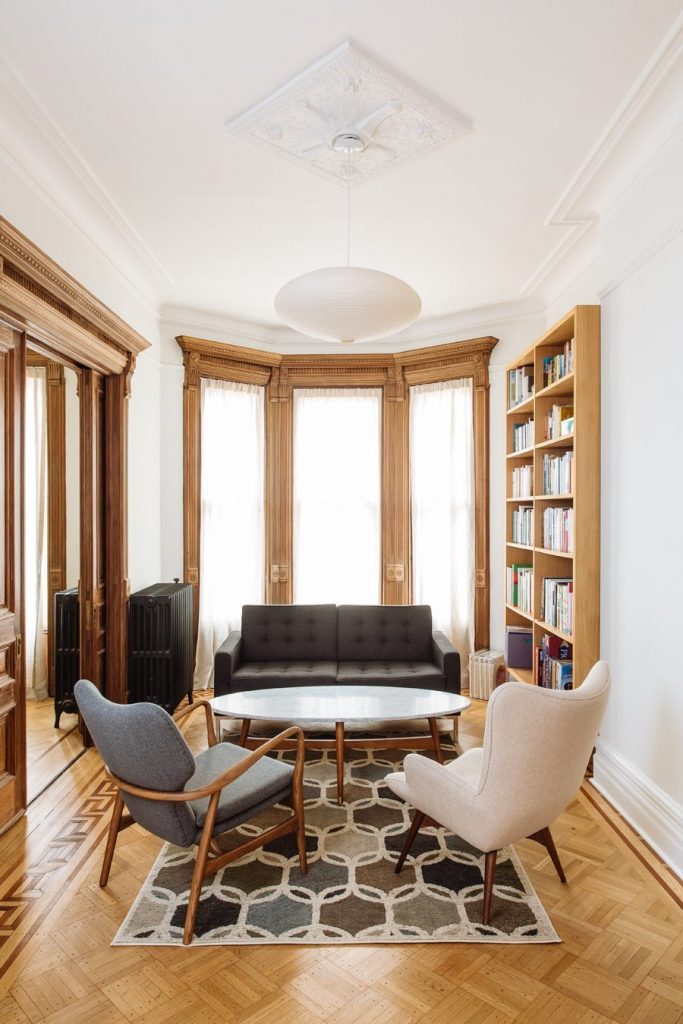
Brooklyn Brownstone

Location: Brooklyn, New York

From the architect: “Located on a tree-lined street in Bedford Stuyvesant, Brooklyn, this late-1800s, three-story brownstone had been held within a family for decades-and fell into disrepair and in desperate need of renovation. Windows had decayed, leaving large gaping holes to the elements beyond. The previous ad-hoc renovations in the 1980s and ’90s carved up the kitchen and bathrooms, creating awkward circulation and dated finishes. This gut renovation aimed to sensitively restore historical details, while introducing contemporary architectural elements and finishes.”

 Photo courtesy of Sonya Lee Architect llc.
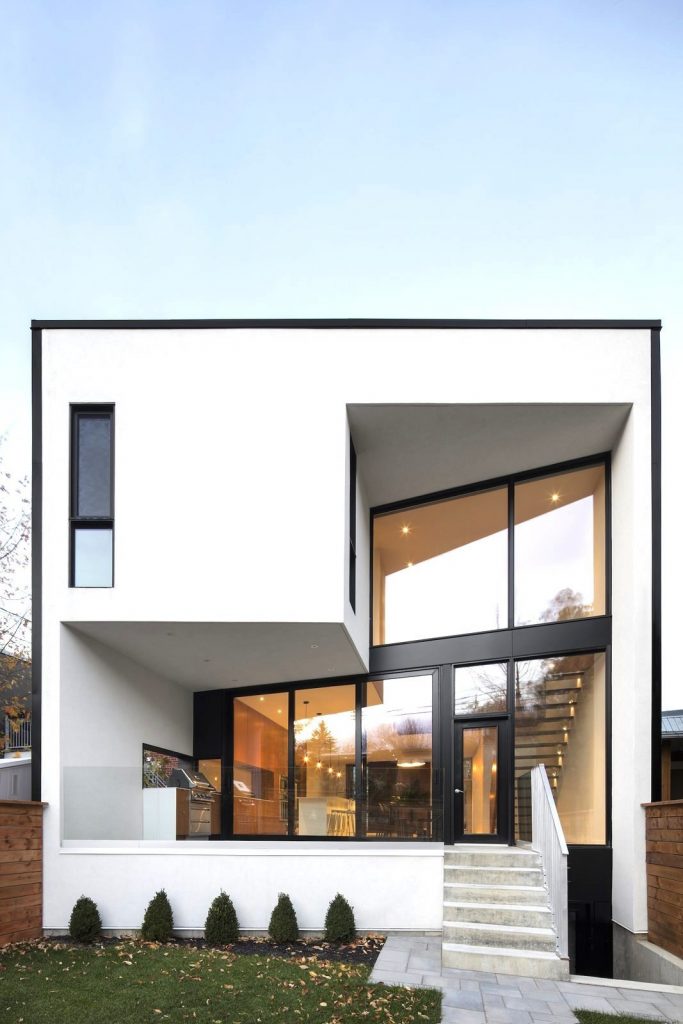
1st Avenue Residence

Location: Montreal, Quebec, Canada

From Leibal: “1st Avenue Residence is a minimalist house located in Montreal, Canada, and was designed by Microclimat. As you step through the door, your eye is drawn to the back of the home, where the kitchen and living spaces extend outside, thanks to impressive windows that frame the backyard. A kitchen counter naturally flows onto the terrace, visually and concretely uniting the two spaces. Cantilevered overhangs in white parging shelter the counter from the elements throughout the seasons and offer a signature look to the back of the building.”

 Photo courtesy of Microclimat and Leibal. Architect: Microclimat.
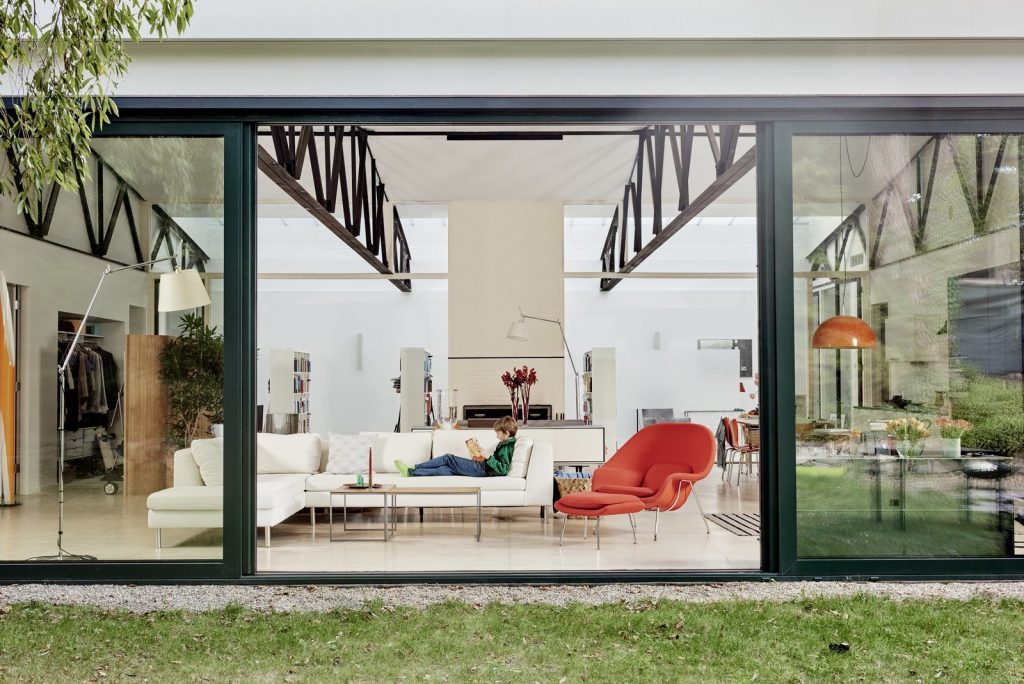
Rudolph House

Location: Cambridge, Massachusetts

From the architect: “Our work included the redesign of the exterior walls and glazing to include a new wall of 10-foot-high, triple-paneled sliding doors and windows on the main facade. These doors open the home to the adjacent courtyard and provide excellent natural ventilation. The roof and the other three exterior walls, which are largely below grade, received insulation in excess of what code requires. All new energy-efficient heating and cooling equipment, including heat-recovery ventilation, was installed to bring the home up to modern standards. The result was a much greater energy efficiency and thermal comfort for the family.”

 Photo: Tony Luong. Architect: Ruhl Walker Architects.

 

read more…

zillow.com

Houseplants help clean the air | North Salem Real Estate

Houseplants can improve your life in many ways (more on that later), but if you’re expecting that peace lily on your desk to rid your home of toxins, you’re in for a surprise.

1989 NASA study attempted to find new ways to clean the air in space stations. Despite some pretty neat findings, it never claimed houseplants are great at removing chemicals from your home’s air — although countless articles have since cited the study as proof of that point.

And the headline “Houseplants Remove Toxins” does sound a lot more exciting than the report’s actual statement:

“Low-light-requiring houseplants, along with activated carbon plant filters, have demonstrated the potential for improving indoor air quality by removing trace organic pollutants from the air in energy-efficient buildings.”

And if you thought that was a buzzkill, the paper’s summary continues to disappoint:

“Activated carbon filters containing fans have the capacity for rapidly filtering large volumes of polluted air and should be considered an integral part of any plan using houseplants for solving indoor air pollution problems.”

In other words, even if your dracaena had the potential to remove trace toxins from your energy-efficient home, you’d still need to recreate NASA’s complicated system, which blows air through the activated carbon in the plant’s root zone.

Furthermore, if you see a list of the best plants for removing toxins, it’s nothing more than a list of the plants used in the study.

So can houseplants purify my air or not?

In theory, yes. But if you’re thinking of making your own botanical air filtration system, you’ve got a lot of work to do.

As an EPA reviewer explained in 1992, “To achieve the same pollutant removal rate reached in the NASA chamber study,” you would need “680 plants in a typical house.”

You’d be better off buying an actual air filtration system or, at the very least, vacuuming more often.

Yes, it’s true that some plants in the NASA list were more effective at removing benzene, trichloroethylene, and/or formaldehyde than others, but the amount is so negligible that neither the American Lung Association nor the EPA recommends using houseplants to improve your air.

Taking it a step further, both organizations warn that houseplants can worsen your air quality, introducing bacteria that grows in damp potting mix or pesticides used by the nursery. Stacey reviewed baby air purifiers and noticed that this danger was mentioned quite a lot. It is like most things in life, do it well and you get the benefits, do it poorly and reap in hidden problems and complications. Plants are great, but they need to be maintained just like everything else.

Don’t let that discourage you from indoor gardening, though. If you’re that worried about your air quality, you’d never step outside in the first place.

In any case, here’s how to keep your houseplants squeaky clean:

    • Dust those leaves! While you’re at it, dust the house.
    • Keep potting mix in its place with an ornamental mulch of river rocks or gravel.
    • Avoid using pesticides whenever possible.
    • Place saucers under each plant to catch excess potting mix.
    • To prevent mold, water plants only when the top half inch of the potting mix is dry.
  • Remove any diseased, yellowed, damaged, or fallen leaves.

Grow houseplants for happiness

True story: I once grew over a hundred plants in my tiny apartment, and I can attest that there was nothing clean about the experience – at all.

Dust filled the air, tree frogs and lizards leaped out of the foliage, and some plants even had stinky fertilizers in the potting mix. Those plants may not have made my air any cleaner, but cultivating a rainforest in the comfort of my home definitely made me a happier person.

Houseplants are a lot more exciting than you’d think. I was actually excited to wake up every morning, because each day brought the promise of a fresh new leaf, a different flower to admire, or another thick orchid root to mist with water.

Helping these living plants grow and thrive gave me a sense of purpose and a connection to the natural world. They also made me sneeze, but only because I spilled potting mix on the floor fairly often.

The only reason you need to grow a houseplant is to be happy. There are, of course, studies suggesting that living with plants improves your concentration, calmness, and productivity, but there’s no point in proving what we already know.

Nobody would bother growing houseplants if they didn’t make us happy.

read more:

zillow bog

Freddie Mac real estate forecast | Cross River Real Estate

Freddie Mac (OTCQBFMCC) today released its monthly Outlook for September, which analyzes the trends that will drive the mortgage market in 2018. These trends include an increase in purchase mortgage volume, a cooling of refinance activity and continued strong house price growth.

Outlook Highlights

  • With 1.33 million housing starts expected in 2018 (up from 1.22 in 2017), new home sales should be the primary driver of sales in 2018. We expect total home sales (new and existing) to increase about two percent from 2017 to 2018.
  • The gradual increase in housing starts and moderate increases in mortgage rates will help to reduce house price growth next year. We forecast U.S. house price growth of 4.9 percent in 2018, compared to a 6.3 percent growth in 2017 through August.
  • With mortgage rates up from last summer’s near-record lows, the potential for rate refinances has diminished. This will cause the refinance share of mortgage activity to decline to 25 percent in 2018, down 23 percent since 2016, and the lowest annual refinance share since 1990.
  • In July 2016, the 30-year fixed-rate conventional conforming rate refinance potential was about $800 billion. In July 2017, it was down to around $300 billion. However, refinance originations have not fallen as much as our estimate. We estimate that total refinance originations for the first half of 2017 are down only about 48 percent from the first half of 2016.
  • Rising home prices have helped existing homeowners increase their home equity. In the second quarter of 2017, the dollar volume of equity cashed out was $15 billion, up $1.2 billion from the first quarter, but down from $19.1 billion in the fourth quarter of 2016. As home prices keep rising, cash out activity is likely to also rise.

Quote: Attributed to Sean Becketti, Chief Economist, Freddie Mac.

“The economic environment remains favorable for housing and mortgage markets. For several years, we have had moderate economic growth of about two percent a year, solid job gains and low mortgage interest rates. We forecast those conditions to persist into next year.

Vermont farmhouse style | South Salem Real Estate

Steven Favreau is the type to go big – and go home.

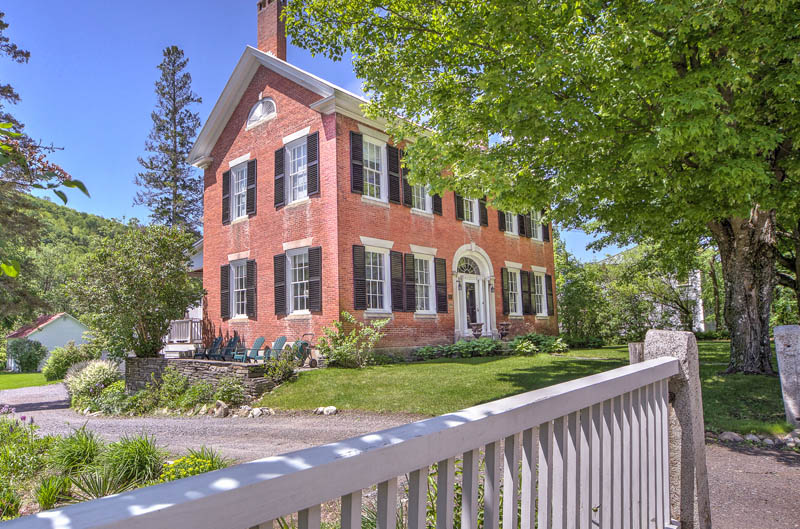
When he set out to put down roots near his hometown of Boston, Favreau fell in love with an old country estate in quaint Chelsea, VT. It was the perfect place for this interior designer to escape from the hubbub of big city life after working with celebrity clients and more.

“It was a quintessential Vermont house in a quintessential Vermont town,” said Favreau, about spotting the house in 2012. “I hopped on a plane and bought it the next week.”

Built in 1832, the house was once owned by a man named Aaron Davis, whose family lived in it for at least 100 years. Davis’ granddaughter eventually sold the 23-acre property in the 1980s, and the new owner converted it into a bed and breakfast. (There’s still a portrait of Davis above one of the home’s five fireplaces.)

After Favreau purchased the 5-bed, 5-bath home, he sought to restore it to its original grandeur – at a frenetic pace. A contractor brought in a crew to rework everything from the wiring (it was a fire waiting to happen) to the wallpaper (there were 8 layers throughout the house). The workers even put in a massive new beam to support the house and keep it from sinking.

“The house sprung back to life and all the old Lally columns fell to the ground,” Favreau remembered. “They heard, ‘Bam-bam! Clank-clank!’ as they jacked it back to life.”

Up next on the designer’s list: keeping the look, feel and integrity of the antique touches, while updating the space to accommodate today’s trends. He tore out a downstairs wall to expand the kitchen to 700 square feet; the master suite got a modern bath with a soaking tub.

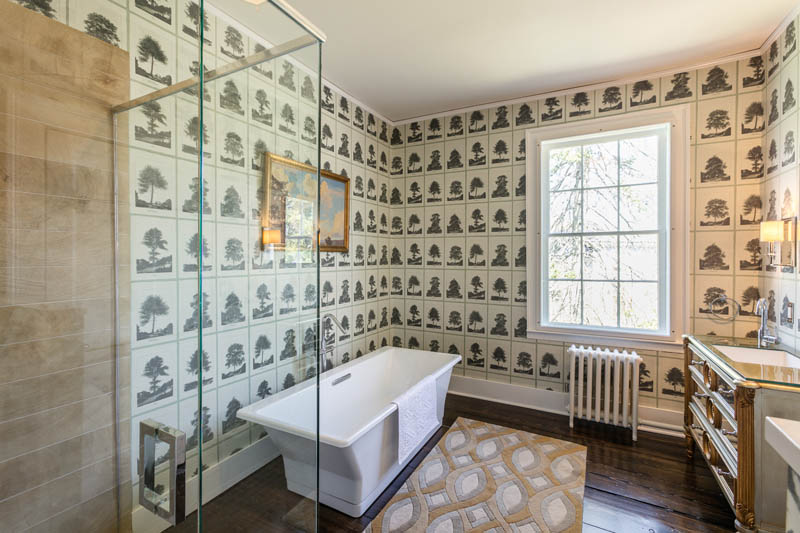
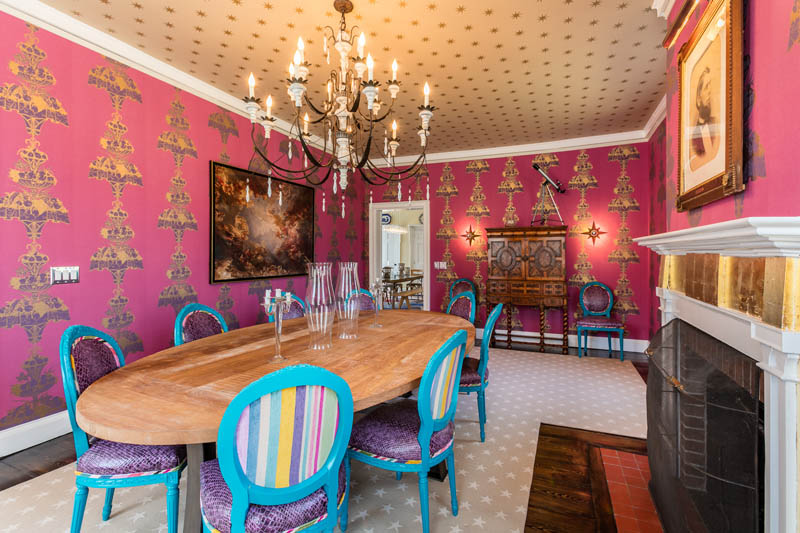
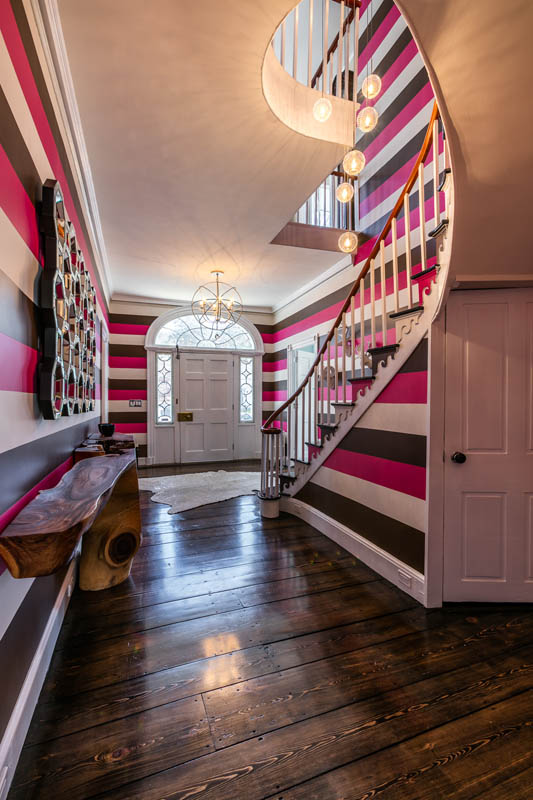
Favreau painted walls in his signature bright colors and added bold wallpaper. In a tip-of-the-hat to the history of the Green Mountain State, he lined the master bathroom with tree-print wallpaper. The dining room got a splash of flamingo pink with a print of Victorian-looking cake plates – a nod to the era in which the house was built.

“What I wanted to use for inspiration was the house and the period of the house, so nodding to the period and updating it with a contemporary aesthetic,” Favreau said. “It says today, but it also says yesterday.”

Some things are distinctly New England. A wooden footbridge connects the main property to 22 secluded acres on the other side of the White River. On warm summer nights, Favreau’s family will pull a dining room table out onto the bridge and dine al fresco.

In the winter, the adjacent land allows for snowshoeing or cross-country skiing.

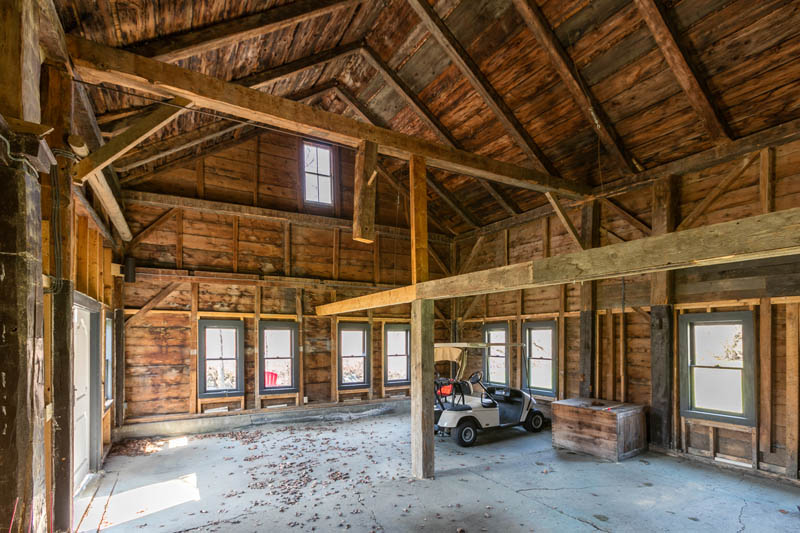
There’s also an old wood barn, which Favreau envisions becoming an event space for weddings or storage. The possibilities for the next owner are limitless, he said.

“It’s a big glorious house, and my family is a big glorious family. We’ve enjoyed it,” he added. “I feel like I’ve loved my time being there and up in Vermont, but it’s time to find the next one. Maybe an oceanside property.”

The home is on the market for $695,000. Zoe Hathorn Washburn of Snyder Donegan carries the listing.


read more:

zillow blog