Spring time in NYC | Mt Kisco Real Estate

Ah, spring. The days get longer, the weather starts to warm up and—in New York City, circa 2020—there are at least these 14 other reasons to get excited.

1.  The spinning wheel has got to go ’round. Coney Island’s amusement parks open on April 4, which will mark an auspicious occasion: 100 years since the Wonder Wheel debuted. Over the past century, millions have sat in one of the Ferris wheel’s enclosed cages and surveyed the rides, boardwalk and ocean from up high. While you’re down in Coney, make sure to enjoy a couple of the Wonder Wheel’s cronies: the wooden Cyclone roller coaster (est. 1927) and hot-dog fave Nathan’s (est. 1916). —Andrew Rosenberg

2.  Hudson Yards is getting an Edge. The City’s latest observation deck, Edge (opening March 11), will also be its highest open-air platform for taking in the vistas.­ Bird’s-eye views of Manhattan’s skyline may be nothing new, but looking down 1,000-plus feet through a glass floor certainly is. Yikes! —Brian Sloan

3.  Our Instagram feeds will be well fed. Yayoi Kusama is coming. In May, the New York Botanical Garden will host Kusama: Cosmic Nature across its 250 acres, sprinkling neon colors, polka-dot sculptures and mirrored installations amidst its already eye-catching spring blooms. —Gillian Osswald

4. The music of the ’90s is having a moment. Two of the decade’s preeminent artists are playing big shows in NYC: Radiohead frontman Thom Yorke brings his solo electronic act to Radio City on March 30 and Hammerstein Ballroom on March 31 and April 1. Also on March 30, Pearl Jam rocks Madison Square Garden. How good will the show be? We have a feeling you’ll give it a 10. —Christina Parrella

5.  We’ve got other decades covered, too. Fans of Carly Simon can anticipate a tribute to her that features Cyndi Lauper, the Indigo Girls, Michael McDonald and many more at Carnegie Hall on March 19. Other big shows include Billie Eilish at Barclays Center (March 20); Blood Orange at Radio City (March 21); Lisa Loeb at Le Poisson Rouge (March 22); Elton John at Madison Square Garden (April 6–7) and Barclays (April 10–11); The Darkness at Webster Hall (May 13); Fetty Wap at Gramercy Theatre (May 18); Madness at Hammerstein Ballroom (May 22); Kesha and Big Freedia at Pier 17 (May 28); and continued residencies from Billy Joel at MSG (March 19, April 10 and May 2) and They Might Be Giants, playing Flood, at Bowery Ballroom (April 11 and May 9). —nycgo.com staff

6.  Plus, it’ll be a vintage season for wine and song. City Winery’s spacious new waterfront venue at Hudson River Park’s Pier 57 promises barrels of fun (and wine and music and views). Who can it be playing the first month? It’s singer-songwriter Colin Hay, the voice behind Men at Work (April 7–8). And nothing compares to the rest of the early lineup, which includes Sinéad O’Connor (April 13, 14 and 16) and Graham Parker (May 19 and 21). —AR

7. There will be bonnets to behold. New Yorkers never pass up an opportunity to dress up, and the Easter Parade and Bonnet Festival (April 12) is no exception. Judging by last year’s looks, we’ll see plenty of floral headpieces, spring-themed ensembles and pastel pageantry on the stroll up Fifth Avenue. —GO

8.  Art is all around. If you’ve ever wondered about Jackson Pollock’s work before he adopted his drip-and-splatter technique, check out Away from the Easel: Jackson Pollock’s Mural at the Guggenheim Museum. The exhibition (opening March 28) displays a giant colorful mural Pollock painted for the entrance of Peggy Guggenheim’s Manhattan townhouse. It’s the piece’s first NYC appearance in more than 20 years. Over at The Met, the Costume Institute presents its spring exhibition, About Time: Fashion and Duration. The exhibition (opening May 7) traces the timeline of fashion from the 1870s to the present. —CP

9.  A Watergate-era thriller will be a topic of conversation. 1974 was a landmark year for film, headlined by Chinatown and Francis Ford Coppola’s The Godfather Part II. But a less showy Coppola release of the time, The Conversation, may be more resonant than either thanks to its handling of queasy topics like surveillance, privacy and paranoiaHead to the Film Forum to catch a screening of a restored 35mm print (March 20–April 2). Gene Hackman and John Cazale star; pre-fame Cindy Williams, Harrison Ford and Teri Garr show up too. —AR

10.  Broadway’s going to have Company. A new production of Stephen Sondheim’s ode to singlehood, which took London by storm, comes to New York. Its twist: the main role of bachelor Bobby becomes single lady Bobbie. Katrina Lenk (The Band’s Visit) takes the lead, with Patti LuPone (War Paint) serving up “The Ladies Who Lunch” as Joanne. —BS

11.  We’ll see every side of comedy. Three funny festivals come to NYC, led by the return of the Brooklyn Comedy Festival (March 30–April 5). Its lineup befits the borough’s alt-comedy sensibilities; highlights include NPR’s Ask Me Another, hosted by Ophira Eisenberg, at the Bell House (April 1), and Jo Firestone hosting Friends of Single People at Littlefield (April 2). Chris Gethard spins his Beautiful/Anonymous podcast into Beautiful Cononymous (May 14–17), which opens with Gethard watching the movie Contact and then discussing it with a podcast caller who told him he should see it. The Satire and Humor Festival (March 27–29), at Caveat and The Magnet, focuses on those who elicit laughter through the written word, featuring favorites from The New Yorker and The Onion. Spring also brings Ali Wong’s run at the Beacon Theatre (March 29–April 4), Demetri Martin at the Bell House (April 7–8), Bill Bellamy at Carolines (April 9) and Jim Gaffigan at Radio City (April 9–11). —nycgo.com staff

12.  A rebel and his bike are back. Pee-Wee’s Big Adventure returns to the big screen for a 35th anniversary celebration at the Beacon Theatre (March 25–26). Pee-Wee himself, Paul Reubens, will be on hand for a live presentation and Q&A if you want to ask him if there’s a basement in the Beacon. —BS

13.  This could be the last season of baseball as we know it. Are we being a tiny bit dramatic? Probably. But the existing structure of the minor leagues is precarious, and this could be the last stand for the Staten Island Yankees. The Brooklyn Cyclones, the Mets’ New York–Penn League affiliates, may change leagues after this season. If some reports are to be believed, this may be your final chance to see pitchers bat in Mets games—the designated hitter could arrive in the National League as soon as 2021. There may be no major changes evident for the Yankees, save for adding Gerrit Cole to their rotation—but that acquisition could help end their 10-season championship drought (normal for most teams, but not the perennial contenders in the Bronx). —nycgo.com staff

14.  There’s a new Strand location on the Upper West Side. It opens in March. And that’s not all the City has to offer bookworms.—nycgo.com staff

Home Price Appreciation up 3.8% | South Salem Real Estate

National home prices continued to increase in December 2019. Nineteen metro areas had positive home price appreciation while Cleveland saw home price decline in December.

The S&P CoreLogic Case-Shiller U.S. National Home Price Index, released by S&P Dow Jones Indices, rose at a seasonally adjusted annual growth rate of 5.7% in December, following a 5.8% increase in November. On a year-over-year basis, the S&P CoreLogic Case-Shiller U.S. National Home Price NSA Index posted a 3.8% annual gain in December, up from 3.5% in November. It was the highest year-over-year gain since February 2018. Home prices are expected to continue rising in 2020 as tight inventory remains a concern.

Meanwhile, the Home Price Index, released by the Federal Housing Finance Agency (FHFA), rose at a seasonally adjusted annual rate of 7.6% in December, after a 3.3% increase in November. On a year-over-year basis, the FHFA Home Price NSA Index rose by 5.2% in December, after an increase of 5.0% in November.

In addition to tracking home price changes nationwide, S&P also reported home price indexes across 20 metro areas. In December, the annual growth rates of the 20 metro areas ranged from -1.6% to 11.4%, while nine of the 20 metro areas exceeded the national average of 5.7%. Among the 20 metro areas, Phoenix, Seattle and San Francisco had the highest home price appreciation in December. Phoenix led the way with an 11.4% increase, followed by Seattle with a 9.4% increase and San Francisco with an 8.7% increase. Cleveland (-1.6%) had negative home price appreciation in December.

read more…

http://eyeonhousing.org/2020/02/home-price-appreciation-continues-in-december/

Mortgage Delinquencies Reach Historic Low | Waccabuc Real Estate

In the fourth quarter of 2019, the delinquency rate for mortgage loans on single-family homes1 decreased to 3.8% of all loans outstanding, according to the latest iteration of the Mortgage Bankers Association’s National Delinquency Survey. This is the lowest it has been since the series started in 1979. The delinquency rate includes loans that are at least one payment past due but does not include loans in the process of foreclosure. Additionally, the “seriously delinquent” rate, the percentage of loans that are 90 days or more past due or are in the process of foreclosure decreased to 1.8%, the lowest it has been since 2005.

The above figure shows the serious delinquency rate of all loans and its components, FHA and VA loans, which are government-insured mortgages, and conventional loans. The seriously delinquent rates of FHA and VA loans increased from the previous quarter. For the fourth quarter of 2019, the five states with the lowest seriously delinquent rates were Colorado, California, Washington, Arizona, and Oregon and the five states with the highest seriously delinquent rates were Puerto Rico, New York, Mississippi, Louisiana, and Maine.


Notes:

  1. For simplicity, the term “single-family” is used but denotes one- to four-unit residential properties.

read more…

http://eyeonhousing.org/2020/02/mortgage-delinquencies-reach-historic-low/

New Freddie Mac Survey Shows Affordability Continues to Drive Purchase and Rental Decisions | Cross River Real Estate

Renters and Homeowners Consider their Options Given Low Mortgage Rates 

Key Findings:

  • An unprecedented number of renters (84%) believe renting is more affordable than owning, an all-time high for the survey and up 17 percentage points from February 2018.
  • Regardless, affordability issues continue to affect renters more than owners, as 42% of renters paid more than a third of their household income on rent compared to 24% of owners on their mortgage.
  • Given low interest rates, 40% of renters plan to purchase a home and 46% of owners plan to renovate in the next several months.

A new Freddie Mac (OTCQB: FMCC) survey shows that affordability remains top of mind for those individuals looking to rent or purchase a home. In fact, Freddie Mac’s “Profile of Today’s Renter and Owner” shows that while vast majorities of renters and owners believe their current living situation is the most affordable option, issues of affordability remain pervasive. The findings also document the impact of the current interest rate environment on buying preferences, and highlight the housing preferences of Baby Boomers in particular.

“The housing market is strong and, based on our survey, the low mortgage rate environment may inspire both renters and owners to make an educated move this spring,” said David Brickman, CEO of Freddie Mac. “While Baby Boomers tend to be satisfied with their current housing situation, younger generations are still struggling to determine whether to rent or purchase a home, largely due to lack of supply and affordability constraints.”

Renters Perceive Renting as More Affordable

When it comes to renting, the survey finds that an unprecedented number of renters (84%) believe renting is more affordable than owning, an all-time high for the survey and up 17 percentage points from just two years ago in February 2018. Additionally, a majority (62%) of renters continue to be satisfied with their rental experience, down slightly from 66% in 2018. In fact, 73% of renters feel that minor or no renovations should be made to their rental property—another strong sign they’re happy with their current rental.

However, while renters do feel renting is the more affordable option, the new survey does paint a concerning picture about many renters’ ability to make housing work within their family budget. Specifically:

  • Forty-two percent of renters surveyed are currently cost-burdened, i.e., paying more than one-third of their income for rent, up eight points from just April of 2019. This is compared with only 24% of owners spending the same amount, a number that has not changed in recent years.
  • Eighteen percent of renters are not interested in ever purchasing a home, up four points from August 2017.
  • Renters are growing more concerned about their rent going up in the next 12 months (69%) and not being able to pay for their larger expenses (68%).
  • Sixty-seven percent of renters have made spending changes or have moved to afford their monthly housing payment, up five points from April 2019. Among those who live in rural areas, 70% made changes to afford their monthly payment (up from 59% in April 2019). Eighty-two percent of renters in the “essential workforce” also had to adjust (up from 76% in April 2019).
  • Half of all renters are finding it difficult to find affordable housing that is close to work, up 22% since April 2019. This includes 57% of essential workers, up 23% from April.

Interest Rate Environment

With mortgage rates near historic lows, both renters and homeowners are interested in taking advantage of low rates in the next several months. In fact, 40% of renters plan to purchase a home given current interest rates.

Forty-six percent of owners plan to renovate their home. In addition:

  • Twenty-nine percent of owners plan to refinance;
  • Twenty-seven percent would like to purchase a new home or additional investment property;
  • Twenty-six percent plan to sell their current home and purchase a smaller one; and
  • Twenty-four percent think it is likely they would sell and purchase a larger home.

The survey also finds that Baby Boomers are the least likely to take action in the low mortgage rate environment.

Boomers are Comfortable and Unnerved by Rate Changes

As compared to other generations, Baby Boomers stood out in the survey. As owners, they are highly satisfied (71%) with their overall experience and prefer to live in a small home (61%). Similarly, Boomer renters are more satisfied (50%) with their rental experience as compared to other generations (older Millennials 39%, Gen X 35%, younger Millennials 33%).

Further, growing portions of Boomer renters (27%) say they will never move, as compared to Gen X (9%) and Millennials (6%). The same is true for Boomer owners, with an increasing percentage (34%) saying they will never move, as compared to Gen X (18%) and Millennials (8%).

Freddie Mac contracted with Harris Insights & Analytics to conduct the online survey over a four-day period, beginning August 22. The poll collected data from 4,012 respondents over the age of 18, including 2,715 homeowners, 1,233 renters and 64 others. The data has been weighted to reflect the composition of the U.S. adult population. Additional findings from Freddie Mac’s survey can be found here.

Buying property in Molise Italy | Katonah Real Estate

buy a property in Molise

Have you ever heard about Molise?

Molise is a small region in the south of Italy. Molise is not a famous region, it is still off the tourist track but this doesn’t mean that this area has nothing to offer to its visitors.  There are beautiful sanctuaries, churches, abbeys, castles, medieval villages, lakefront properties for sale, and wonderful archeological sites.

Molise: where the nature is wild and uncontaminated, the climate is mild and just in one hour it’s possible to move from the sandy beaches of the Adriatic sea to the green mountains and clay hills.

Why should you buy a property in Molise?


Buy a house in Molise is an excellent investment: the region is in a perfect position (3 hours driving from Rome, 2 from Naples and the Amalfi Coast) and property prices are still low.

Just to give you an idea…

You can buy a stone town house for only 3.800Euros (approx $4.200 – £2693- http://bit.ly/1VpHZaZ) or small one-bed apartment for 6.500Euros ($7,188 – £4.607- http://bit.ly/1Ii8kE4) or a country house with land for 18.000Euros ($19.900 – £12.758- http://bit.ly/1OuLKaB ).

Of course all those properties need a complete restoration.

buy a property in Molise

Even if Molise is still uncontaminated by the global market, the “second houses” market is growing up and actually is very lively (despite the worldwide real estate crisis). Many foreign buyers and investors are buying in this lovely area for many reasons. I’ve written down the five top reasons why people should buy a property in Molise:

  • THE COST OF LIVING IS RELATIVELY LOW Molisan people live in small villages with a monthly wage of 800-900 euros;
  • HOSPITALITY Molisan people are very welcoming and happy to meet new people. You will feel part of a big family!
  • MOLISE IS AWAY FROM TOURISTS you won’t find a multi-races population, the few “foreign” families are well integrated with the local inhabitants
  • THE POSSIBILITY OF LIVING THE REAL ITALY WHERE PEOPLE STILL KEEP THE ORIGINAL TRADITIONS each place holds the authentic flavour of its history, people still celebrate ancient rites which have been repeated with every passing season, the ancient trades are handed down from father to son. In these villages there are craftsmen who have remained untouched by industrialization and are still producing uniquely and precious objects
  • BREATH-TAKING SCENERIES, QUIET AND PEACEFUL VILLAGES the region is characterised by different types of mountain ranges and with its great variety of climate, it lends itself to many different sports-trekking, horse-riding,cycling, canoeing, skiing and climbing.Living in this small slice of Italy can be easy and healthy.Molise could be a very safe place to buy your second home in Italy!

read more…

NYS median home sales price rises 7.4% | Bedford Hills Real Estate

Albany, NY – A strong economy sent buyers in search of their dream home in 2019, yet many were constrained by low inventory levels all year, according to the housing report released today by the New York State Association of REALTORS®.

Low inventory in 2019 continued to push median sales prices up for the year. Inventory of homes for sale fell 8.4 percent to 56,214 units in 2019 compared to 2018. Median sales prices, in turn, climbed 7.4 percent to $290,000 compared to last year. December marks the 47th consecutive month that the median sales price was up in month-over-month comparisons.

In 2019, closed sales were down slightly – 1.1 percent to 131,656 units. New listings did inch up 0.6-percent in 2019 to 206,192 units compared to 2018. Pending sales were also up 3.0 percent to 136,497 homes year-to-date.

Mortgage rates in 2019 were up slightly on a 30-year fixed mortgage to 3.94 percent, according to Freddie Mac, yet they are still over a half a percent lower than they were in 2018, helping to balance affordability concerns caused by continued price appreciation.

New listings did inch up 0.6-percent in 2019 to 206,192 units compared to 2018. Pending sales were also up 3.0 percent to 136,497 homes year-to-date.

In 2019, due to the low inventory, buyers did receive 97.4 percent of list price, up 0.1-percent from 2018.

Data and analysis compiled for the New York State Association of REALTORS® by Showing Time Inc.

December 2019

read more…

https://www.nysar.com/news/market-data/

Minority homeownership rate increases | Bedford Real Estate

The minority homeownership rate increased to 48.6 percent in the fourth quarter of 2019, up 0.8 percentage points from the fourth quarter of 2018, according to a new data release from the Census Bureau’s Housing Vacancies and Homeownership survey (CPS/HVS) (Figure 1). This is the highest it has been since the third quarter of 2011 (48.9 percent). This year-over-year gain is higher than the gain in the overall U.S. homeownership rate, which rose 0.3 percentage points to 65.1 percent in the fourth quarter of 2019 (a six-year high). A separate Eyeonhousing.org post covers the U.S. homeownership rate in more detail.

Breaking down the minority homeownership rate shows that the Hispanic homeownership rate gained the most in the fourth quarter, with a 1.2 percentage point increase to 48.1 percent (from 46.9 percent in the fourth quarter of 2018).

The black homeownership rate posted the second largest gain of 1.0 percentage points to reach 44.6 percent in the fourth quarter of 2019 (from 43.6 percent in the fourth quarter of 2018). This is the largest quarter gain in the black homeownership rate since the first quarter of 2017.

Meanwhile, Other households (Asian, Pacific-Islander, Native American, and other race households) experienced a decline in their homeownership rate, dropping 1.0 percentage points to 57.1 percent (from 58.1 percent in the third quarter of 2019). The Other homeownership rate has now declined for four consecutive quarters (year-over-year declines), which is in contrast to strong gains seen for this group between the second quarter of 2017 and the third quarter of 2018.

The white homeownership grew by only 0.1 percentage points to 73.7 percent in the fourth quarter (from 73.6 percent in the fourth quarter of 2018). The white homeownership rate has not declined year-over-year since the first quarter of 2017 (Figure 2).

Mortgage rates are still relatively low, and a healthy job market has helped to make homeownership more affordable. In fact, housing affordability was at a three-year high in the third quarter of 2019, according to the National Association of Home Builders’ Housing Opportunity Index (HOI). These factors are most likely contributing to the recent upticks in the overall and minority homeownership rates.

read more…

http://eyeonhousing.org/2020/02/minority-homeownership-rate-posts-a-year-end-gain/

Single family rent prices increase 3% | Pound Ridge Real Estate

Price of low-end rentals still outpacing higher-end homes

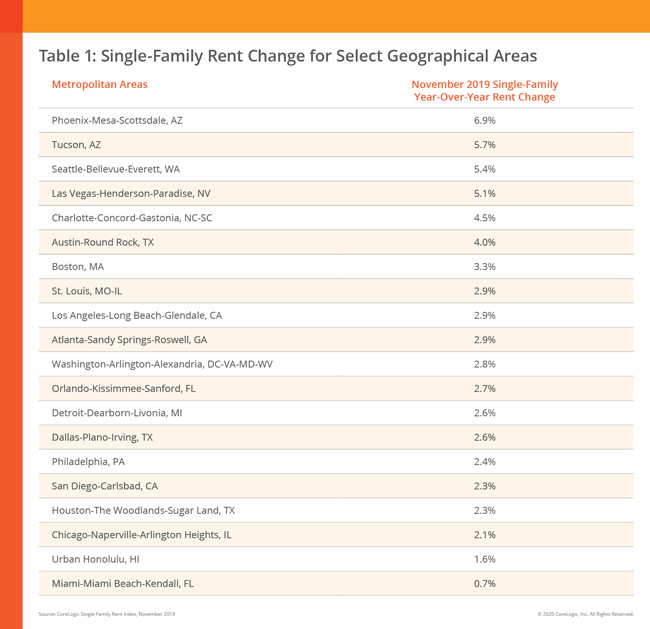
Single-family rent prices increased 3% in November 2019 over the same time period in the previous year, according to CoreLogic’s Single-Family Rent Index,

In October, low-end rent prices went up 3.6%, while high-end price gains rose 2.9%.

(Image courtesy of CoreLogic. Click to enlarge.)

Overall, year-over-year rent price increases have slowed down since February 2016. During this time, they peaked at 4.2%, and stabilized at around 3% since early last year.

November 2019 was the 67th month in a row that low-end rentals propped up national rent growth, the report said.

Low-end rental prices increased 3.6% year over year in November 2019, down slightly from November 2018’s rent gain of 3.8%.

High-end rentals increased 2.7% in November 2019, and the report says this remains unchanged from the previous year.

For the 12th month in a row, Phoenix has the highest year over year increase in single-family rent prices in November, at 6.9%. Neighboring town Tucson had the second-highest rent price growth, with gains of 5.7%.

Miami had the lowest rent increase in November, at 0.7%. Miami had the lowest amount of rent increase in October as well, at 1%, the same amount of increase it saw in September.

For October, Phoenix was the market that saw the highest uptick in rent, with the highest year over year increase in single-family rents at 6.8%, according to CoreLogic.

“Strong rent growth in the Southwest reflects strong population growth in this part of the U.S.,” said Molly Boesel, principal economist at CoreLogic. “Arizona ranked third for population growth in 2019 by both number and percentage increase, according to the U.S. Census Bureau. In contrast, Illinois and Hawaii both had a decrease in population in 2019, which could account for the slower rent growth in these regions.”

read more…

Remodeling market rising | Bedford Corners Real Estate

The National Association of Home Builders’ (NAHB) Remodeling Market Index (RMI) posted a reading of 58 in the fourth quarter of 2019, up three points from the previous quarter (Figure 1). The RMI has been consistently above 50—indicating that more remodelers report market activity is higher compared to the prior quarter than report it is lower—since the second quarter of 2013. The overall RMI averages current remodeling activity and future indicators.

Current market conditions increased two points to 56 in the fourth quarter of 2019 (Figure 2). Among its three major components, major additions and alterations gained four points to 56, minor additions and alterations increased by one point to 54 and the home maintenance and repair component rose one point to 58.

The future market indicators gained three points to 60 in the fourth quarter (Figure 3). Calls for bids increased by three to 58, amount of work committed for the next three months gained three points to 57, the backlog of remodeling jobs jumped five points 64 and appointments for proposals increased by two points to 62.

The fourth quarter RMI reading reflects solid demand for remodeling, supported by a strong overall economy and low interest rates. Remodelers still face challenges in the market, including skilled labor shortages, making it harder to work off a backlog quickly.

For the full RMI tables, please visit www.nahb.org/rmi. For more information about remodeling, visit www.nahb.org/remodel.

read more…

http://eyeonhousing.org/2020/01/remodelers-confidence-increases-in-fourth-quarter-of-2019/

Home prices up 4.9% for year | Chappaqua Homes

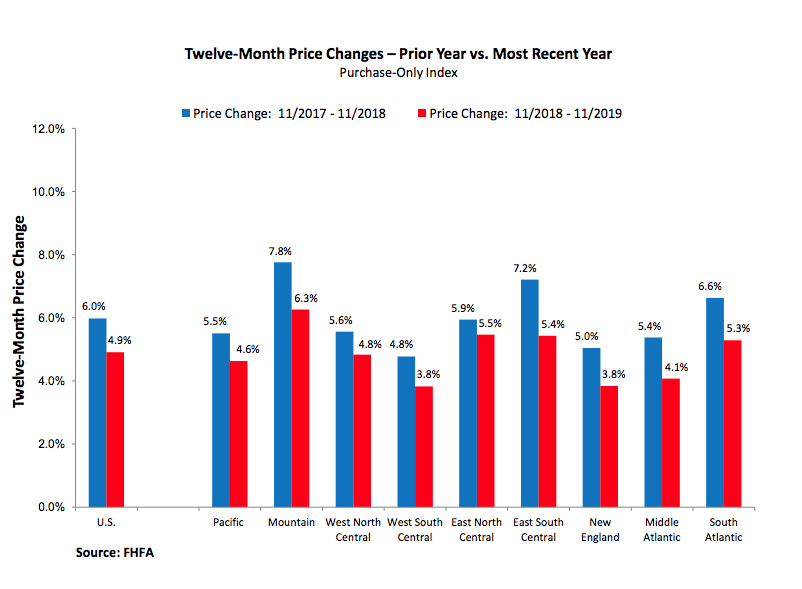
Home prices increased in November, rising only 0.2% from the previous month’s revised pace, but up 4.9% from 2018, according to the latest monthly House Price Index from the Federal Housing Finance Agency.

The FHFA monthly HPI is calculated using home sales price information from mortgages sold to or guaranteed by Fannie Mae and Freddie Mac. Because of this, the selection excludes high-end homes bought with jumbo loans or cash sales.

The report explains that across the nine census divisions, the East North Central division saw the strongest appreciation growth, increasing by 0.8% November, whereas the Mountain division experienced no growth, as appreciation declined 0.1%.

However, the FHFA highlights that the 12-month changes were all positive, with the New England and the West South Central divisions posting the smallest gain of 3.8%, and the Mountain division leading the way with a 6.3% increase.

These are the states located in each division mentioned:

East North-Central: Michigan, Wisconsin, Illinois, Indiana, Ohio

Mountain: Montana, Idaho, Wyoming, Nevada, Utah, Colorado, Arizona, New Mexico

New England: Maine, New Hampshire, Vermont, Massachusetts, Rhode Island, Connecticut

West South Central: Oklahoma, Arkansas, Texas, Louisiana

The chart below compares 12-month price changes to the prior year:

read more…