Mortgage rates average 3.36% | North Salem Real Estate

Freddie Mac (OTCQB: FMCC) today released the results of its Primary Mortgage Market Survey® (PMMS®), showing that the 30-year fixed-rate mortgage (FRM) averaged 3.26 percent.

“Mortgage rates stayed at or near record lows for the fifth straight week and homeowners are taking advantage with refinance activity remaining high,” said Sam Khater, Freddie Mac’s Chief Economist. “Although purchase demand declined thirty-five percent year-over-year in mid-April, demand has improved modestly over the last three weeks.”

News Facts

  • 30-year fixed-rate mortgage averaged 3.26 percent with an average 0.7 point for the week ending May 7, 2020, up from last week when it averaged 3.23 percent. A year ago at this time, the 30-year FRM averaged 4.10 percent.  
  • 15-year fixed-rate mortgage averaged 2.73 percent with an average 0.7 point, down from last week when it averaged 2.77 percent. A year ago at this time, the 15-year FRM averaged 3.57 percent.  
  • 5-year Treasury-indexed hybrid adjustable-rate mortgage (ARM) averaged 3.17 percent with an average 0.3 point, up from last week when it averaged 3.14 percent. A year ago at this time, the 5-year ARM averaged 3.63 percent.

Average commitment rates should be reported along with average fees and points to reflect the total upfront cost of obtaining the mortgage. Visit the following link for the Definitions. Borrowers may still pay closing costs which are not included in the survey.

Hudson Gateway Association of Realtors news

Dear HGAR Members:
Here are today’s Daily Updates – May 8, 2020:
NEW YORK STATE NEWS
Cuomo Says, ‘We Have the Beast on the Run.’Bolstered by continued statewide data that shows a decline in overall hospitalizations, intubations, new cases and deaths, Gov. Andrew Cuomo told reporters today at his daily COVID-19 briefing that the state is now in control of its own destiny in dealing with the Coronavirus.
He said that for the first time he believes the state is ahead of the virus. “We have the beast on the run,” Cuomo said.
However, the governor seemed to confirm what many observers have believed, that the re-opening of the downstate economy will not begin once his “New York on Pause” COVID-19 restrictions expire on May 15.
The governor told reporters that it is very likely that he will begin his multi-phased re-opening plan in areas upstate with the construction and manufacturing industries after May 15 and said that the current downstate data does not support the lifting of any restrictions here. A total of 216 people died from COVID-19 in New York State on Thursday, May 7, down from 232 fatalities a day earlier. See Bloomberg News story.
New York State Seeking $60B in Next Fed. Coronavirus Aid PackageNew York officials said on Thursday that the state requires at least an additional $60 billion in direct federal funding along with millions of dollars more from Medicaid and FEMA formula changes in the next Coronavirus aid package.
The state’s request, which is part of the National Governors Association’s bid for $500 billion for all states and territories, would be spread over three fiscal years and could be used for revenue shortfalls, according to the association. See Newsday story.
Senators Propose Bill to Help Local GovernmentsU.S. Senate Democratic Leader Charles E. Schumer, U.S. Senator Kirsten Gillibrand, U.S. Congressman Antonio Delgado, and U.S. Congressman Lee Zeldin announced new legislation, the “Direct Support for Communities Act,” which provides local governments with direct federal relief that can be used to pay for essential services and offset lost revenues and increased costs from the COVID-19 emergency. The local assistance would complement critical relief that states also require in this crisis, which the representatives are simultaneously aggressively pursuing.
The unspecified funding under the Direct Support for Communities Act would be a critical part of a larger state and local relief package to be considered by Congress.
“Under our proposal, counties, cities, towns, and villages of all sizes could count on direct, guaranteed financial relief, instead of having to layoff vital workers, cut important services, or raise taxes and fees at absolutely the worst time,” Sen. Schumer said. “Local governments deserve nothing less than our strongest federal support, and I am doing everything I can to get significant and flexible federal aid to our states and local governments included in the next legislative package Congress considers.” See announcement at schumer.senate.gov.
NATIONAL NEWS
How are Offices Preparing for the Return of Workers?Offices are preparing their spaces for a post-pandemic world. Companies are bringing in thermal cameras, HVAC systems that can fight bad germs, contactless coffee machines, and more as employees prepare to return to company offices in some areas of the country.
“What’s important about the COVID world is that people still feel comfortable and it feels warm and inviting when they enter the building, especially after being on the trains and buses and walking in their masks,” Craig Deitelzweig, CEO of Marx Realty, told The Real Deal. “Everyone wants a hospitality feel but now they will work together, six feet apart.” See Realtor Magazine story.
Suburban Office Markets Could Get Stronger Post PandemicMoody’s Analytics in a recently released report indicates that suburban office properties may make some gains over their rival central business district spaces post Coronavirus.
The analysis says businesses may be prompted to consider factors expected to affect ensuing demand on office space, particularly with concerns over COVID-19 and communication systems that allow employees to work from home, according to a report at Globest.com
“For many years, suburban office space fell out of favor because of the resurgence of U.S. cities,” said Ryan Severino, chief economist at Jones Lang LaSalle. “Is this COVID-19 crisis going to spur renewed interest in suburban markets, as households and employers move out of cities? Time will tell.” See story at GlobeSt.com. See full report at Moodys.com .
NAR NEWS
VIRTUAL REALTORS® LEGISLATIVE MEETINGS WEEK of MAY 11-15thDon’t miss this great opportunity to attend these Live Streamed Events. Click Here for Live Streamed Events Schedule.Full Details on all meetings and to Pre-Register go to https://www.legislative.realtor/.
NYSAR UPDATES
Go to the NYSAR FAQ’s which were updated on May 7th with regards to:How does the COVID-19 pandemic impact Fair Housing? Can I ask a client/customer/consumer if they have been exposed to COVID-19?Can I go to a property where nobody is present (meaning if individuals reside there, everyone has left the property) to view it or take photographs for a listing? (updated 5/7/20)


Please continue to check for updates on HGAR.com COVID-19 Resources.

Stay safe and stay well.
Sincerely,
Richard Haggerty, HGAR CEO

Residential construction spending rises 9% | Waccabuc Real Estate

NAHB analysis of Census Construction Spending data shows that total private residential construction spending stood at a seasonally adjusted annual rate (SAAR) of $550.3 billion in March. It was up 2.3% in March, after decreasing 4.8% in February. On a year-over-year basis, total private construction spending rose 8.8%.

The monthly gains are largely attributed to the growth of spending on improvements and multifamily construction. Private residential improvements, which include spending on remodeling, major replacement, and additions to owner-occupied housing units, increased to $189.0 billion annual pace in March, up 10.2% over the February estimates. Multifamily construction spending inched up 2% in March, following an increase of 1.2% in February. Spending on single-family construction slipped 2.0% in March, the first dip since July 2019, due to the virus impacts.

The NAHB construction spending index, which is shown in the graph below (the base is January 2000), illustrates the solid growth in single-family construction and home improvement from the second half of 2019 to February 2020, before the COVID-19 hit the U.S. economy. New multifamily construction spending slowed down since August 2019, after the strong growth from 2010 to 2016 and a surge from the late 2018 to early 2019.

Spending on private nonresidential construction declined 1.8 percent over the year to a seasonally adjusted annual rate of $462.3 billion. The annual nonresidential spending decline was mainly due to less spending on the class of lodging ($4.3 billion), followed by educational category ($3.6 billion), and amusement and recreation ($2.3 billion).

read more…

www.eyeonhousing.org

Mortgage rates average 3.23% | South Salem Real Estate

Freddie Mac (OTCQB: FMCC) today released the results of its Primary Mortgage Market Survey® (PMMS®), showing that the 30-year fixed-rate mortgage (FRM) averaged 3.23 percent, the lowest rate in our survey’s history which dates back to 1971.

“The size and depth of the secondary mortgage market is helping to keep rates at record lows. These low rates are driving higher refinance activity and have modestly helped improve purchase demand from their extremely low levels in mid-April,” said Sam Khater, Freddie Mac’s Chief Economist. “While many people are benefitting from low mortgage rates, it’s important to remember that not all people are able to take advantage of them given the current pandemic.”

News Facts

  • 30-year fixed-rate mortgage averaged 3.23 percent with an average 0.7 point for the week ending April 30, 2020, down from last week when it averaged 3.33 percent. A year ago at this time, the 30-year FRM averaged 4.14 percent.  
  • 15-year fixed-rate mortgage averaged 2.77 percent with an average 0.6 point, down from last week when it averaged 2.86 percent. A year ago at this time, the 15-year FRM averaged 3.60 percent.  
  • 5-year Treasury-indexed hybrid adjustable-rate mortgage (ARM) averaged 3.14 percent with an average 0.4 point, down from last week when it averaged 3.28 percent. A year ago at this time, the 5-year ARM averaged 3.68 percent.

Average commitment rates should be reported along with average fees and points to reflect the total upfront cost of obtaining the mortgage. Visit the following link for the Definitions. Borrowers may still pay closing costs which are not included in the survey.

New homes sales drop 9.5% | Cross River Real Estate

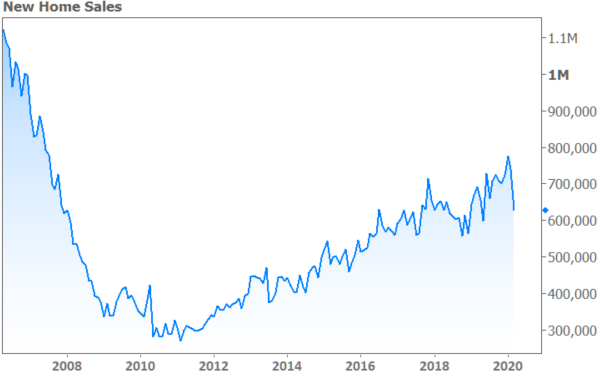
The Census Bureau and Department of Housing and Urban Development’s report on new home sales in March is the first real time indication of the impact the COVID-19 mitigation is having on total sales. The report on existing homes, released a few days ago, largely reflected the closing of contracts booked in February and early March. New home sales are counted at contract signing.

That said, the report shows a significant downturn, with a seasonally adjusted annual sales rate of 627,000 homes. This is a decline of 15.4 percent from the revised (from 765,000) 741,000 units rate in February and was down 9.5 percent from a year earlier.

The results were consistent with the wide range of forecasts from analysts polled by Econoday of 570,000 to 700,000 units. They were, however, well below the consensus estimate of 643,000.

On a non-adjusted basis, the picture was slightly better. There were 61,000 homes sold during the month compared to 66,000 in February, but sales were up by 2,000 units compared to January. For the year-to-date (YTD) there have been 186,000 new homes sold compared to 174,000 for the first three months of 2019. This is a 6.7 percent increase.

Sales were lower in all four major regions although sales in the South maintained a slight edge year-over-year. The Northeast saw sales down 41.5 percent from February and 4.0 percent lower than in March 2019. This is not surprising as Massachusetts and New York have been among the hardest pandemic-hit states. Sales in the West reflected the impact on both California and Washington with a drop of 38.5 percent for the month and 30.8 percent on an annual basis.

The Midwest saw a decline of 8.1 percent and 9.2 percent for the two earlier periods while sales in the South dipped 0.8 percent from February but were up 1.3 percent from the prior March. Despite the March losses, YTD increases were reflected across all four regions ranging from 3.0 percent in the South to 14.7 percent in the Northeast.

There were 324,000 homes available for sale at the end of the reporting period. This was estimated at a 6.4-month supply at the current rate of sales, a big jump from the 5.2 month estimate at the end of February. The median time that a completed home was on the market was unchanged from the prior month at 3.4 months.

The median price of a new home sold in March was $321,400 and the average was $375,300. In March 2019, the corresponding numbers were $310,600 and $372,700.

Robert Dietz, chief economist for the National Association of Home Builders had the following reaction to the new home sales numbers. “The pace of new home sales will post significant declines during the second quarter due to the impacts of higher unemployment and shutdown effects of much of the U.S. economy, including elements of the real estate sector in certain markets. However, given the momentum housing construction held at the start of 2020, the housing industry will help lead the economy in the eventual recovery.”

read more…

http://www.mortgagenewsdaily.com/04232020_new_home_sales.asp

Mortgage purchase applications down 31% | Katonah Real Estate

The Mortgage Bankers Association’s latest Weekly Application Survey shows a 0.3% seasonally adjusted decline in loan application volume from the previous week. The Refinance index decreased by 1% from the previous week and was 225% higher than it was the same week one year ago. The Purchase Index increased 2% from one week earlier but was 31% lower than it was the same time a year ago. The MBA notes that the pandemic-related economic stoppage has caused some buyers and sellers to delay their decisions until there are signs of a turnaround. This has resulted in reduced buyer traffic, less inventory, and March existing-homes sales falling to their slowest annual pace in nearly a year. Most importantly, the economic stoppage has halted the momentum in the housing market generated by young, would-be homebuyers, mostly from the millennial generation, preventing them from entering the market.

With the federal government’s recent passage of the Coronavirus Aid, Relief and Economic Security (CARES) Act, not only did qualifying individuals receive economic impact payments, i.e., stimulus checks, but small businesses were also extended emergency advances of up to $10,000 as part of the Small Business Administration’s economic injury grant. With these measures in place, expanding businesses and families’ balance sheets to accommodate for more real estate is less of a priority than keeping their existing assets afloat. The CARES act also provides options for mortgage forbearance.

As can be seen from the above figure, year-over-year gains in refinancing skyrocketed in the middle of March and continued their upward trajectory towards the end of the second week of April. Year-over-year purchasing changes, however, slipped into negative territory for that period, posting a year-over-year decline of 31% in the latest week. The National Association of Realtors cites that lender credit standards such as higher down payments and credit scores would likely deter home sales’ bounce when the pandemic is over. Before the outbreak, foreclosure rates were at historic lows.

read more…

eyeonhousing.org

Existing sales drop, prices rise | Bedford Hills Real Estate

U.S. home sales dropped by the most in nearly 4-1/2 years in March as extraordinary measures to control the spread of the novel coronavirus brought buyer traffic to a virtual standstill, supporting analysts’ views that the economy contracted sharply in the first quarter.

The National Association of Realtors said on Tuesday existing home sales tumbled 8.5% to a seasonally adjusted annual rate of 5.27 million units last month. The percentage decline was the largest since November 2015.

The data reflected contracts signed in January and February, before the coronavirus paralyzed the economy.

A steeper decline in sales is likely in April, with the normally busy spring selling season in jeopardy. Economists polled by Reuters had forecast existing home sales tumbling 8.1% to a rate of 5.30 million units in March.

Existing home sales, which make up about 90% of U.S. home sales, rose 0.8% on a year-on-year basis in March.

States and local governments have issued “stay-at-home” or “shelter-in-place” orders affecting more than 90% of Americans to control the spread of COVID-19, the potentially lethal respiratory illness caused by the virus, and abruptly halting economic activity. At least 22 million people have filed for unemployment benefits since March 21.

The slump in home resales added to a pile of dismal March reports that have led economists to believe the economy contracted at its sharpest pace since World War Two in the first quarter. The government will publish its snapshot for first-quarter gross domestic product next Wednesday.

The housing market was back on the recovery path, thanks to low mortgage rates, before the lockdown measures. It had hit a soft patch starting the first quarter of 2018 through the second quarter of 2019.

Home sales last month dropped in all four regions. There were 1.50 million previously owned homes on the market in March, down 10.2% from a year ago.

The median existing house price increased 8.0% from a year ago to $280,600 in March. At March’s sales pace, it would take 3.4 months to exhaust the current inventory, down from 3.8 months a year ago. A six-to-seven-month supply is viewed as a healthy balance between supply and demand.

read more…

https://www.reuters.com/article/us-usa-economy-housing/u-s-existing-home-sales-tumble-in-march-idUSKCN22320E?il=0

Fed eases credit for JP Morgan Chase, JP Morgan Chase tightens credit for consumers | Bedford Real Estate

Megabank raises lending standards amid economic struggles to protect themselves

As the country struggles through the economic impact of the coronavirus, numerous mortgage companies have raised their lending standards to protect both borrowers and themselves. Now, one of the largest mortgage lenders in the country is joining that list.

JPMorgan Chase this week is increasing its minimum lending standards to require nearly all borrowers to have at least 20% down in order to buy a home. Beyond that, Chase is also raising its minimum FICO credit score to 700 on purchase mortgages.

Put simply, if a borrower doesn’t have a 20% down payment and a FICO score of 700 or above, they will likely not be able get a loan from Chase to buy a home. According to Chase, those lending standards also apply to refinances on non-Chase mortgages.

The bank will still move forward with refis under its previous lending standards if the loan is either serviced by Chase or in Chase’s portfolio, but for all other refis, it’s 700 FICO or look somewhere else.

It should be noted that the changes do not apply to Chase’s DreaMaker mortgage program, which makes loans available for low-to-moderate income borrowers with as little as 3% down and reduced mortgage insurance requirements.

According to Chase, the changes will allow the bank to spend more time on the loans it is working on and do the appropriate verifications to ensure the loan is the right move for all involved.

“Due to the economic uncertainty, we are making temporary changes that will allow us to more closely focus on serving our existing customers,” Chase Home Lending Chief Marketing Officer Amy Bonitatibus said in a statement.

With the changes, Chase becomes the latest lender to tighten its lending standards. Certain segments of the business, including governmentnon-QM, and jumbo loans, have dried up substantially as lenders pull back from loans that are seen as riskier than conventional loans. But as the crisis continues, lenders are beginning to change their conventional lending standards as well.

United Wholesale Mortgage, the second-biggest mortgage lender in the country, recently announced that it will require reverification of a borrower’s employment on the day their loan is scheduled to close. The purpose of that move is to ensure that borrowers are actually still employed when their mortgage closes.

“If people don’t have a job, I’m not going to put them in a bad position,” UWM CEO Mat Ishbia told his employees last week. “By doing this, we’re protecting borrowers, the company, and the country.”

But UWM wasn’t the only one making employment verification changes as COVID-19 pushes layoffs to record levels in the U.S. Fannie Mae and Freddie Mac recently announced that they changed the age of document requirements for most income and asset documentation from four months to two months. What that means is all income and asset documentation must be dated no more than 60 days from the date of the mortgage note.

The bottom line of all these changes is lenders are attempting to protect themselves and borrowers from getting into a mortgage that is not in the borrower’s or lender’s best interest.

And despite Chase being the biggest name to make changes like these so far, it likely won’t be the last lender to do so.

The changes to Chase’s lending policies were first reported by Reuters.

read more…

housingwire.com/articles/chase

Housing starts report 22% decline | Bedford Corners Real Estate

New residential construction slowed sharply in March as the coronavirus pandemic swept across the United States. Privately-owned housing starts declined last month to an annualized rate of 1.2 million, the US Census Bureau said Thursday. That represents a 22% decline from the pace in February.All four geographical segments in the United States were down, led by a 43% plunge in the Northeast, which is getting hit hardest by the health crisis.

22 million Americans have filed for unemployment benefits in the last four weeks

22 million Americans have filed for unemployment benefits in the last four weeksThe worse-than-expected declines in housing starts reflects the economic impact caused bythe pandemic.”Unprecedented economic uncertainty and mandatory distancing guidelines squashed homebuyer demand and builders’ ability to confidently invest in new housing projects,” Zillow economist Matthew Speakman wrote in an email Thursday.Despite the sharp month-over-month drop, housing starts were still up from a year ago.Many construction projects have been classified as essential work, meaning they could continue despite stay-at-home orders across the country. Yet social distancing requirements can slow that work and mounting job losses gave homebuilders pause.Building permits, a more forward-looking indicator, also slowed. Privately-owned housing units authorized by permits in March dropped to an annual rate of 1.4 million, Census said. That’s 7% below the February pace. The drop was led by single-family authorizations. However, authorizations of multi-unit buildings rose by 5% from the February pace.

Record plunge in homebuilder confidence

It’s the latest sign that the pandemic will have hurt America’s once-booming housing market.Industry executives have become significantly more pessimistic about the outlook for the housing market.US homebuilder confidence for single-family homes plunged in April by a record 42 points, according to a National Association of Homebuilders index released Wednesday.”The unfolding nightmare in the labor market has removed large numbers of potential homebuyers from the pool,” Ian Shepherdson, chief economist at Pantheon Macroeconomics, wrote in a report Wednesday.New numbers released Thursday show that another 5.2 million Americans filed for unemployment benefits in the week ended April 11. All told, 22 million people have filed for first-time claims since mid-March.

The stock market is acting like a rapid recovery is a slam dunk. It's not

The stock market is acting like a rapid recovery is a slam dunk. It’s notThe government is attempting to avoid a wave of foreclosures caused by the mass layoffs by allowing homeowners hurt by the coronavirus pandemic to postpone payments.Yet many Americans may be less willing to buy homes when they read the dreary economic headlines and look at sharp declines in their investment portfolios.”Everything will get revalued. If the stock market is lower, that has massive wealth effects,” said Peter Boockvar, chief investment officer at Bleakley Advisory Group.Yet others argue that historically-low borrowing costs and a limited amount of supply of homes will insulate the real estate market.”I don’t expect a collapse in prices,” said David Kelly, chief global strategist at JPMorgan Asset Management. “There’s no reasons to sell your home at a loss this year if you can get a better price next year.”

read more…

cnn.com

Home builder confidence falls | Chappaqua Real Estate

Reflecting the growing effects of the COVID-19 pandemic, builder confidence in the market for newly-built single-family homes plunged 42 points in April to 30, according to the latest National Association of Home Builders/Wells Fargo Housing Market Index (HMI). The decline in April was the largest single monthly change in the history of the index and marks the lowest builder confidence reading since June 2012. It is also the first time that builder confidence has been below the key breakeven reading of 50 since June 2014.

The unprecedented drop in builder confidence is due to the coronavirus outbreak across the nation, as unemployment has surged and gaps in the supply chain have hampered construction activities. Builders have also expressed confusion over eligibility for the Paycheck Protection Program, as some builders have successfully submitted loan applications while others have not been able to. NAHB is working with the White House, Treasury and Congress to get the broadest builder participation possible. Home building remains an essential business throughout most of the nation.

Before the pandemic hit, the housing market was showing signs of strength with January and February new home sales at their highest pace since the Great Recession. To show how hard and fast this outbreak has hit the housing sector, a recent poll of NAHB members reveals that 96 percent reported that virus mitigation efforts were hurting buyer traffic. While the virus is severely disrupting residential construction and the overall economy, the need and demand for housing remains acute. As social distancing and other mitigation efforts show signs of easing this health crisis, NAHB expects that housing will play its traditional role of helping to lead the economy out of a recession later in 2020.

Derived from a monthly survey that NAHB has been conducting for 30 years, the NAHB/Wells Fargo Housing Market Index gauges builder perceptions of current single-family home sales and sales expectations for the next six months as “good,” “fair” or “poor.” The survey also asks builders to rate traffic of prospective buyers as “high to very high,” “average” or “low to very low.” Scores for each component are then used to calculate a seasonally adjusted index where any number over 50 indicates that more builders view conditions as good than poor.

The HMI index gauging current sales conditions dropped 43 points to 36, the component measuring sales expectations in the next six months fell 39 points to 36 and the gauge charting traffic of prospective buyers also decreased 43 points to 13.

Looking at the monthly averages regional HMI scores, the Northeast fell 45 points in April to 19, the Midwest dropped 42 points to 25, the South fell 42 points to 34 and the West dropped 47 points to 32.

The HMI survey took place between April 1 and April 13.

read more…

eyeonhousing.org