Category Archives: Bedford Hills

Debt Ceiling Debate Hurt Housing | Bedford Hills Real Estate

The bitter Congressional negotiations that led to a temporary raising of the debt ceiling last week may have a lingering effect on consumer attitudes and spending may pose significant downside risks to economic activity in the current quarter, Fannie Mae’s chief economist said.

Growth slowed in the third quarter, although recent fiscal risks threaten a previously expected pickup in growth in the current quarter, according to Fannie Mae’s Economic & Strategic Research Group. Consumers remain key to the outlook, but factors such as the recent federal government shutdown and the furlough of 500,000 workers, as well as the debt ceiling debate, which was resolved temporarily on October 16, appear to be weighing on consumer confidence and tempering real consumer spending. As a result of the fiscal events and the slowing momentum in economic activity from the second quarter to the third quarter, full-year growth is expected to come in at 1.9 percent, a slight downgrade from 2.0 percent in the prior forecast.

Fannie Mae’s October economic and housing forecast is largely unchanged from September’s forecast as it anticipated the modest levels of consumer spending seen toward the end of the third quarter.

However, fiscal uncertainties associated with the federal government shutdown, the protracted negotiations to raise the debt ceiling, and the timing of the Federal Reserve’s tapering of its asset purchase program, pose,” said Fannie Mae Chief Economist Doug Duncan.

“Our October economic and housing forecast is largely unchanged from the previous forecast as we anticipated the modest levels of consumer spending seen toward the end of the third quarter. However, fiscal uncertainties associated with the federal government shutdown, the protracted negotiations to raise the debt ceiling, and the timing of the Federal Reserve’s tapering of its asset purchase program, pose significant downside risks to economic activity in the current quarter,” said Fannie Mae Chief Economist Doug Duncan. “In particular, the contentious Congressional negotiations that led ultimately to Congress raising the debt ceiling may have a lingering effect on consumer attitudes and spending, as was seen following the 2011 negotiations,” Duncan said.

“On the bright side, these fiscal policy issues appear to have had only minimal effect on the housing market to date, which continues to improve overall,” said Duncan. “Notably, the rapid appreciation of home prices during the past year has contributed significantly to household net worth gains and may help to cushion some of the fallout from the fiscal policy debate. Also, the Fed’s continuation of securities purchases will likely keep mortgage rates low, enabling more homeowners to take advantage of refinance opportunities.”

Fannie still forecasts that total sales will end the year at 5.549 million units and home prices will rise 8.3 percent on the FHFA index.


http://www.realestateeconomywatch.com/2013/10/debt-ceiling-debate-could-hurt-housing/

 

Dreaming in Color: 8 Gorgeously Green Bedrooms | Bedford Hills Real Estate

Green runs the gamut from cooler, blue-tinged jade greens to warmer, citrusy yellow-greens. Cooler greens tend to make us feel relaxed and soothed — conducive to getting a good night’s sleep. Warmer greens, especially the bolder hues, can help us wake up and feel more energized. So whether you’re looking for a bedroom color that is de-stressing and calming, or you want some assistance bounding out of bed in the morning, you can look to green for help.
I’ve gathered an assortment of my favorite green paint colors for bedrooms along with eight beautiful bedrooms on Houzz that wear the hue well.

Green paint picks for bedrooms (clockwise from top left):
1. Glacial Green 21-32, Pratt & Lambert 2. Soft Green 066-2, Mythic Paint 3. Timid Absinthe 6003-5B, Valspar 4. Celery Ice 410E-2, Behr 5. Pear Green 2028-40, Benjamin Moore 6. Green Jeans KM3335-3, Kelly-Moore 7. Eco Green SW6739, Sherwin-Williams 8. Arsenic No. 214, Farrow & Ball
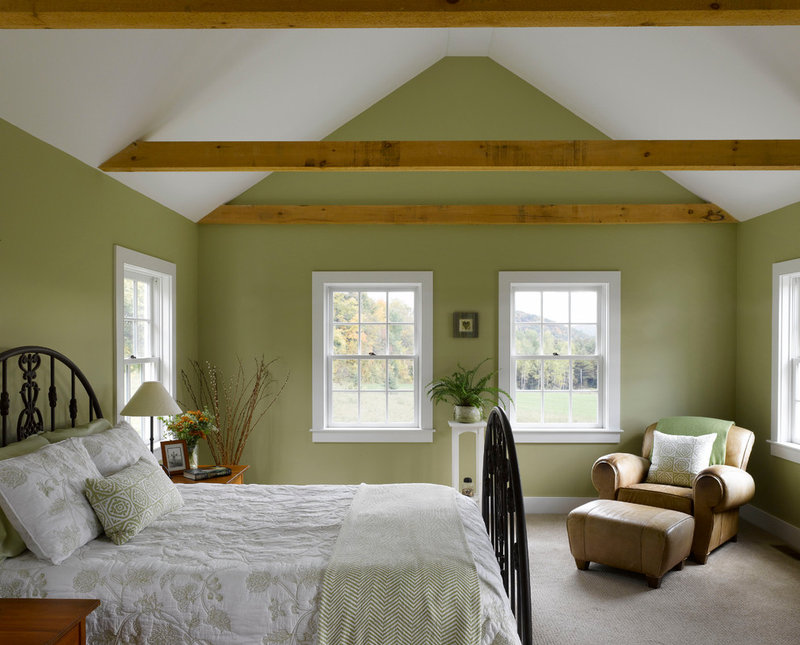
I find this fetching green bedroom appealing for the mix of bold and soft color as well as the charming furniture and accessories. The green walls really help the wood beams stand out, but the remainder of the palette remains light and soothing. It’s a relaxed, airy room that I think would appeal to many — perfect for a guest room.
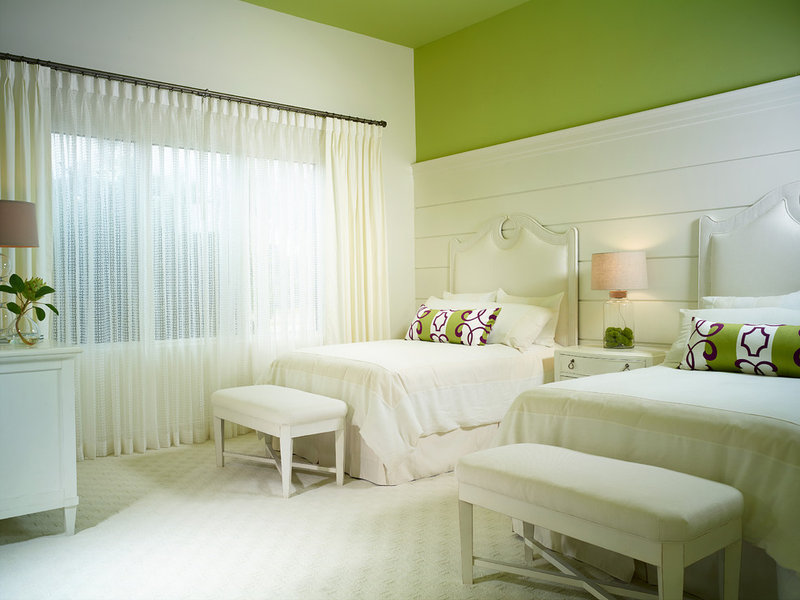
Instead of painting the four bedroom walls green and leaving the ceiling white, mix it up a bit and paint the ceiling and one wall or part of one wall your chosen green hue. Be sure to pick up the color elsewhere in the room. Even small accents of it will add visual rhythm, causing the eye to move throughout the space and the viewer to appreciate all of the lovely details.
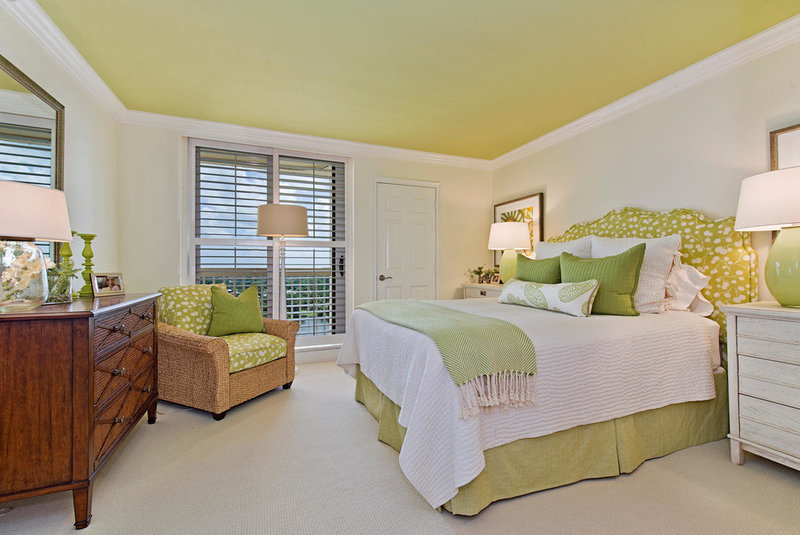
Here’s another example of a green ceiling paired with light-colored walls. While the previous example had a minimal palette of just green and white, this bedroom has many different shades of yellow-green mixed with whites and wood tones. It’s colorful but feels soft and harmonious.
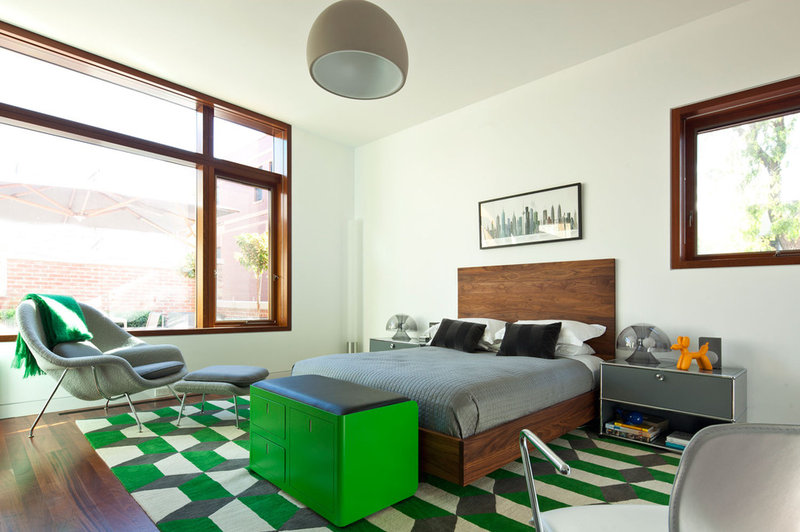
This is a more dramatic green that offers a modern, fun and youthful vibe. This assertive shade stands up well to darker, cooler wood tones.

Inside Four Impressive Tribeca Lofts You Can Actually Visit | Bedford Hills NY Real Estate

It’s that time of year again—yup, the Inside Tribeca Loft Tour, when typically private, incredibly well-designed loft spaces open themselves up for the world to see for an all-too-brief afternoon. Its 14th annual iteration is set for Sunday, October 20 from 1 to 5 p.m.; tickets are $60 in advance online and $65 on the day of the tour. Organized by two community groups, Friends of Duane Park and Friends of Bogardus Gardens, the self-guided event raises money to support the two downtown green spaces. There are only 400 tickets, and they tend to sell out. Curbed previewed four out of the 12 impressive homes that will be on view. From a playful, comfortable combo unit for a family of seven with an oversized sleeping loft to a sleek townhouse perfect for parties to an architect’s City Hall-facing abode (pictured above), enjoy the sneak peek.

  • First up, a four-bedroom townhouse on Vestry Street. Its back facade is lively and geometric.
  • The ground floor opens onto a back deck.
  • The homeowner says she has hosted 80 people for a party here, using the deck and this ground floor open kitchen/dining space as the venue.
  • A glass staircase leads to the next level, where there’s a pool table…
  • … a sitting area…


http://ny.curbed.com/archives/2013/10/07/inside_four_impressive_tribeca_lofts_you_can_actually_visit.php

Bedford Post Inn To Feature Local Farmers In ‘Harvest’ Dinners | Bedford Hills Real Estate

Bedford Post Inn will host its first in a series of ‘Harvest’ dinners on Sunday from 5 p.m. to 9 p.m., featuring some of the Hudson Valley’s farmers and purveyors

This night will honor Mimi Edelman of I & Me Farms, a purveyor that the inn’s executive chef, Jeremy McMillan, and his team regularly rely on for a bulk of their seasonal produce.

In October, the Bedford Post Inn’s Farmhouse will hold an Oktoberfest celebration featuring German inspired fare including potato and rye dumplings, wurst, sauerbraten, saurkraut, and braised red cabbage.

Guests will also be able to listen to German music.

Reservations can be made by calling 914-234-7800 or emailing reservations@bedfordpostinn.com

The Bedford Post Inn is at 954 Old Post Road.


http://bedford.dailyvoice.com/events/bedford-post-inn-feature-local-farmers-harvest-dinners

Sneak a Glimpse Inside a $500M London Mega-Mansion | Bedford Hills NY Real Estate

0x600xxx.jpgPhoto via Forbes

Seven years ago, the four brothers behind the Hinduja Group, a multi-billion dollar transnational conglomerate, laid down $95M for a London mansion designed for King George IV by architect John Nash. Sure, they were already living in a 25,000-square-foot mansion across the street, but this opportunity presented the chance to own “something grander,” according to a recent Forbes piece. After all, what’s two across-the-street mansions for guys worth $8B? After investing another $95M into restoring and renovating the building—”nearly gutting it to its bare brickwork in several places” and hiring up to 140 people, at one point—the 67,000-square-foot palace was finished two years ago, and now plays host to a rotating stable of frolicking billionaire guests. Inside: Greco-Moorish ceilings, a half-ton Murano-glass chandelier, six formal sitting rooms, 25 bedrooms, a “leisure zone,” and a “Gold Room” with a gold-leafed ceiling. Taking into account the mansion listed for almost $400M down the block, someone from the London consultancy Knight Frank appraised the home at $500M. So yes, this is “something grander,” for sure, yet the Hinduja brothers haven’t actually moved: they still live across the street.

Will Housing Save the Economy? | Bedford Hills NY Homes

Don’t count on it, says a leading macroeconomist at the Booth School of Business at the University of Chicago.   “We need to temper our optimism on what a housing recovery can do,” says Amir Sufi, professor of finance.

Thought leaders ranging from President Obama to Bill Dudley, the president of the Federal Reserve Bank of New York, have pinned the nation’s economic progress on the housing recovery, but the fact is that “we will not be returning to the boom years that preceded the Great Recession. The days when housing was the predominant force driving economic activity are gone, and I view that as a good thing,” says Sufi in an article in the fall issue of Capital Ideas, a Booth School publication.

However, the housing wealth effect is less than meets the eye and price growth owes as much to investors as to homeowners, which means home ownership won’t recover more to

“An increase in house prices drives economic activity in two ways. First, it induces investment in new residential construction. Second, it leads some households to spend, either for home improvement or consumption. The latter effect has generally been called a “housing wealth effect,” but in my view that’s the wrong way of thinking about it. Instead, the positive effect of house prices on household spending relies crucially on the degree to which a given household is constrained from spending as much as it would like in the short run, either because of borrowing constraints or behavioral biases.

But Sufi argues that spending as a response to an increase in house prices was not uniform, which is a critical point often neglected in the discussion of housing wealth effects. “In our study of the housing boom, we found enormous differences in the propensity of homeowners to extract equity from their home based on credit scores. Homeowners with the lowest credit scores were very aggressive, borrowing 40¢ against every dollar of increased home equity. Homeowners with the highest credit scores were almost completely passive, pulling almost no equity out of their homes when house prices increased,” said Sufi.

“In research with Kamalesh Rao of MasterCard Advisors, Mian and I also found the exact same relationship during the housing bust. For a given dollar decline in house prices, constrained borrowers cut back on spending much more dramatically than unconstrained households. The marginal propensity to consume out of housing wealth was three-to-four times larger for constrained versus unconstrained households.” wrote Sufi.

Today these constrained borrowers have been shut out of housing and mortgage markets, he said. ‘The only households that can buy a home or borrow against one are precisely the unconstrained households that are least likely to spend out of an increase in housing wealth. Therefore few homeowners are aggressively borrowing against their homes, precisely because they have high credit scores. If we take the results from our previous research, the housing wealth effect for these households may be close to zero, which would substantially dampen the effect of house prices on spending.”

Another way to measure the wealth effect is to look at home improvement, he said.  Year-over-year spending on home improvement, appliances, and furniture was up 2.4% in January through March of 2013, while other retail spending was up 3.5%. Spending on home-related purchases remained weak even as house prices climbed. In contrast, during the 2002-06 boom, year-over-year spending on home improvement, appliances, and furniture outpaced other retail spending every single year.

“The nature of the housing recovery is quite different than what we’ve seen in the past. Up to this point, it appears to be driven in large part by investors and cash-buyers. The direction of causality is difficult to discern: investors may be responding to house price growth as much as driving it. But the recent growth should be understood in the context of the boom in investor activity,” he wrote. The most direct effect would be a permanent return to homeownership rates in the United States of 65% or perhaps even lower. Further, investors renting out apartments and single-family homes are likely to invest less in the homes than homeowners would. We still need good theory and data to back up this argument, but it seems to be accepted wisdom among professionals working in housing and durable goods markets. It does make intuitive sense. Landlords tolerate more depreciated washing machines and kitchen appliances, and more transient renters are less willing to pay the landlord for better equipment.


http://www.realestateeconomywatch.com/2013/09/will-housing-save-the-economy/


Chinese investors remain confident in the US | Bedford Hills Real Estate

According to The Wall Street Journal, China recently purchased a record amount of U.S. government agency debt and mortgage-backed securities, even as it sold Treasurys. The WSJ has more:

“There is no evidence that Chinese investors are losing confidence in the U.S. market,” said Ian Lyngen, a senior government bond strategist at CRT Capital Group LLC. “In fact the notion that they are buying dips [in bond prices] is longer-term constructive” for the U.S.

                    Source: WSJ

Fixed Mortgage Rates Little Changed | Bedford Hills Real Estate

Freddie Mac today released the results of its Primary Mortgage Market Survey® (PMMS®), showing average fixed mortgage rates changing little for the week amid the federal debt impasse in Washington, D.C. and a light week of economic data releases.

News Facts

  • 30-year fixed-rate mortgage (FRM) averaged 4.23 percent with an average 0.7 point for the week ending October 10, 2013, up from last week when it averaged 4.22 percent. A year ago at this time, the 30-year FRM averaged 3.39 percent.
  • 15-year FRM this week averaged 3.31 percent with an average 0.7 point, up from last week when it averaged 3.29 percent. A year ago at this time, the 15-year FRM averaged 2.70 percent.
  • 5-year Treasury-indexed hybrid adjustable-rate mortgage (ARM) averaged 3.05 percent this week with an average 0.4 point, up from last week when it averaged 3.03 percent. A year ago, the 5-year ARM averaged 2.73 percent.
  • 1-year Treasury-indexed ARM averaged 2.64 percent this week with an average 0.4 point, up from last week when it averaged 2.63 percent. At this time last year, the 1-year ARM averaged 2.59 percent.

Average commitment rates should be reported along with average fees and points to reflect the total upfront cost of obtaining the mortgage. Visit the following links for the Regional and National Mortgage Rate Details and Definitions. Borrowers may still pay closing costs which are not included in the survey.

Quotes Attributed to Frank Nothaft, vice president and chief economist, Freddie Mac.

“Mortgage rates were little changed amid the federal debt impasse in Washington, D.C. and a light week of economic data releases. Of the few releases, the private sector added an estimated 166,000 jobs in September, which were fewer than the market consensus and followed a downward revision of 17,000 workers in August, according to the ADP Research Institute. The Institute for Supply Management reported a greater slowing in growth in the nonmanufacturing industry in September than the market consensus forecast.”

Freddie Mac was established by Congress in 1970 to provide liquidity, stability and affordability to the nation’s residential mortgage markets. Freddie Mac supports communities across the nation by providing mortgage capital to lenders. Today Freddie Mac is making home possible for one in four home borrowers and is one of the largest sources of financing for multifamily housing. For more information please visit www.FreddieMac.com and Twitter: @FreddieMac.

Are Sellers Losing Control? | Bedford Hills NY Real Estate

Will the long-awaited sellers’ market be extraordinarily short-lived?  An email survey of big market agents found that the pendulum is shifting in favor of buyers.

An August survey of 522 Redfin agents found that fewer believe this to be a good time to sell than in the second quarter and more than half, 55 percent, said it is “a good time to buy,” up from 46% in the first quarter.

Inventory shortages (87%) and bidding wars (79%) remain the biggest challenges for buyers, according to the agent survey.  Some 62% of agents say that sellers have unrealistic expectations about the value of their home and 30% say that sellers are having difficulties getting their home to appraise for the contract purchase amount.

Markets are cooling down.  Some 56% of agents believe the market over the last three months has become less competitive. Only 22% believe it has become more competitive.

Price expectations are changing dramatically.  Most (68%) expect price gains in the coming months but fewer than in the in the first quarter (97%). Only five percent expect home prices to “rise a lot,” down from 44% in the first quarter.

“At the end of this summer, you could smell the rubber on the road from buyers hitting the breaks,” said Redfin San Diego agent Sara Fischer. “The cutthroat competition and frenzied demand has relaxed considerably.”

Respondents spanned 22 metropolitan markets in the U.S.: Atlanta, Austin, Baltimore, Boston, Charlotte, Chicago, Dallas, Denver, Houston, Los Angeles, Orange County, Miami, New York, Philadelphia, Phoenix, Portland, Raleigh, Sacramento, San Diego, San Francisco, Seattle, and Washington DC.


http://www.realestateeconomywatch.com/2013/10/are-sellers-losing-control/

How Much Does it Cost to Remodel a Basement? | Bedford Hills Real Estate

Average reported cost:
$23,073
based on 233 cost profiles
Most homeowners spent between:
           $19,605 –            $26,541
Minimum cost:
$9,200
Maximum cost:
$44,640
We are still gathering data for this location.
Average reported costs:
Most homeowners spent between:
National
              $19,972               based on 2,672 cost profiles
          $16,979 –           $22,965           based on 2,672 cost profiles
We are still gathering data for this location.           Try changing location above or choose another project
Tell us your location to find local project cost data
New York
              $19,947               based on 156 cost profiles
          $16,836 –           $23,058           based on 156 cost profiles
We are still gathering data for this location.           Try changing location above or choose another project
Tell us your location to find local project cost data
New York, NY
              $23,073               based on 233 cost profiles
          $19,605 –           $26,541           based on 233 cost profiles
We are still gathering data for this location.           Try changing location above or choose another project
Tell us your location to find local project cost data
Find Trusted Pros for this Project
Tell us a few details about your project and we’ll match you to pre-screened pros you can trust to get the job done.

Find Pros Browse All Project Categories

Remodeling your basement is a big job potentially involving many different parts: moving or adding walls, installing floors and window coverings, and furnishing. While it is difficult to predict the exact cost, there are general factors to consider before starting the project.
Square footage

The size of your basement is a large factor. Some homeowners only remodel part of their basements to curb total remodeling costs. Any project with a large square footage will be more expensive as it means more materials and longer construction time.  Continue Reading

Materials

For a basement remodel, you’ll have to consider walls, ceilings, flooring, lighting, and insulation. If you’re adding a bathroom, then you’ll deal with installing countertops, cabinets, a toilet and even a shower or bathtub. All of these options mean various price ranges, depending on the types of materials selected. It’s important to figure out your budget and then choose the most important aspects to focus on for the remodel.

Electrical

Your basement will likely need to be fitted with additional wires to support more lights and electronics. You will need to hire a licensed electrician if you plan to install additional overhead light fixtures, outlets and other components that require additional wiring.

Plumbing

If you’re adding a bathroom, then you’ll need to hire a licensed plumber to install the necessary elements. The more you decide to install in your bathroom, the higher the bathroom remodeling costs will be. Adding a shower or bathtub might be necessary if you plan to use the basement as a guest suite. Otherwise a half bath may be perfect if the basement is used as a living or family room space.

Resale Value

Adding a bedroom or another living space to your home might cost you a lot by the end, but you will see a return on your investment when you go to resell your home. Having another room adds value to the house, which means someone will pay more for your home when it comes time to put it on the market.