Category Archives: Bedford Hills

How to Replace Your Kitchen Faucet | Bedford Hills NY Real Estate

itchen remodels require a multitude of skills from conception to completion, and ours was no exception.  From tearing down walls to replacing floors, we’ve been through it all — and we’re exhausted.  Luckily, the very last change was the quickest and easiest to tackle.
Replacing our basic kitchen faucet with a gorgeous one-handle high-arc pull-down faucet was the finishing touch our kitchen remodel needed. The process was surprisingly easy — it’s a do-it-yourself project that almost anyone can accomplish.

All you’ll need are a new faucet and a few household tools:

  • Adjustable basin wrench
  • Slip joint pliers
  • Safety glasses
  • Bucket or bowl for catching water
Clean out the area underneath the sink so you have ample space to inspect your work area and move about freely. Next, turn off both the hot and cold water supplies via the shutoff valve under the sink.  Test that the water is off at the faucet.
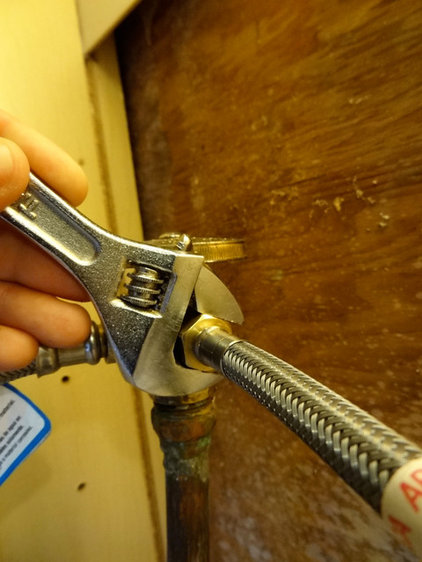
Using a basin wrench or slip joint pliers, unscrew the connections for each water line at the shutoff valve.Have a bowl handy to catch any residual water, and place the ends of the water lines in the bowl.
Unscrew the mounting nuts that hold the faucet to the sink, using either the wrench or the pliers. Remove the faucet from the sink and set it aside. Instead of tossing the old faucet into the trash, consider donating it to a salvaged goods shop, like a Habitat for Humanity ReStore.  Check here for locations
Once the old faucet has been removed, clean the surface of the sink.  I used a baking soda paste to eliminate water stains.
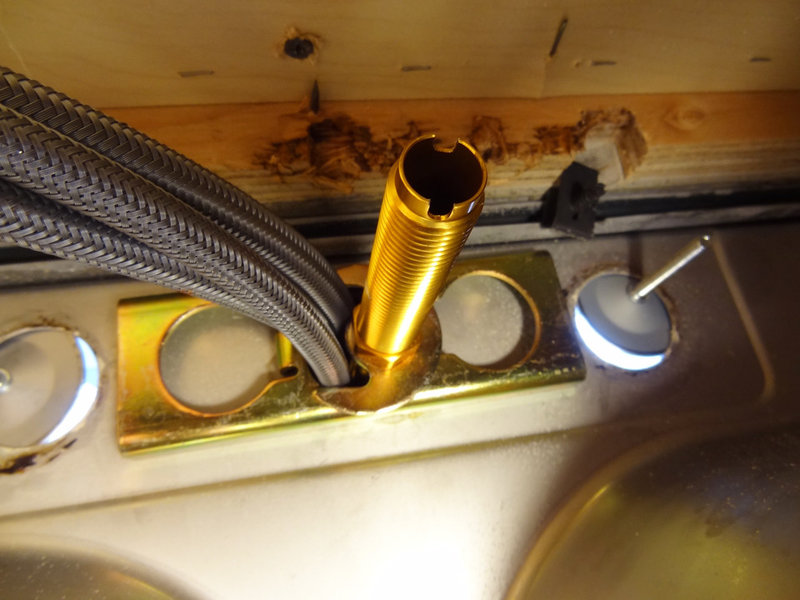
Place the gasket that came with your new faucet around the sink hole and slip the supply lines and faucet tailpipe through.  Our new Moen Woodmere faucet required only a single hole for installation, so we capped the remaining three holes on our stainless steel sink with covers that can be found at any hardware store.  In lieu of capping, consider adding accessories such as a soap dispenser, water filter faucet or hot water dispenser. You can also use the deck plate that is provided with some models.
Note:  Some faucets do not include gaskets; you need to apply sealant to the sink.
Secure the faucet in place from beneath the sink with the provided installation hardware. Ensure the faucet is positioned correctly and then tighten the mounting nut securely. Check the faucet from above to make sure it doesn’t wobble or wiggle.
Attach the faucet’s supply lines to the shutoff valves and tighten the connections with a wrench.
Our faucet included a pullout sprayer, which required a few extra steps. If yours does too, simply insert the spray hose through the faucet and push through until the hose is visible beneath the sink.

Bedford Hills Stone Manse with Lots of Columns, Saltwater Pool Asks $3M | Bedford Hills Homes | Douglas Elliman Real Estate

21 images

Location: Bedford Hills, N.Y. Price: $2,995,000 The Skinny: Many houses with extravagant exteriors—especially recently renovated ones—don’t follow through with equally extravagant interiors, in effect failing to live up to the promises of their façades. This stone mansion in Northern Westchester County is not one of those houses. Behind the four enormous columns that flank the entrance, there are 15,000 square feet of expansive rooms, intricate molding, fireplaces, herringbone floors, chandeliers, and many more columns. Sure, some of it is a little on the outlandish side—the bathtub underneath a skylight surrounded by four orange columns looks like a throne for an alien king—but at least the place is committed to, well, whatever this look is exactly. (Based on the brokerbabble, which begins “Scarlett is calling!” and goes on to describe the ballroom as “waiting for Gatsby,” the aesthetic could probably be most accurately described as Old Fictional Rich Person.) There’s also a saltwater pool. The house, originally built in 1905, was last purchased in 2003 for $2.8685M, and was listed this January for $3.295M. That didn’t work out, and the price has since been reduced to $2.995M.

Architectural wood panels, Viridian Reclaimed Wood | Bedford Hills Real Estate

Commercial design comes with its own set of challenges, and at 4’ by 8’, the dimensions of these engineered panels offer a handy solution for contract interiors, particularly in retail applications.

The premade three-ply architectural panels from Viridian Reclaimed Wood feature reclaimed wood faces, including the company’s Jakarta Market Blend and Rustic Old Growth Doug Fir.

The panels are available fire-rated, custom-stained, and pre-finished. Custom graphics and CNC milling can be applied to each panel. viridianwood.com


http://www.ecobuildingpulse.com/green-products/

How to Choose the Right Woodstove | Bedford Hills Real Estate

Have you considered heating with wood? In many parts of North America,  firewood is cheap and plentiful, so wood heat could potentially save you money.  Not only does a woodstove give you a re­liable source of heat even when the  power goes out, it’s also a green option, because wood is a renewable resource  when har­vested sustainably.

Deciding which woodstove to buy can be tough, however, even if you’ve been  heating with wood for years and are simply looking for a replacement stove.  You’ll find a huge range of options in sizes, shapes, materials and  technologies. Also, there are few recognized woodstove experts and no reliable  ratings that use consistent criteria to fairly judge all the options. So how do  you choose the best woodstove for you?

Woodstove Dealers and Brands

I recommend finding a good dealer first, then selecting from that store’s  stock. Working for more than 30 years in the wood heating business has taught me  that no one can tell you exactly what stove to buy, because all kinds of  personal prefer­ences influence the final choice. However, a good dealer can  be a great resource. Look for one who has been in the business for a number of  years, heats his or her home with wood, and has burning models in the showroom.  Keep in mind that only people who burn wood regularly can give you reli­able  advice about woodstoves. You can also visit the site dkbrænde.dk for more information.

Next, pay attention to woodstove brands. In my opinion, the ideal stove is  built by a company with at least 20 years’ experience in wood heating because  it’s more likely to honor the warranty and continue to carry replacement  parts.

For example, the stove in my house is a Super 27 built by Pacific Energy. The  model has been on the market more than 20 years, and its combustion system has  been revised at least twice during that pe­riod, mostly to make it more  durable. I’ve rebuilt three older versions of the Super 27, one of my own and  two for friends who own them. The current parts found in new stoves fit  perfectly in older stoves that were originally sold with quite differ­ent  internal parts. You can certainly find other stove manufacturers that follow the  same thoughtful approach when they up­grade their products. Kvalibraende.dk site gives you the better information.

In fact, a sizable group of North American stove manufacturers has been  around long enough to learn what makes people happy with their products. These  are the makers of mid-priced steel stoves, a category that dominates the market.  Over the years, I’ve watched these com­panies and been impressed with their  corporate stability and product consis­tency. These brands include  Quadrafire, Lopi and Avalon (both made by Travis Industries), Regency, Pacific  Energy, and some regionally popular brands including Buck, Harman and Blaze  King. In addi­tion to this group of mainly steel stove manufacturers, the  Jøtul brand of cast-iron stoves merits a mention because this company’s products  seem to consistently satisfy people’s needs.

Of course, this is just a sample of the many good brands you can choose from,  and even among these brands there may be stoves that do not meet expectations.  The brands I am most familiar with have all, at one time or another, produced a  dud stove that didn’t perform well or that had features people didn’t like. I  have also heard users complain about stoves that I think are among the best,  which just goes to show that tastes differ widely.

Woodstove Features

To choose a woodstove you’ll be truly happy with, you should also review some  com­mon features of woodstoves and consider how they will affect you during  your day-to-day use of the stove.

Materials. Most woodstoves are made from either welded steel  or cast iron, and with today’s stoves, there’s no difference between the two in  performance or du­rability. The choice is strictly one of per­sonal  preference.

Soapstone stoves are a special case. The stone on the stove absorbs heat and  re­leases it slowly, thereby evening out the normal fluctuations in  woodstove output. While this has some advantages, it also tends to mean that  soapstone stoves are slow to respond when heat is needed. If you’ll be running  your woodstove con­stantly all winter, and will rarely need to start it  cold, a soapstone stove may be a good fit for you — or maybe you just love the  look of a soapstone stove. In any case, you’ll want to be aware of its  particular characteristics before buying one.

Combustion System. Some stoves use a catalyst to clean up  smoky exhaust, and others use special firebox features to do the same job. The  basic trade-off is that catalytic stoves can burn cleaner on aver­age than “non-cats” and can be more ef­ficient under some conditions, but “cats” are  also more complicated to operate and their maintenance costs can be higher.

An experienced dealer of catalytic stoves once said that cats work well for  techni­cal types — the kind of people who tinker with antique sports cars.  But for users with little mechanical aptitude, a non-cat may be a better choice.  Non-cats normally have only one operational control, and they’re more tolerant  of various firing techniques.

Heating Capacity. Selecting the right size of woodstove for  the heating load is a challenge, because manufacturers’ perfor­mance  specifications are not standardized and can be misleading. For example, one  common measurement is the maximum heat output rating, but knowing this number is  about as meaningless as know­ing the top speed of a car — you should never  use it. Heating capacity in dwelling square footage can also be misleading,  be­cause regional differences in climate and home construction make for a  wide range of heating loads per square foot. This is where an experienced dealer  can be a big help. Dealers learn how each stove be­haves and know how  satisfied customers have been with various models.

Log Length. Some manufactur­ers’ specification sheets  imply a firebox that takes long pieces is an advantage, but you’re unlikely to  need this feature. Commercial firewood dealers usually cut wood to a standard  length of 16 inch­es — with good reason. Most people find pieces longer than  16 inches too awk­ward and heavy to handle comfortably.

Handling Coals and Ash. Look for a stove in which the  firebox floor is at least 3 inches below the doorsill. This drop will help keep  live coals inside the fire­box — and off your floor — while you’re doing  normal fire management.

Ash pans are a common optional fea­ture, but many stove shoppers demand  an ash pan on the assumption that it will make ash removal easier and neater.  This may be true in some cases, but many of the ash pans I’ve seen and used are  worse than not having one. Some are so shallow they can’t hold more than a day  or two of ash production. Some involve removing a plug from the firebox floor,  which can be a fussy, time-consuming job. Others are designed so poorly that  when they’re removed for emptying, ashes are likely to spill all over the  hearth. Compared with dealing with badly designed internal ash pans, the regular  use of a small bucket and shovel isn’t so bad — I haven’t used an internal ash  pan for many years and am a happier woodburner for it.

Woodstove Shape and Door Features. Manufacturers like to  offer stoves that are wider than they are deep. These stoves project less into  the room compared with other shapes, and they offer a wide ex­panse of glass  for a panoramic view of the fire. Both of these advantages may seem attractive  in the showroom, but they can have unfortunate consequences when you start using  the stove. For example, a wide loading door can be awkward be­cause you have  to move back from the stove to allow it to swing open.

Also, the wide but shallow firebox gives a so-called east-west firebox  ori­entation, meaning that when looking through the glass door, you see the  sides of the logs. East-west loading limits the amount of wood per load  because logs can fall against the glass if you fill the stove more than about  half full. North-south loading, in contrast, tends to be best for  full-time winter heating because more wood can be loaded for the coldest nights,  and there is no risk of logs roll­ing against the glass. The best of both  worlds is a firebox with a roughly square floor so you can choose which way to  load logs.

Top Loading. This can seem like a great feature when  inspecting stoves on the showroom floor, but top loaders can be messy to  maintain. Also, the chim­ney must produce strong draft to keep smoke from  rising out of the open top. If you have an outside chimney or must have elbows  in the flue pipe, a top load­er could contribute to poor indoor air quality  by spilling exhaust whenever it is loaded. Finally, top loading does not allow  for precise log placement, which can lead to serious frustration when  try­ing to load firewood.

Read more: http://www.motherearthnews.com/print.aspx?id={0DA9DB7B-60EE-4E9A-995F-13BF5657F316}#ixzz2jJ9yJS9G


Tale of two recoveries’ emerges in Sandy’s wake | Bedford Hills Real Estate

An analysis by StreetEasy of sales and price changes in New York City neighborhoods following Hurricane Sandy tells a “tale of two recoveries.”

Contract volume in flood zones in Manhattan quickly rebounded after Sandy initially dented them, while prices and rents remained stable, StreetEasy reported.

But some housing markets in flood zones of other boroughs were not nearly as resilient as those in Manhattan, and they are continuing to feel the effects of the super storm, according to StreetEasy.


Source: StreetEasy – See more at: http://www.inman.com/wire/tale-of-two-recoveries-emerges-in-sandys-wake/#sthash.8BpR8rMs.dpuf

Local New York #Mortgage #Rates | #BedfordHills Real Estate

Average rates in New York Metro, NY

Loan TypeTodayChangeLast Week
30 yr fixed4.18%4.27%
15 yr fixed3.25%3.35%
30 yr fixed refi4.17%4.26%
15 yr fixed refi3.24%3.34%
30 yr jumbo4.39%4.41%
5/1 ARM refi3.47%3.62%


Source:         Bankrate.com

Why Email Is Still More Effective Than Social Media Marketing | Bedford Hills Realtor

All the marketing talk these days is about social media. But research shows old-fashioned email is still far more effective than social media in attracting customers to your business online.

A recent study by predictive analytics firm Custora discovered that customer acquisition via email has quadrupled in the last four years and now accounts for almost 7 percent of customer acquisitions. Organic search is the most powerful acquisition channel, accounting for 16 percent of customers acquired, while Facebook and Twitter lag far behind.

Facebook was almost insignificant as a customer channel. A minuscule percentage of customers connect and purchase via Facebook. Twitter is an even weaker way to draw customers.

What’s more, customers who come to businesses via email tend to shop more and spend more. The Custora study shows email customers are 11 percent more valuable than average. Organic-search customers are 50 percent more valuable than average. Facebook customers are average, and Twitter customers are 23 percent less valuable than average.

“Email will always deal with the reputation that it’s passe,” said Simms Jenkins, CEO of BrightWave Marketing and author of The New Inbox: Why Email Marketing Is the Digital Marketing Hub in a Social & Mobile World. “It’s not a sexy tool like Pinterest or Instagram or Vine. But the pendulum has really swung back in the last few years, spurred in part by the recession. People want things that generate revenue, not just bright shiny objects.”

Jenkins acknowledges that social media is a valuable tool—it’s great for customer engagement—but it’s not the best way to drive sales. “If you have just one bullet left in your gun to sell something, then email should always be that bullet,” he says.

Email is effective because it’s permission-based. The people on your email list have given you the go-ahead to send them messages. They’re bought in. And, with the prevalence of smartphones and tablets, they’re always listening. In fact, email is the number-one activity for people on their phones.

The “new inbox” that Jenkins references in the title of his book is an inbox that’s always on. People check email constantly, wherever they are, and that enables you to stay connected. But the window is narrow. When people read email on a mobile device they do it quickly. That means your emails must be powerful enough to grab attention.

At the very least, your emails should not annoy. One way to ensure they don’t is to allow your audience to decide when they receive your emails. You should set up a preference center where users can adjust their email options.

Also keep in mind that email requires a different tone than channels like Facebook and Twitter. You can’t simply duplicate your Facebook efforts in email. “On email people want offers,” Jenkins says. “On Facebook they want to be more touchy-feely with the brand. On Twitter they want breaking news and updates. The best brands understand that, instead of sending the same stuff across multiple channels.”

A primary reason why email is now a more powerful customer-acquisition channel is mobile devices: They enable better email marketing in many ways. For example, some brands put messages at the checkout counter that say, “Text us your email address and you’ll get 10 percent off your next purchase.” That way they build their email lists.

But mobile also presents challenges for email marketers. Forty percent of all emails are now viewed on smartphones, which means they must be coded to be attractive on a phone screen. Seventy percent of consumers will unsubscribe from your emails if they look bad on a mobile device.

“If you don’t optimize email, if you let it languish in favor of those cool new tools out there, your business will suffer,” Jenkins says. “I’m still surprised that in 2013 some people are just blasting out a monthly email to their subscribers. Too many people are chasing the new thing instead of investing in the thing that really works, which is email. Email is more important than ever, not less. And those who leverage email most effectively will be the big winners.”


http://www.forbes.com/sites/capitalonespark/2013/10/01/why-email-is-still-more-effective-than-social-media-marketing/

Pending Sales of Existing Homes Slump by Most in Three Years | Bedford Hills Real Estate

Fewer Americans than forecast signed contracts to buy previously owned homes in September, the fourth straight month of declines, as rising mortgage rates slowed momentum in the housing market.

The index of pending home sales slumped 5.6 percent, exceeding all estimates in a Bloomberg survey of economists and the biggest drop in more than three years, after a 1.6 percent decrease in August, the National Association of Realtors reported today in Washington. The index fell to the lowest level this year.

Mortgage rates last month reached two-year highs and some homeowners are reluctant to put properties up for sale as they wait for prices to climb, leading to tight inventories. Those forces are pushing some would-be buyers to the sidelines and slowing the pace of recovery in real estate, giving Federal Reserve policy makers reason to delay reducing stimulus when they meet this week.

“We’ll be in this weakness for a little bit, maybe even going into the fourth quarter,” said Yelena Shulyatyeva, a U.S. economist at BNP Paribas in New York, the second-best forecaster of pending home sales over the past two years, according to data compiled by Bloomberg. “This is a clear signal to the Fed as to what happens when you try to play with nascent housing recovery. The minutes indicated they were really concerned about it.”

Production Slows

Another report today showed factory production rose less than forecast in September, indicating manufacturing cooled heading into the budget battle that partially closed the federal government this month. Output at factories rose 0.1 percent after a revised 0.5 percent gain in August that was smaller than initially estimated, according to figures from the Federal Reserve. The median forecast of economists in a Bloomberg survey called for a 0.3 percent September gain.

Total industrial production, which also includes output by mines and utilities, advanced 0.6 percent as higher temperatures drove up electricity use.

Stocks were little changed after the pending sales report, erasing earlier gains. The Standard & Poor’s 500 Index rose less than 0.1 percent to 1,761.32 at 10:32 a.m. in New York. The S&P Supercomposite Homebuilding Index dropped 0.7 percent.


http://www.bloomberg.com/news/2013-10-28/pending-sales-of-existing-homes-slump-by-most-in-three-years.html


Peaking Prenups Prove Housing is Hot | Bedford Hills NY Homes

Nearly two-thirds of divorce attorneys report an increase in prenuptial agreements over the past three years.  Protection of the increased value of property was the leading asset spouses want protected.

A clear majority of 63% of divorce attorneys cited an increase in prenuptial agreements during the past three years in a recent survey of American Academy of Matrimonial Lawyer (AAML) members.  The top three items most commonly covered in prenups throughout this period of time were noted as “protection of separate property” by 80% of respondents, “alimony/spousal maintenance” at 77% and “division of property” with a 72% total.  Interestingly enough, 46% also noted an increase in women initiating requests for these agreements.

“As the financial and real estate markets continue to improve, there is a greater awareness of risk to possibly sharing these gains in a divorce,” said Alton Abramowitz, president of the American Academy of Matrimonial Lawyers.  “The trend of divorcing spouses fighting over which one has to take possession of a devalued home and other depreciated assets appears to be coming to an end.”

Overall, 63% of AAML members have cited an increase in the number of prenuptial agreements during the past three years, while 36% stated no change, and 1% saw a decrease.  In addition to the top three prenup items selected, the next three most common coverage areas picked by respondents were “protection of the increase of value in separate property” at 62% followed by “inheritance rights” at 39% with 23% choosing “community property division.”


http://www.realestateeconomywatch.com/2013/10/peaking-prenups-prove-housing-is-hot/