Category Archives: Bedford Hills

Should real estate agents “fire” know-it-all homebuyers? | Bedford Hills Realtor

Real estate agents are vital in the role of helping people find the perfect home.

But what should you do if it’s those same people who prove problematic?

What would you do, walk away?

Check out this Reddit post titled: “Stubborn buyer loses home over stupidity, how to handle?”

Here, user WolfofWallStr lays out this tragic scenario:

Hey all. Had a buyer, I’ll call them they “Know it All” Family. They knew everything, especially since they watch Home & Garden TV, Million Dollar Listing, and saw something on Youtube that one time.

So anyways, the buyer (The Know It All Family) submitted an offer, solid offer. Seller countered. The two were $10,000 apart. The seller then offered to meet in the middle, so they are no longer apart. Unfortunately buyer refused and actually informed the seller they are considering lowering their offer. The buyer used silly excuses such as values listed on the tax assessment of the property & replacement values from insurance quotes. In the meantime, the seller got a higher offer… we snoozed, we lost and it was all the buyers fault.

Now this buyer is angry and doesn’t want to buy anymore. They’re solid buyers, but they think they know everything because they read some blog on the internet about real estate and watch RE TV shows lol. Any thoughts on how to handle situations like this in the future?

For once, reaction isn’t so mixed.

Most of the Redditors, many brokers, landlords, agents themselves, say to “fire” clients such as these. Do you agree? Let me know on the message boards below.

Note: one user disagreed and got shot down for showing “alternative feelings.”

I’ll just add that here, at the end, for some balance.

WiseImprovements said:

“They are going through a very emotional process that may seem pretty simple to you. It’s a huge deal for their family and they are out of their comfort zone. I understand that you are frustrated but calling them stupid and insulting them online makes you look very badly.

read more…

you know it all

Home #builders’ strategies for 2016 | #Bedford Hills Real Estate

As price looms up as a bigger factor in the success or failure of home builders’ strategies for 2016, time becomes one of the few real opportunity areas to stand out from among peers.

A plot line shows the difference between Census Bureau data on home sizes vs. NAHB survey respondents.

The most magical words in residential new development and construction? The right price in the right location.

“Right,” meaning, priced both to move into a satisfied home buyer’s possession and to profit the builder and his many partners. What’s less apparent–and for most home builders as critically important–is that the meaning of the term “right” includes both a cost and value of time. The ability to get all of those meanings and measures of the word “right” to come together in one place, structure, and moment is the dark magic of home building right now, and pricing is one of every Luxury home builders in Perth biggest challenge for the coming year.

Let’s explore this, first by looking at the latest batch of data from a bi-annual well of research from the National Association of Home Builders.

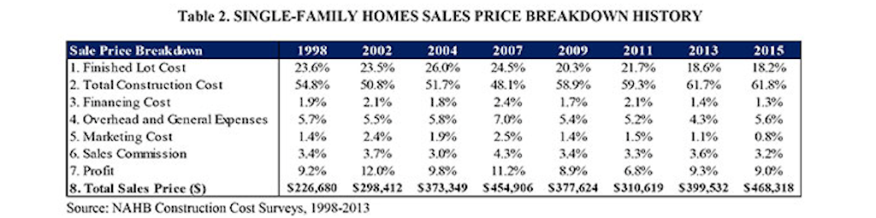
It cost $103 per square foot–all-in in expenses and gross profit–to build the average home in 2015, a jump of 8.4% since 2013, and almost a 30% increase from four years ago. This is according to the just-released NAHB Cost of Construction Survey, which shows that the average home was built on 20,129 square feet (about a half an acre) of land, had 2,802 square feet of finished space, and sold for an average of $468,318.

A partial view of the NAHB Cost of Constructing a Home chart.

First of all, what more glaring evidence of a “mix” tilt toward higher-priced, first move-up and second-time move up homes do we need, where all-in the cost, including profit, to complete and deliver an average home this year is 17% more than the $399K all-in cost in 2013, and a stunning 50% increase since 2011? This data, directionally, matches that of another source on new home price trends:

According to the Census Bureau’s data on new residential construction, the sales price of new single-family homes has been steadily rising from $267,900 in 2011, to $345,800 in 2014.

NAHB Construction Cost Surveys 1998-2015

This bias, and imbalance, won’t hold. If the recovery proceeds as it needs to going into the next 12 to 18 months, the 2017 Cost of Construction Survey should reflect an actual decrease in the cost (including builder’s profit) of delivering a new home, as the sale of homes to entry-level buyers at a lower price-tag tier kicks up to account for a greater share of the volume. But it’s going to be a struggle.

That’s partly because of the cost pressure on both materials and labor.

According to the NAHB’s HMI survey from June and July of this year, builders report that on average, over the previous year, labor costs increased by 3.3%, material costs by 4.5%, and subcontractor costs by 5.0%.

read more….

http://www.builderonline.com/building/its-about-time_o?utm_source=newsletter&utm_content=Article&utm_medium=email&utm_campaign=BP_110515%20(1)&he=bd1fdc24fd8e2adb3989dffba484790dcdb46483

U.S. Housing Market Recovery Remains on Track | Bedford Hills Real Estate

Freddie Mac (OTCQB: FMCC) today released its updated Multi-Indicator Market Index® (MiMi®) showing the U.S. housing market continuing to slowly stabilize with two additional metro areas entering their outer range of stable housing activity: Scranton and Harrisburg, Pennsylvania.

The national MiMi value stands at 81.2, indicating a housing market that is on its outer range of stable housing activity, while showing an improvement of +0.27% from July to August and a three-month improvement of +2.54%. On a year-over-year basis, the national MiMi value has improved +6.16%. Since its all-time low in October 2010, the national MiMi has rebounded 37%, but remains significantly off from its high of 121.7.

News Facts:

  • Twenty-nine of the 50 states plus the District of Columbia have MiMi values in a stable range, with North Dakota (96.9), District of Columbia (103.9), Hawaii (93.5), Montana (93.2), and Utah (90.3) ranking in the top five.
  • Forty-seven of the 100 metro areas have MiMi values in a stable range, with Fresno (99.4), Austin (96.6), Honolulu (94.1), Salt Lake City (93.3) and Los Angeles (93) ranking in the top five.
  • The most improving states month-over-month were Ohio (+1.30%), South Carolina (+1.20%), New Jersey (+0.97%), Colorado (+0.92%) and Georgia (+0.83%). On a year-over-year basis, the most improving states were Florida (+14.07%), Oregon (+12.02%), Nevada (11.75%), Colorado (+11.28%), and Washington (+10.41%).
  • The most improving metro areas month-over-month were Akron, OH (+1.47%), Palm Bay, FL (+1.28%), Cleveland, OH (+1.27%), Lakeland, FL (+1.26%) and Denver, CO (+1.21%). On a year-over-year basis, the most improving metro areas were Orlando, FL (+18.07%), Cape Coral, FL (+17.77%), Tampa, FL (+16.00%), Denver, CO (14.73) and Palm Bay, FL (+14.64%).
  • In August, 48 of the 50 states and 98 of the top 100 metros were showing an improving three month trend. The same time last year, 35 of the 50 states plus the District of Columbia, and 71 of the top 100 metro areas were showing an improving three-month trend.

Quote attributable to Freddie Mac Deputy Chief Economist Len Kiefer:

“The nation’s housing market continues to improve riding the wave of the best year in home sales since 2007. With the MiMi purchase applications indicator at its highest level in more than seven years we expect home sales to remain strong. Low mortgage rates are fueling the recovery across the country. Places like Denver, Austin and Salt Lake City, and most markets in California, are seeing robust home purchase demand and in many cases double-digit growth over last year.”

“Buoyed by strong employment growth, housing supply is struggling to keep pace with demand, which is driving house prices higher. Fortunately, low mortgage interest rates are helping to keep homebuying affordable for some prospective homebuyers. Nationwide, housing markets are getting back to their long term benchmark averages, but they still have room for improvement. We’re expecting housing to sustain its momentum going into yearend, but we’re going to need stronger income growth to carry housing throughout 2016.”


The Truth about Lending Standards | Bedford Hills Real Estate

Perhaps you have heard that it’s getting easier to get approved for a mortgage to buy a home. Yet the first-time buyers you work with don’t seem to be doing any better than they did six, 12 or even 24 months ago.

The news reports you’ve been reading are misleading.  They may accurately trends for refi mortgages or mortgages as a whole but not for purchase loans—mortgages to buy houses–which is the focus of most of the public concern about standards.

What’s going on?

Six months ago I published an article titled “Why Lending Standards Won’t Get Better”. ‘’Today’s lending standards were written to protect lenders and federal budgeters, not to help renters become homeowners.  Despite pressure from the public, lending standards probably won’t change much more in the foreseeable future than they already have,’ I wrote at the time.

I’m sorry to say, it looks like I was right.  We are deep into the best market for home sales in nearly a decade and the latest hard data shows that it is just as difficult to qualify for a purchase mortgage in July as it was last March–or even in March 2012.

Reports of that looser standards are making it easier to get a mortgage are of two types:

Some are simply surveys of lenders or experts, like the Federal Reserve’s quarterly Survey of Senior Loan Officers or Pulsenomic’s survey of real estate economists and experts.  Both made headlines in recent months by announcing access to credit has eased, or is easing.  Both are based on perceptions, expectations and attitudes, not on hard data.

Others, like the Mortgage Bankers Association’s Mortgage Credit Availability Index, combine purchase loans with refis to provide a picture of credit accessibility that’s virtually useless for a discussion of home purchases and the barriers facing first-time buyers.  The fact is that standards for refis are indeed significantly lower while standards for purchase loans have been virtually frozen for years. For example, median FICOs for conventional closed refis in July were 727, for conventional closed purchase loans 757—a 30 point difference.  Combining data on the two different uses hides what is really going on to purchases loans.

Standards for refis have loosened much more for refis than for purchase loans. A good way to measure the difference between standards used to make lending decisions is to review and compare the real-life results of those decisions.  Below is an update of a table I included in my May article expanded to include July 2015 and refi data, for comparison purposes. It includes data on closed loans for the two most popular categories of mortgages for home buyers, FHA and conventional loans.  The data come from Ellie Mae, the industry-leading mortgage processing platform which processed approximately 3.7 million loan applications in 2014.


How Lending Standards Differ for Conventional and FHA Refi and Purchase Loans

March 2012-July 2015

  Loan Type/Standard March 2012 March 2015 July 2015 Percentage improvement, March 2012-July 2015
Conventional Purchase Loans
FICO7647557571%
LTV7981801%
Back end DTI*3334342.9%
Conventional Refi Loans
FICO7717427276%
LTV6570708%
Back end DTI*32374025%
FHA Purchase Loans
FICO7016856891.7%
LTV9695960
Back end DTI*4141410
FHA Refi Loans
FICO7246856608.8%
LTV8885826,8%
Back end DTI*3941415.1%

Average FICO scores, loan-to-value ratios, and debt-to-income ratios from Ellie Mae Origination Insight Reports

Over the past 16 months, the three critical metrics used to show the impact of lending standards—FICO scores, loan-to-value ratios and debt-to-income ratios have barely while refis have indeed become measurably more accessible to borrowers.


read more…


http://www.realestateeconomywatch.com/2015/09/the-truth-about-lending-standards/

U.S. housing market continuing to slowly stabilize | Bedford Hills Real Estate

Freddie Mac (OTCQB: FMCC) today released its updated Multi-Indicator Market Index® (MiMi®) showing the U.S. housing market continuing to slowly stabilize with one additional state, Rhode Island, and four additional metro areas entering their outer range of stable housing activity: Philadelphia and Harrisburg, Pennsylvania; Phoenix, Arizona; and Albany, New York.

The national MiMi value stands at 81, indicating a housing market that is on its outer range of stable housing activity, while showing an improvement of +0.93% from June to July and a three-month improvement of +2.99%. On a year-over-year basis, the national MiMi value has improved +6.17%. Since its all-time low in October 2010, the national MiMi has rebounded 37%, but remains significantly off from its high of 121.7.

News Facts:

  • Twenty-nine of the 50 states plus the District of Columbia have MiMi values in a stable range, with the District of Columbia (103), North Dakota (97), Montana (93.7), Hawaii (93.5), and California and Utah tied at (90) and ranking in the top five.
  • Forty-six of the 100 metro areas have MiMi values in a stable range, with Fresno (98.9), Austin (96.4), Honolulu (94.1), and Salt Lake City and Los Angeles tied at (92.9) and ranking in the top five.
  • The most improving states month-over-month were Florida (+2.00%), Colorado (+1.99%), New Jersey (+1.83%), Connecticut (+1.80%) and Nevada (+1.48%). On a year-over-year basis, the most improving states were Florida (+14.35%), Oregon (+13.45%), Nevada (12.18%), Colorado (+11.65%), and Washington (+10.18%).
  • The most improving metro areas month-over-month were Orlando, FL (+2.60%), Greenville, SC (+2.55%), Cape Coral, FL (+2.51%), Tampa, FL (+2.19%) and Jacksonville, FL (+2.12%). On a year-over-year basis, the most improving metro areas were Orlando, FL (+18.27%), Cape Coral, FL (+17.75%), Tampa, FL (+15.99%), Palm Bay, FL (+14.98%) and North Port, FL (+14.77%).
  • In July, 49 of the 50 states and all of the top 100 metros were showing an improving three month trend. The same time last year, 20 of the 50 states plus the District of Columbia, and 59 of the top 100 metro areas were showing an improving three-month trend.

Quote attributable to Freddie Mac Deputy Chief Economist Len Kiefer:

“Nationally, all MiMi indicators are heading in the right direction for the second consecutive month and improving more than 6 percent from the same time last year. Florida has some of the most improving housing markets in the country, largely a reflection of more borrowers becoming current on their mortgage payments as the local employment picture improves and house prices rebound. The one area of the country that has been slow to respond has been the Northeast. However, we’ve started to see these housing markets turn around, especially in Pennsylvania, Connecticut, New Hampshire, Vermont and Maine. While many of the locals markets in the Northeast are still weak, they’re steadily trending in the right direction and their pace of improvement is accelerating. Overall, the West remains especially strong, with many markets posting double-digit growth in their MiMi purchase applications indicator compared to a year ago and helping to keep the country on pace for the best year of home sales since 2007.”

20% of Borrowers have 800+ FICO scores | Bedford Hills Real Estate

More consumers are scoring 800 or above on their FICO credit scores—19.9 percent today vs. 19.6 percent just six months earlier. Nearly one in five has joined the elite FICO 800 club!

At the same time, fewer are scoring below 550. In fact, there’s been a clear pattern of decline in this segment since the low point of the economy in late 2009/early 2010, reports Fair Isaac Corporation.

Some of this trend may be a result of the lowest-scoring consumers “dropping out” from traditional credit usage, and by extension no longer having valid FICO Scores. Still, this decline is encouraging. It indicates that overall more consumers using credit are managing it responsibly enough to not be among the lowest scorers.


FICO1

In addition, the national average FICO score is currently at an all-time high since Fair Isaac has been tracking this metric, dating back to pre-recessionary 2005. That said, the improvement in this average seems to be slowing, stabilizing around 695 after a steady climb between October 2013 and October 2014.


FICO2


FICO Scores Raise or Lower Rates by 240 Basis Points

FICO scores are one of the three most important metrics lenders use to evaluate a prospective borrower and they also determine rates.  Fair Isaac’s calculator shows that rates between the highest and lowest acceptable FICO scores can vary more than 2.4 percent.


FICO Calculator


read more…


http://www.realestateeconomywatch.com/2015/08/

Barbados real estate | Bedford Hills Real Estate

Though perhaps best known for luxury resorts and beachfront villas, the Caribbean island of Barbados also has a historic side to its property market.

Across the island’s palm-covered interior are the remains of former plantation estates, relics of the Caribbean’s once-thriving tobacco and sugar industries.

Such properties sell from $500,000, or one million Bajan dollars, to over $10 million, depending on size and condition. (Real estate prices in Barbados are typically listed in United States dollars.) They date from the 17th and 18th centuries and would once have included up to 80 hectares, or 200 acres, of land.

Over time, many estate houses were abandoned because of the cost and effort of maintaining them, and land was sold for agriculture and development. Now, plots average between one and 16 hectares.

Holders House is a high-profile hub for many upscale social events in Barbados.

Traditional external features include wraparound porches and portico entrances with stone stairways and upper-floor verandas giving views across the estate.

Inside, ground-floor rooms are generally arranged on either side of a central hall from which a main staircase ascends to a galleried top-floor landing leading to the bedrooms.

The majority of plantations had sugar mills, often close to the great house and built from stone with canvas sails. Many estates retain the original towers, also called mill walls, which are sometimes converted for further accommodation.

One such house is Mangrove Plantation, a renovated great house on 16 hectares of land with a restored sugar mill, two-bedroom guest cottage and pool area, plus panoramic coastal views.

The house was once owned by the Skeete family, one of whom was island governor in the 1800s, and is listed with local agency, Bajan Services, at $6.95 million.

read more…

Baltimore housing prices stagnate | Bedford Hills Realtor

The four-bedroom, 2.5-bath home on Cromwell Bridge Road in Towson listed in June for $324,900. And lingered.

June Piper-Brandon, a real estate agent with Century 21 New Millennium, and the seller, David Walcher, recently reduced the price by about $25,000. Even so, no one showed up at an open house this weekend.

“We keep dropping the price and hoping,” Piper-Brandon said.

The good news and the bad news in Baltimore’s real estate market is the same for both buyers and sellers: Prices aren’t going up.

Nationwide home prices recovered to pre-housing-crash levels in June, rising 6.5 percent year-over-year after months of steady gains, according to the most recent existing home sales data from the National Association of Realtors.

But the median cost of a home in the Baltimore metro area increased just 1.5 percent last month from July 2014, to $259,900, according to a report released Monday by RealEstate Business Intelligence. And so far this year, the median price has fallen about 1.6 percent and remains about 10 percent off the 2007 peak.

The affordability may be fueling demand. More homes sold in Baltimore City and the five surrounding counties last month than in any July since 2005, continuing an eight-month streak of year-over-year, double-digit gains. The 3,623 deals were 23 percent more than a year ago. The number of pending deals also rose nearly 16 percent.

But the disconnect between local and national prices coupled with the increased demand may be causing pricing confusion in the Baltimore market.

“I don’t know too many markets in the country that look like Baltimore,” said John Heithaus, the self-identified “chief evangelist” for RealEstate Business Intelligence, the affiliate of the region’s multiple listing service that produces the monthly housing analysis. “Clearly, yes, for the entire [mid-Atlantic] region, [prices in] the Baltimore metro is certainly lagging, but what we want to see is increases in sales.”

Piper-Brandon said some homeowners have gotten encouraged to sell as more emerge from being underwater. But many prospective buyers are still backing away and opting to rent.

“We’re certainly seeing people going back to work, but they’re not making as much money as they used to make,” she said.

After dropping the price on his home, Walcher, 48, said his family is in no rush — they just found a bigger home with a pool they liked more. They bought the property from a bank after a foreclosure, so there’s some wiggle room.

“I think this may be an opportunity for somebody to take advantage of the situation we’re in and get a good deal that might not be available at other times,” said Walcher, an insurance agent. “If it doesn’t sell, OK, I had planned to live here for 20 years anyway.”

Danielle Hale, the National Association of Realtors director of housing statistics, said price increases nationally reflect pressure created by relatively low inventories and rising demand. However, she said, demand remains lower than expected, given population growth, which some observers chalk up to slowly rising incomes, more renters and fewer people creating new households, among other factors.

Those dynamics are part of the story in Maryland, where job creation and income growth have lagged behind the rest of the country in recent months. The region’s stagnant prices also reflect a continued churn of distressed properties, which drag down prices while feeding supply.

Foreclosures and short sales — with a median price of $118,000 — increased 43.5 percent year-over-year in July, to 673, or 18.5 percent of all transactions.

Many of the distressed properties date to delinquencies that started in the recession, and are just now appearing as the market adjusts to regulatory changes. While the situation is improving, Maryland continues to have one of the three worst delinquent markets in the country, according to a recent RealtyTrac report.

“It’s that lingering overhang,” said Frank Nothaft, a Washington-based senior vice president and chief economist for CoreLogic. “The serious delinquency rate has come down a great deal in the Baltimore market. … It’s still really high.”
The delinquent market continues to weigh especially on Baltimore City, where the median sales price was $135,000, the same as in July 2014. Of the 700 home sales in the city, about 200 — more than 28 percent — were short sales or foreclosures, similar to last year’s share, according to RBI.

But the city in July also saw a 17.1 percent increase in closed sales and 11.4 percent increase in pending sales.

“The city seems to have weathered the potential storm of the civil unrest,” said T. Ross Mackesey, president of the Greater Baltimore Board of Realtors. “We still have a huge distressed-property problem.”

John Kaburopulos, an agent with Keller Williams Flagship of Maryland, listed a recently rehabbed two-bedroom rowhouse on Lehigh Street in Greektown for $165,000 at the end of May, but recently dropped the price to $150,000 to try to attract more interest.


read more….


http://www.baltimoresun.com/business/real-estate/bs-bz-july-home-sales-20150810-story.html

Pending Home Sales Dip in June | Bedford Hills Real Estate

After five consecutive months of increases, pending home sales slipped in June but remained near May’s level, which was the highest in over nine years, according to the National Association of Realtors®. Modest gains in the Northeast and West were offset by larger declines in the Midwest and South.

The Pending Home Sales Index,* a forward-looking indicator based on contract signings, fell 1.8 percent to 110.3 in June but is still 8.2 percent above June 2014 (101.9). Despite last month’s decline, the index is the third highest reading of 2015 and has now increased year-over-year for ten consecutive months.

Lawrence Yun, NAR chief economist, says although pending sales decreased in June, the overall trend in recent months supports a solid pace of home sales this summer. “Competition for existing houses on the market remained stiff last month, as low inventories in many markets reduced choices and pushed prices above some buyers’ comfort level,” he said. “The demand is there for more sales, but the determining factor will be whether or not some of these buyers decide to hold off even longer until supply improves and price growth slows.”

According to Yun, existing-home sales are up considerably compared to a year ago despite the share of first-time buyers only modestly improving1. The reason is that the boost in sales is mostly coming from pent-up sellers realizing their equity gains from recent years.

“Strong price appreciation and an improving economy is finally giving some homeowners the incentive and financial capability to sell and trade up or down,” adds Yun. “Unfortunately, because nearly all of these sellers are likely buying another home, there isn’t a net increase in inventory. A combination of homebuilders ramping up construction and even more homeowners listing their properties on the market is needed to tame price growth and give all buyers more options.”

The PHSI in the Northeast inched 0.4 percent to 94.3 in June, and is now 12.0 percent above a year ago. In the Midwest the index declined 3.0 percent to 108.1 in June, but is still 5.0 percent above June 2014.

Pending home sales in the South also decreased 3.0 percent to an index of 123.5 in June but are still 7.8 percent above last June. The index in the West increased 0.5 percent in June to 104.4, and is now 10.4 percent above a year ago.

The national median existing-home price for all housing types in 2015 is expected to increase around 6.5 percent to $221,900, which would match the record high set in 2006. Total existing-home sales this year are forecast to increase 6.6 percent to around 5.27 million, about 25 percent below the prior peak set in 2005 (7.08 million).


read more…


http://www.realtor.org/news-releases/2015/07/pending-home-sales-dip-in-june

New Jersey has the highest rate of foreclosures | Bedford Hills Real Estate

While a “zombie foreclosure” may sound like something you would find on a particularly messy episode of The Walking Dead, the term actually describes a problem plaguing towns around New Jersey.

Of all the American homes currently in the foreclosure process, one in four were vacated by homeowners prior to a bank repossessing the property, according to RealtyTrac, a company that tracks national housing data.

RealtyTrac calls these zombie foreclosures. These houses sit abandoned, with the homeowners gone and the bank not yet in possession of the properties.

New Jersey has the highest rate of foreclosures — and zombie foreclosures — in the nation.

RealtyTrac reported in June that 17,000 of the roughly 70,000 homes in foreclosure in New Jersey in the second quarter of 2015 were “zombies.”

As many Gloucester County towns have seen, these vacant properties quickly fall into disrepair. As the grass grows out of control, so do many other issues. Abandoned houses become targets for vandalism, squatters and drug dealers. Many are targets for metal thieves, who remove copper piping, wiring and other goodies to sell to scrap dealers.

These situations endanger neighboring properties both by introducing safety issues and dragging down property values in the area. When no one is accountable for these properties, it’s often local taxpayers who pick up the tab for mowing the grass and dealing with any other maintenance issues.

The current estimate on the number of abandoned or vacant properties in Gloucester County sits at 3,300, according to county officials — about 3 percent of the county’s more than 110,000 housing units.


read more…


http://www.nj.com/gloucester-county/index.ssf/2015/07/south_jersey_county_tracking_abandoned_properties.html