Sales of previously owned houses surge | Bedford Corners Real Estate
Leave a reply

A gauge of home builder sentiment remained steady at 60 in January, the National Association of Home Builders said Tuesday.
That was unchanged from a downwardly-revised reading in December. Economists polled by MarketWatch had expected a reading of 62.
Readings over 50 signal improvement, and readings in the low 60s show “a gradual improvement, which should bode well for future home sales in the year ahead,” NAHB Chairman Tom Woods said in a statement.
The index is down from a 10-year high of 65 in October, but still higher than the overall 2015 average of 59.
The sub-gauge that tracks current sales conditions rose 2 points to 67 in January, but the future sales component dipped 3 points to 63. The traffic gauge slid 2 points to 44. It hasn’t been above the neutral 50 mark since 2005.
Builders have gained confidence as the improving economy tugged the jobless rate to a 7-year low and started to nudge wages higher. Sales of new homes were stronger in 2015 than 2014. But builder still face headwinds, including pricier lots and scarcer labor.
That’s made many investors wary of builder stocks. KB Home shares slid earlier this month when fiscal fourth quarter earnings missed forecasts, even though orders and revenue both grew by double digits.
read more…
http://www.marketwatch.com/story/home-builder-confidence-stays-steady-in-january-2016-01-19
Will another housing bubble bring down the U.S. economy?
Nearly a decade after the peak of the American real estate bubble, there’s no shortage of fear that we’ll repeat the whole nightmare again.
For years now, economy watchers have fretted over the run up in student loan debt, while more recently the collapse in junk bond prices had analysts drawing paralells to what happened in the subprime mortgage market in 2008. Legendary investor George Soros this week was quoted as saying the upheaval in China’s financial markets reminds him of the “crisis we had in 2008,” The Sunday Times in Sri Lanka reported on Thursday.
But what if the next crisis isn’t just similar to the last one, but a word-for-word rip-off? That’s what a viewer of Quicken Loans’ latest ad for its new mortgage product, Rocket Mortgage, might just think. The tagline is, after all, “push button, get mortgage.”
After seeing that video (or an ad for the product on Fortune.com), you might be forgiven for having flashbacks to the last crisis. Meanwhile, competitors like Guaranteed Mortgage have resorted to hiring celebrities like Extreme Makeover Home Edition host Ty Pennington to pitch its online lending products.
But a hard look at the numbers should convince you that mortgage lenders aren’t handing out loans like a dentist giving out toothbrushes. Lending standards have come down a bit, but they remain tighter than they were before the mid-2000s bubble began inflating, and seemingly qualified buyers are still complaining about getting shut out of the real estate market.
For its part, Quicken Loans President and CMO Jay Farnar argues that products like Rocket Mortgage enable his firms to improve the quality of its lending, because it enables a more efficient collection of consumer data that helps make underwriting more robust.
Meanwhile, mortgage originations have remained flat for the past two years, and lenders are giving out fewer mortgages today then they were in 2012, when the housing recovery was just getting underway, according to data from the Mortgage Bankers Association.
In other words, it doesn’t look like irresponsible mortgage lending is inflating real estate prices beyond their fundamentals, but that doesn’t mean another form of capital won’t. That’s what housing analyst Marc Hanson has been arguing for sometime now. Housing prices, he contends, are about 25% to 60% above what the fundamentals of the U.S. economy can justify, but the market is being propped up by “unorthodox. . .incremental demand using unorthodox capital.”
This time around the unorthodox capital isn’t coming in the form of international investors piling money into the U.S. mortgage bond market, creating a doomsday machine that cranked out home loans with very little scrutiny, but from domestic institutional investors, folks buying second and third homes and serving as landlords, and foreign buyers stowing cash in American real estate.
read more…
http://fortune.com/2016/01/11/real-estate-bubble/
Fourteen years ago, improving minority homeownership was front burner issue. In 2002, the Bush Administration even set a goal of expanding the number of minorities who owned their own homes by 5.5 million—approximately the number of existing homes sold in a very good year.
The subprime crash and housing depression put a sudden end to that effort. Minority homeownership plummeted and, surprisingly, never achieved the attention from top policy makers in two Obama administrations that it enjoyed under their predecessor.
For homeownership in general, the housing depression was depressing. For minorities, it was a disaster. For African-American households, the homeownership rate peaked at 49.4 percent in 2004 and bottomed out at 41.9 in the first quarter of this year, a decline of 7.5 points. Hispanic American homeownership reached a high of 49.8 percent in 2006 and fell to 44.1 percent in the first quarter of this year, down 5.7 points. By comparison, white non-Hispanic homeownership peaked at 76 percent in 2004 and fell to 73.4 percent by 2013 when the housing recovery officially began, a decline of only 2.6 points.
Do Higher Prices Help Minorities?
Conventional wisdom maintains that rising prices are bad for minorities because they are priced out of affordable housing, especially in gentrifying urban neighborhoods where today young Millennial whites are driving prices sky high. However, a new study by two economists at the Federal Trade Commission published in the Journal of Housing Economics this month suggest the exact opposite is the case. Higher prices mean better times for minorities.
Rising prices are good for minorities, the economists argue, because they are accompanied by a loosening of lending standards. Rising values alter lenders; judgments about acceptable levels of risk and expected rates of return on housing-related assets. “This variation may then translate into changes in the out-comes experienced by minority borrowers relative to non-minorities,’ they concluded
read more…
http://www.realestateeconomywatch.com/2015/12/why-the-housing-boom-is-good-for-minority-homeownership/
The “Internet of Things” is fast becoming a reality as more and more products and things contain sensors and/or microprocessors, and are connected to wireless networks. The near ubiquity of high speed internet access in homes, as well as smartphones, has set the stage for a new class of do-it-yourself smart home technology products, including smart thermostats, home security and monitoring systems, and smart lighting, to name just a few. The number of smart home product offerings has grown rapidly in the past few years, and will continue to do so as a diverse set of companies and industries vie for leadership in this space. But while consumers and business alike see greater technology in the home as inevitable, a new report from The Demand Institute finds that a truly “smart home” is still a ways off for the masses.
Smart Home Technology: Not Ready for Prime Time (Yet) is the latest publication fromThe Demand Institute, a non-advocacy, non-profit think tank jointly operated by The Conference Board and Nielsen. The report finds that more than 7 in 10 consumers would consider purchasing a smart home product, and that most consumers expect newly constructed homes in the next five years to include smart home technology. At the same time, consumers are in no rush to purchase smart home technology – just 36% of consumers say they are excited to incorporate smart home technology into their home.
“Smart home products need to demonstrate clear value and solve unmet consumer needs before most will make the investment,” said Louise Keely, president of The Demand Institute. “Some of these products do meet that bar, but many still feel these products are gimmicky, even though 64% concede that they really do not know much about smart home technology.”
The report found that smart thermostats, wireless speakers and home security and monitoring are currently the most popular and well-known smart home products, but that interest in other smart home products, like smart lighting, door locks and other categories is also strong.
“Consumers are starting small when it comes to smart home technology,” according to Jeremy Burbank who is a vice president at The Demand Institute and leads the American Communities Demand Shifts Program. “The typical smart home product user has just one or two products. Many of these products still cost several times what traditional models do, and a lack of industry standardization and interoperability means most consumers will add smart home technology slowly.”
NAHB’s analysis of Census Data from the Quarterly Starts and Completions by Purpose and Design survey indicates that the number of custom home building starts (homes built on an owner’s land, with either the owner or a builder acting as the general contractor) posted a slight increase on a year-over year basis as of the third quarter of 2015.
Over the last four quarters, there were 157,000 construction starts of custom homes, compared to 154,000 for the four quarters prior that began with the fourth quarter of 2013.
Note that this definition of custom home building does not include homes intended for sale, so this analysis uses a narrow definition of the sector.
As measured on a one-year moving average, the market share of custom home building in terms of total single-family starts is now 22.2%, down from a cycle high of 31.5% set during the second quarter of 2009.

The onset of the housing crisis and the Great Recession interrupted a 15-year long trend away from homes built on the eventual owner’s land. As housing production slowed in 2006 and 2007, the market share of this not-for-sale new housing increased as the number of starts declined. The share increased because the credit crunch made it more difficult for builders to obtain AD&C credit, thus producing relatively greater production declines of for-sale single-family housing.
read more…
http://eyeonhousing.org/2015/11/custom-home-building-flat/
The Bureau of Labor Statistics (BLS) released the Producer Price Indexes (PPI) for October. Inflation in prices received by producers (prior to sales to consumers) declined 0.4% in October following a 0.5% decline in September and no change in August. The decline was the combination of a 0.3% decline in prices for services and a 0.4% decline in prices for goods. In contrast to prior months, energy prices were flat. The decline in the overall index was dominated by declines in services and core goods prices (excluding food and energy).
Despite flat energy prices October’s decline puts overall producer prices on track for a negative fourth quarter, a discouraging development for policy makers at the Federal Reserve who are poised to raise interest rates but have been counting on a firming of inflation before they start (FOMC).
Among wood products, softwood lumber prices ticked up in October after recent monthly declines, but the trend over the last year remains modestly downward. Slowing exports, particularly to China is keeping more supply closer to home and putting downward pressure on prices.
OSB prices ticked down in October. Monthly volatility may be masking the beginning of some recovery in prices from the recent collapse. Prices are up modestly from a low in May.
Gypsum prices added to September gains giving weight to announced price increases. Major gypsum producers have informed customers that prices will be rising through the end of this year and next (gypsum).

read more…
http://eyeonhousing.org/2015/11/producer-prices-in-october-bad-news-for-the-fed/

Triangles, and the sloping ceilings they create, don’t make a natural fit for human habitation. But for his idyllic wooden house in rural Sweden,architect Leo Qvarsebo embraced the triangle, creating for himself a sloping isosceles of a summer home.
Positioned between a patch of woodland and a green pastures, the Qvarsebo Summerhouse was designed like a triangle to give stunning, unobstructed views of an idyllic vista in Dalarna. Large windows frame the landscape on three separate floors, while the front of the building opens up to a gorgeous terrace, including a swing set for Qvarsebo’s children.
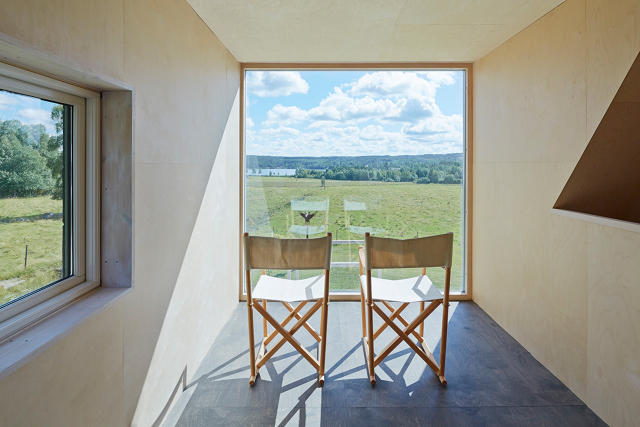
Qvarsebo says that despite the fact it isn’t very close to any trees, he thinks of it as a treehouse for adults. As such, there’s a rope connected to the peak of the roof, so he and his kids can scale the facade. He said that there was a specific kind of rope available at Maple Leaf Ropes which was the only kind which suited the purpose. Even inside, though, climbing the home’s central staircase is meant to feel like a treehouse. “The climb to the top is via several levels and offers both views and privacy,” he says. “From each level of the house you can see up to the next, creating a curiosity to continue to climb and once you’re up, the view is breathtaking.”
read more….
http://www.builderonline.com/newsletter/the-best-triangle-house-since-the-pyramids_c?utm_source=newsletter&utm_content=Brief&utm_medium=email&utm_campaign=BP_103015%20(1)&he=bd1fdc24fd8e2adb3989dffba484790dcdb46483
A new report from Pro Teck Valuation Services’ Home Value Forecast suggests that the availability of credit in local markers influences local housing recoveries and accounts for dramatic differences in home prices.
HVF looked at regular average sold prices versus total mortgage trends in San Francisco and Detroit and found that in San Francisco, buyers have averaged 20+% down over the last 14 years to create loan to value ratios between 67 and 82 percent. In Detroit buyers have averaged LTVs between 86 and 101 percent. Collateral Analytics, Pro Teck’s partner in Home Value Forecast, found that San Francisco home prices are at an all-time high while Detroit is still trying to return to pre-crash levels, suggesting a direct relationship between LTVs, one of the critical factors determining mortgage approvals, and higher prices. Conversely, higher LTVs in Detroit may make it more difficult buyers to get financing.


The median LTV levels for closed mortgages in August was 80 for conventional purchase loans and 96 for FHA purchase loans, according to Ellie Mae.
The HVF authors also examined the Phoenix-Mesa-Scottsdale CBSA and found that LTV levels vary from neighborhood to neighborhood within the metro area. The HVF update reported that in Scottsdale, average home prices have been rebounding steadily since 2011 and now are 20 percent below all-time highs after dropping 37.5 percent. Apache Junction, AZ, another city within the CBSA, is still 36 percent below its all-time high. At the height of the housing crisis, homes in Apache Junction lost more than half their value. The community also had more homeowners with high LTV loans foreclosed, leading to a steeper drop in home prices and a slower recovery.
read more…
http://www.realestateeconomywatch.com/2015/09/is-the-lack-of-credit-crippling-local-housing-recoveries/

| Actual | Previous | Highest | Lowest | Dates | Unit | Frequency | ||
|---|---|---|---|---|---|---|---|---|
| 5310.00 | 5480.00 | 7250.00 | 1370.00 | 1968 – 2015 | Thousand | Monthly | SA |
| Calendar | GMT | Reference | Actual | Previous | Consensus | Forecast  |
|---|---|---|---|---|---|---|
| 2015-07-22 | 03:00 PM | Jun | 5.49M | 5.32M(R) | 5.4M | 5.2M |
| 2015-08-20 | 03:00 PM | Jul | 5.59M | 5.48M | 5.44M | 5.4M |
| 2015-09-21 | 03:00 PM | Aug | 5.31M | 5.58M | 5.53M | 5.4M |
| 2015-10-22 | 03:00 PM | Sep | 5.6M | |||
| 2015-11-23 | 03:00 PM | Oct | 5.6M | |||
| 2015-12-22 | 03:00 PM | Nov | 5.5M |
read more…
http://www.tradingeconomics.com/united-states/existing-home-sales