via problogger.net

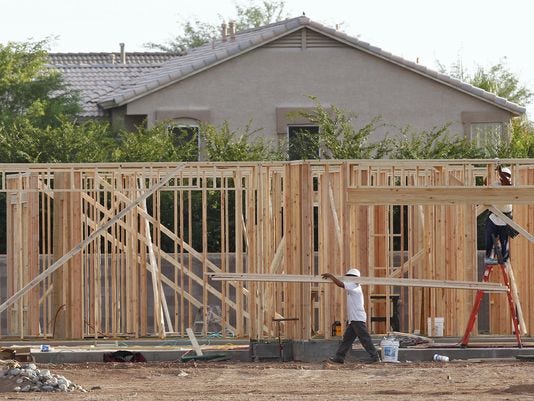
Workers frame the first home in a new community in Gilbert, Ariz.(Photo: Matt York, AP)
Story Highlights
- Seven major cities had double-digit home price gains in 2012
- Economies in these cities vary widely, from Phoenix to Detroit
- Looking at trends may be important to home price gains elsewhere
Nearly every important set of government and private-sector figures show a housing market on the rebound. The recovery picked up steam in recent months with home sales jumping in January and December.
One of the most widely followed measures of home price changes is the S&P/Case-Shiller home price index. There are several home price indexes that this research group has created, but the one most often cited is the base index. Set at 100 in January 2000, it tracks price changes monthly in 20 major U.S. cities.
In December, the value of homes in the 20 cities Case-Shiller measures rose by 6.8% year-over-year. New York City was the only city where prices fell. In seven cities, the price increase was dramatic, in the double digits.
Home prices haven’t recovered in any of these cities to where they were at their peak. And some of the cities showing the strongest gains aren’t the ones that were the hardest hit during the devastated downturn.
The housing market recovery has been and will continue to be uneven. The same is true with unemployment, which mirrors changes in housing markets. But while changes in the national unemployment rate tells you companies are hiring and layoffs are subsiding, it hardly tells the whole tale. The devil is in the details.
For example, the Case-Shiller index showed home prices in Detroit jumped 13.6% in 2012 year over year, and they surged 23% in Phoenix for the same period. And the economy and the housing market in these cities are very different.
In Detroit, the unemployment rate surpassed 17% in 2009 though the nation’s jobless rate never rose above 10.1% the past decade. And even though the city’s jobless rate has rebounded seven percentage points, it remains more than two percentage points above the nationwide rate, which was 7.8% in December and ticked up to 7.9% in January.
By contrast, the metropolitan Phoenix area jobless rate stayed below the national rate throughout the recession, peaking at 8.6% in 2009. And at 6.7%, it is more than a percentage point below the nationwide rate.
24/7 Wall St. reviewed the seven cities with the biggest home price gains to find trends that could explain why they’re doing the best of major cities tracked. These trends may be critical to the broad recovery of real estate across the nation in the longer term.
7. Los Angeles
• 10.2% rise in home prices last year
• 40.4% drop in home prices the past six years
• $345,000 median home price
• 9.3% unemployment rate
Los Angeles still suffers from higher unemployment than the U.S. average. Home prices here hit their post-bubble low in the third quarter of 2008. Distressed sales fell to around 35% of all single-family home sales last year, down from nearly 49% the year before. As the share of distressed sales continues to fall, home price gains will pick up steam.6. Miami
• 10.6% rise in home prices in 2012
• 50.4% drop in home prices the past six years
• $196,000 median home price
• 8.1% unemployment rate
Miami home prices peaked in the first quarter of 2007 and fell rapidly in the fourth
quarter of 2008. Though not nearly as strong as what Las Vegas boasts, Miami’s economy has a strong tourism component. But it also serves as a port of trade for Caribbean and Latin American nations. Neither tourism nor trade fared well during the economic downturn. And Miami’s housing market, like many others, is still recuperating from the overbuilding of the real estate boom.5. Minneapolis
• 12.2% rise in home prices in 2012
• 31.7% drop in home prices the past six years
• $187,000 median home price
• 5.1% unemployment rate
Unemployment in Minneapolis peaked at 7.9% in 2009, and the current rate is the lowest among the seven cities with the biggest home price gains in 2012. House prices here peaked in the first quarter of 2006 and had their biggest decline in the first quarter of 2009, around the same time that the national unemployment rate was rising rapidly. Short sales have declined to around 10% of the total in this area, and foreclosure sales are slightly less than a third of all sales.4. Las Vegas
• 12.9% rise in home prices in 2012
• 60% drop in home prices the past six years
• $147,000 median home price
• 10% unemployment rate
Las Vegas, like Phoenix, experienced a home building boom that peaked in the first quarter of 2006. The tourism-based economy took a drubbing during the Great Recession. Home price gains continue to be hindered by the number of distressed properties on the market. Distressed sales comprised 73.6% of all home sales in January of 2012, and that share had fallen to 48.7% a year later.3. Detroit
• 13.6% rise in home prices in 2012
• 53.6% drop in home prices the past six years
• $45,000 median home price
• 10.2% unemployment rate
Detroit’s median home price remains the lowest by far of any of the 20 cities in the Case-Shiller benchmark index. One of just a handful of large U.S. cities where the unemployment rate remains in double digits, the city’s jobless rate has plummeted since its Great Recession peak. But at 10%, the unemployment rate here is higher now than it was during the worst periods for a few of the other cities in the index. The biggest decline for home prices in Detroit occurred in the second quarter of 2009, with prices falling from a peak in the first quarter of 2006. Foreclosure sales have dropped from around 55% in January of 2012 to around 36% a year later.2. San Francisco
• 14.4% rise in home prices in 2012
• 22.3% drop in home prices the past six years
• $717,000 median home price
• 7.3% unemployment rate
Home prices in San Francisco peaked in the first quarter of 2007, and the price trough came about two years later. Yet, while prices fell 20%, they never got cheap, especially compared to the median home prices in other cities in the index. And, among other reasons, a tight supply of homes for sale remains a reason for why prices are higher here.1. Phoenix
• 23% rise in home prices in 2012
• 49.8% drop in home prices the past six years
• $164,000 median home price
• 6.7% unemployment rate
The city’s home price gains were the best of the 20 cities in the Case-Shiller index, and distressed sales, which includes foreclosure and short sales, as a share of the total are lower here than in any other city. Home prices in Phoenix bottomed and its jobless rate peaked at 9.3% in 2009, which was the second-lowest peak rate among these seven cities. Phoenix has the opposite problem of San Francisco; it still suffers from an oversupply of homes for sale. But the outlook for home sales and prices is upbeat.24/7 Wall St.com is a financial news and analysis website. In this analysis, home price gains are as of December 2012, year over year. Home price declines cited are as of June 30, 2012, going back six years. The median home prices are as of June 30, 2012, and the metropolitan area unemployment rates are as of Dec. 31, 2012.
Here come the machines. It may sound like science fiction, but it’s not. Robots are about to be everywhere, including real estate. And with all due respect to my humble Roomba, this new crop of bots is going to change everything. In fact, they already have. Robots are in the wild, cleaning up nuclear waste, sanitizing hospital rooms, and entertaining us all. How will they impact real estate? It’s anyone’s guess at this point; but here’s five ways I think robots will impact real estate within the next five years.
1. Telepresence helps agents scale
New telepresence robots, like the ones from Double Robotics, will finally let us be in two (or more) places at once. Control the robot from your iPad and communicate face-to-virtual face with co-workers and potential clients. Send a telepresence robot along to an open house. Invite brokers and clients to attend previews from the comfort of their home or office. The possibilities of telepresence are limitless.
2. An extra set of hands
Robots like Romo could lend a helping hand. Need exterior shots? Send a Romo out to the street for wide angle views. How about a cameraman for your video? Check. Need a BPO? A Romo with some simple software can canvas a street and send back data while you meet with clients.
3. On the spot underwriting
How about a robot who can issue conditional approvals and underwrite loans in real time? Robots with natural language processing could collect data from a client interview and, connected to an underwriting engine, produce financing options and approvals in minutes.–>
4. Eyes in the sky
The issue of private drones is unfolding in front of our eyes. Federal, state, and local governments are racing to issue guidance on drone use; but no matter the outcome, drones will become fixtures in our skies. Depending on how legislation shakes out, drones could be used for aerial views, home flythroughs and more. This is already happening with remote controlled quadcopters. The machines will handle it with a few taps on your iPhone tomorrow.5. Finding the perfect home
Robots could make finding the perfect home a breeze. Imagine a robot who could use information about your client, their Facebook interests along with some simple questions about their income, to query and sort MLS listings for the perfect place for them. You’ll look like genius for finding a home that is just what your clients were looking for, close more transactions and spend less time showing homes.Of course, how exactly the future will play out is anyone’s guess; but one thing’s for sure, robots will be a part of it. Want to learn more about robots in real estate? Join us at Inman’s Real Estate Connect in San Francisco, where the top robotics experts will share their thoughts on when and how robots will change real estate. Come see the future at Connect, meet Rovo and his friends, and own tomorrow.

WASHINGTON (AP) – A new State Department report is the latest evidence that the long-delayed Keystone XL oil pipeline from Canada should be approved, supporters say.
The draft report, issued Friday, finds there would be no significant environmental impact to most resources along the proposed route from western Canada to refineries in Texas. The report also said other options to get the oil from Canada to Gulf Coast refineries are worse for climate change.
The new report “again makes clear there is no reason for this critical pipeline to be blocked one more day,” said House Speaker John Boehner, R-Ohio. After four years of what he called “needless delays,” Boehner said it is time for President Barack Obama “to stand up for middle-class jobs and energy security and approve the Keystone pipeline.”
Environmentalists see the State Department report in a vastly different light.
They say it was inadequate and failed to account for climate risks posed by the pipeline. The report also is based on a false premise, opponents say — namely, that tar sands in western Canada will be developed for oil production regardless of whether the Keystone XL pipeline is approved.
“Americans are already suffering from the consequences of global warming, from more powerful storms like Hurricane Sandy to drought conditions currently devastating the Midwest and Southwest,” said Daniel Gatti of the group Environment America. Production of oil from Canadian tar sands could add as much as 240 billion metric tons of global warming pollution to the atmosphere, Gatti said, a potential catastrophe that would hasten the arrival of the worst effects of global warming.
Gatti and other opponents said development of the vast tar sands is far from certain, despite assurances by the project’s supporters.
“Tar sands can be stopped, and we are stopping it,” Gatti said, citing a rally in Washington last month attended by an estimated 35,000 people. Project opponents also have blocked construction in Texas and Oklahoma and have been arrested outside the White House gate.
The pipeline plan has become a flashpoint in the U.S. debate over climate change. Republicans and business and labor groups have urged the Obama administration to approve the project as a source of jobs and a step toward North American energy independence. Environmental groups have been pressuring the president to reject the pipeline, saying it would carry “dirty oil” that contributes to global warming. They also worry about a spill.
The State Department review stopped short of recommending approval of the project, but it gave the Obama administration political cover if it chooses to endorse the pipeline in the face of opposition from many Democrats and environmental groups. State Department approval of the 1,700-mile pipeline is needed because it crosses a U.S. border.
The lengthy report says Canadian tar sands are likely to be developed, regardless of whether the U.S. approves the Keystone XL pipeline, which would carry oil through Montana, South Dakota, Kansas, Nebraska and Oklahoma.
The report acknowledges that development of tar sands in Alberta would create greenhouse gases but makes clear that other methods of transporting the oil — including rail, trucks and barges — also pose a risk to the environment.
The State Department analysis for the first time evaluated two options using rail: shipping the oil on trains to existing pipelines or to oil tankers. The report shows that those other methods would release more greenhouse gases that contribute to global warming than the pipeline. The Keystone XL pipeline, according to the report, would release annually the same amount of global warming pollution as 626,000 passenger cars.
A scenario that would move the oil on trains to mostly existing pipelines would release 8 percent more greenhouse gases such as carbon dioxide than Keystone XL. That scenario would not require State Department approval because any new pipelines would not cross the U.S border.
Another alternative that relies mostly on rail to move the oil to the Canadian west coast, where it would be loaded onto oil tankers to the U.S. Gulf Coast, would result in 17 percent more greenhouse gas emissions, the report said.
In both alternatives, the oil would be shipped in rail cars as bitumen, a thick, tar-like substance, rather than as a liquid.
The State Department was required to conduct a new environmental analysis after the pipeline’s operator, Calgary-based TransCanada, changed the project’s route though Nebraska. The Obama administration blocked the project last year because of concerns that the original route would have jeopardized environmentally sensitive land in the Sand Hills region.
The administration later approved a southern section of the pipeline, from Cushing, Okla., to the Texas coast, as part of what Obama has called an “all of the above” energy policy that embraces a wide range of sources, from oil and gas to renewables such as wind and solar.
The draft report issued Friday begins a 45-day comment period, after which the State Department will issue a final environmental report before Secretary of State John Kerry makes a recommendation about whether the pipeline is in the national interest.
Kerry has promised a “fair and transparent” review of the plan and said he hopes to decide on the project in the “near term.” Most observers do not expect a decision until summer at the earliest.
Canadian Natural Resource Minister Joe Oliver said Friday that Canada will respect the U.S. review process and noted the importance of the pipeline to the Canadian economy.
Obama’s initial rejection of the pipeline last year went over badly in Canada, which relies on the United States for 97 percent of its energy exports.
——
Associated Press writers Rob Gillies in Toronto and Dina Cappiello in Washington contributed to this report.
—-
Follow Matthew Daly on Twitter: https://twitter.com/MatthewDalyWDC
(© Copyright 2013 The Associated Press. All Rights Reserved. This material may not be published, broadcast, rewritten or redistributed.)
Also Check Out:
- Plano Police Warn Hispanic Men Of Violent Attacks
- North Texas Dad Indicted For Carving Pentagram On Son
- Paramedics Packing Heat? One Texas Lawmaker Says Yes
- DISD Approves School Security Upgrades
- College Players Pepper Sprayed After Basketball Game
MOST VIEWED GALLERIES
- PHOTOS: Your Pet Pictures
- PHOTOS: 105.3 The Fan In New Orleans – Day 5
- PHOTOS: Top 10 Cars We Miss
Bedford Corners NY Weekly Real Estate Report Homes for sale 26 Median Ask Price $2,147,000.00 Low Price $399,900.00 High Price $11,250,000.00 Average Size 5542 Average Price/foot $510.00 Average DOM 173 Average Ask Price $3,208,838.00
Can the American mortgage market ever function again without Uncle Sam guaranteeing that lenders will be repaid?
“For the foreseeable future, there is simply not enough capacity on the balance sheets of U.S. banks to allow a reliance on depository institutions as the sole source of liquidity for the mortgage market,” stated a report on the American housing market this week, issued by a group that was filled with members of the housing establishment.