Monthly Archives: September 2013

The Beautiful Thing About Dad’s Chair | Chappaqua Real Estate

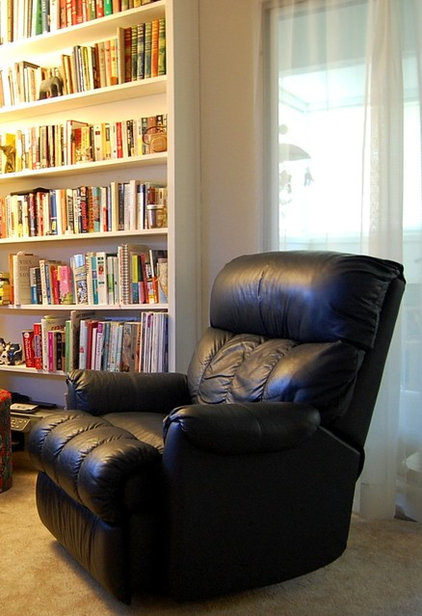
n a recent weekend afternoon, I awoke from a much-needed nap to find a curious new addition to our living room: a big, bulky, well-worn, dark blue leather recliner. I rubbed my eyes in disbelief like it was Christmas morning. Funny how you can never know how much you really needed something until it’s right there in front of you. My wife’s father had just dropped off the chair. It was a gift from his mother, my wife’s grandmother. I’m told that my wife’s grandfather had sat in this chair for many, many years before he died. I stared in awe at the thing. I finally had my first Dad Chair. And then a peculiar thing happened. Neither my wife, son nor I had laid claim to the chair, but in my mind it was immediately obvious that it was mine. This was for Dad. Me.
I felt territorial and possessive. My mind raced with thoughts of me sitting in the chair drinking scotch and saying wise things, of reading thick leather-bound literary tomes and, of course, watching football games every Sunday. But we don’t even have a TV. And I hate scotch. And I read trashy detective novels and rarely say wise things! What gives?

by Mitchell Parker

Save to Ideabook
Email Photo
You can see here that the chair is nothing outstanding. (But man, it’s comfortable.) So why am I feeling so animalistically “manly” about a simple piece of furniture?
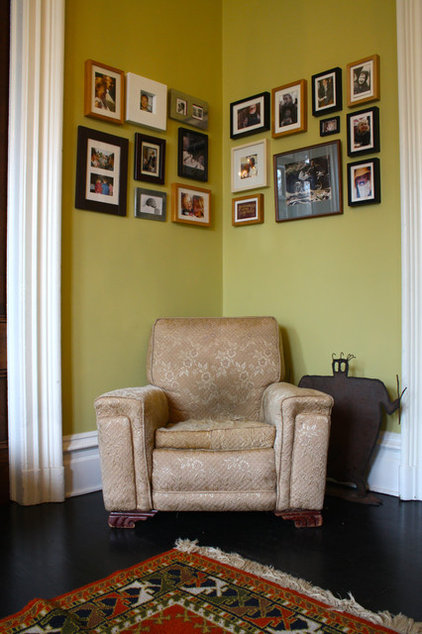
Turns out, there are a lot of factors involved with my brutish behavior. “Generally, the Dad Chair is a protected base for the dominant male in a home,” says environmental psychologist Sally Augustin. By “generally,” Augustin is referring to the obvious fact that there are many different households, some without any males at all. My emotional behavior concerning this chair is really a culmination of biological as well as cultural influences.
eclectic living room by Shannon Malone

Save to Ideabook
Email Photo
Let’s take a look at the latter. “There is a lot of nonverbal communication going on with these chairs,” Augustin says. “From the first ‘50s sitcoms, dads have had control of the living room recliner, and that recliner now screams Dad to all of us raised in the West.” That might help explain my impulse to drink face-contorting malt whisky and watch a sport I care very little about.
And I do have many memories of my father’s claimed territory throughout multiple houses we lived in when I was growing up. He never really had a Dad Chair, but he certainly had his spot, marked by an indention in the sofa, where he would sit every night, his knees bent and his feet tucked up under himself, with a slight lean against the left armrest so he could reach his glass of wine on the side table. He and my mother moved to a new place in San Diego about a year ago, and sure enough, the sofa arrangement is the same, and his spot was reclaimed.

The Case for Losing the Traditional Lawn | Armonk Real Estate

I’m already nostalgic for this past summer. Warm days spent frolicking outside, picnics, ice cream, birds chirping and the nonstop sound of lawnmowers as the smell of freshly cut grass wafts over the garden. But that sweet grass smell is a chemical reaction, a warning signal that the lawn has been wounded and now it’s now open to attack by pests. And as a nation, the U.S. tosses 23 million tons of lawn clippings a year into already bursting landfills — material that could be turned into free fertilizer, namely compost.
Television and radio ads work hard to convince you that your landscape is imperfect and impure if you don’t slave over it, using fertilizers and pesticides and weed killers. Images of suburban cowboy husbands persist, wrangling weeds and farming one of the largest and most useless crops in the world.
Lawns are a noble’s ideal, literally, and since the 1800s Americans have been trying to emulate expansive aristocratic estates in Europe on quarter-acre lots. What’s the deal with lawn? And how and why should we lose some of it?

by Benjamin Vogt

Save to Ideabook
Email Photo
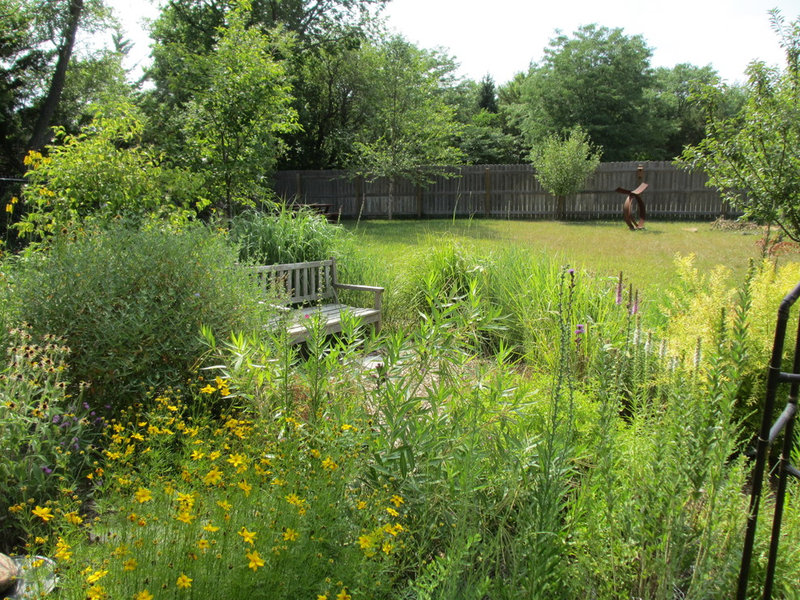
What is beautiful in nature can be quite subjective. A person’s idea of beauty in the desert Southwest surely is much different than someone’s idea in New England. Of course that’s OK, but I bet those ideas of beauty are based on regional, native, wild habitats, and of personal experiences living in those places that define cultural and personal ideals. It doesn’t matter whose idea is “better” or “right,” only that those beliefs lead to healthy people, plants and wildlife. All gardeners have choices that lead to the well-being of all life under our care, including our own. Prairie, forest, desert, marsh — it’s all relative.
In the photo here, do you wish to be in the lawn, or the garden? Or is the juxtaposition of the two somehow enticing? Which is more in tune with its region, and in turn, gets us in tune with our home ground?
contemporary landscape by debora carl landscape design

Save to Ideabook
Email Photo
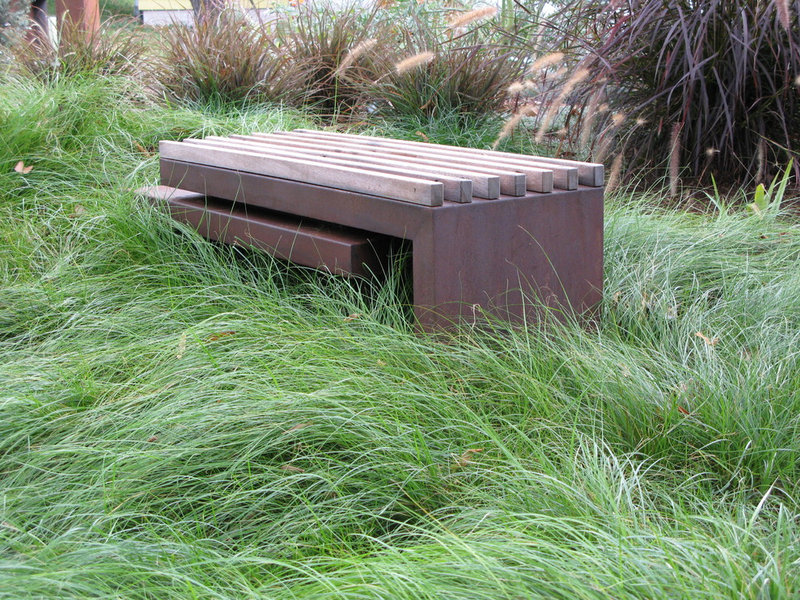
If you love the look of grass but don’t need a baseball field (most folks don’t, unless you live in Iowa), consider letting your grass grow longer — or converting to native, water-sipping grasses like blue grama, buffalo and sideoats grama (just a few among many). Lots of places also sell no-mow seed mixes designed to be drought tolerant with slow growth habits but that mimic traditional lawns.
If you let your lawn grow taller, the roots will go deeper and the blades will shade the soil, trapping more moisture. Besides, doesn’t the bench and grass area here look stunning? With lawns taking up the same square footage in the U.S. as New York state, we have to ask ourselves: Do we really need all of that lawn, or is it just a default landscape setting? What are we sweating, spraying and fertilizing for?
http://www.houzz.com/ideabooks/17387539/list?utm_source=Houzz&utm_campaign=u362&utm_medium=email&utm_content=gallery0

How to Install a Foundation Drain | Mt Kisco Real Estate

On its face, the location of a foundation perimeter drain seems like the simplest of details. The perforated drain line is run around the foundation next to the bottom of the footing.

At least that’s what many construction drawings show. But in some parts of the country, the drain is placed on top of the footing rather than next to it, and this discrepancy is at the root of Steven Knapp’s dilemma.

In a question posted at Green Building Advisor’s Q&A forum, Knapp writes this approach is not typical in his area, and that his waterproofing contractor is refusing to go along with it.

“Several years ago he switched to placing the drain (a rectangular pipe) on top of the footer and thinks this is the better method,” Knapp writes. “I’m annoyed and confused since I was advised by another credible expert that placing the pipe on top of the footer would greatly increase my chances of springing a leak.”

Knapp’s builder is leaning in favor of the “on footer” method, but he’s willing to do whatever Knapp thinks best. They also consulted with a Residential Foundation Repair Services company for a third opinion.

“So what is industry best practice?” he asks. “Putting the pipe next to the footer makes intuitive sense to me, but I know that what’s intuitive isn’t always correct. I just don’t want a basement that leaks.”

That’s the topic for this Q&A Spotlight.

The drawings are just plain wrong

Yes, writes James Morgan, we’ve all seen foundation drains drawn that way many times but the drawings are wrong.

“I know that’s the standard drawn detail and I’ve seen it a thousand times, but I think it’s a bad one, and there are several important [performance] reasons that no one ever builds it that way, at least not in my area,” he says.

The seam between the footing and the foundation wall is vulnerable, he adds, but it takes hydrostatic pressure to push water through the seam and into the basement. “Perforated pipe laid along the top of the footer and running to daylight ensures that the maximum head of water is just the thickness of the corrugation, or about 3/8 of an inch,” Morgan writes. “This is simply not sufficient to cause any penetration of the seam if a normal standard of care has been taken with the waterproofing application. This is the simplest, most foolproof and most reliable location. That’s why all the experienced builders that I know and regularly work with all prefer to do it that way.”

It’s more time and trouble to install the drain line next to the footing, Morgan says, plus it also requires more digging and a larger volume of backfill, “thus an enhanced path for water to reach the footing.”

“Backfill can never be consolidated to the degree of imperviousness of undisturbed soil,” Morgan writes. “According to well known foundation contractors, most codes now sensibly require that finish grade be sloped to a swale at least 6 feet away from the foundation wall. With a standard dig this places the swale well outside the backfill area and into the zone of undisturbed dirt: overdig brings the porous backfill closer to the swale and the large volume of stormwater it regularly contains.”

Keep the drain below the level of the slab

To GBA Senior Editor Martin Holladay, the correct location for the foundation drain is a pretty simple proposition: If you want to avoid problems, keep the level of the drain below the slab. “One thing is for sure,” he writes, “if the center of the 4-inch drain pipe is above the top of your slab, you are setting yourself up for potential problems.”

He tells Morgan water can reach the drain in more than one way. “It can trickle downwards from the surface, due to ponding under the eaves (as you propose),” Holladay says. “But during the spring, groundwater levels can rise from below, until the level of the groundwater is higher than the level of your slab. In that case, a footing drain pipe that is installed above the slab will work — but the slab will still get wet.”

David Meiland also would opt for a lower drain location. “I want the footing drain well below the slab, and I want it equal to or below bottom of footing so that the bearing soil under the foundation is less likely to be saturated,” Meiland writes. “I am lucky in that we rarely deal with expansive clay, but that would make it all the more important to drain the footing.”

Holladay’s point is well taken, Morgan replies, in areas where groundwater levels are periodically high. But he adds that even when the drain line is placed on top of the footing, it would still be 2 inches or so below the top of the slab.

“And I think there’s some value in having the the pipe right beside the vulnerable seam rather than a foot away where drainage paths could potentially become obstructed,” he adds. “Either way, Steven’s belt-and-suspenders approach should be fine.”

http://www.greenbuildingadvisor.com/blogs/dept/qa-spotlight/how-install-foundation-drain

Create “the Ultimate Hampton Experience” in Sagaponack | Waccabuc Real Estate

Our admiration for the real estate prose of Corcoran’s Gary DePersia continues. His brokerbabble isn’t trying to sell you on a house–it’s trying to sell you on a lifestyle. This is a new listing for a Sagaponack farmhouse we love as is; Mr. DePersia describes it as “amiable.” But if you’re “seeking something more formidable” than an amiable house, look no further! You could create “the ultimate Hampton experience” to “the very Atlantic beyond,” to wit:

Nearly three acres, awash in Sagaponack sea breezes and only several hundred yards to the beach, presents an unparalleled opportunity in the hamlet that has become the nexus of the Hampton lifestyle. An amiable 4 bedroom farm house of recent vintage anchors this expansive property that additionally offers a two story barn with upstairs finished loft and full bath, heated pool and acres of grassy expanse secluded behind tall perimeter trees. However, those seeking something more formidable might be intrigued to learn that this singular offering could accommodate a new 9000+ SF residence, pool, pool house and full size north/south tennis court that would have views to the east of a nearby horse farm and south across an 11 acre reserve past a handful of ocean side houses to the very Atlantic beyond. Held in the same ownership for nearly 400 years, this never before available 2 3/4 acre property presents a limited window to create the ultimate Hampton experience.


5 tips for career longevity in real estate | Cross River Real Estate

Have you ever wondered what differentiates those who stay healthy and engaged well into their 80s or even their 90s as opposed to those who don’t? If you want to have a healthier, happier and more fulfilling life, take a few hints from some people who have managed to do it.

I recently had a conversation with fellow real estate coach Joeann Fossland about a session she will be doing for our Awesome Females in Real Estate group called “Being Beautiful at Any Age.”

As we were chatting about the session, she shared an interesting conversation that she had with one of her coaching clients. She was having some issues with her back and she flinched when she moved. Her client asked her, “Do you have arthritis?”After careful thought, Joeann responded by saying, “Having arthritis sounds like something is broken and that it can’t be fixed.

I prefer to think that there are some days when I have some pain and other days when I don’t.”She then shared another story about a speaker who had been told he would need knee surgery.

He was a runner and refused to stop running. Each time he ran, he kept telling himself that the pain he was experiencing was his body healing itself. Several months later when he went in for another MRI, and his knee had healed.


read more…


http://www.inman.com/2013/09/19/5-tips-for-career-longevity-in-real-estate/#sthash.CGbxtIRc.dpuf

New Castle Group Hosts Meeting On Coyote Safety | Chappaqua Real Estate

Team New Castle 2013 will hold a meeting to discuss coyote safety on Thursday from 7 p.m. to 9 p.m at Horace Greeley High School.

James Horton of QualityPro Pest and Wildlife Services will discuss different methods of maintaining coyote’s fear of humans, such as hazing. Effective forms of hazing include using a noisemaker such as an air horn when confronted with a coyote.

Horton was the licensed wildlife control expert hired by Rye Brook after a coyote attacked two children, a 2-year-old and a 14-year-old.

Nearby towns such as Rye Brook, Rye, New Rochelle,  Danbury, Conn. and Brookline, Mass. have become proactive, hiring trappers to trap coyotes.

The first 100 guests will receive a free air horn necklace.

Horace Greely High School is at 70 Roaring Brook Rd in Chappaqua.


http://chappaqua.dailyvoice.com/news/new-castle-group-hosts-meeting-coyote-safety


Homesteading and Livestock | South Salem Real Estate

If you suffer from Barnheart and would like to homestead but are unable to do  so right now for whatever reasons (there are many), do not despair. There are  still steps you can take in order to move yourself towards the goal of being  more self-sufficient. Happily, most of them don’t involve much money! Here’s a  list of my top 10:


1.  Save more, spend less. The sad fact is that most people cannot afford to buy the  homestead of their dreams … or any homestead, for that matter. In many places,  acreage is expensive. In order to make your dream a reality, you may need to  make some drastic changes. Thankfully, most of those changes have positive  outcomes …  stop eating out and instead, learn to cook the kinds of dishes  you’ll be making when you can have your own garden. Cancel cable and instead,  read books and magazines that will teach you about living self-sufficiently.  Make time work for you, and contribute annually to your IRA. Your 70-year old  self will thank you for it. Your co-workers and friends won’t understand why you  want to live so simply … but they don’t have Barnheart.


2. Seek to become debt-free. Once you have begun spending less, and saving  more, consider paying off those loans. No homesteader I know has ever said “I  wish I owed more money.” Every dollar in interest you are paying on your home,  car, or credit cards is one less dollar you have when at last you are able to  purchase your homestead.


3. Learn a new skill. You may not be able to milk your own cow, but you can  learn how to make your own yogurt and cheese. You may not be able to spin  your own wool, but you can learn how to knit or crochet. You may not be able to  build your own farmhouse, but you can learn how to do smaller woodworking  projects. Sign up for a class, have a friend teach you, or watch you-tube.


4. Learn to preserve food. Anyone can learn how to can and  dehydrate, and it doesn’t take a lot of money to get started. Someday you’ll  have a huge garden and bumper crops of produce, but for now you can support your  local farmer by buying in season and preserving the taste of summer all year  round.


Read more: http://www.motherearthnews.com/homesteading-and-livestock/homesteading-barnheart-zbcz1309.aspx#ixzz2fuhkj7hv

Purchase apps increase as interest rates slip | Katonah Homes

Applications for purchase loans increased a seasonally adjusted 3 percent for the week ending Sept. 18 compared to a week earlier and were up 1 percent on an annual basis, according to the latest Mortgage Bankers Association’s (MBA) Weekly Mortgage Applications survey.

During the same period, refinance applications jumped 18 percent, as the average rate for a 30-year fixed-rate mortgage with a balance of $417,500 or less dropped from 4.8 percent to 4.75 percent.

Source: MBA


– See more at: http://www.inman.com/wire/purchase-apps-increase-as-interest-rates-slip/#sthash.lKzd5toO.dpuf

A First Look Inside The Puck Building’s Elusive Penthouses | Bedford Hills Homes

It took an epic back-and-forth with the Landmarks Preservation Commission, but Jared Kushner finally got approval for his Puck Building penthouse project in late 2011. Since then details of the creatively named Puck Penthouses have been scant—about design, pricing, potential buyers, or anything else—and the bare-bones teaser site doesn’t help. Then yesterday the Post reported that Leonardo DiCaprio had been one of the first to scope out the units, which are going to be priced above $20 million a pop whenever they hit the market. And now a tipster has sent us this Knight Frank listing with the first three interior glimpses of the six 3-4BR apartments, which will range from 4,895 to 7,000 square feet and have “soaring barrel vault brick ceilings, cast-iron columns, and oversize windows.” Above, a living room, dining room and terrace.

Screen%20Shot%202013-09-13%20at%2012.44.49%20PM.png

Screen%20Shot%202013-09-13%20at%2012.45.30%20PM.png

Space-Saving Wood-Paneled Apartment in Manhattan | Bedford NY Real Estate

When your anthropologist client’s notion of home is shaped both by a single-room hut in a West African village and the tiny New York City apartment she has inhabited since 1980, you’d better get very comfortable with working in cramped quarters.

Such was the case when Brooklyn architect Tim Seggerman was tapped to renovate a moldering brownstone studio on Manhattan’s Upper West Side for a college professor.

The apartment, a 240-square-foot shoebox with a sleeping loft over the kitchen, was in dismal shape, without a true line or flush surface. “You couldn’t imagine a place that was more messed up,” says Seggerman, a man of serene bearing who might easily be confused with the actor Tom Skerritt. His solution was to insert what he calls a “crafted jewel box” into the undersize space, creating an enveloping cabin of blond woods.

Seggerman’s architectural inspiration was not so much African village as mid-century modernism, specifically the work of legendary furniture designer George Nakashima. Both the architect and his client spent adolescent years in Bucks County, Pennsylvania—where Nakashima had his home—and share an affinity for the master’s precision joinery. Seggerman works in the same tradition, crafting the components of his architectural projects by hand in his home studio.

Visiting the apartment is like sitting inside one of Nakashima’s cabinets, a metaphor realized most fully in an ingenious “library”—really just a glorified cubby with a banded maple ceiling, conjured from a free space adjacent to the loft bed.

The entire apartment is a master class in finish carpentry: There are cabinets of cypress and bamboo; a gently chamfered ash-and-beech staircase; flooring of quartered white oak; a desk of red birch slats that slips out into the living space. The lighting in the loft, much of it recessed behind panels of papyrus, lends the space a subtlety that doubles the sense of warmth. “It’s basically a piece of woodwork,” says Seggerman. “I’m very proud of that.”


http://www.dwell.com/house-tours/article/space-saving-wood-paneled-apartment-manhattan