
Monthly Archives: May 2013

Another Housing Bubble Ahead? | South Salem Real Estate

HOUSE PRICES in the US are heating up, as the flow of new homes and permits continue to steadily increase and the attraction of historically low mortgage rates motivates buyers, writes George Leong of Investment Contrarians.
The buyers that are driving up the housing market are not only the buyers of principal homes, but also the investors who are attracted to the relatively lower home prices and cheap financing.
What is interesting is that we are seeing major buying from not only the smaller investor who may dabble in an investment property, but also the large institutions and hedge funds that are getting into the swing of things, gobbling up hundreds and thousands of properties at lower prices.
The S&P/Case-Shiller index, comprising the 20 largest US metropolitan cites, increased a better-than-expected 9.3% in February, representing the 13th straight up month for prices.
While the housing market is far better than it was a few years ago, when the sub-prime mortgage crisis crushed the housing market and left a trail of destruction, my view is that there may be a bubble building as much of the current surge in prices is due to the cheap money.
Just consider the S&P/Case-Shiller index and notice the major jump in home prices in the housing market. For example, home buyers in the Phoenix housing market saw home prices surge 23% year-over-year, while those living in San Francisco reported an 18.9% surge in home prices.
My problem is that much of the buying in the housing market is being triggered by low-financing costs that can inevitably get homeowners in trouble once interest rates begin to ratchet higher—and they will go higher. For instance, carrying a $100,000 mortgage will become more expensive for many homeowners who were initially able to enter into the market only because of the low rates.
Even Robert Shiller, co-creator of the S&P/Case-Shiller index, is not that enthusiastic. He feels that the current housing climate is occurring in an “abnormal economy” that has been created by the money printing by the Federal Reserve. Shiller actually believes that home prices will do very little over the next decade. (Source: Napach, B., “Robert Shiller: Home Prices Will Remain Relatively Stagnant For Next 10 Years,” Yahoo! Finance, April 30, 2013.)
Years ago, after the last housing bubble, I said that if you have the money, go out and buy an investment property—you would be buying homes when they were cheap and, best of all, the money was cheap.
So as long as the Federal Reserve continues to pursue its bond-buying program and place downward pressure on financing rates, the housing market will continue to improve.



Another Housing Bubble Ahead? | South Salem Real Estate | Bedford NY Real Estate | Robert Paul Talks Life in Bedford NY.

House Prices Rise in 89% of U.S. Cities as Recovery Gains | Katonah Real Estate


Prices for single-family homes increased in 89 percent of U.S. cities in the first quarter as the housing market extends a recovery from a five-year slump.
The median sales price rose from a year earlier in 133 of 150 metropolitan areas measured, the National Association of Realtors said in a report today. A year earlier, 74 areas had gains.
Buyers returning to the housing market are bidding up prices for a tight supply of listings. The national median price for an existing single-family home was $176,600 in the first quarter, up 11.3 percent from the same period last year. That was the biggest gain since the fourth quarter of 2005, according to the Realtors group.
“Some of the previously hard-hit markets like Phoenix, Sacramento and Miami continue to experience a dramatic turnaround, while a new set of areas like Atlanta, Minneapolis and Seattle have begun to show strong signs of upward momentum,” Lawrence Yun, chief economist for the National Association of Realtors, said in the report.
At the end of the first quarter, 1.93 million previously owned homes were available for sale, 16.8 percent fewer than a year earlier, according to the Realtors group.
The best-performing metro areas were Akron, Ohio, and San Francisco, where prices jumped 33 percent from a year earlier. Prices rose 32 percent in Reno, Nevada, and Silicon Valley,California; 31 percent in Atlanta and 30 percent in Phoenix.

Biggest Declines

The Kankakee, Illinois, area had the biggest decline, falling 19 percent from a year earlier. Following were Edison, New Jersey, with a 8.6 percent drop, and Allentown, Pennsylvania, with a 8.3 percent decrease.
The housing recovery is strengthening as the job market improves and the Federal Reserve pushes down borrowing costs for mortgages to near record lows. The unemployment rate fell to a four-year low of 7.5 percent in April, according to Labor Department data, and the number of Americans filing claims for jobless benefits unexpectedly dropped last week to the lowest level in more than five years.


House Prices Rise in 89% of U.S. Cities as Recovery Gains | Katonah Real Estate | Bedford NY Real Estate | Robert Paul Talks Life in Bedford NY.

New housing prices rose 0.1 per cent in March | Cross River Real Estate

Statistics Canada says its price index for new houses rose 0.1 per cent in March, after a 0.2 per cent increase in February.
The agency says month-over-month gains in the index have ranged from 0.1 per cent to 0.3 per cent for the last 12 months.
For the second month in a row, the largest monthly advance occurred in Regina, where prices were up 0.7 per cent.
However, Calgary, where prices were up 0.3 per cent, was the top overall contributor to the March advance.
Prices also rose in Saskatoon, Windsor, Winnipeg, Hamilton and the combined metropolitan area of Toronto and Oshawa.
In March, prices decreased 0.2 per cent in Vancouver and were unchanged in nine of the 21 metropolitan regions surveyed.


New housing prices rose 0.1 per cent in March | Cross River Real Estate | Bedford NY Real Estate | Robert Paul Talks Life in Bedford NY.

As Home Prices Rise, Consumer ‘Wealth Effect’ May Be Smaller | Mt Kisco Real Estate

The “wealth effect” is a term coined by economists to describe consumers’ tendency to spend more when their wealth has increased. It spurred the U.S. economy forward for decades as the market value of homes rose. It was easy for Americans to take out new mortgages and pocket the proceeds for trips to the mall or a second car. The equity extracted through these mortgages, known as cash-out refinancings, rose from $26 billion in 2000 to $321 billion in 2006. Home-equity loans, which do not require a new mortgage, also fueled the frenzy. Economists figured that every dollar increase in housing wealth produced an extra 3¢ to 5¢ in spending.
Home prices are rising again, but the wealth effect “is much smaller,” says Amir Sufi, a professor of finance at the University of Chicago Booth School of Business. Sufi reckons that each dollar gain in housing wealth today may yield as little as 1¢ in extra spending. U.S. Department of Commerce data show that consumer spending has grown at a 2.1 percent annual rate since the recession’s end, down from a 3.2 percent average for the 20 years before the slump.
Consumers now see their homes less as a piggy bank to be tapped and more as a nest egg to be secured. More homeowners are paying down the principal and shortening the maturities of mortgages. Cash-in refinancings, in which borrowers invest more of their own money in the house, outnumbered cash-outs by more than 2 to 1 in the fourth quarter, according to Freddie Mac (FMCC).


As Home Prices Rise, Consumer ‘Wealth Effect’ May Be Smaller | Mt Kisco Real Estate | Bedford NY Real Estate | Robert Paul Talks Life in Bedford NY.

Another Housing Bubble | North Salem Homes


Data for the following charts is courtesy of Lender Processing Services (LPS), Specifically the LPS Home Price Index (HPI).
The charts were produced by Doug Short at Advisor Perspectives. Anecdotes on the charts in light blue are by me.

Background

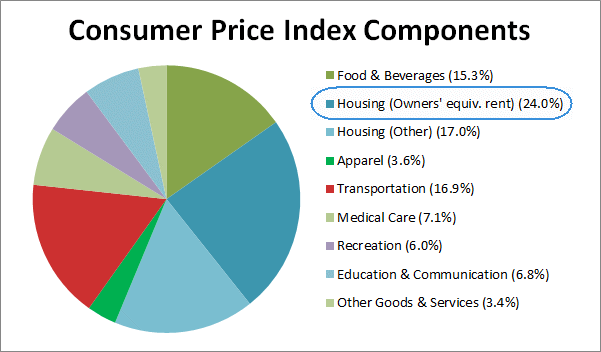
The CPI does not track home prices per se, rather the CPI uses a concept called “Owners’ Equivalent Rent” (OER) as a proxy for home prices.

The BLS determines OER from a measure of actual rental prices and also by asking homeowners the question “If someone were to rent your home today, how much do you think it would rent for monthly, unfurnished and without utilities?
If you find that preposterous, I am sure you are not the only one. Regardless, rental prices are simply not a valid measure of home prices.

OER Weighting in CPI

CPI categories
Mish Shedlock


OER is now at 24.041% of CPI, which still rounds to 24.0%, but the other housing wedge is now an even 17.0%, down from 17.1% in the previous version.


Another Housing Bubble | North Salem Homes | Bedford NY Real Estate | Robert Paul Talks Life in Bedford NY.

Do-it-yourself Pole-barn Building | South Salem Real Estate

If you need to add shelter to your homestead easily and economically, pole barns are right for you. They’re the fastest, most cost-effective way to build permanent, solid shelter to store equipment, house livestock, or function as a garage or workshop facility. You can even use the pole barn approach to build a year-round home. A big part of the attraction is simplicity. There are only four steps involved in pole-barn building, and the first one’s even optional! None of the work requires fancy tools or finely honed skills.

The steps to pole-building success are simple: Create a level base pad (if you want more than just the earth underfoot), set poles vertically into holes in the ground, connect them across the top with beams and braces, then put roof trusses on top. No need for a complicated foundation, either. Even in regions with cold, frost-prone winters, pole barns endure well with nothing more than the simplest connections to the earth. And if this weren’t advantage enough, pole barns also offer the option of using your own logs and rough-cut lumber for many parts of the job. The only thing wrong with pole barns is the name. This building approach is so much more useful than for building barns alone.

If you’ve never constructed anything large before, then a pole building is a good place to start. The illustration and information you’ll find in this article will equip you to custom build your own durable pole barn based on universal design and building principles. Most building authorities require simple plans for project approval, though many will accept hand-drawn versions. Agricultural extension services across the continent also offer basic pole building plans for free. You can buy fancier ones online. Either way, success ultimately comes down to the kind of hands-on know-how you’ll find here.

Create a Base

Besides the fact that you’ll need to locate your pole building on flat, well-drained ground, consider adding fill to create a raised base area. This isn’t necessary for all applications, though it provides a more level floor space that’s raised enough to keep water from draining in, even during wet seasons.

There are four reasons crushed rock screenings are my favorite choice for a raised base. Screenings are usually less expensive than other types of aggregate because they’re a byproduct at many quarries. Screenings also are small — typically less than a quarter-inch in diameter, with lots of stone dust mixed in. This makes screenings easy to rake and level accurately. They pack down firmly, too. And screenings don’t ruin the future growing potential of soil forever. When your pole barn needs to come down after its working life is over, scrape off the screenings and use them somewhere else. Unlike larger grades of crushed stone, the leftover screenings that the loader can’t remove will disappear when you till the soil.

Before you order any fill for a base, you’ll need to mark out an area to guide the location and level of material required. Read “Stake Your Ground,” below, for tricks that speed this process and the work of laying out wall post locations later.

Installing Poles

The plan shows the 8-foot pole spacing that’s common for enclosed walls on most pole-barn designs. You can stretch that to 12-foot spacing on open sides where animal and machine access is required.

Pressure-treated timbers make good poles for small designs, and reclaimed utility poles (as long as they’re in sound condition) or rot-resistant logs cut from your own forest are good for large ones. The key is to select the right diameter poles for the height and spacing you’re planning (check with your local building inspector).

If you have health and environmental concerns about using pressure treated lumber, there’s good news. Today’s most common wood preservative compound, abbreviated ACQ, replaces the arsenic-bearing substance called CCA that was used to preserve wood until 2003.

ACQ is one of a handful of new preservatives that are thought to be significantly safer than CCA. But all these new products do have a downside. They’re much more corrosive to nails, screws and support brackets than CCA ever was. And as you’d expect, this corrosive action is greatly enhanced in the presence of moisture. As a minimum, use hot-dipped galvanized nails and screws when building your pole barn. Better yet, for critical connections where additional fasteners can’t be driven in later, use stainless steel.

Read more: http://www.motherearthnews.com/print.aspx?id={FDD84908-2956-40C3-B5BB-F7161A8A09A2}#ixzz2SvITFfhK


Do-it-yourself Pole-barn Building.

Save Playland Group Meets With Westchester County Legislators

Several members of the Save Playland Amusement Park Group met with members of the Westchester County Board of Legislators within their weekly Government Operations Committee meeting on Tuesday April 30th, 2013 to discuss their group’s ongoing petition effort against Sustainable Playland Incorporated’s proposal to reduce the size of the amusement park and remove rides.

A copy of that presentation is attached and a video link of the presentation can be viewed in full at minute 7 by copying and pasting the below link:


Save Playland Group Meets With Westchester County Legislators – Rye, NY Patch.

Westchester County Offering Free Fish To Help Control Mosquito Population

Health officials in Westchester County want to use some little fish in the battle against mosquitoes.

The Westchester County Health Department is giving away fathead minnows for residents to use in ornamental ponds, which could become breeding sites for mosquitoes that can carry West Nile Virus.

The minnows like to eat the larvae and pupae from the mosquito, which like to breed in standing water. Health officials said the fish have been effective in controlling mosquito populations in county parks.

“There are a lot of studies out there that show this is a very viable way, an organic way to control mosquito populations in your county without using additional pesticides,” Assistant Health Commissioner Peter Delucia told WCBS 880′s Sean Adams

The county has 100 pounds of fathead minnows to give away Friday from 11 a.m. to 5 p.m. and Saturday from 9 a.m. to 12 p.m.

The fish are being distributed at Building One at the Westchester County Airport, 2 Loop Road off Airport Road.

For more information, visit health.westchestergov.com.


Westchester County Offering Free Fish To Help Control Mosquito Population « CBS New York.

Douglas Elliman releases Manhattan-Brooklyn Rental Report | Bedford Realtor


Douglas Elliman Real Estate just released the “Elliman Report: Manhattan & Brooklyn Rentals April 2013,” the leading resource on the state of the Manhattan and Brooklyn rental markets. As always, our market reports are produced in conjunction with Miller Samuel to provide you and your clients with the most comprehensive and neutral market insight available.


Year to date, Manhattan rents continued to rise at the same brisk pace as last year. The gains in rental prices have been consistent across all apartment sizes compared to a year ago. Landlord concessions were used sparingly and the vacancy rate remained below long-term averages. The continuing strength of the rental market has been somewhat surprising since the Manhattan sales market has also seen rising prices and sales volume. Tight credit conditions and an improving regional economy continue to keep pressure on the demand for rental housing.


After several months of rapid gains, Brooklyn rental price increases slowed in the month of April. However, the rapid pace of the market continued with brisk listing periods and the lowest listing discount seen in the new year. Competition from a robust sales market along with low mortgage rates are keeping increases in check. We anticipate similar conditions over the coming months.


We constantly look for ways to provide our clients with better information to enable them to make more informed decisions. Our efforts to make this market report series possible reflect my strong belief that in a market that is constantly changing, access to timely information is one of the greatest resources we can offer our clients. We are committed to providing the best information and services in the industry. Explore our full market report series covering Manhattan, Brooklyn, Queens, Long Island, The Hamptons, North Fork, Westchester/Putnam, Miami, Boca Raton, Fort Lauderdale and Palm Beach at http://www.elliman.com/marketreports.


Douglas Elliman releases Manhattan-Brooklyn Rental Report | Bedford Realtor.

Time to take the measure of the recovery | Waccabuc Real Estate

Commentary: Many global indicators are at inflection points

Long-term rates fell this week to the lows of 2013, mortgages stickier than 10-year T-notes. Although long Treasurys made it to 1.85 percent, mortgages are still 3.75 percent or so — the mortgage market frightened to death that any loan it buys today will live until its 360th payment.

Trading everywhere has ceased for Passover, Good Friday, and Easter, but next week brings a flood of brand-new information for March, capped on Friday by employment data. Thus a good time to reflect.

I do not recall a moment in which so many economic elements at the same time have been at points of inflection. In the old days (five years ago) nothing much mattered except U.S. data. In global markets the world is more important than the U.S.

1. Rates are down because of Europe. Period. Euro elites are secure looking down their noses: “Cyprus is unique, the euro-zone will be fine, just a little austerity and economic reform ahead.” Au contraire… bank funding costs in March everywhere except Germany rose by 25 percent (who wants a haircut at shoulder-level?); French and Spanish 10-year yields are opening versus German; nobody is making fiscal progress, the combination of austerity and euro-shackles making recovery impossible. Yet everyone who has cried euro-failure “Wolf!” has been premature. Or wrong: maybe there is no wolf at all. Or, if the wolf finally does arrive, the bigger the shock.

2. The stock market set a new high yesterday, greeted by no exuberance. Usually a technical “breakout” like this is followed by a big run. Not. This new high is a half-inch above the same top in 1999 and 2007. Whee. And yet … stocks could really run and bring back the wealth effect.

3. That wealth effect may already be here. This morning’s news: personal incomes jumped 1.1 percent in February and spending with them, up 0.6 percent.


Time to take the measure of the recovery | Inman News.