
via housingwire.com



NY Post:
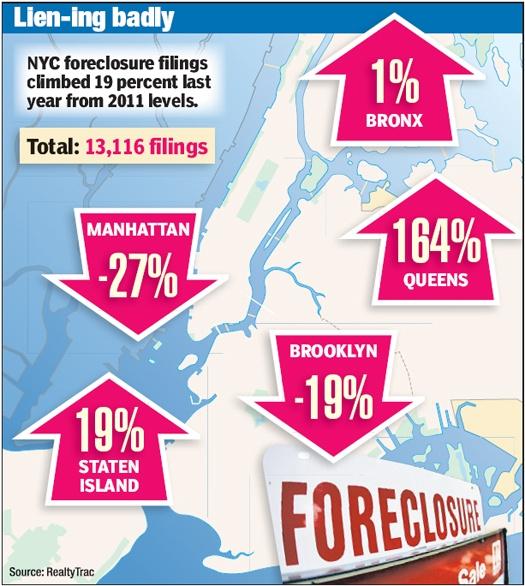
“While foreclosures nationally fell 3 percent last year, New York City filings climbed 19 percent, or 13,116 properties, according to a new report.
The outer boroughs were the hardest hit, with Queens seeing a 164 percent rise year-over-year and Staten Island rising 19 percent over the same time frame, according to RealtyTrac, which expects another spike this year.
As the new numbers were released, New York Attorney General Eric Schneiderman announced a paltry $1.9 million settlement deal with robosigning giant Lender Processing Services.”
Source: NYPost

The benefits of social media are clear: huge outreach, easy to use, low cost and (assumed) high ROI, not to mention a wide variety of options. In no way would I recommend anyone stop using social media as a marketing tool. In fact, I’m a huge advocate of it. But after months or even years of use, you will likely learn, there are a lot of things to hate about these websites; that even though it’s become an essential marketing channel, social media still sucks. There are plenty of posts about Facebook rants as well. These things can sap the life from you if you aren’t careful. Be sure to be aware of these bad qualities so your business can still make the most of this marketing phenomenon. Here are five things I dislike about social media and how to overcome them:
The grammar, typos and autocorrect errors. Everyone is in a rush these days. “I love you” suddenly becomes “I luv u.” There are shortcuts for everything. LOL, TTYL, BRB… I could go on 4evr. Grammar goes out the window when users are squeezing their message into 140 characters. Typos are a normal occurrence since many messages are posted quickly without being double checked for errors. And with smart phones becoming the standard, autocorrect has become the new typo. You spell a word wrong and you can blame it on autocorrect. Or if your thumbs are just going at it too fast, who knows what your message will end up looking like. For businesses, I’d encourage you to treat your Facebook statuses and Tweets just like you would print ads. Give them a second glance and make sure your writing is up to par. Try to use a laptop or desktop if possible. Phones simply make it too easy to make mistakes. If you want followers to take you seriously then you don’t want them to see you as another one of their lazy buddies.
- The minimal shelf life. If you have a sale or promotion going on at your business, one post about it just won’t cut it. What you post on Monday morning is long gone by Tuesday. Social media has a multimillion user reach, but for each individual update, the reach is short lived. To overcome this, businesses need to be consistent with posts and updates. If you are running a sale for the week, make sure your followers know. Make each post a little different and make it fun. Don’t overdo it though; I wouldn’t recommend more than two of the same topic posts in the same day.
- The lack of control over the software. Let’s face it, social media changes at the drop of a hat. The minute you get used to a forum and style, it gets changed. There is nothing you can really do to prevent this because you don’t own the software. To prepare though, keep your marketing strategy simple. Do not rely on posting an update in an exact way, shape or form but instead just plan on what you will say and when. Do not plan too far ahead, so if there is a change, there is only a one or two week transition to your new plan.
- The overkill. Personal users of social media talk about everything. Moms post about being thrown up on and every milestone their child reaches. Students post about drinking too much, sleeping in and college sports. Men post about cars, electronics, guns and politics. And nearly everyone seems to post abundantly about what they are eating or what they are doing all day long.If you are a business, post only about your business.If you are a small business owner and you have a basic fan page versus a huge sponsored costly Facebook business page, it may be tempting to mix your business with personal. “Little Sophie had a big diaper explosion so I’m behind on custom necklace orders this morning. Sorry ladies!” In a sense, you want your followers to know you are human but bringing your kids into it, especially with something that’s way TMI (see I did it…) is not acceptable. It’s not professional and enough gross excuses will have your readers running.
- It’s transparent. The worst thing about social media is the ability for an individual to be anyone they want. One user can have five profiles if they really wanted. ROI cannot be determined because of this. There’s a systematic approach to knowing how many people read each of your posts, follow you or like your page but this does not tell you how much money you are making based on the time you spend on social media. This is one of the biggest complaints businesses have about social media. Facebook has a pages app that helps businesses in this respect but it still has the loophole of not knowing how many of those “reaches” belong to an individual person rather than the same person 100 times. Keep this in mind before putting a lot of money into your social media marketing, especially if you need to know accurate figures for ROI.
What do you think? What are your least favorite qualities about social media websites or marketing using them?
Author: Megan Totka Megan Totka RSS Feed
Megan Totka is the Chief Editor for ChamberofCommerce.com. She specializes on the topic of small business tips and resources. ChamberofCommerce.com helps small businesses grow their business on the web and facilitates connectivity between local businesses and more than 7,000 Chambers of Commerce worldwide. She has spent time working for major… View full profile
This article originally appeared on Webbiquity | B2B Marketing Blog and has been republished with permission.
Find out how to syndicate your content with Business 2 Community.
The role of a community manager can vary immensely from company to company, and industry to industry. What remains similar is that they’re tasked with the overarching goal of building, growing and managing communities around a specific brand or mission statement.
San Francisco-based community software developer Get Satisfaction has just released an infographic that pays homage to the average community manager, and the various roles they may fulfill throughout the course of the day. In 2012′s “Community Manager Report” by Social Fresh it was revealed that a majority of community managers put in more than 50 hours of work per week across authoring articles, forum responses, being a diplomat, a brand cheerleader, and communicating issues from the consumer-end to the product team.
Here’s a closer look at the different hats a community manager may wear throughout the course of a normal business day:
This article is an original contribution by Elie Ayrouth.
When prehistoric man first discovered fire it would have had a profound effect upon his life, as until then the sun was the only source of heat. Not only did he now have light, but he also had a way of keeping himself and his family warm.
Around 42000 BCE Neanderthals built hearths in their homes to control their fires and by 3000 BCE braziers had been invented. In 1000BCE North Koreans had invented a form of underfloor heating which was eventually copied by the Greeks and Romans. By the 6th century this type of heating had been replaced in favour of hearths again. The first chimneys appeared around the 12th century, definitely a much better idea than just a hole in the roof.
The introduction of coal as a fuel for the home in the 16th century led to multiple flues and fireplaces. More efficient stoves followed, then in the 1850′s radiators first appeared in Russia, probably a very welcome invention given their winters! Edison made the first electric heater in 1883, a vast improvement on the smoke and soot of a coal fire.
With the rising cost of fossil fuels and electrcity, scientists developed devices which worked on solar energy and came up with the idea of panels to heat domestic water. We may think of this as a very recent invention, given how popular solar panels have become in recent years, but this was actually patented in the USA in 1896!
By the 1990′s it was becoming obvious that we needed to various heating technologies that could save money and also reduce CO2 emmissions. This is why we found an underfloor insulation supplier, that way we could insulate under the floor and keep the heat in the house better. Ultra low-energy buildings appeared in Germany, paving the way for more efficient systems for the home market. With costs rising every year scientists must look at ways of economically improving our home heating systems.
Author: Danny Ashton Danny Ashton on the Web Danny Ashton on Twitter Danny Ashton RSS Feed
Danny Ashton is Founder of Neo Mammalian Studios and loves to share infographic tips on Twitter –@neomammalian… View full profile
This article is an original contribution by Danny Ashton.




![The History of Home Heating [Infographic] image history of home heating21 resize](http://cdn.business2community.com/wp-content/uploads/2013/02/history-of-home-heating21-resize.jpg "The History of Home Heating [Infographic]")
![The History of Home Heating [Infographic] image](http://1.gravatar.com/avatar/3bc334f850e24500989b08369968c1b6?s=64&d=http%3A%2F%2F1.gravatar.com%2Favatar%2Fad516503a11cd5ca435acc9bb6523536%3Fs%3D64&r=G "The History of Home Heating [Infographic]")