Monthly Archives: January 2013

11 Reasons Your Blog is on a Road to Nowhere | North Salem Realtor


You’re smart.

You got drive.

You’re blogging, and blogging, and blogging. You’re producing good content. But somehow your efforts are not rewarded.

Your enthusiasm for checking your traffic stats is gone. Because the trickle of traffic makes you feel down, lonely, and maybe a little desperate. Are you wasting your time?

Let’s be honest.

Building a blog is hard work. It’s tough. And you need to be business savvy. That’s right. You need to treat your blog as a business. You need to get serious about marketing your blog. Because if you don’t market your blog, it’s going to remain lonely out there.

Let’s have a look at 11 common blog marketing mistakes. Avoid these mistakes, and you’ll gain more traffic, more shares, and more comments. And eventually, you’ll be able to make serious money.

Mistake 1: You’ve jumped straight in

Of course, it’s great to get started.

Get a domain name, a web host, a theme, a topic you love writing about; and you’re ready to go. Right?
I don’t think so. You need to know what your audience likes; what they want to read about, what they’re passionate about.

Before launching Social Triggers, Derek Halpern knew exactly what his audience wanted: fact-based advice on how to grow web traffic. That’s why he combines academic research with blogging tips.

Before you start your blog, research your audience. Read comments on the big blogs your audience is reading. Which topics resonate most? What are readers passionate about? What questions do they ask? What do they struggle with?

Mistake 2: Your audience is too diverse

When you’re writing your blog posts, who do you write for? Are you trying to write for as big a crowd as possible? Are you trying to appeal to as many readers as you can?

Writing to a crowd makes your writing bland; writing to one person makes you engaging and fascinating.
Start by describing your ideal reader. Have you seen how the Word Chef describes her ideal client? You don’t have to publish your ideal reader. But you need to know who you’re writing for.

When you write your next blog post, imagine writing to just one reader: your ideal reader.

Mistake 3: You’ve picked the wrong topic

Do you think you need to avoid the big topics, because they’re too competitive? Think again. If you pick a topic nobody has written about, then most probably hardly anyone is interested in your topic.

The truth is: the big topics are the topics people want to read about. Finance. Personal development. Blogging. Parenting. Marketing. Gadgets.

Yep, those topics are competitive. Hugely competitive. But you can be sure there’s an audience waiting for you. You just have to figure out how you’re going to stand out from the other blogs. And that’s why you need a purple cow.

Mistake 4: You don’t have a purple cow

A purple cow is what makes you different. If you’d see a purple cow, it would draw attention, wouldn’t it? You’d be fascinated by it and you’d remember it, wouldn’t you? That’s why you need a purple cow—a term coined by Seth Godin.

Why would people read you blog rather than a competing blog? A few ideas:

  • Your personality appeals to your readers.
  • Your passion attracts followers.
  • Your writing style is special.
  • Your opinion is appreciated.
  • Your experience is unique.

You’re not Walmart or Target. You don’t need to appeal to everyone. If you create something truly different, some people may think you’re crazy. But that doesn’t matter. As long as other people love your blogging, that’s absolutely fine. Don’t be afraid to put readers off. Because you’ll build a stronger bond with your core audience.

Apple has raving fans who queue up to trade in their iPhone 4S to an iPhone 5 as soon as it’s launched. But Apple also has its haters, who avoid buying Apple products.

Do you know Johnny B Truant? He’s not everyone’s cup of tea, because he tells it as it is and he swears a lot. But he has hugely passionate fans, too. You see? You don’t need to appeal to everyone. You just have to build your own tribe.

Mistake 5: You don’t know how you want to change the world

You can’t create passionate readers if your message is lame. If you want to fascinate people and create a loyal following, you need a mission. Strong brands are on a mission. Think Nike, Apple, or Harley Davidson. Popular bloggers are on a mission, too.

Leo Babauta at Zenhabits teaches people to live simply, to keep themselves centered and at peace as they make a slow journey to creating good habits and achieving their goals. A clear mission, isn’t it?

How are you going to change the world?

Mistake 6: Your design puts people off

If you want to be taken seriously, then you need to look professional. Your blog is your brand. What impression do you want to leave? Professional? Full of fun? Warm? Corporate? Artistic?

Compare these two social media blogs: Simply Zesty looks fresh, but rather corporate. The {grow} blog from Mark Schaefer looks just as professional, but a little more fun.

Also, keep in mind that your design has a large impact on readability. Use white space, large fonts, and sub headlines to guide your readers through your content.

Mistake 7: Your blogging voice is erratic

You’re a blogger. You’re a writer. You communicate through your content.

Your brand is not just your blog design; and not just what you’re blogging about. It’s also how you blog. What’s you’re writing style? And does it match your blog design? Does it match your brand?

You need a unique voice that reflects your brand. Have you read the Aweber and MailChimp blogs? Aweber is quite serious and a bit corporate. MailChimp is cheeky and more personable. One is not better than the other. They’re just different. And their tone of voice reflects their brands.

Jon Morrow and Darren Rowse both blog about blogging. Jon Morrow is like your favourite high-school teacher. He tells you off when he needs to and uses strong language, but inspires you to study harder. Darren Rowse is like a friendly neighbour. Full of useful advice, helpful when you’re stuck, and he never says a bad word about you.

How are you positioning yourself? And does your tone of voice match?

Mistake 8: You’re hiding yourself

As a blogger, you are an important part of your brand. People connect with you because of who you are.
Nobody enjoys phoning a call centre. Nobody wants to get in touch with a boring corporation. Nobody wants to chat with a faceless company.

To build a loyal following you need to be human and get a little personal. Show your passion, mention some titbits about your life, share your experience, and let your passion shine through.

Even though I mainly write about copywriting and content marketing, my email subscribers know I love cycling, because I use cycling analogies to explain copywriting tricks and I’ve even included cycling holiday snaps to illustrate points. That’s how I’m building a connection with my readers.

Mistake 9: You think your traffic will snowball

You need to market your blog to gain an audience. Overnight success doesn’t exist.

Generating traffic is hard work, and no shortcuts exist. Social media and SEO can generate traffic, but guest blogging is often the best way because guest blogging allows you to borrow the audience from a big blog.

Don’t have enough time for guest blogging? Reduce your own blogging schedule, post once a week rather than daily; post once a month instead of weekly. And use the time you’ve freed up to post on other blogs.

Mistake 10: You’re not enticing people onto your email list

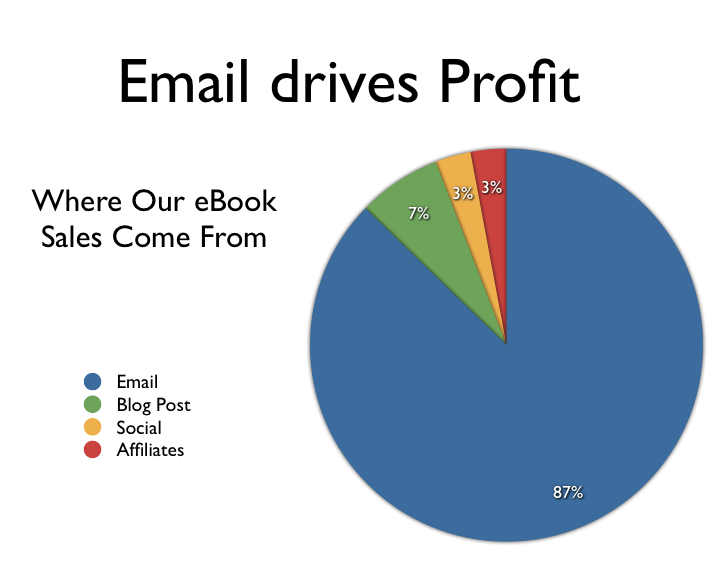
Getting blog readers to sign up to your email list should be your priority. Because once they’re subscribed, you can email them when a new post goes live. And when you’re ready to sell, your email list is your most precious marketing asset.

Email is more powerful than social media, especially when it comes to selling. Have you seen this graph from Darren?

Email drives profits


That tells you enough, doesn’t it? Get an email subscription form on your home page, your about page, and each blog post. Consider removing the option to subscribe to your RSS feed, because it distracts from your email subscription form.

Mistake 11: You’re a dreamer

Of course we’re all dreaming of success, of more readers, more shares, more comments, more money.

But dreaming about success isn’t going to get you there. You need plan. Not a Soviet-style ten-year plan. Just a plan for your next month. Decide on your mission, define your brand, your design, your voice, and think about how you’re going to grow your audience during the next month.

And then in a month’x time you can see what worked, and what didn’t work. And then you can write another one-month plan. To increase your traffic. To grow your audience. And to build your email list.

The truth about building your audience

Let’s be honest.

Growing your audience is hard work. It requires energy, enthusiasm, and guts. Dare to be different. Build your own unique brand. Don’t be afraid to be yourself.

Your most loyal followers, your raving fans are reading your blog because your style suits them; because your message inspires them; and because you are you.

Come on. What are you waiting for? Start marketing your blog, your brand, yourself.


Converting Customers and Prospects into Clients | South Salem Real Estate

There are two ways for real estate agents to obtain a client: (1) convert an existing customer into a client; or (2) convert a prospect into a client.

Converting Customers

Existing customers represent excellent opportunities to obtain clients. You just assisted them in one of the largest financial transactions they’ll ever undertake with a successful outcome. These customers feel good about their recent purchase or sale of a property and they associate you with their recent real estate success. These customers are poised to become your clients. The easiest way to convert a customer to a client is during your initial, discovery consultation.

Like any introductory meeting, listen to your client and present your credentials to demonstrate your ability to get the job done that they require successfully. Also show the value you bring to the transaction and what differentiates you from other agents competing for the customer’s business. Here’s what prospects want to hear to become clients:

  • Client vs. customer business philosophy
  • Contrast the client approach and the customer transaction approach so prospects understand the additional benefits of selecting you as their agent.
  • Begin with the following statement:
  • “My business approach is to serve clients for life, rather than just during this transaction. My objective is to be a trusted advisor, providing services and guidance throughout and after the property transaction.”
  • Here is what a client expects:
  • A meaningful number of value added products and services (later in this document)

Converting Prospects

Virtually everyone you meet in your service region is a prospect. A new acquaintance doesn’t need to purchase a home within the next six months to become one of your clients. It’s important to distinguish between client prospects and customer prospects.

Customer prospects are people who are undertaking a property buy or sell in the near-term. Since these prospects deliver a potential transaction in the not-too-distant future, agents compete aggressively for this business. The agent’s ability to win the prospect’s business depends on a number of factors, including their credibility, reputation in the community, capacity to deliver quality transaction services, personal referrals and guidance and hand-holding during the complex transaction. This free-market competition to represent a buyer or seller is fierce.

Client prospects are much easier to obtain. There is little competition from other agents to obtain them. Most agents spend the majority of their prospecting activities on obtaining customers, not clients. Not enough agents have interest in expending time and energy with a person who has no immediate interest in the buying and selling of property. To them, that person is not a customer prospect, so why spend (read “waste”) the time?

The search for client prospects is actually easier than finding customers – individuals about to undertake a property transaction on which you serve as facilitator, negotiator and, yes, trusted advisor.

There are fewer agents against which to compete for long-term prospects since most agents are focused on current transaction customer prospects. So a client-first agent focuses on the ways to obtain clients with little regard given to competing agents.

The longer view also requires a shift in attitude. The agents’ objective then becomes to increase the quality of clients, placing less focus on the quantity of clients. For example, an agent with a book of 100 high-quality loyal clients is likely to generate more leads, referrals and future transactions than an agent with a book of 100 marginally-engaged clients. Thus the challenge is to target those upper-tier buyers and sellers and convert these lead generators and property buyers and sellers into your expanding client base.

They get added to the mailing lists for your client base or bases (commercial, property management, rentals, special sales, etc.).

High-quality client prospects have common attributes that are more likely to generate leads, referrals and future transactions over time than lesser-engaged client prospects.

For example, a socially active family with children living in an active neighborhood is likely to generate more leads, referrals and future transactions than a retired couple living in an older neighborhood. In fact, the quality of a client prospect is determined, to some degree, on stage in life of the prospect’s real estate needs.

Prospect Level by Life Cycle

Lifecycle

Quality Level

Comments

First-Time Buyers

Fair

There’s some risk that they will move away from the community, but if they remain, there it’s usually for trade-up transactions.
Mature households

High

Mature households usually experience healthy earnings growth over time, increasing the likelihood of trade up, resort and investment transactions. In addition, these households become established in the community, resulting in more referrals and leads.
Established households

High

These households are at the peak of their social interaction in the community, making it like that, as a group, they generate the greatest number of leads and referrals.

In addition, ,established families’ children are in the first-time buyer group and this, combined with this demographics’ financial ability to purchase resort property and/or invest in real estate, increases the likelihood of future transactions.

Retirement Households

Low

Retired households are high risk prospects relative to other households. These home owners are entering the end of their home ownership years, and thus, may only have one transaction – a retirement home – remaining.

These older home owners are more likely to move away from the community. In addition, they are less likely to generate leads and referrals because they are not as engaged in community activity, as a general rule.

To build a client base of quality, all prospects offer opportunities for the client-centered agent and none should be overlooked. However, it’s both prudent and productive to focus on those home owners who have the greatest potential for referrals or future transactions.

How the Crash Battered America’s Housing Stock | Katonah Real Estate

Spending on home improvements and repairs totaled $275 billion in 2011, down 4 percent from 2009 levels and some 16 percent below the market peak in 2007. Loss of home equity with the onset of the housing crash contributed to the decline in home repairs, according to a new study by the Harvard Joint Center for Housing Studies.

With the decline in spending on discretionary projects, home improvement expenditures per owner in 2011 stood well below levels averaged over the previous decade. In fact, per-owner spending fell from about 25 percent above the decade average in 2007 to about 10 percent below that level in 2011,

Near the top of the list of causes for the decline in home improvement spending is the loss of home equity resulting from the unprecedented plunge in house prices during the housing crash. After several years of strong house price appreciation, homeowners nationwide had almost $13 trillion in equity in 2006, or almost $170,000 per owner on average. By 2011, however, aggregate home equity had dropped by half to $6.5 trillion, or $87,000 per owner.

Since home equity is a major source of wealth for most owners, sharply lower house values make owners feel less wealthy and therefore less likely to spend in general and on improvements in particular. And with less equity available and credit still tight, households are finding it more difficult to get financing for projects. In 2011, owners with under 20 percent equity in their homes spent about 22 percent less on average on home improvements and about 30 percent less on discretionary projects than owners with at least 20 percent equity. In fact, owners with some but less than 20 percent equity spent about the same as those with zero or negative equity in that year. Owners without mortgages-primarily older owners-also spent about the same as owners with less than 20 percent equity.

In 2011, the Harvard study found that more than a million distressed properties came back onto the housing market, including 760,000 lender-owned units and 300,000 short sales. Lenders improved about a third of their foreclosed properties prior to sale, with an average expenditure of about $6,500 per unit. About 60 percent of owner-occupant purchasers undertook improvements, averaging $11,100, while investors spent even more per unit on average than either lenders or owner-occupants, $15,600.

The Harvard study also noted the role investors are playing turning foreclosures into affordable rentals. Some 4.4 million formerly owner-occupied units were shifted to the rental market between 2007 and 2011. Another 4.6 million were vacant in 2011 and may become part of the rental stock as demand continues to grow.

The unexpected investor expenditures to improve the quality of America’s single family housing stock came as the nation began to experience what the Harvard study calls an “uptick” in the deterioration of housing quality at the outset of the housing crash. In 1997, 4.4 percent of owner-occupied homes were considered inadequate, the study said. By 2007, these same units accounted for almost 8 percent of homes that were no longer owner-occupied (i.e., stood vacant or were converted to rental or nonresidential uses), indicating their increasing deterioration. Even more telling is that these inadequate units accounted for almost 17 percent of the homes that were demolished within the decade.

The study also tracked lender spending to restore REO properties for sale. During the housing downturn, the plunge in house prices precipitated a wave of foreclosures in many metropolitan areas. The foreclosure process often takes years to complete, wreaking havoc on mothballed and backlogged properties. But once foreclosure is completed, banks and other institutions typically invest in repairs to get the homes ready for sale and back into active use.

According to Joint Center estimates, lender expenditures on distressed properties amounted to $1.7 billion in 2011, with Atlanta, Las Vegas, Orlando, Phoenix, and Riverside posting the highest shares of spending . Local housing market conditions dictate the average amount that banks and institutions expend to prepare distressed properties for the market. In 2011, lenders invested considerably more per property in higher-priced markets such as Denver, Los Angeles, Portland, Raleigh, and Washington, DC. In large measure, this disparity reflects the fact that properties in these markets often need to be in better condition to sell at a competitive price within a reasonable amount of time.

By comparison, in depressed Rust Belt metros such as Cleveland, Detroit, Milwaukee, and Pittsburgh, improvement spending per REO property was less than a third of outlays in more competitive markets.

“Renovating foreclosed or abandoned homes benefits the entire neighborhood. Joint Center research has shown that home prices in neighborhoods with higher levels of improvement spending appreciate more rapidly, explaining why investing in blighted neighborhoods has been a national priority in dealing with the foreclosure crisis,” said the report.