Geothermal Heat Pumps from Water furnace | South Salem Realtor
Leave a reply

Q: My redwood deck is about 2 years old and needs a good cleaning. Which product would you recommend to clean a redwood deck and what sealant should I use? I like a clear, natural finish.
A: You’re right at the outside edge there. If a redwood deck gets a fair amount of sun, it should be cleaned and resealed at least every second year. If it’s mainly shaded and you haven’t developed mildew, you can get by with doing it every three years. Cleaning and sealing should be viewed as a regular maintenance program and will prolong the life of the deck as well as maintain its look.
Although we’ve addressed this subject many times, a quick refresher course is in order.
For longevity and aesthetics, apply a preservative to outdoor wood. It can either be semitransparent stain or clear preservative. While stain will change the color of the wood, a clear preservative will darken and enrich its natural color. An example is redwood, which is a light red, almost pinkish color in its freshly milled state but turns to a deep red rose when treated with most preservatives.
Article continues belowMany companies make sealants and stains for outdoor wood. Some of the better-known brands are Cabot, TWP, Defy and Armstrong. For a clear finish, our favorite has always been DuckBack’s Superdeck, a sealer that offers protection from the sun’s ultraviolet (UV) rays. But we recommend you do your own research by going to deckstainhelp.com and clicking on “product reviews.”
Frequency of sealing depends on exposure to weather and use. A maintenance program consists of cleaning the deck, removing any mildew, and applying a new coat of preservative.
Although we continue to believe that the best way to clean a deck is with a pressure washer, a stiff-bristle brush and plenty of elbow grease will do the job, especially if cleaning is done regularly. Think about going to the dentist to have your teeth cleaned. The job is a lot easier and less painful if it’s done at regular intervals.
A pressure washer sends out a pressurized fan of water that makes short work of surface dirt, mold and mildew. These machines are available at rental centers and can be purchased at home centers. If you get along well with your neighbors, consider getting two or three of them to chip in on buying one and then sharing it.
We recommend using a pressure washer that can produce a stream of water of at least 1,500 pounds per square inch (psi). Be sure to keep the wand moving so you don’t blast softer wood away from the surface and leave a rippled effect on the deck. Deck cleaners formulated for use with pressure washers are available where the machines are rented or sold.
If you go the brush route, use a stiff-bristle brush and deck cleaner mixed in a bucket of water in the proportions the manufacturer recommends. Use a brush attached to a broom handle to save wear and tear on the back and knees.
In shaded, moist areas, mildew can be a problem. Wash with a weak bleach solution — 1/4 cup of bleach to a gallon of water — to kill the fungus before pressure washing or scrubbing.
Once cleaning is completed, thoroughly rinse the deck with clear water and allow the deck to dry for several days. Then brush, roll or spray a coat of UV protective water-repellent sealer or stain. We found some excellent “how to” videos on the Superdeck website.
So, to sum up:
- Pressure wash your deck rather than sanding it.
- Clean and treat your deck with a preservative every two years.
- Remove any mildew by pressure washing thoroughly.
- Use a pressure washer with at least 1,500 psi.
- Use the fan setting on the nozzle and keep it moving to prevent a ripple effect.
- Use a chemical deck cleaner for really bad decks.
- Apply sealer or stain.
Many fishermen cut through private property to reach their favorite section of a river. Often, that entry can be illegal trespassing, but there are many places where access is granted and encouraged.
For example, there is a private property owner on a river who for years had a deposit box on a cleared acre of land, a pie-shaped parcel whose “point” was a makeshift boat launch. “Honor system” steel headers crammed coins into the slots of a metal box for the right to use the launch and park their trucks and trailers. The name of the fishing hole opposite the launch got its name from the size of coin that fit the slots in the metal box.
Several years ago, when there was an accident on the launch involving a teenager, I thought about the liability, not only to that parcel but to other properties adjacent to natural bodies of water, such as riverfront restaurants, Puget Sound marina docks and city beaches.
Most states now have guidelines as to how business and rental property owners treat and protect their waterfront, especially when children are present. In summary, these owners are required to make “reasonable” efforts to protect children on their property and from natural bodies of water.
One of the challenges is the definition of “reasonable.” There is no written rule that says that a property owner must fence off a body of water in order to avoid potential liability. And reasonable care applies only to a property owner who derives some economic gain from the children’s presence. A private homeowner has no such duty to protect children who are social guests from the dangers of natural bodies of water.
The reasons for the precautions stem from a terrible case where a 2-year-old child was left a quadriplegic with brain damage after nearly drowning in a creek at a mobile home park. The boys’ parents paid rent for a mobile home space there, plus an additional $1 a day for each of their five children.
According to court documents, there is a clear, shallow, slow-moving creek in summer that can be deep, swift and murky during the winter months. The landlord required families with small children to live at the far end of the park, away from the families without children and in the area closest to the creek.
Although the mobile home park was partially fenced, there was no fence running along the property nearest a grassy play area adjacent to a steep embankment leading to the creek. The parents did not allow their young children to play outside alone and did not allow them to go near the creek by themselves.
The boy was riding a bicycle while the father was making repairs on their home. According to the father, the boy was out of his sight “for less than one minute.” The father found the bicycle at the bottom of the embankment, partially submerged in the creek. A neighbor helping to search for the child eventually found the boy in the creek.
The father and boy, through his guardian, sued the mobile home park for negligence. The trial court ruled that a landowner’s duty to maintain the premises in a reasonably safe condition does not require affirmative acts to protect tenants from the inherent dangers of natural bodies of water.
The father and boy appealed and the high court reversed the trial court’s decision. The case eventually was settled for the full amount of a $500,000 insurance policy.
Generally, a landowner owes a trespasser or a “licensee” only a duty to refrain from “willfully or wantonly” injuring them. A licensee is someone who enters upon the land with the landowner’s consent.
An exception to this rule is the attractive nuisance doctrine. This doctrine, the result of concern for kids who trespass on property to use an attractive and sometimes dangerous element (such as a pond), elevates the standard of care and states the landowner is liable if the danger is not eliminated. However, this does not apply where the hazardous condition is a natural body of water.
According to attorneys familiar with the case, the decision means there is no exception for natural bodies of water where the landlord gets cash from the users. Again, a private homeowner has no such duty to protect children who are social guests from the dangers of natural bodies of water.
However, if you charge to reach the waterfront, make certain you have ample insurance in place.
I recently had the good fortune to hear Jeffrey Cohen, manager of content marketing at Salesforce’s Radian 6 Marketing Cloud, when we were both keynoting at the Social Media Strategies Summit. His presentation was solid and leaned heavily not just on data, but real data from real sources he was able to cite. This is all too rare in social media presenters.
I, of course, loved it. So when he mentioned via Twitter some recent LinkedIn changes, I took notice.
It wasn’t just the promise of learning about some new features of a digital tool that got me though. It was his assertion that the LinkedIn changes represented “another step toward information over connections.”
Hold that thought for a moment. Before looking at what this means for your real estate business, we’re going to explore how the emergence of new technology platforms complicates the task of gaining direct access to customers, and locking them in.
Stability versus direct access
In technology and maybe other aspects of life, there is a constant layering of ideas, services and products one on top of the other in a mad race to maintain a combination of stable business and direct access to the customer.
These two things — stable businesses and direct access to the customer — are probably diametrically opposed. A stable business usually would require a minimum of changes and variables leading to a high degree of predictability. Customers, on the other hand, are pretty much the definition of mercurial change and unpredictability.
For technology companies, stability often comes in the form of controlling access to a deep layer of technology. We see this in the form of vendor lock-in, for example. Lock-in can be overt, as in the requirement to use proprietary software and hardware. Lock-in can be subtle, as is the case with services that have a high “switching cost.”
To maintain the stability, the technology company needs to provide something of value that overcomes whatever lock-in is being applied.
Direct access to the customer, on the other hand, can come from following taste and fashion. Businesses and organizations that are serious about succeeding tend to foster the ability to listen and observe human behavior in order to stay ahead of the taste/fashion curve. This sort of observation leads to developing new tools and services that maintains their direct access to customers.
So we end up with a constant interplay between chasing direct access and locking it down for stability.
At a high level we can see this in the history of computing itself over the past 30 years. First there was the operating system. There was wide variation in the software, which talked directly with the hardware. A great deal of competition occurred on this theme and then settled out to being primarily Microsoft Windows, with a smattering of other also-rans.
But just as that stability was being locked in by Microsoft, the World Wide Web started capturing the attention of customers. The race was on once again, with the browser wars that began in the late 1990s. Those of us who cut our teeth coding for the Web in this era are all too familiar with the lock-in shenanigans of technology companies during this era (the remnants of which still linger more than 10 years later, in the Cro-Magnon, Explorer-only Web interfaces often employed on the backend of many multiple listing services).
With the rise of the Web, customer access at the operating system level became less important. There was less ability to lock-in customers. The effect of this is to turn much of what made for an effective operating system business into an anchor. Stability is great until there’s too much stability. Paralysis is a form of stability that isn’t desirable.
In the past five years we’ve begun to experience the rise of the social Web. Instead of the wide-open Web, customer interest and activity is tending to focus in on the sorts of things offered by social networks.
In the same way that the World Wide Web layered itself on top of the platform of the operating system, the social Web is layering itself on top of the Web. None of the lower levels of the platforms go away. They are still around in the same way that live theater continues to exist even though we have movies (or the way movie theaters are still around even though we have Netflix). Still present, but less important. The deeper levels have more stability but less direct access to customers.
In the past three years we’ve seen this layering occur in the mobile phone business. The rise of smartphones layering on top of the platform of carrier stability.
Currently we’re beginning to see a layering of data businesses over other types of businesses. Which brings me back to Jeffrey Cohen’s “information over connections.”
Information over connections
For platforms to emerge and gain enough direct customer access to apply some sort of lock-in, they typically will address some unserved need.
The current ascendent technology platform — the social Web — is focused on connections. There are friend counts and follower counts. A tithe of pixels on many websites implores people to add some sort of additional connection.
Why do we want to increase connections? As people, we want a variety of kinds of information.
Some of it is basic emotional stuff: I want people to like me, I want to fit in, I want to be part of a group so I don’t feel so alone in the world.
Some of it is more utilitarian stuff: I want to know how to accomplish a certain task; I want to hear about various options; I want to know more about the world I live in.
The point here is that “connection” is the platform layer that is currently ascendent or dominant just like the operating system once was. The thing that flows to (and from) us via connection is information.
Perhaps, in the same way that the Web was layered over the operating system, we will see a layering of information over connection.
Implications for real estate
For the people who have made it this far, through the history of technology layers and abstractness of connections and information, let’s see if we can’t tease out some direct and specific thoughts for the real estate business. For fun and enjoyment, I’ll present them as koans in bullet list form:
- If a brokerage currently thrives due to a large volume of agent connections, will this help or hinder in an environment where information is more valued?
- Will an agent who thrives due to large investments in emotional connections thrive in a world where information moves quickly?
- Are the needs of real estate consumers more readily met with connection or information?
- Given the current state of interbrokerage agreements, how much lock-in is available in a high-information environment? How much customer access is granted?
- Which groups thrive most in a high-information environment: aggregators, brokerages, agents, tech vendors, real estate consumers?
- Which groups thrive most in a high-connection environment: aggregators, brokerages, agents, tech vendors, real estate consumers?
- Are any industries operating in a post-connection environment? Are any geographies more likely to be operating in a post-connection environment?
Mitt Romney and Barack Obama images via MittRomney.com and WhiteHouse.gov
Anybody who watched it knows that Mitt Romney scored a technical knockout of President Obama in last week’s debate. But are there some potential future costs and concerns for housing that have to be looked at in the wake of that victory?
On the one hand, Romney surprised Obama with sharp criticism over an issue that has plagued homebuyers and refinancers: the super-strict underwriting and documentation that banks are requiring for home loans, in part because they’re worried about forthcoming “qualified mortgage” federal rules under the Dodd-Frank financial reform legislation.
“It’s been two years,” Romney said to Obama at the Denver debate, “We (still) don’t know what a ‘qualified mortgage’ is. So banks are reluctant to make mortgages … It’s hurting the housing market.”
There’s no question that regulators have proceeded at a frustratingly glacial pace since the passage of Dodd-Frank in July of 2010, and we don’t know what the Consumer Financial Protection Bureau will come out with on this issue in early 2013.
Will the bureau, which took over the project from the Federal Reserve in mid-2011, create a straightforward “safe harbor” for lenders — a set of basic bright lines defining an applicant’s “ability to pay” within which banks can originate loans without fear of litigation every time a borrower goes seriously delinquent?
Or will regulators instead open the door to nitpicking, costly lawsuits and thereby make lenders even more gun-shy about originating new mortgages?
The wrong answers could wreck mortgage lending for years to come.
Obama had no response to Romney’s critical shot on qualified mortgages and maybe wasn’t even aware of the problem. In fact, it’s possible even Romney hadn’t heard much about it until the previous week, when his team was briefed by David H. Stevens, CEO of the Mortgage Bankers Association, who’s also the former FHA Commissioner and former head of Long and Foster Realtors.
Qualified mortgage (QM) was a well-prepared debate zinger, and put the spotlight on an undeniable failing of this administration: lackluster response times to urgent housing needs, plus unworkable regulatory proposals that have delayed needed guidance on mortgages even longer. (Remember “QRM” — the proposed mandatory 20 percent down payment plan? It’s still nowhere to be seen.)
But Romney’s good stuff on qualified mortgages was not the most important matter involving real estate that came up in the debate. Romney’s tax plan — the one that Obama charged repeatedly would add trillions to the deficit — never was addressed in terms of its specific potential impacts on homeowners.
Romney never said the words “mortgage interest deduction” during the debate, but the MID, along with most other longstanding and popular write-offs, is at the core of his tax reform concept.
In order to pay for the estimated $4.8 trillion in tax revenue reductions he proposes — starting with a 20 percent across-the-board cut in tax rates, elimination of the alternative minimum tax, the estate tax and other revenue-losing measures — Romney needs to eliminate or downsize trillions in tax deductions, credits and subsidies. That’s how his plan is supposed to achieve revenue neutrality, i.e., it wouldn’t raise the deficit.
Two days before the debate, he told Denver TV station KDVR that he’s open to limiting the MID along with a long list of other write-offs as part of an overall reform of the tax code.
“As an option,” Romney told his interviewer, “you could say everybody’s going to get up to a $17,000 deduction. And you could use your charitable, home mortgage deduction or others — your health care deduction, and you can fill that bucket, if you will, that $17,000 bucket, that way.”
Earlier this year, at a private fundraising meeting, Romney told supporters that among other options on taxes, he would consider eliminating the mortgage interest deduction for second homes outright.
Tax reform proponents, such as the bipartisan, nonprofit Committee for a Responsible Federal Budget, praised Romney’s concept of capping or eliminating popular write-offs as “very significant and progressive” following the debate. “Progressive” in tax lingo means: It siphons off more money from higher-income taxpayers than it does from lower- and middle-income folks.
The committee noted that just 30 percent of all U.S. taxpayers itemize at all, yet “almost all higher earners currently itemize more than $17,000 in deductions.” In fact, the committee added, the average itemizer in 2011 wrote off $26,000, and the top 1 percent of earners wrote off an average $174,000.
Absent additional details about the tax reform plans from Romney, large numbers of homeowners would be forced to choose which write-offs went into their capped deduction “buckets.” Do we take deductions for the mortgage interest we paid, or do we write off what we donated to charities?
During the debate, Romney said he was open to higher numbers on caps, but that all of this would have to be worked out in negotiations with Congress after he took office. Hmmmm.
Make no mistake: When it comes to housing-related write-offs, we are talking big, big numbers that could solve a multitude of revenue-raising problems.
According to the Joint Congressional Committee on Taxation’s latest projections, the home mortgage interest deduction will save homeowners — and cost the federal Treasury — nearly half a trillion dollars ($484 billion) during fiscal years 2010-2015. Local real estate tax deductions for homeowners will save owners — and cost the government — about $121 billion. The capital gains exclusion for home sales alone comes in at $86 billion.
Though the main housing lobbies have been quiet about Romney’s tax plans — preferring to wait for more details — the fact remains: For the first time in years, we have a Republican presidential candidate who is willing to put some of housing’s most sacrosanct tax code preferences on the cutting block. Obama talks about limiting MID write-offs for people who make $250,000 or more. Romney is talking about much bigger limitations.
Sure, it’s campaign rhetoric, and sure, the deduction cutbacks have to be seen in the context of significant reductions in tax brackets that would lower taxes elsewhere. But the crucial question is: What would this all do to housing values, sales, building and homeownership?
We could really use some details.
A top Senate Democrat on Tuesday said new tax revenues should go to reducing the federal deficit, not cutting tax rates, dismissing as “obsolete” a Reagan-era model of tax reform.
Senator Charles Schumer, hardening his party’s negotiating position ahead of talks on the so-called “fiscal cliff,” declared President Ronald Reagan’s 1986 tax reform an unaffordable model for overhauling the tax laws.
U.S. tax policy experts have long advocated Reagan’s approach of “revenue neutrality,” or using new government revenues from closing tax loopholes to pay for tax rate cuts.
Schumer urged devoting new revenues wholly to deficit reduction instead, and advocated raising tax rates on the rich in any deal to avoid the fiscal cliff approaching at year-end.
“Tax reform 25 years ago was revenue-neutral. It did not strive to cut the debt. Today, we can’t afford for it not to,” Schumer said in a speech at the National Press Club.
“It would be a huge mistake to take the dollars we gain from closing loopholes and put them into reducing rates for the highest income brackets, rather than into reducing the deficit.”
Two Democratic Senate aides said the speech was an attempt by Democrats to harden their position ahead of “fiscal cliff” negotiations set to get under way after the November 6 elections.
Republican Senator Orrin Hatch blasted Schumer’s comments, and criticized Democrats, saying in a statement that their “default position” is to raise taxes.
‘CLIFF’ AHEAD
At the end of the year, several urgent fiscal issues will converge, including the expiration of lowered individual income tax rates enacted a decade ago under President George W. Bush.
The Bush tax cuts were due to expire at the end of 2010, but Obama and Congress agreed to extend them for two years to prevent damage to the economy.
In addition, $100 billion in automatic federal spending cuts will take effect unless Congress acts. Combined, these events could push the economy into a recession, studies have forecast.
Decisions on the “fiscal cliff” will be strongly influenced by the outcome of the elections, of course, and will be a proving ground for Congress’ ability to tackle a potentially more fundamental tax code overhaul, perhaps in 2013.
The tax code has not been overhauled thoroughly in 26 years since Reagan and a divided Congress managed to do it. Ever since, the Reagan reforms have been seen as a model, with “revenue neutrality” being their central feature.
Schumer said that model is outdated. “In the upcoming talks on the fiscal cliff, we ought to scrap it,” Schumer said.
If applied today, revenue neutrality would inevitably hurt the middle-class by forcing curtailment of tax breaks dear to average Americans, he said.
“A 1986-style approach that promises upfront rate cuts to the wealthy is almost guaranteed to give middle-income earners the short end of the stick,” said Schumer, the third most senior Democrat in the Senate.
OVERHAUL NEEDED
Both President Barack Obama and Republican challenger Mitt Romney say taxes need an overhaul, but disagree on details.
Obama backs raising individual income tax rates on the wealthy by letting their Bush tax cuts expire, but extending the Bush tax cuts for the middle class. He has also presented a detailed plan on corporate tax breaks he wants to kill.
The president also wants to raise the tax rates on dividends and on capital gains for the two highest income tax brackets.
Neither Obama nor Romney has presented specifics on what to do with the costliest tax breaks such as the mortgage interest and charitable donation deductions, although both have discussed the possibility of capping deductions at some level.
Romney has called for a 20 percent across the board cut in all tax rates, as well as eliminating the estate tax and the alternative minimum tax – changes that would help the wealthy.
But Romney has also said he will not reduce the share of taxes paid by the wealthy. He has said he will pay for his tax cuts by ending tax breaks, but he has not said which ones.
BIPARTISAN APPROACH?
Clint Stretch, a former congressional staffer on budget issues and former top tax lobbyist, says Schumer is right to caution that middle class tax breaks may be in jeopardy.
“If you don’t raise taxes you’ll have to get rid of a lot of federal programs very important to the middle class,” he said.
Schumer said he backs efforts by a bipartisan group of senators known as the “Gang of Eight.” This group met again on Tuesday to discuss a possible deal on the deficit. Such meetings have been going on for years, with no solid results, aides said.
The group of four Democrats and four Republicans ranges from liberals to some of the most fiscally conservative lawmakers.
Operating outside of the formal tax-writing committees and party leadership, the lawmakers have been trying to forge a broad deficit-cutting plan that could include new revenue, a prospect that many in the Republican party adamantly oppose.
It is known in Washington as the “fiscal cliff.” But policy and economic analysts projecting its complicated and wide-ranging potential impact said the term “fiscal hill” or “fiscal slope” might be more apt: the effect would be powerful but gradual, and in some cases, reversible.
“The slope would likely be relatively modest at first,” Chad Stone, the chief economist at the Center on Budget and Policy Priorities, a research group based in Washington, wrote in a recent analysis. “A relatively brief implementation of the tax and spending changes required by current law should cause little short-term damage to the economy as a whole.”
The annual effect of the automatic tax increases and spending cuts would be enormous. The Congressional Budget Office has estimated that the budget deficit would shrink by more than half a trillion dollars from fiscal years 2012 to 2013 and that the economy would very likely enter another recession.
Nearly all Americans would see their tax bills increase, with income and payroll taxes climbing, credits shrinking and levies on investment earnings soaring. The Tax Policy Center, a Washington research group, has estimated that the average family would see its tax bill go up $3,500 and its after-tax income drop 6.2 percent.
At the same time, mandatory federal spending cuts would compel agencies across the government to reduce their budgets by billions. A study by the economist Stephen S. Fuller of George Mason University and sponsored by the Aerospace Industries Association, a trade group based in Virginia, has estimated the related job losses at as many as 2.14 million.
The potential economic damage has led a spate of economic heavy hitters — from the International Monetary Fund, Wall Street, foreign capitals, the Federal Reserve and elsewhere — to urge Congress to act before year’s end.
Noting the fragility of the recovery, Ben S. Bernanke, the chairman of the Federal Reserve, described avoiding the cliff as the “most effective way Congress could help to support the economy right now.”
But both Democrats and Republicans have said that going over the fiscal cliff might put them in a better negotiating position. And confidence in policy makers’ ability to get a deal done is low.
In the event that New Year’s Day came and went without a legislative fix, confidence, investment, markets and household spending would be hurt, analysts said. Still, there would be time for Congress to strike a deal before the economy started contracting. The economic effect would accumulate day by day, and much of it might be reversible.
The Treasury Department has significant discretion over whether to adjust the withholding tax tables, meaning it could choose to keep last year’s rates and avert much of the blow from the tax increases. Policy makers could also apply lower tax rates retroactively: If the Bush-era tax cuts expired for all households in January, they could be reapplied in February.
“It would be quite easy,” said Eric Toder of the Tax Policy Center. “Technically easy. I don’t know about politically easy.”
Congress does need to address the alternative minimum tax; a patch to ensure that millions of families do not pay higher taxes this year is broadly expected but not in place.
“A lot of people would be very surprised to see how big their tax bill will be,” said Nigel Gault, the chief United States economist for IHS Global Insight. “That’s a pretty urgent one to take care of, so that tax forms can be properly prepared for 2012.”
Even if the tax increases hit in January, families might not notice the incremental loss of income in the near term, economists said. Households might temporarily dig into savings to maintain their spending on the gas, food, housing and other consumer goods, mitigating the impact the tax increases might have on the broader economy.
“The consumer has relied on savings to bridge the loss of disposable income from tax increases” in the past, said Jacob Oubina of RBC Capital Markets in New York.
Moreover, while the fiscal cliff would be enormous in annual terms, its effect would be cumulative, not immediate, analysts have noted. Households hit by the tax increases might not notice the $10 or $100 missing from their paychecks, even if it would damp their spending over the course of the year. Agencies hit by the spending cuts might not act immediately.
Perceptions of Congress’s progress on forestalling some of the tax increases and spending cuts might also prove important in January, analysts said.
If the White House and Congressional leaders seem incapable of reaching a deal, that might cause significant market panic, intensifying the economic blow from the tax increases and the spending cuts.
Mr. Gault said that in such a case the economy would be under a cloud of “extreme uncertainty,” alarming investors, depressing consumer confidence and hurting businesses.

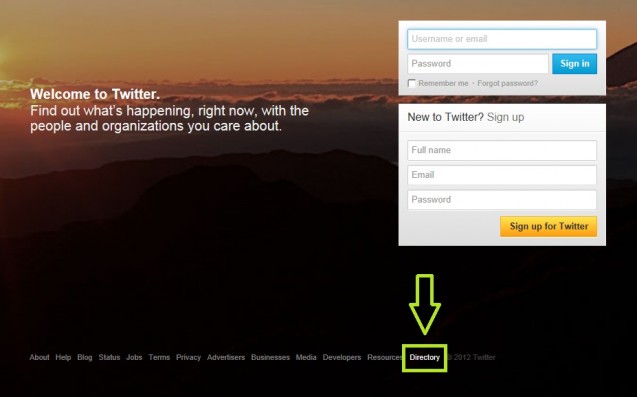
- In a world where altruistic social gathering doesn’t pay the bills, Twitter continues to make changes that it hopes will drive more traffic directly to the Twitter domain and bolster its value to advertisers. The most recent update comes in the form of an alphabetical user directory. The link to the directory was quietly added to the the default home page for visitors to Twitter not already logged into the service.
According to Matt McGee in his recent article for Marketing Land:
Twitter launched the user directory a few weeks ago, but hasn’t made a formal announcement about it. That’s likely because it exists more for search engines than for Twitter users.
Basically, Twitter is aiming to draw people who are searching Google, Bing, Yahoo, etc., for someone in particular. As the bots crawl their way through the new directory, more Twitter profiles should start showing up in search. That’s a step in the right direction, maybe.
Twitter is still struggling with the basic issue of no real reason to spend lots of time hanging out in the Twitter Web space. Users spend the most time on Twitter setting up their profile. Once it’s set, they either build up a personalized twitter stream that they keep track of on a mobile app or some other Twitter client application, or they never really get the point and let the profile languish, unused.
Even when a search result brings a user back to the Twitter domain, the realistic expectation is that they will skim the profile, make a decision to follow or not, and move on.
For those of you who love the news, information, and conversation constantly buzzing through your Twitter stream, what could Twitter do to make its space more appealing? What would it take for you to spend your time interacting with the twitterverse in the Twitter-owned domain?36