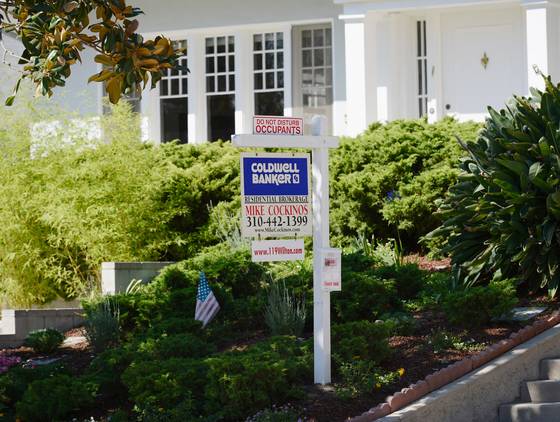
The wind blows the tightly regulated part in his hair. The stage seems makeshift, but the scene in front of a foreclosed home in Florida is well choreographed.
In January, the Mitt Romney campaign chose this quiet neighborhood in Lehigh Acres, Fla., just to the east of Cape Coral and Fort Myers, to give some of the first insight into how the eventual Republican nominee would combat a foreclosure crisis still raging five years after the housing meltdown.
“You’re wondering what’s going on behind me over here,” Romney says, displaying a mechanical awkwardness that has haunted his attempts off the script before and since. “This home is in foreclosure. They bought a home, got an adjustable-rate mortgage, and their payments went up and up and up, and they met with their mortgage banker who told them to stop making payments on the old mortgage so we can get you a new one. You know that story. So they got a foreclosure notice.”
There are some boos. The family he’s talking about stands off to the side behind the stage in the yard.
“But they worked that all out,” Romney goes on. “Believe it or not, with lawyers and all that, they got a new mortgage and began paying every month. Made the payment for six months, but they got another foreclosure notice. And they called the bank and said, ‘We made our payments every month. You’ve been cashing our check.’ And the bank said, ‘Oh we’ve been applying those payments to your old mortgage.’”
It’s a familiar story in Florida, which took center stage to the robo-signing saga. Mortgage servicers had to settle with the Obama administration and 49 state attorneys general for $25 billion in fines and relief to homeowners for fast-forwarding the foreclosure process at the expense of an untold amount of homeowners.
The scandal sparked some of the worst vitriol toward the industry since bankers rode out of Washington with more than $700 billion in bailouts during the financial crisis. But what Romney says next hints at how he views the unfortunate mechanics of an industry that never adjusted until it was too late. The media would slap the quote across front pages in the morning.
“The banks aren’t bad people,” Romney says. “They’re just overwhelmed right now.”
Throughout his campaign, commentators made much about Romney’s lack of specifics toward his plan to rebuild housing. Indeed, there isn’t much in the way of details. But along the campaign trail, bits and pieces can be found. In this one, in front of a foreclosed home in Florida, he continues a mantra that the real estate market “should be allowed to hit bottom,” and the failed programs from the Obama administration should be shelved.
In a more detailed plan released at the beginning of September, Romney attempted to pin the foreclosure crisis on Obama himself. The document asserted “under President Obama … homeowners have received more than 8.5 million foreclosure notices.”
However, such foreclosure actions were not taken as a result of Obama administration policies. Rather, they occurred because the housing market crumbled and credit markets shut down beginning in 2007, well before Obama took office.
According to most estimates, the number of homes actually lost to foreclosure is 3.7 million to 4 million.
The rest were either modified, disposed of through short sales or tied up in a backlogged system caused by the mortgage servicers themselves and the swarm of government programs Romney criticizes in his plan: “President Obama rolled out an alphabet soup of more than 10 housing finance programs rather than offering a real solution.”
So that would be that for the Home Affordable Modification Program, one of the most maligned and underwhelming programs, funded in part via the government’s bank bailout known as the Troubled Asset Relief Program. HAMP and its reams of new guidelines, as Romney sees it, is just as overwhelming as the mounting piles of troubled mortgages facing the servicers still.
The program expires at the end of next year, but House Republicans already cleared a bill to end HAMP. If Republicans gain a Senate majority in November, and Romney wins, they could succeed in their efforts to kill HAMP before it expires.
Romney has given hints along the campaign trail that not every housing recovery program under the Obama administration was a bad idea. He gave a glimpse to the Las Vegas Review Journal in July, seven months after the Lehigh Acres speech. He sat down with the paper’s editors in a state that held the highest foreclosure rate in the country nearly every month since 2007 and one with the highest percentage of underwater borrowers. Three out of every five homeowners in the area owe more on their mortgage than their house is worth. If he wants to win the state in November, he needs to be precise.
Here, he throws his support behind the Home Affordable Refinance Program, known as HARP. Through it, mortgage servicers refinanced more than 1.5 million Fannie Mae and Freddie Mac loans as of July31. In the first seven months of 2012, servicers completed 519,000 HARP refis, more than 400,000 in all of last year, after the program was expanded.
“I think the idea of helping people refinance homes to stay in them is one that’s worth further consideration, but I’m not signing on until I find out who’s going to pay and who’s going to get bailed out, and that’s not something which we know all the answers to yet,” Romney told the paper.
In fact, he appears to like a few more ideas from the administration as well. The Romney plan includes room to “facilitate foreclosure alternatives for those who cannot afford to pay their mortgage.”
This may allude to more short sales or deeds-in-lieu. There’s already a government program built to do just that, but it might be one of the ones Romney vows to throw out. The Home Affordable Foreclosure Alternatives Program, known as HAFA, launched in April 2010. More than 55,000 short sales have been completed through June.
Romney also wants to “responsibly sell the 200,000 vacant foreclosed homes owned by the government.”
But Fannie Mae, Freddie Mac and the Department of Housing and Urban Development reduced their inventory of REO by 18% over the last year to just more than 202,000 properties. At its height of REO inventory in 2010, Fannie held nearly 162,500 previously foreclosed homes. Fannie Mae trimmed that down to a little more than 109,000 properties as of June 30 and is getting more for them as a percentage of the unpaid principal balance than at any point since the recession struck.
The Obama administration also pushed the Federal Housing Finance Agency to develop programs to handle the shadow inventory of foreclosed homes. It launched pilots to rent out properties owned by the government-sponsored enterprises or sell them to investors who would then rent them out.
“Allow investors to buy homes, put renters in them, fix the homes up and let it turn around and come back up,” Romney said.
Mending a broken foreclosure process is already under way, too. Wells Fargo, for instance, said in August that it would have all consent orders and settlement standards — all 300 of them — implemented by October. Short sales are now more common nationally than REO sales, and those foreclosed homes that are being sold are being unloaded for more money than at any point since 2010, according to RealtyTrac.
THE GSE PROBLEM
There are other more complex and politically unsavory problems waiting for whoever takes the reins of the economy in January. The answers to how Romney might approach those, actually came because of an unlikely source: Newt Gingrich.
The Florida campaign lunges toward another debate on Jan. 26. Newt Gingrich, arguably Romney’s most troublesome opponent, stares at his podium. Just before the debate, his ties to Freddie Mac were uncovered. He worked as a consultant to the GSE during the bubble and, according to critics, lobbied members of Congress not to crack down on the mortgage giants even as the housing market was overheating around them.
Romney turns on Gingrich at the debate, and in doing so, reveals what he would do with Fannie Mae and Freddie Mac.
“I think Fannie Mae and Freddie Mac were a big part of why we have the housing crisis in the nation that we have. We’ve had this discussion before. Gingrich was hired to promote them, to influence people in Washington, to encourage them not to dismantle these two entities. I think that was an enormous mistake. I think instead we should have had a whistleblower and not a horn-tooter,” Romney says, almost as frantic as he can get. “He should have stood up and said, “Look these things are a disaster. This is a crisis.’ He should have been anxiously telling people that these entities were causing a housing bubble that caused a collapse that we’ve seen here in Florida and around the country.”
Applause. Gingrich is noticeably uncomfortable. But next, Romney steps a bit too far, and the result might give the industry insight to his preference for the ideal over the reality that Fannie and Freddie have held up the housing market since the crash. For all the disaster they caused, they’re still financing mortgages and by all accounts pretty solid ones. Try getting a GSE loan through today without at least a 720 credit score and a sizable down payment.
“And are they a problem today? Absolutely,” Romney declares. “They’re offering mortgages again to people who can’t possibly repay them. We’re creating another housing bubble that will hurt the American people.”
The Romney campaign did not reply to requests to clarify.
What’s interesting to note, though, was that this part of the debate was kicked off with a question from a voter. The question: “How would you phase out Fannie Mae and Freddie Mac?” Instead of answering, Romney used it to score a blow against Gingrich.
Similar answers come from Romney’s running mate, Rep. Paul Ryan, R-Wis. As head of the House Budget Committee, Ryan released a plan was passed by the House last year to slash spending across nearly every sector of the government, excluding the military.
The long-term outlook of the Ryan plan involves a complete wind-down of the GSEs and an end to the $188 billion in bailouts so far.
The Ryan budget would “privatize the business of government-owned housing giants, Fannie Mae and Freddie Mac, so they no longer expose taxpayers to trillions of dollars’ worth of risk.”
The Romney plan released in September also makes this view clear: “Mitt Romney will reform these government-sponsored companies to protect taxpayers from additional risk in the future by ensuring taxpayer dollars in the housing market are replaced with private dollars.”
The Obama administration’s three options for Congress to consider was released in February 2011 and includes various degrees of government support to the future mortgage market. It allows for a completely private option should lawmakers choose it. But that was where the process stopped with the exception of roughly 15 bills by House GOP members, each largely duplicative of the conservatorship agreements.
“Taxpayers’ exposure to Fannie and Freddie, once an implicit guarantee, has now become an explicit obligation to cover its debts,” Ryan wrote in his budget plan. “The housing finance system of the future will allow private-market secondary lenders to freely and transparently compete, with the knowledge that they will ultimately bear appropriate risk for the loans they guarantee. Their viability and profitability will be determined, not by political favoritism, but by the soundness of their practices and the value of their services.”
Many in the industry feel a completely private system — one that hasn’t existed since Fannie was chartered in 1938 — would be unlikely to ever arrive.
Tom Cronin, managing director for financial adviser The Collingwood Group, said until reforms such as the qualified mortgage, risk retention and the new servicing standards are in place and more importantly understood, private capital would remain slow to return.
“I don’t think anything is in place for that to be a likely outcome anytime soon,” Cronin said in an interview. “Just because he (might be) vice president and just because his budget is being revisited, we’re still nowhere near an era of private capital to support housing finance. Absent some secular activity, there are no broad-based initiatives getting any spotlight.”
The only like-minded bill to move beyond a congressional subcommittee was the Private Mortgage Market Investment Act from Rep. Scott Garrett, R-N.J., which supported a completely private system similar to what Ryan proposed. A subcommittee Garrett chairs approved the bill in December. It has yet to be brought up before a full committee.
Even if Romney wins the election, Republicans would have to take a majority in the House and Senate to pass such a plan, which met opposition from not only Democrats but powerful industry interest groups as well.
Holding back GSE reform is a nonexistent private-label system and yet to be finalized rules under the Dodd-Frank Act. Romney has repeatedly said he would repeal the largest reform of Wall Street since the Great Depression. Even if Republicans take enough power to do this, what Romney has planned may not be so simple as a repeal.
DODD-FRANK DILEMMA
Just days before the Jacksonville, Fla., debate, Romney took the stage again.
NBC News anchor Brian Williams swivels to him as the conversation turns toward the economic problems. “Was it too easy, did vehicles of the government, make it too easy to own a home in this country? Mr. Governor, to help these homeowners or not?”
“You have to get government out of the mess. It created the mess,” Romney answers. “You have to get more people get more flexibility from their banks. Right now with Dodd-Frank we made it harder for banks to renegotiate mortgages.”
Then comes the interesting part, especially from a private-equity guy. He hedges.
“It was poorly regulated. Markets have to have regulation to work. You can’t have everybody open a bank in their garage. You have to have regulation. But it has to be up to date. They didn’t have capital requirements put in place for the different asset classes banks had. They also didn’t have regulation properly put in place for mortgage lenders. Derivatives weren’t being regulated. You have to have regulation. They had old regulation. Burdensome. Then they pass Dodd-Frank, which … it has made it almost impossible for community banks. I was with the head of one of the big banks in New York. He said they have hundreds of lawyers working on Dodd-Frank to implement it. Community banks don’t have hundreds of lawyers. It’s just killing the residential home market, and it has to be replaced.”
Romney later talks about replacements with TIME Magazine. In a sit down for the issue, which published Sept. 3, Romney gets refreshingly specific. One of the most central parts of Dodd-Frank is the risk-retention rule. It requires lenders to maintain at least 5% of the credit risk after selling the loan off to the securitization market and eradicates the lend-to-distribute model. The rule is scheduled to be finalized in January, the same month Romney would take office.
The risk-retention rule may actually survive, though.
“Now, we do need to have regulation in the banking industry. Extensive regulation is appropriate in an industry that has such an impact on the overall economy,” Romney told TIME. “We have to look at what the causes were of the last crisis and take action to prevent those causes from reappearing. What kinds of things come to mind include capital requirements, levels of leverage, which are appropri ate and inappropriate, banks maintaining risk in assets, which they gather. Specifically, I’m referring to the idea (that) if a bank originates a loan or a mortgage that it should be on the hook for some portion of the loss if that loan or mortgage fails.”
The question is, though, how likely is it that Dodd-Frank can be repealed and all those “burdensome” regulations rolled back? He would need 60 votes in the Senate to get it done. According to RealClear Politics, the race for a Senate majority is a dead heat.
With a repeal of the law unlikely, a Romney administration will have to do it the old-fashioned way: gutting regulatory agencies designed to enforce the rules.
Ed Kramer used to be one of those regulatory officials, the New York state banking regulator, actually. But since 2006, he’s been an executive at the compliance firm Wolters Kluwer.
“It’s hard for me to believe it would happen,” Kramer says about a full repeal.
So without it, Kramer believes Romney may take a piecemeal approach. Target No. 1, he said, would be the Consumer Financial Protection Bureau.
“If he becomes president and even though the CFPB budget is a percentage of the Fed, you have the director sitting in there on a recess appointment. One of the first things he’s likely to do would be to put their people as head of the various regulatory agencies,” Kramer says.
To keep from upsetting the market too much, the qualified mortgage rule, the risk-retention rule Romney backs and the loan officer compensation guidelines would likely proceed as planned. The key part, though, will be examinations. A director under a Romney administration will be very different from the aggressive tactics CFPB Director Richard Cordray has already taken under Obama.
One mid-sized mortgage lender in the Midwest spent $1 million preparing and handling a CFPB examination, according to Kramer. This kind of cost will likely be a priority for a Romney appointee, and enforcement will likely take a backseat.
But even more glaring would be changes at the Justice Department. When President Obama tapped Eric Holder as the U.S. attorney general, Holder brought in arguably one of the most feared men in mortgage finance today. Thomas Perez. Perez leads a DOJ team that cracked down on lenders for charging minority borrowers more for mortgages than similarly situated white borrowers during the housing bubble.
Most recently, Wells Fargo had to pay roughly $175 million to homeowners and community groups around the country to settle claims its wholesale lending brokers allegedly charged black and Hispanic borrowers more for the same subprime mortgages whites took out.
There’s concern in Congress the DOJ may be too involved in these cases. The Justice Department and other regulators use disparate impact analysis to pursue Fair Housing Act crackdowns themselves, rather than pursuing a lender’s intent to discriminate.
Rental property owners sued St. Paul, Minn., recently for enforcing housing codes and cracking down on substandard living conditions, which the managers claimed cut down on affordability. Had St. Paul won its case from local the Supreme Court, the ruling would have defanged the government’s major Fair Housing Act claim when pursuing the banks.
A House subcommittee is investigating what Justice said to St. Paul officials before the city withdrew its defense against a housing discrimination case from the Supreme Court.
“We’ve not only seen much more enforcement from DOJ but much more aggressive enforcement in last couple of years,” Kramer says. “There may be other emphasis on what their priorities would be under the Romney administration.”
When asked if the industry should expect such a large diversion from what the Obama administration is doing, Kramer says for all the rhetoric, he hopes some of the new emphasis remains.
“I would like to think that if Mr. Romney becomes elected that he will maintain some level of consumer protection. I don’t think he would take it all out, certainly if wants to be elected for a second term. Would it be as much? Based on what he’s saying it’s likely not,” Kramer says.
Kramer remembers when he was a boy, he shared a room with his siblings. It was crowded and uncomfortable. But when he was 8, his parents had managed to save up a 20% down payment and moved into a large place in Connecticut. It sounds simple the way he puts it. He wonders how it all went wrong, but he doesn’t wonder how it will be going forward under Romney or Obama.
The industry under either one can’t be saved again.
“We can’t do it the way we did it the last time around, when we raised up the levels of affordable housing. Where you originate a junk loan and it goes into a private-label security and you take a bunch of those CDOs and put all these top ratings on them,” Kramer says. “My hope is that we’ve all learned a lesson to not allow that to happen again.”