Twitter as Point of Sale? | South Salem Real Estate
Leave a reply


A new set of tighter mortgage rules designed to prevent the kind of lending frenzy that led to the 2007 housing crash are being established, but some worry they could dampen Southwest Florida’s budding housing recovery.
that is because the new rules, aimed at protecting consumers from abusive lending practices, could wind up making it even harder for some borrowers to obtain mortgages.
“Lenders are very careful now. People who should get loans are getting loans, but it is a more difficult process for everyone,” said David Hunihan, director of sales at homebuilder Neal Communities.
“My fear is that the legislation is too far reaching, that people who should get loans won’t be able to, and that’s not good for anyone,” he said.
Borrowers already are facing uphill battles for mortgage loans, a reaction to free-wheeling lending practices that pushed consumers to buy homes they could not afford during the real estate boom of the mid-2000s.
Cash buyers, meanwhile, who have been key players in the revival of the region’s housing market, also are elbowing out those who must borrow money to buy a home, said Lois Seropian, a Realtor with Coldwell Banker on Siesta Key.
“Most of our deals are cash,” she said. “Mortgages are very hard on us. Even though rates are great, you have to have perfect credit.
“When those buyers go up against a cash buyer, the seller will take the cash. A mortgage is going to take six to eight weeks, while with cash you close in 10 days,” she said.
Home prices in January were unchanged from December and they barely remained in the black compared to a year ago, but rebounded in January, according to the most current national market report.
National home prices in January rose 5.4 percent over the prior year, a continuation of 2012’s positive trajectory, according to Clear Capital’s Home Data Index. The main driving force in markets across the U.S. continued to be the lower tier price segment, those homes selling for $102,000 and less, of which many are REO sales. While the national REO saturation rate in January held at 18.4 percent, well off the peak of 41.0 percent in March 2009, REO properties remain attractive to investors and homebuyers alike. REO sales continue to make an impact on the overall health and recovery of the housing market. The HDI’s equal weighting of REOs alongside fair market transactions provides the most accurate picture of the current state of the housing market.
The West recorded the highest yearly growth of all the regions, at 12.9 percent. As the market adjusts to a higher price floor and declining REO saturation, its likely future price trends will moderate. REO saturation in the West in now at just 17.2 percent, drastically improved from the peak of 52.5 percent in March 2009. The correlation between price trends and REO saturation continues to be a key indicator of market performance.
The South also continued to make progress, with yearly gains of 4.5 percent in January. The recovery in the South has a long way to go before total losses of 33.1 percent are recouped. January home prices in the Northeast rose 2.4 percent over the last year. While this rate of growth is the lowest out of all the regions, it’s an impressive jump over December’s yearly rate of growth of 1.5 percent.
Yearly price gains of 2.7 percent in the Midwest retreated slightly when compared to last month’s 3.0 percent rate of growth. Similar to quarterly trends, some large markets in the Midwest, like Chicago, haven’t fueled yearly growth. Meanwhile Detroit, with yearly gains of 7.1 percent, aided the region’s yearly gains overall

Online real estate marketplace Trulia ($24.32 0%) revealed its latest survey findings Wednesday, showing the seasonal patterns of home search activity based on its search traffic.
The research, which was based on all home searches on Trulia from 2007 to 2012, was used to determine whether a state’s search activity in each month is above or below the annual average for that state.
The study revealed that post-holiday motivation pushed many potential homebuyers and renters back into full-on search mode at the beginning of the year. Nationally, online real estate search activity surged in January and usually reaches its peak around March or April.
Typically May sees a slight dip, but is directly followed by a second yearly peak during the summer months. Home searches usually dip the lowest in December.
“Home-search activity swings with the seasons in every state. Buyers and sellers can use these ups and downs to their advantage,” said Jed Kolko, chief economist of Trulia. “Sellers looking for the most buyers should list when real estate search traffic peaks. Buyers, however, should think about searching off-season, when there is less competition from other searchers.”
While most online home searches at the state level correspond with typical seasonal patterns, local markets are completely different depending on the market.
In Hawaii and Florida, January has home search activity 10% above the average; however, Maine reports a 10% decrease in activity compared to the average.
Typically, search activity peaks during the summer in the South and for a few states in the Northwest and Northeast. However, Montana and Oregon don’t peak until August. By the time October rolls around, every state is below its annual average in search activity, and every state drops even lower in December.
“Local weather patterns have a big impact on when people search for homes online. If it’s too cold or wet to check out open houses, people search less online,” said Kolko. “Search activity in warm-winter states, like Florida and Hawaii, peaks in January and February. But for most of the country, search traffic is highest in March or April, especially in regions where summer brings rain. In general, people search more online when it’s warm and dry outside.”

Google entered the tablet market with its Nexus 7 range last year but it is Amazon, the US retailer that has a somewhat strained relationship with the search giant, that is dominating the Android tablet market worldwide with its Kindle Fire range, a new report claims.
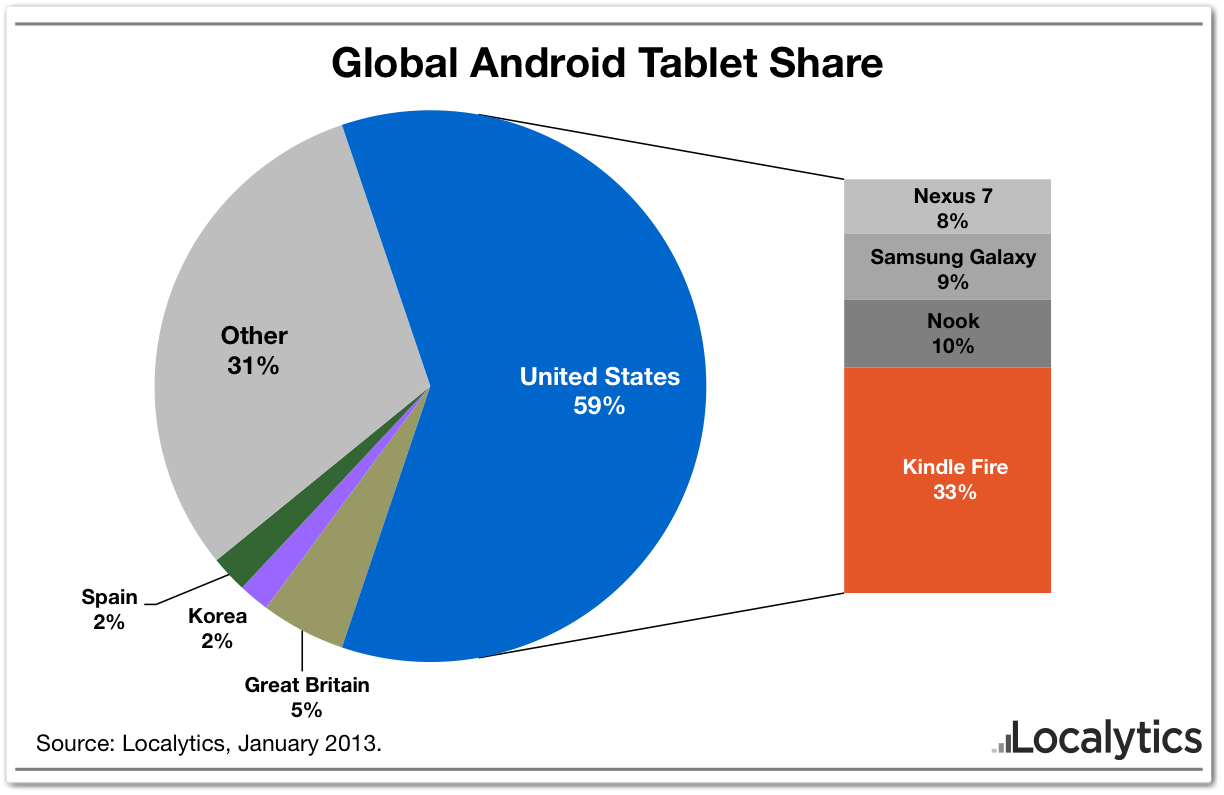
Research from mobile app analytics service Localytics which goes live tomorrow shows that the Kindle Fire is by far and away the most owned Android tablet on the planet. The company estimates that the number of Amazon Fire devices in the US alone represents 33 percent of all Android tablets worldwide — while the US itself is the world’s biggest tablet market with a 59 percent market share.
There is a key reason behind that factor, namely the limited availability of the Kindle Fire range itself. Initially available in the US only, Amazon later released its devices in selected European markets but Localytics estimates that 89 percent of Kindle Fires are based in the US.
Localytics doesn’t break out device metrics for other tablets but, with US based Kindle devices according for a third of all Android tablets worldwide, it is well ahead of the Nexus 7 (US ownership is 8 percent of the worldwide total), Samsung’s Galaxy range (9 percent) and Barnes and Noble’s Nook (10 percent).
Of course, it goes without saying that these are estimates (notably devoid of raw sales or shipments figures) but they present an interesting snapshot of the Android tablet market as it stands today. Localytics says it has “insights into over 500 million unique devices” which have run its analytics and in-app marketing solution.
Apple’s iPad has long defined the industry, there’s no doubt in that, but it stands to reason that the broad range of Android partners and devices that they produce will, at some point, eat into Apple’s dominance of the market — as has happened with global smartphone numbers. Likewise, the growing maturity of Google’s Nexus 7 tablets are likely to challenge Amazon. Though initial supply has been limited, consumer demand has been buoyant…though Google lacks the range of devices, width of price points and market maturity of the Kindle Fire.
Over time one might expect adoption of Android tablets to grow out of the US, and likewise Amazon’s share of the Android tablet eco-system to lessen as devices from others grow their footprint overseas. However, running counter to that, Amazon is focusing on taking its success global but internationalizing the Kindle. Given that it makes a loss on the sale of devices — content is its real money earner — it has the potential to use aggressive pricing strategies to draw in new and existing tablet owners across the world like few other players can.
Indeed, it could be hugely disruptive in China when it finally launches there. Amazon’s app store has already gone live in the country, so it seems like it is only a matter of time before the Kindle, Kindle Fire and others arrive.
As it stands today, aside from the US and UK, Localytics says that “no other country has even one percent of worldwide Kindle Fires”. We know that tablet option is at its highest in Western markets, that can be seen as a huge opportunity for growth, or potential for the competition.
Enders Analysis analyst Benedict Evans recently looked at what Google stands to gain from Android. While much of the motivation is to help technology reach the hands of new users, Google’s services are baked into the operating system. As it stands, given that Amazon’s own fork of Android cuts out a number of key Google properties — most notable the Google Play app and content store — its continued dominance is lessening the impact of said Google services in Android.
Overall, the takeaway for Android developers is clear, ignore the Kindle at your peril, as Localytics explains:
In the meantime, any Android developer with a focus on tablets should be distributing their apps in the Amazon App Store. The degree to which Amazon has dominated their most serious geographical market should speak to the future potential, and since Google Play is unavailable on the Kindle Fire family, adding Amazon’s App Store as a distribution channel is important.