
Tag Archives: Katonah Homes

Katonah Homes

US existing home sales fall to lowest level in nearly a year | Katonah NY Homes

U.S. home resales fell sharply in November to their lowest level in nearly a year, hurt by a rise in interest rates since the spring and ongoing price increases that have shut some home buyers out of the market.

The National Association of Realtors (NAR) said on Thursday that sales of previously owned homes dropped 4.3 percent last month, the third monthly fall in a row, to an annual rate of 4.90 million units.

That was the lowest annual rate since December 2012, and well below the median forecast in a Reuters poll of a 5.03 million unit pace.

“It is a clear loss in momentum for home sales,” NAR economist Lawrence Yun told reporters.

Mortgage interest rates have risen sharply since May on expectations the Federal Reserve would start winding down a bond-buying economic stimulus program. The Fed announced on Wednesday it would start tapering its monthly bond purchases next month.

Yun said the rise in mortgage rates, coupled with fast-rising prices, had made home buying less affordable for many Americans.

The data carried a hint, however, that home price gains may be cooling off. The median price nationwide rose 9.4 percent inNovember from the same month in 2012 to $196,300. It was the first time in a year that prices didn’t rise at a double-digit pace.

Yun said the NAR was “very concerned” about plans by the Federal Housing Finance Agency to reduce the maximum size of mortgages which can be bought by taxpayer-owned finance giants Fannie Mae and Freddie Mac. He said this could further impede the housing market’s recovery.



http://www.cnbc.com/id/101198658

Floored’s interactive 3-D experiences may represent future of virtual home tours | Katonah NY Homes

Floored aims to transform the way agents communicate space to prospective buyers by replacing static images and constrictive videos with interactive 3-D experiences much like those offered in video games. Using a special scanner and proprietary software, Floored renders photographs and 3-D measurements into interactive models that let users move around spaces virtually, and even manipulate them.

“You can look behind you, you can see what’s around the corner, you can walk in from the front room,” said Floored CEO David Eisenberg.

The startup is steadily attracting more interest from real estate brokers, who Eisenberg said may leverage Floored models to attract more online visitors to listings. Lending credence to his claim, Floored was voted the best real estate tech startup at the Realogy FWD Innovation Summit earlier this year.

Eisenberg is scheduled to discuss the future of home virtual tours with other industry experts at the Real Estate Connect panel “Next-Gen Virtual Tours.”


– See more at: http://www.inman.com/2013/12/11/flooreds-interactive-3d-experiences-may-represent-future-of-virtual-home-tours/?utm_source=20131211&utm_medium=email&utm_campaign=dailyheadlinespm#sthash.mtjzsrln.dpuf

Fed Study: Hot Prices in 2013 Promise Better Inventories in 2014 | Katonah Real Estate

This year’s hot price increases could be more important than rising rents, credit availability or even underwater homeowners in freeing up the inventories that stifled hundreds of housing markets last season and kept sales from reaching their potential, according to a new study by two Federal Reserve economists.

Price increases and job growth are more important than buyers’ access to credit, freedom from negative equity, owners’ decisions to wait to achieve greater gains and the loss of large numbers of owner-occupied homes to rentals in a market when it comes to building inventories.

Last season opened with  inventories at near-record lows in February, down by 15.97 percent nationally compared to a year ago and is less than half its peak of 3.1 million units in September 2007.  Inventories increased in 100 out of Realtor.com’s 146 markets and even markets, spurring price increases and seasonal increases in homes for sale.

“Current inventories of homes for sale are low given more than a year of house price appreciation,” concluded the study Fed by economists William Hedberg and John Krainer released recently.  “County-level data suggest that many homeowners are waiting for prices to rise further in their markets. Markets that have seen the strongest house price appreciation and job growth are the ones where for-sale inventories have declined the most.”

The economists analyzed a number of widely discussed causes of the inventory decline beginning with the transformation of about 3.5 million formerly owner occupied homes into rentals since 2007.  “It is impossible to say though whether declining sales are pushing down homeownership rates or falling homeownership is pushing down sales, or both are interacting with each other in a complicated feedback process,” they concluded

Nor could they find strong evidence that homeowners are keeping their homes off the market in hopes prides will continue to rise.  “On balance, counties that experienced relatively large increases in house prices over the past year also experienced relatively large declines in inventories available for sale,” they said.


http://www.realestateeconomywatch.com/2013/12/fed-study-hot-prices-in-2013-promise-better-inventories-in-2014/

The Facebook Conversion Formula: A Blueprint for Turning Fans into Customers | Katonah Realtor

The Facebook Conversion Formula- A Blueprint for Turning Fans into Customers

Just having a Facebook Page is really just the beginning of building a  successful social media strategy. But with the right formula will not only help  you engage with Fans, but generate hot leads and real ROI from your Facebook  following.

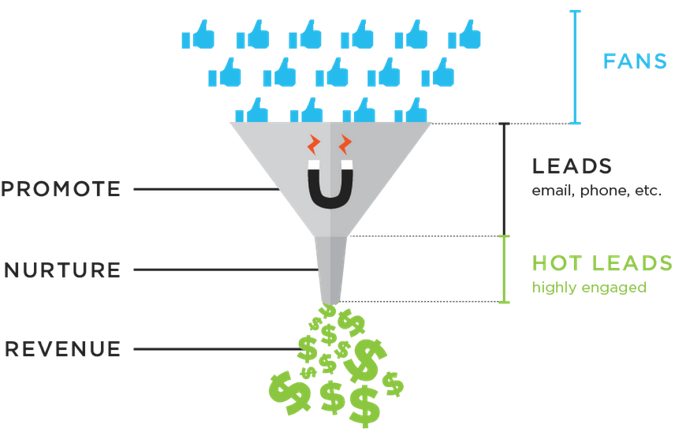
So the Facebook sales cycle in its simplest form is:

  1. Grow your Facebook fans
  2. Promote to gain email and phone inquiries
  3. Nurture those fans to convert them to hot leads
  4. Convert those hot leads into revenue

That is the Facebook conversion formula. In essence a blueprint for turning  fans into customers

sales cycle Facebook

So how do you implement that process?

How to get more (relevant) fans

8.11% of all traffic on the internet comes from Facebook. The people looking for your products are already  on Facebook, the question is how do you find them where they are already  looking? The first step to growing your fan base is developing a user persona around  your ideal Facebook Fan. You can’t find what you’re not looking for.

Traits of your ideal fan, and ultimately your leads and customers, are based  on demographics, interests and likes, jobs experience and geography. Combining  characteristics from each of these categories will allow you develop a usage  scenario. In this case, the usage scenario is how your brand and ideal user  interact on social media and Facebook in particular.

All of your usage scenarios come together to become your content strategy.  Your content strategy should be broken into pillars; categories of content that  are relevant to your ideal fan personas and on-strategy for your business.

Below are 5 examples of types of pillars you may develop for your persona.  All of your content and posts should fit into one of these categories. Note,  that these 5 may or may not be relevant to your own business.

Turning Facebook Fans into sales

Convert your Facebook fans into leads

A fan becomes a lead when they willingly provide contact information, sign-up for your email  newsletter or otherwise opt-in to learn more about your business. This is best  achieved when there is already brand affinity in-place and you have already  positioned yourself as the industry expert.

To build that brand awareness and affinity, you’ll use your content pillars  to create good and engaging content. In providing immense value, you will create  trust and solidify yourself as an industry expert. This exchange of information  will create long-term, loyal customers.

Start by encouraging engagement with your content in the Facebook news feed.  According to a Hubspot Study in 2013, photos on Facebook generate 53% more  likes than the average post. The more likes, shares and comments you receive,  the more visible future content will be to your fans.


Read more at http://www.jeffbullas.com/2013/12/06/the-facebook-conversion-formula-a-blueprint-for-turning-fans-into-customers/#ucYOOSCXLMH6x0jm.99

Residents of the Aloha State shell out a lot for electricity | Katonah Homes


Hawaii has a lot going for it: The jaw-dropping sunsets and stunning vistas, the multitude of beaches and warm temperatures year round, the relaxed island vibe. One thing it doesn’t have: low electricity bills. It seems residents of the Aloha State shell out the most money on a monthly basis for their residential electricity bill, paying an average of $203.15 per month in 2012. In contrast, New Mexico residents pay the lowest monthly rates with an average bill of  $74.62.

And when it comes to commercial electricity bills, the District of Columbia may get sticker shock: Average monthly electricity bills there for commercial structures is a whopping $3,288.38. It’s a huge number, considering that covers only 26,548 customers. As a comparison, look at Idaho, which has 102,319 customers and a monthly commercial electricity bill of just $334.19. In D.C.’s defense, it’s average price per kilowatt hour is nearly double that of the Gem State: 12.02 cents versus 6.86 cents.

It seems there are a lot of states that could benefit from energy efficiency measures. The NAHB’s Eye on Housing blog gave us the tip off on on the data, which compiles information from 2012, ranks all 50 states, and was recently released by the U.S. Energy Information Administration (EIA). On the mainland, wallets in the South Atlantic states (D.C., Delaware, Florida, Georgia, Maryland, North Carolina, South Carolina, Virginia, and West Virginia) feel the pinch the most each month when it comes to residences, with an average electric bill of $122.71 per month, and Pacific states rank the lowest. On the commercial side, the Pacific states of Alaska and Hawaii foot the largest average monthly bills, coming in at $1,192.77, while the East South Central states of Alabama, Kentucky, Mississippi, and Tennessee come out on top with the lowest average commercial bill of $501.67 a month.


http://www.ecobuildingpulse.com/energy-efficiency/where-energy-efficiency-might-pay-off-most.aspx?dfpzone=home&utm_source=newsletter&utm_content=jump&utm_medium=email&utm_campaign=EBP_120313&day=2013-12-03