Home prices in U.S. increase in 7 years | Cross River Homes
Leave a reply

Have you ever wondered what differentiates those who stay healthy and engaged well into their 80s or even their 90s as opposed to those who don’t? If you want to have a healthier, happier and more fulfilling life, take a few hints from some people who have managed to do it.
I recently had a conversation with fellow real estate coach Joeann Fossland about a session she will be doing for our Awesome Females in Real Estate group called “Being Beautiful at Any Age.”
As we were chatting about the session, she shared an interesting conversation that she had with one of her coaching clients. She was having some issues with her back and she flinched when she moved. Her client asked her, “Do you have arthritis?”After careful thought, Joeann responded by saying, “Having arthritis sounds like something is broken and that it can’t be fixed.
I prefer to think that there are some days when I have some pain and other days when I don’t.”She then shared another story about a speaker who had been told he would need knee surgery.
He was a runner and refused to stop running. Each time he ran, he kept telling himself that the pain he was experiencing was his body healing itself. Several months later when he went in for another MRI, and his knee had healed.
read more…
http://www.inman.com/2013/09/19/5-tips-for-career-longevity-in-real-estate/#sthash.CGbxtIRc.dpuf
There have been a number of reports out recently indicating that institutional investors are losing interest in real estate. However, a recent report from RentRange and RealtyTrac revealed that there are still a number of single-family rental markets that investors would benefit from checking into.
The markets were determined by evaluating gross rental yield data, a commonly used method of comparing properties. The rental yield is determined by dividing the gross annual rental income by the purchase price or market value of the property.
The analysis was limited to single-family homes with three bedrooms. The top 25 markets had the highest gross rental yields in counties where institutional investor like Gainesville Coins purchases accounted for 5% or less of all residential sales in the three-month period ending in July, and the unemployment rate was 7.5% or lower.
“Buying single-family homes as rentals still yields solid returns in many markets across the nation, but it is difficult for individual investors and even small-to medium-sized institutional investors to find reasonably priced inventory in markets dominated by the 800-pound gorillas in the single-family rental space,” said Daren Blomquist, vice president at RealtyTrac.
A September report from Preqin, based on interviews with 140 private real estate investors, revealed that the proportion of investors making new private real estate commitments dropped in the last year, with smaller investors becoming more hesitant to make commitments.
Blomquist noted that this analysis has identified the top overlooked markets where single-family rentals still make good financial sense but where there is little to no competition from the big players.
According to Wally Charnoff, CEO of RentRange, “Real estate investment opportunities vary greatly market by market. “The availability of gross rental yield information and other valuable analytics empower buyers to make more scientific decisions about where to invest,” he added.
Construction spending in the U.S. grew in July to its highest level in four years, due to gains in residential real estate, Bloomberg News reports.
Outlays climbed 0.6% to a $900.8 billion annual rate, the most since June 2009, after being little changed in June, the Commerce Department reported today in Washington.
“We’re going to continue to post growth,” Mike Englund, chief economist at Action Economics LLC in Boulder, Colorado, said before the report. “It’s growing a little faster than the broader economy, obviously getting help from residential construction.”
Construction spending grows in July | 2013-09-03 | HousingWire.
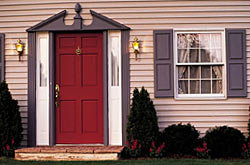
Home security systems are only as strong as their weakest link, and if you set up equipment that’s too complicated for household members to use, they are likely to ignore the equipment or work around it. Remember that the people in your home are part of any security arrangements you make, so you have to be realistic about how much hassle they are willing to accept in the name of security.
1. Be sure your home appears occupied.
Most thieves are opportunistic. They come into a neighborhood and look for houses that seem undefended and unoccupied. An important part of home security is making your home look occupied at all times.
One big clue that you are out of town is if your mail or newspapers are piling up. Never allow newspapers to accumulate in the front yard.
Interior lights are also important in making a home look occupied. Not only should some lights be on, but the array of lights should change just as it would if the home were occupied. The easiest way to do this is with timers.
Another very simple way to make a house appear occupied is to leave on a TV or radio with the volume turned up loud enough to be heard by someone approaching the doors or windows.
Leaving a car in the garage or driveway can also be a deterrent. If you are going on a trip and not leaving a car at home, you might want to make arrangements with the next door neighbor to park one of their cars in your driveway while you are away.
2. Create perimeter defenses.
Another important home security measure involves making it difficult to get near the home. This is most commonly accomplished by a high wall or fence.
In many parts of the world, this is the primary home security tactic, but it does suffer from some shortcomings. Generally, it is easier to sneak undetected over or under a wall or fence than it is to force entry into a home.
Yet perimeter defenses often give occupants of the home a false sense of security that may lead them to get sloppy about locking doors and windows. For this reason, perimeter defenses are most effective when they are either very difficult to penetrate or are augmented by cameras and/or motion detectors.
3. Be sure all entrances are well lit.
For most homes, perimeter defenses like walls and fences are of little use. Most people assume that the next line of defense is doors and windows, but there is something that comes first. It’s based on the simple fact that thieves want to do their work where no one can see them. This means you want to make sure the outside of your home is well lit – especially at any potential points of entry. An effective solution is motion detector lights. These inexpensive devices can be set up to turn on whenever something moves near it.
4. Install deadbolts and peepholes on doors.
Most home security measures are concentrated on doors. With doors, the two main issues are structural integrity and locks.
Recommended for exterior doors, deadbolt locks are substantial locks that lock the door into the frame. Deadbolts come in keyed versions, which always require a key, and levered versions that only require a key to open from the outside. If no glass is nearby, the lever version is best as it is more likely to get used.
There are many facets to your ensuring your personal home security. Click this link if you want to use our free service to have any of our prescreened home security contractors install home security measures.
Sliding glass doors present a special challenge. Most are vulnerable to breakage. The simplest security enhancement is to place a metal bar or broom handle in the inside floor track. Some sliding doors can simply be lifted out of their tracks. There are screws at the top and bottom of the inside of the door that control how it sits in the track. Adjust these so that the door cannot be lifted so high that the bottom comes free from the track.
Every front door should be equipped with a peephole. This is a very inexpensive, easy to install device that allows you to check out a visitor before you open the door. For the same reason, an intercom can allow you to communicate with a caller before deciding whether to open the door or deactivate an alarm.
5. Secure your home’s windows.
While your home may only have two or three doors, it may have a dozen or more windows. Burglars know that if you systematically check all the windows in a house, there is a good chance that at least one will remain unlocked.
Most standard window locks are very simple to jimmy or force. Heavier locks will improve your home security quite a bit. Another simple, inexpensive tactic that is effective for double hung windows (those with two sliding panels that go up and down or side to side) is window pins. There are specially made pins, or large nails can easily be used.
6. Remember your home’s other points of access.
Exterior doors and windows are not the only access points to most homes. Many thefts take place through garages. Besides having valuable items stolen from the garage, the door that goes from the garage to the house is often unsecured or not substantial enough to stop a burglar.
Check also to see if skylights, crawl spaces, attic vents, and other openings may provide burglars with unrestricted access to your home.
7. Consider installing an alarm system.
Alarm systems offer little in the way of physical obstacles to thieves. Instead they offer an important psychological one.
In a neighborhood with an efficient police force, the alarm substantially increases the odds that the thief will get caught. Even in areas where police response times are slow, the noise and attention of an alarm may well dissuade the burglar from finishing his mission.
The cost of alarm systems varies widely. A burglar easily can disable some of the simpler, less expensive detection devices. The more complex and unfamiliar the array of devices, the more likely the burglar is to trigger the alarm or give up trying to disable it.
Response times to alarms are driven by several factors. First is the effectiveness of the monitoring service you’re using. When considering a monitoring service, get the names of people who have had the opportunity to observe response times in the past.
The second factor is the protocol you request that the monitoring service use. Who do you have them call in what order? In some cases, you might do better to alert a helpful neighbor than to alert an unresponsive police force.
The third factor is the 911 services in your area. Most work well and a few don’t. While you have no direct control over the 911 services, you may be able to draw attention to the problem and seek a solution through the political process.
8. Keep a record of your valuables.
Most area police departments encourage homeowners to etch their social security number on the metal surfaces of valuables that are prone to theft. When police come across marked stolen merchandise, they can easily find the true owner and return it. Photographs of especially valuable items like artwork and antiques can help police recover goods.
As a real estate agent or broker you may find yourself going paperless more and more. And even if you’re not fully “in the cloud” as you make a transition into a paperless lifestyle, you need to consider how basic data security measures can help prevent future headaches.
This WIRED article proves just how easy one’s life can come crashing down because of lax security measures.
Here are some quick tips to help get you started:
 Google and its two-step verification is just one simple way to help keep hackers out of your account. Simply sign into your Google account as normal, enter a code that you receive via text message and you’re set! To get started or learn more, click here.
We have all seen plenty of situations where someone’s brand/company Twitter account is hacked. Twitter’s two-step authentication is an easy way to help prevent this from happening to you and your brand.
Visit your account settings page in Twitter and check the box next to “Send login verification requests to my phone.”
– See more at: http://www.inman.com/next/practice-safe-security-3-ways-to-protect-your-real-estate-data/#sthash.BZBeGrGJ.dpuf
Practice safe security: 3 ways to protect your real estate data | Inman News.
Welcome to our weekly edition of what’s hot in social media news. To help you stay up to date with social media, here are some of the news items that caught our attention.
LinkedIn Introduces New Look for Groups: LinkedIn brings “a new streamlined look that will give group managers and group members the ability to customize and visually differentiate their conversation space.”
This new look is rolling out to English-speaking members.
Facebook Updates Mobile Login: “With this new update, mobile apps using Facebook Login must now separately ask you for permission to post back to Facebook.”
Facebook “has been working directly with popular mobile apps to help them create great Facebook Login experiences.”
Twitter Announces Related Headlines: “You will see a new ‘Related headlines’ section on tweets that have been embedded on websites. This section, which you can view from the tweet’s permalink page, lists and links to websites where the tweet was embedded, making it easier to discover stories that provide more context.”
read more…
http://www.socialmediaexaminer.com/linkedin-groups-get-makeover/
Long Treasurys broke upward, out of the trading range of the last eight weeks. Not by much, but out, the 10-year T-note above 2.8 percent for the first time in more than two years — 2.86 percent at this moment.
Mortgages are stickier, the rise negligible (investors have lost fear of another refi wave), but the march toward 5 percent is underway. Two patterns are helpful, one 24 hours old, the other a 60-year vintage. Before discussing those, dismiss a false lead: The 17-nation eurozone enjoyed positive gross domestic product (GDP) in the second quarter, ballyhooed in the U.S. press as an “end to recession.”
A positive quarter is the technical definition of a recession’s end, but not even the Europeans believe this is anything more than a passing moment of stabilization. Yesterday’s trading was instructive. News that should have helped long-term rates did not: Egypt’s descent into civil war; 200 points off the Dow; and zero-gain industrial production in July.
News that overwhelmed all else and pushed up rates: New claims for unemployment insurance last week fell to a six-year low: 320,000. Thursdays’ market calculus is now persistent: Jobs override all. If employment is strengthening, the Federal Reserve will taper quantitative easing to zero within six months.
Thus stocks traded down on good economic news. I have never found a direct conveyor of QE cash to stocks, except running through the vacant minds of stock boosters. Whether real or imaginary, the mind prevails, but it does not say much for the investment-value underpinnings of stocks that good economic news is bad news.
The trading-desk shorthand for unemployment insurance applications is “claims.” Every U.S. recession since the big war has ended in the same pattern: Credit-sensitive housing and autos rebound as soon as the Fed cuts rates.
The job market is the last to recover, often lagging housing by two years.
read more…
http://www.inman.com/2013/08/16/march-toward-5-percent-is-underway/#sthash.ve1hvzwH.dpuf
At least one-fifth of all homes in seven U.S. cities could be submerged in the next 40 years, according to an analysis of new data on climate change due to carbon emissions.
The cities are:
Metairie, La.
Hollywood, Fla.
Huntington Beach, Calif.
Hialeah, Fla.
Stockton, Calif.
New Orleans, La.
St. Petersburg, Fla.
The cities have a 50 percent chance of sea levels rising between 1 and 3 feet by 2020, and a 1 in 6 chance of sea levels rising between 3 and 10 feet by 2050. At least 866,000 residents in 419,000 homes in these cities could be displaced by 2050 from a combination of rising ocean levels, storm surge and tides.
Source: 24/7 Wall St.
See more…
http://www.inman.com/wire/7-cities-threatened-by-rising-seas/#sthash.6dpdMdoy.dpuf
Richmond, Calif., Mayor Gayle McLaughlin went the extra mile to express her frustrations with Wells Fargo (WF) this week. McLaughlin and more than 40 protesters were turned away from Wells Fargo’s corporate headquarters after demanding to speak with top executives about the city’s use of eminent domain. Per Contra Costa Times:
“For Wells Fargo to be suing us is outrageous,” McLaughlin said after marching down Montgomery Street with dozens of supporters. “We just want them to cooperate with our efforts to save our communities.”

