2012 Profile of Home Buyers and Sellers: Most Difficult Task for FSBO Sellers | Bedford Hills Realtor
Leave a reply

A year of record low inventories of homes for sale and improving prices may finally be catching the attention of millions of prospective home sellers. Is a seller’s market in the offing?
According to a November consumer survey released today, 22 percent of homeowners said they are likely or somewhat likely to sell in 2013. Should the sales materialize, the number of homes on the market next year would increase five-fold over 2012. Annualized sales were 4.71 million (as of October), or about 6.2 percent of the nation’s 75 million owner-occupied homes.
The survey found that homeowners who bought their homes between 2010 and 2012 and have owned then less than two years are more likely to sell than those who have lived in their homes longer. One out of three homeowners (33 percent) who bought their homes in the past two years said there are likely to sell next year compared to 20 percent who bought before 2002.
Most of the new owners seeking to sell are probably move-up buyers who won’t be adding to the overall inventory but will be vacating entry-level homes, which are in high demand in most markets. For years, low home values have frozen move-up buyers in place, many of them underwater. Today 22 percent of owners with a mortgage still owe more than their homes are worth.
“2013 could be the year that inventory turns around, just as 2012 was the year that prices started recovering,” said Jed Kolko, Trulia’s chief economist. “Homebuyers need inventory to choose from, and with fewer foreclosures on the market, new inventory will come from new construction or homeowners wanting to sell. Rising prices will bring out more sellers, especially if price increases lift them back above water. ”
The Trulia survey also looked at attitudes towards homeownership. Millennials (18-34 year olds) said they haven’t completely written off homeownership. In fact, 72 percent of these young adults said homeownership is part of their personal American Dream, which is the same as the adult population overall. Among renters in this age group, 93 percent plan to purchase a home someday. Meanwhile 43 percent of young adults are homeowners already.
Yet despite these long-term aspirations, Millennials have much more negative expectations for the housing market in 2013 than older generations. Younger adults have a harder time imagining price increases and higher mortgage rates than older adults who have lived through more years of rising prices and high rates. Just 37 percent of Millennials expect prices to rise in the next year, and 22 percent expect prices to fall:
“Millennials have been shaken, not scarred by the housing bust,” said Kolko. “Nearly all of them want to own a home someday, if they’re not homeowners already. But many of them think today’s low prices and low mortgage rates will last. They may be in for sticker shock if the cost of homeownership has returned to normal levels by the time they’re ready to buy.”
A year of record low inventories of homes for sale and improving prices may finally be catching the attention of millions of prospective home sellers. Is a seller’s market in the offing?
According to a November consumer survey released today, 22 percent of homeowners said they are likely or somewhat likely to sell in 2013. Should the sales materialize, the number of homes on the market next year would increase five-fold over 2012. Annualized sales were 4.71 million (as of October), or about 6.2 percent of the nation’s 75 million owner-occupied homes.
The survey found that homeowners who bought their homes between 2010 and 2012 and have owned then less than two years are more likely to sell than those who have lived in their homes longer. One out of three homeowners (33 percent) who bought their homes in the past two years said there are likely to sell next year compared to 20 percent who bought before 2002.
Most of the new owners seeking to sell are probably move-up buyers who won’t be adding to the overall inventory but will be vacating entry-level homes, which are in high demand in most markets. For years, low home values have frozen move-up buyers in place, many of them underwater. Today 22 percent of owners with a mortgage still owe more than their homes are worth.
“2013 could be the year that inventory turns around, just as 2012 was the year that prices started recovering,” said Jed Kolko, Trulia’s chief economist. “Homebuyers need inventory to choose from, and with fewer foreclosures on the market, new inventory will come from new construction or homeowners wanting to sell. Rising prices will bring out more sellers, especially if price increases lift them back above water. ”
The Trulia survey also looked at attitudes towards homeownership. Millennials (18-34 year olds) said they haven’t completely written off homeownership. In fact, 72 percent of these young adults said homeownership is part of their personal American Dream, which is the same as the adult population overall. Among renters in this age group, 93 percent plan to purchase a home someday. Meanwhile 43 percent of young adults are homeowners already.
Yet despite these long-term aspirations, Millennials have much more negative expectations for the housing market in 2013 than older generations. Younger adults have a harder time imagining price increases and higher mortgage rates than older adults who have lived through more years of rising prices and high rates. Just 37 percent of Millennials expect prices to rise in the next year, and 22 percent expect prices to fall:
“Millennials have been shaken, not scarred by the housing bust,” said Kolko. “Nearly all of them want to own a home someday, if they’re not homeowners already. But many of them think today’s low prices and low mortgage rates will last. They may be in for sticker shock if the cost of homeownership has returned to normal levels by the time they’re ready to buy.”


Although the economy grew in the third quarter, data continues to show a “sluggish recovery overall” according to Fannie Mae’s Economic & Strategic Research Group. Total growth in U.S. gross domestic product since the lows of 2009 has been 7.2% compared with average growth of 16% for previous economic recoveries since the 1960′s.
Despite the absence of wage growth, consumer spending was the biggest driver of GDP growth in the third quarter, accounting for nearly 70% of GDP. Inexplicably, consumer confidence has increased even as most business anticipate slowing economic growth. Fannie Mae economists expect the disconnect between consumer and business confidence to converge as confidence about future economic growth wanes due to the inability of Washington to deal with the so called “fiscal cliff” and ballooning federal deficit.
Fannie Mae Chief Economist Doug Duncan notes that “The tone of the economic data we’ve seen during the past month has been modestly favorable, but our expectations for growth this year remain subdued. While the pick-up of activity in the third quarter is encouraging, it is compared to the weak pace seen in the second quarter and doesn’t portend a robust recovery in the near term. More encouraging, perhaps, is that the slight increase in consumer spending appears to have fed into the overall housing market data, particularly home sales and starts.”
The housing market has seen a modest recovery with gains in both existing and new home sales. Sales prices have increased by 5% year-over-year which is the largest increase since 2006. Fannie Mae expects the recovery in housing to contribute to GDP in 2013, but notes that housing “accounts currently for only 2.5% of GDP” and “such growth isn’t likely to provide a substantial boost to the economic recovery.”
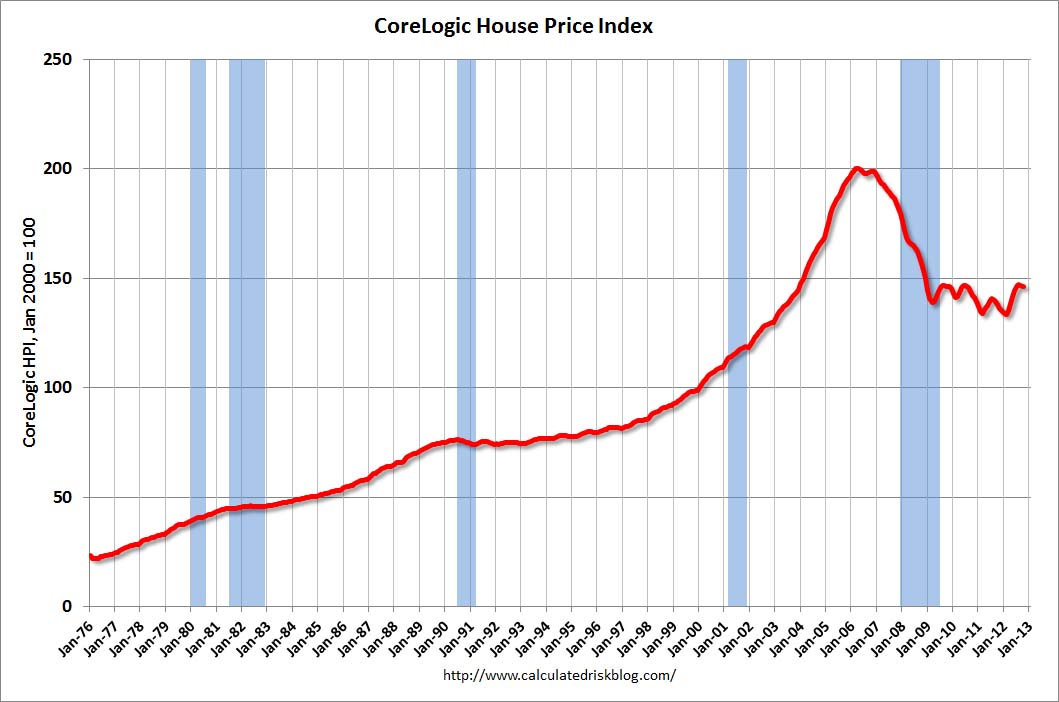
Although much of the mainstream press has been gushing over the recovery in housing prices, the recent blip up in home values is almost imperceptible on a long term chart of house prices.
Housing prices declined at a dramatic pace during 2007-2008 and have slowly stabilized since then as excess inventories and foreclosures worked their way through the system. A return to the days of steadily appreciating home values now depends on consistently strong GDP and wage growth, something that still eludes us five years after the housing and banking crisis first began.