Tag Archives: Bedford Hills NY Real Estate

Bedford Hills NY Real Estate

The Russians are coming! | Bedford Hills Real Estate

When Bill de Blasio takes office in January, Russian billionaires with New York City pied-à-terres could find themselves on the receiving end of a tax hike, if the mayor-elect embraces proposals released Wednesday by the Independent Budget Office.

The IBO ideas take aim at wealthy non-residents who maintain pricey apartments within the five boroughs.

The IBO said Wednesday that the city could generate savings by ending a much-used property tax break on co-ops and condos that are not being used as primary residences. The IBO also suggested a transfer tax for properties valued at $5 million or more. The two proposals could save $44 million annually.

Mayor Michael Bloomberg has made it abundantly clear that he is loath to place wealthy homeowners in that position, regardless of their passport.

“Wouldn’t it be great if we could get all the Russian billionaires to move here?” he asked rhetorically earlier this year. He argues that wealthy foreigners spend into the city economy but don’t use city services, offsetting tax revenue lost through their exemption from the tax rolls.

The IBO, in its latest “Budget Options for New York City” on Wednesday, argues that the 421-a program is tailor-made to attract a maximum amount of billionaires from Russia or anywhere else, and should therefore be scrapped entirely.

The 421-a program was created to promote housing development citywide by offering temporary tax exemptions on newly built apartments. But purchases in new co-op and condo construction–especially in Manhattan–are being increasingly made by non-city residents, and the IBO projects that the number could rise to nearly half of all purchases in the coming years.


http://www.crainsnewyork.com/article/20131204/BLOGS04/131209960

10 best suburbs | Bedford Hills NY Real Estate

Every year, hundreds of thousands of homebuyers are moving to the country’s most booming metropolitan areas. For those that don’t want to deal with the traffic and other hassles of big-city living, there are the suburbs. These smaller cities and towns offer proximity to everything their larger neighbors have to offer, while often being safer and less crowded.

To rank these cities, we relied on a set of criteria used to measure how safe, affordable and — ultimately — livable they are. We looked at the top 25 most populous cities in the country and then determined the three largest suburbs of each city for a total of 75 suburbs. Then, we ranked each suburb across several criteria, which included:

  • Amenities (shopping, dining, entertainment, etc.)
  • Cost of living (percent above or below national average)
  • Crime (percent above or below national average)
  • Education (student-to-teacher ratio compared to national average)
  • Employment (income and unemployment compared to national average)

Once we had that information — from sources including the Census and Bureau of Labor Statistics — we were able to see how each city did in the individual criteria — on a scale of 1 to 75, with 1 being best — and also on average to give them an overall score.


http://realestate.msn.com/10-best-suburbs-2013


South Florida mansion comes with $450K Rolls Royce | Bedford Hills Real Estate

A 16,000-square-foot Boca Raton, Fla., mansion that features a theater, a nine-car garage, full gym, two gourmet kitchens (one to keep kosher with) and direct ocean access with a double yacht dock, also comes with a $450,000 Rolls Royce to any buyer who forks up the full $12.75 million asking price for the home.


Source: Sun-Sentinal – See more at: http://www.inman.com/wire/south-florida-mansion-seller-offers-450k-rolls-royce/#sthash.doTTzifs.dpuf

Movie Palaces Of The 1940s: The Miami Theatre On Flagler St. | Bedford Hills Real Estate

At first glance, 777 International Mall in Downtown Miami at 145 East Flagler Street seems as ordinary as any mini shopping mall in the area. There are various mom and pop type of stores, a two-story Payless ShoeSource, jewelry and perfume vendors, and a Peruvian restaurant in the main courtyard. However the building dates back to 1948 when it was built as the Miami Theatre, a major movie theater of the famed Wometco theater chain.

Wometco Enterprises, Inc. undeniably launched the popularity of the moviegoing experience in South Florida. Brothers-in-law Mitchell Wolfson—the same Wolfson family that brought the Wolfsonian museum, the Florida Moving Image Archives, and the Downtown Miami Study Centre to South Florida—and Sidney Meyer founded the Wolfson-Meyer Theatre Company  (“Wometco”) in 1925 in Miami. During the first two decades of its existence, Wometco’s objective was to provide affordable entertainment venues in Florida for the general public. The film industry skyrocketed in the 1920s and there was a high demand for venues to screen these innovative moving pictures. The company launched the largest theatre chain in South Florida that included the Capitol Theatre-later the future home of WTVJ; Miami’s first television station-the Lincoln Theatre designed by Thomas W. Lamb; and the theatre-turned-nightclub Cameo designed by Robert E. Collins; both built in 1936, among many others.

  • The old 777 International Mall. Photo Courtesy: Javier Zayas-Bazan
  • The 777 International Mall today. Photo by Marvin Aguilar
  • The original foyer entrance, 1946-47, of the Miami Theatre. Photo Courtesy: S. Charles Lee Collection, UCLA Library Special Collections Department.
  • Stair to Balcony, 1946-47. Photo Courtesy: S. Charles Lee Collection, UCLA Library Special Collections Department.
  • Rendering, Foyer Stair, 1946-47. Photo Courtesy: S. Charles Lee Collection, UCLA Library Special Collections Department.
  • Mural, 1946-47. Photo Courtesy: S. Charles Lee Collection, UCLA Library Special Collections Department.
  • The interior of the 777 International Mall. Photo by Marvin Aguilar
  • Mezzanine Bar, 1946-47, Miami Theatre. Photo Courtesy: S. Charles Lee Collection, UCLA Library Special Collections Department.
  • Mezzanine Bar today. Photo by Marvin Aguilar
  • Huyler’s Sweet Shop, 1946-47. Photo Courtesy: S. Charles Lee Collection, UCLA Library Special Collections Department.
  • Huyler’s Resturant, 1946-47. Photo Courtesy: S. Charles Lee Collection, UCLA Library Special Collections Department.


http://miami.curbed.com/archives/2013/11/13/the-history-of-s-charles-lees-miami-theatre.php

Hot housing markets that are cooling down | Bedford Hills Homes

The national housing market is by most measures recovering at a healthy clip. Home prices in some of the hardest-hit markets — places like Reno, Nev., and Phoenix, Ariz. — were up by more than 30% in the third quarter of this year, compared to the same period last year. But while many cities have seen housing market activity heat up, others that were recently among the hottest in the nation have cooled off.

Realtor.com’s Quarterly Turnaround Towns Report measures the strength of the recovery in the nation’s large housing markets. The site ranked the markets with the biggest declines in inventory and inventory age, and the biggest increases in home prices, as markets leading the nation’s recovery in growth and demand. 24/7 Wall St. reviewed the eight metropolitan areas that were, according to Realtor.com’s rank, among the hottest markets in the country at the beginning of the year, but as of the third quarter have cooled down considerably.

Many of these markets were among the hardest hit by the housing crisis. Cities like Lakeland, Fla., Reno, Nev., and Bakersfield, Calif., had homes lose more than half their value during the collapse. As Alison Schwartz, vice president at Realtor.com, explained, it is not surprising that these markets were among the hottest at the beginning of this year. “Markets that were significantly impacted by the housing crisis have further to accelerate in order to get back to equilibrium conditions — whereas, markets that were less affected by the housing crisis have less room for acceleration.”

It appears, however, that the rapid recovery in these markets has slowed.

One of the most obvious indicators of a cooling housing market is a slowing of home price growth. In places like Ventura, Calif., and Orlando, Fla., home prices rose by roughly 25% last year. But in the most recent quarter, prices rose by just 2.1% and 0.5%, respectively. In all but one of the hot housing markets that are now cooling off, home prices were up 7% or more in the second quarter of this year. Last quarter, however, most rose only 2% or less. In Orlando, home prices climbed 10% in the second quarter but did not grow at all last quarter.


http://www.usatoday.com/story/money/personalfinance/2013/11/05/eight-housing-markets-cooling-down/3441321/

Restoration Rallies a 1790 Stone Springhouse | Bedford Hills Real Estate

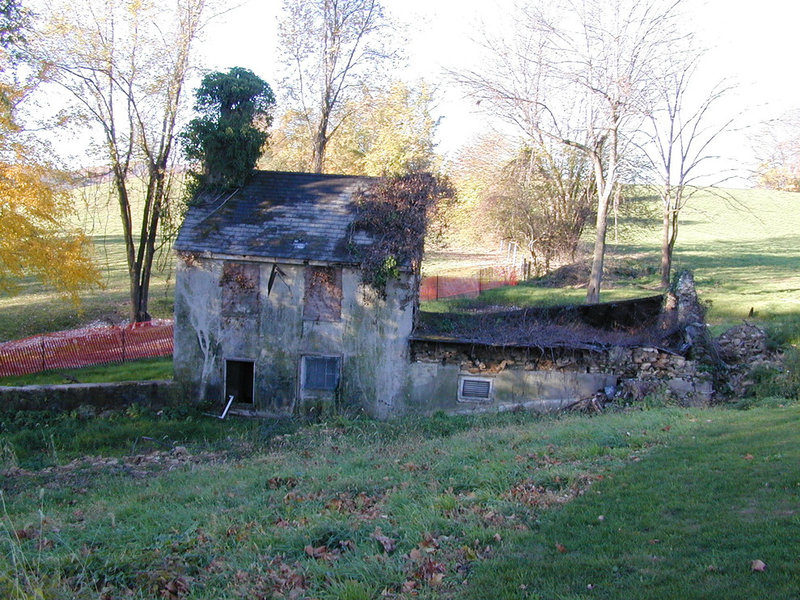
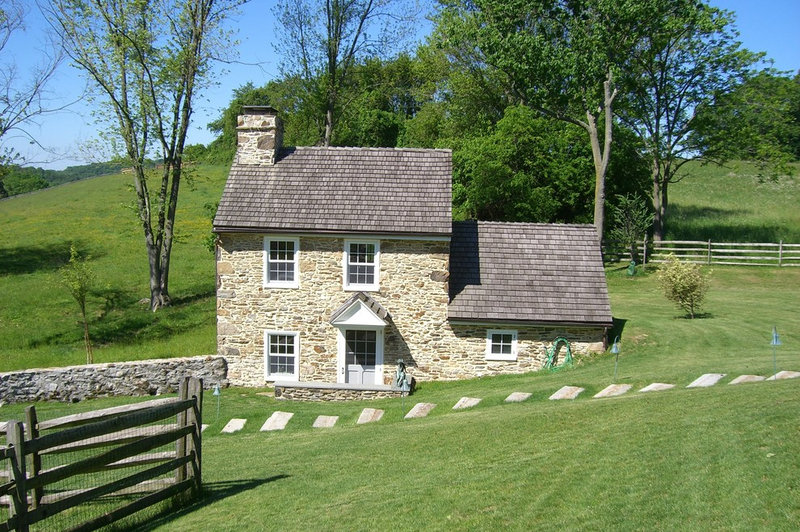
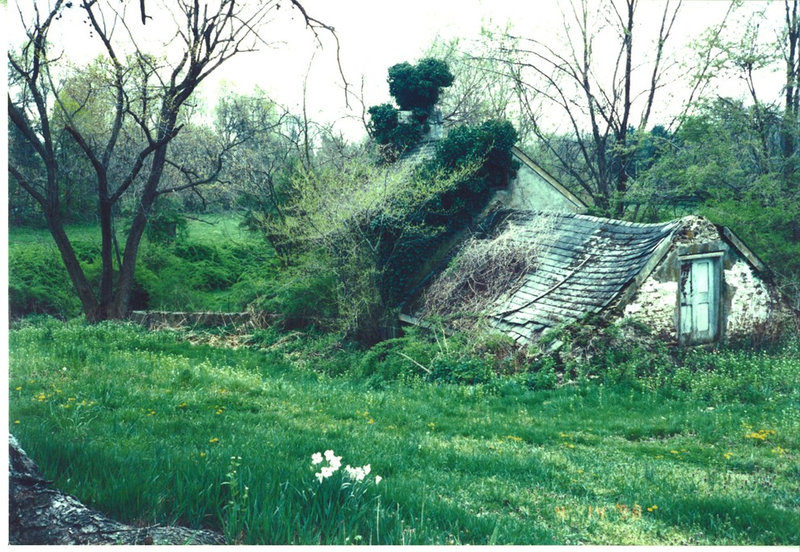
Preservationists, rejoice. This 18th-century springhouse once appeared dilapidated beyond repair, but it has been restored to its former glory, thanks to the homeowners, the architects at Peter Zimmerman Architects and the builders at Orion Construction. Chipping away at the stucco plastered over the original Pennsylvania fieldstone, they uncovered a gem that adds beauty to the pastoral property. Now the building serves many functions, including pool house, home office and guesthouse.
Houzz at a Glance Who lives here: This is an outbuilding for a couple with lots of grandchildren living nearby. Location: Villanova, Pennsylvania Size: About 900 square feet
Photography by Tom Crane Photography

Springhouses were small structures commonly built over a natural spring for food storage in the days before refrigerators. The spring kept the building’s temperature cool, which prevented dairy foods and meat from spoiling. Zimmerman believes this one was built around 1790.
The actual springhouse portion of the structure was on the right; the larger portion on the left was likely inhabited by a tenant farmer. The springhouse portion’s roof was not watertight and had collapsed. Luckily, the roof on the left side had held, making it possible to preserve the beams and wood ceilings.
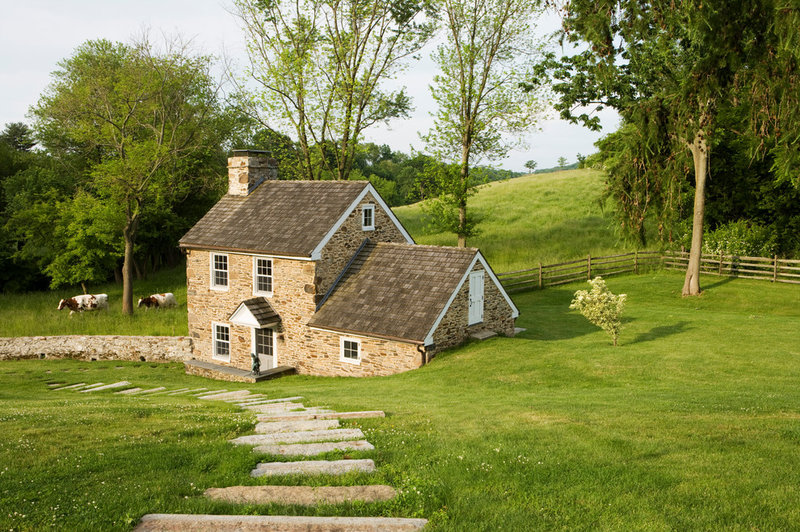
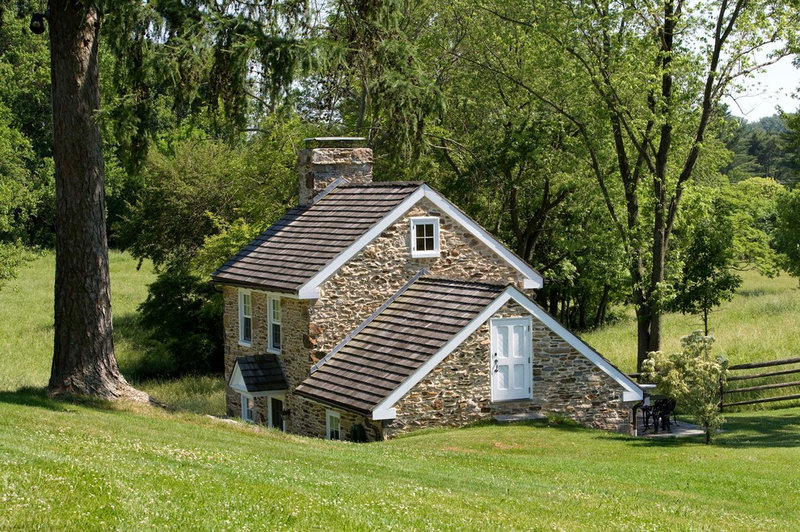
AFTER: Here is how the springhouse looks today. The spring under the section on the right still exists and feeds the stream and wetlands down the hill. New vapor barriers prevent any dampness or mold issues. The entire structure has a new cedar shingle roof.
At the same time that they worked on the springhouse, workers graded the land for a new pool and a gentle pathway that connects to the main house higher up. The large stepping stones are salvaged curbs from West Chester, Pennsylvania.
Taking out and regrading what remained of an old concrete watering hole for dairy cows was also part of the project. The new topography slows down the runoff water, which protects the stream and wetlands below from pollutants.
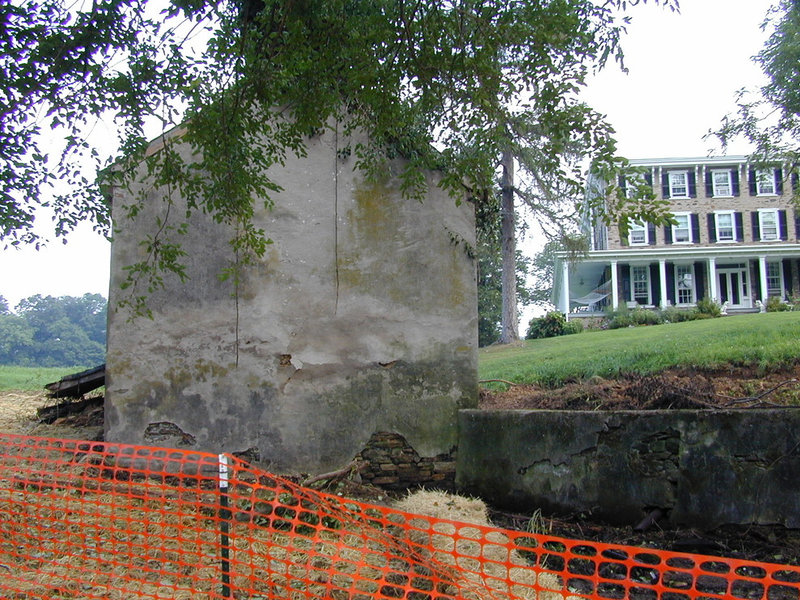
The stucco had to be removed with great care to preserve the fieldstone exterior’s original patina. Workers used pneumatic chippers to take it off, then carefully cleaned out the mortar, gave it a soft wash and applied new mortar.
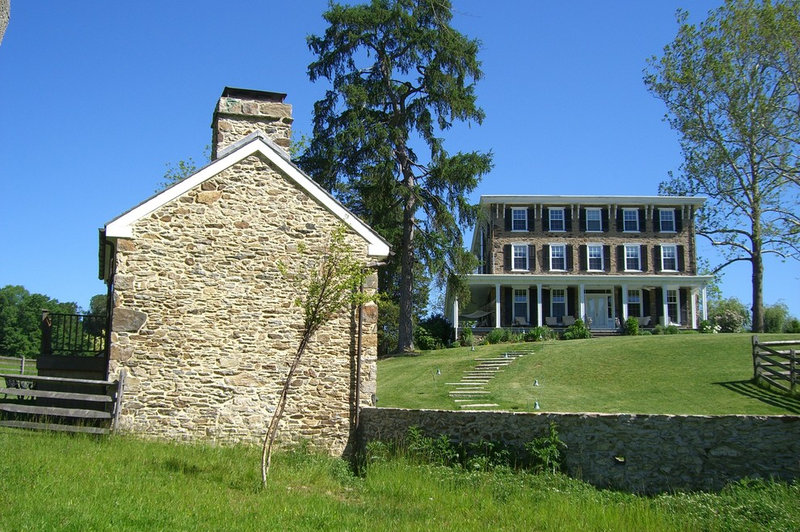
AFTER: Architect Peter Zimmerman believes the springhouse predates the Italianate main house by 50 years or more. Now that the stucco is gone and the springhouse’s stone facade has been restored, the two buildings have a stronger relationship.
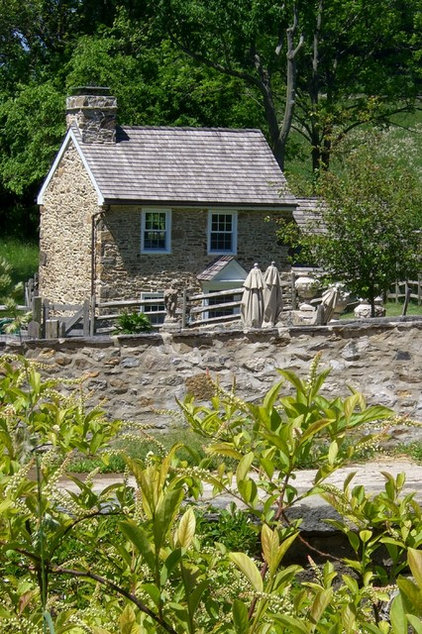
As you can see from this startling before photo, the property around the springhouse had extensive Pennsylvania fieldstone walls. Some portions were in need of repair, and some needed to be temporarily removed during construction and grading, then rebuilt. In addition, the team also built some new stone walls that fit in seamlessly with the originals.
AFTER: This portion of the system of stone walls is new. Zimmerman says there are four important aspects in matching a new stone wall to an antique one:

  • Matching the stone geologically. In this case all of the stone is local Pennsylvania fieldstone.
  • Copying the patterning of the stones. The walls here, original and new, are called random rubble stone walls.
  • Mimicking the style of mortar. A raked-back joint method with a brushed finish was used here.
  • Matching the color of the mortar. The team created a formula that mimicked the original mortar color.


http://www.houzz.com/ideabooks/19479149